A Reading by MaggieDining Chair Cushions & Pads
Navy tie-on chair pads that keep a small deck dining set roomy
Thin boxed pads, ties at the back posts, one dark color. Maggie reads a teak lunch table on a garden deck and what keeps a tight spot feeling generous.

 Save
The quick answer
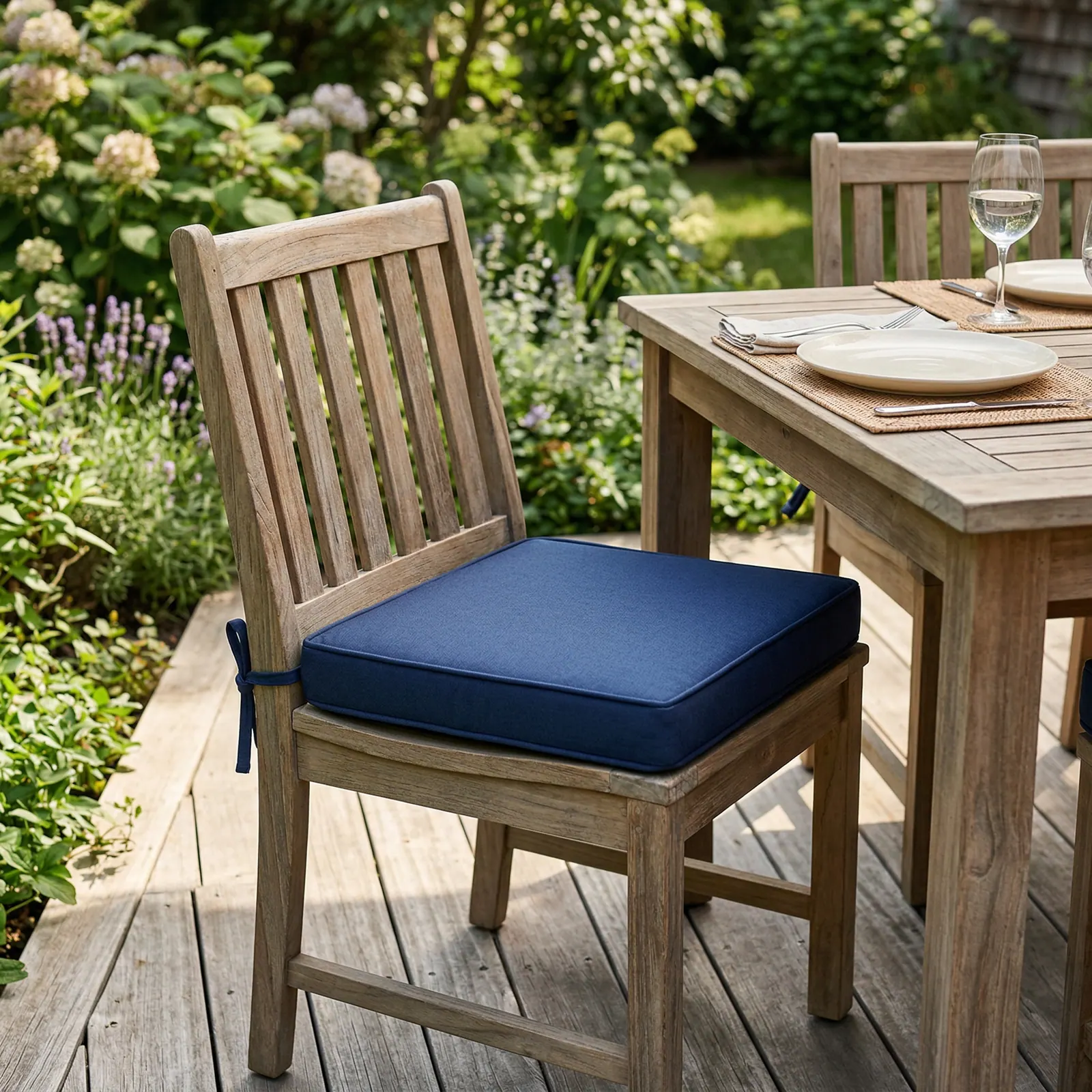
A tie-on chair cushion keeps a small deck dining set roomy when the pad is a thin box that follows the seat's taper, stops inside the seat edge, and ties at the back posts so it stays put as chairs slide in and out. Navy looks deep against silvered teak and hides food marks. Measure front and back widths separately and mark where the posts sit.
Buyer questions: an ottoman, a return, and whether ties are extra
- A common question
Do you sell the ottoman on its own, in the same color as my sofa?
The workshop's answerYes. The ottoman is 39 x 39 in (100 x 100 cm), and the shop sends a custom purchase link in the matching color.
- A common question
My custom dining chair cushion turned out too tall for the room. Can I return it?
The workshop's answerCustom cushions are made to the size you order, so a return is the workshop's call, not this site's. In one past case a change-of-mind return went back at the buyer's expense, return shipping included, and was refunded once the workshop received it; the buyer sent the return tracking number as text so it could be followed. Ask before you ship anything back.
- A common question
Is piping included, and do ties or a non-slip bottom cost extra?
The workshop's answerPiping is included, in any color, at no extra charge. Ties and a non-slip bottom are optional extras you choose on the listing. If you want the cushion reversible, leave off the non-slip bottom.
Now, the reading
Where a small deck really loses its room
A small deck loses its room at the table, not in the garden.
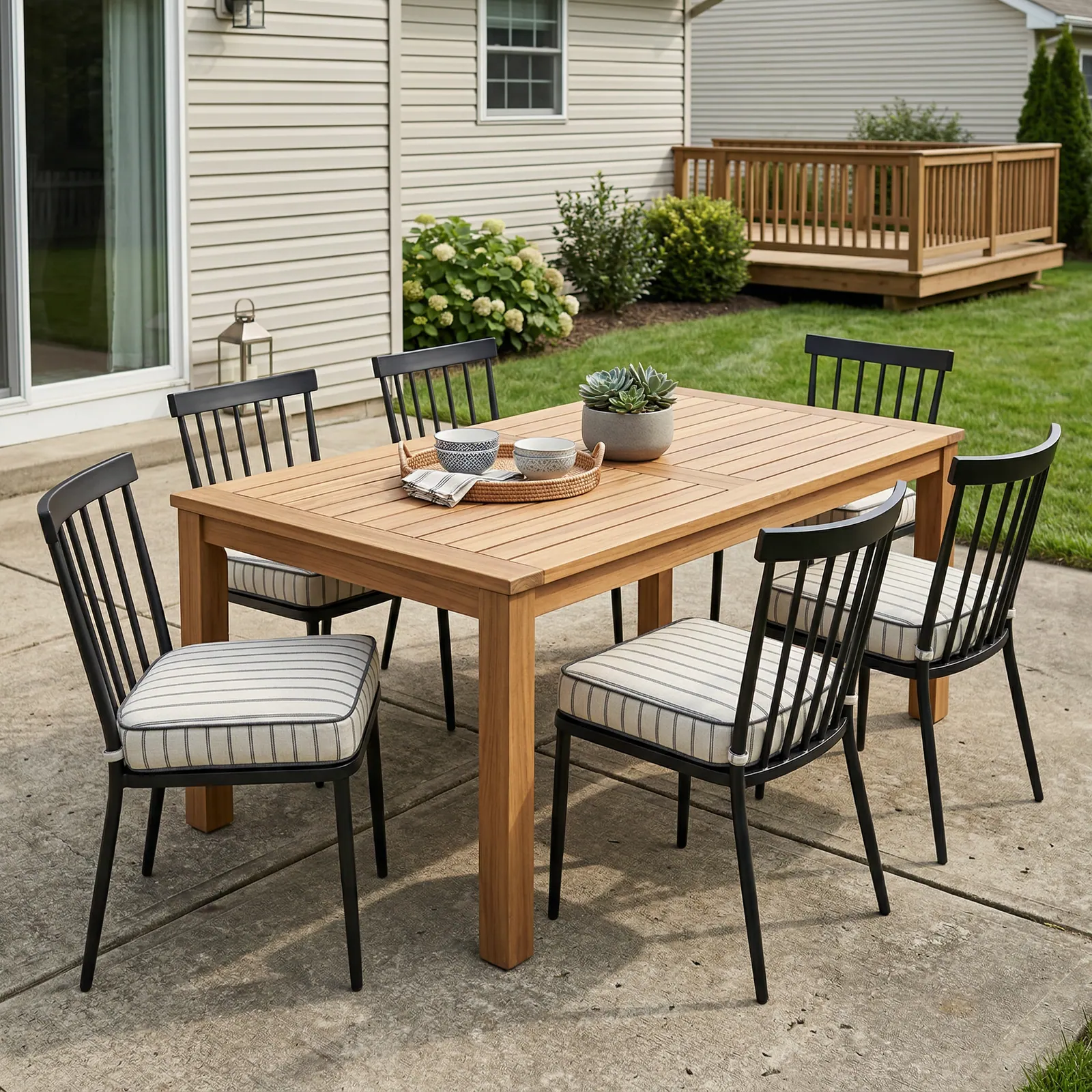
Chairs come out, chairs go back, and every inch a cushion adds to the height or the footprint is an inch the table has to give up. The pad in this photo gives up almost nothing.
It is a boxed seat pad on a weathered teak slat-back chair, thin enough that diners still sit at the right height for the teak table. It follows the seat's slight taper, so nothing pokes past the front corners to catch a knee. And it is tied at the back posts, so when you pull a chair out on a crowded deck, the pad stays with the chair instead of sliding forward onto the boards. I once cut a set of deck pads a touch too generous, and every chair stuck out like a tongue. Lesson learned.
Now the color. Weathered teak goes silver and deck boards go gray. Against both, navy reads deep and rich instead of heavy, and it forgives the vinaigrette that a cream pad would announce to the whole table.
The table is set white on purpose: white plates, a glass of white wine, a woven placemat, a linen napkin with cutlery. Navy stays the darkest note in the frame. Hydrangeas and lavender along the deck edge bring in blues and violets that the cushions quietly repeat.
The piping is self piping, navy on navy. On a lunch table I'd rather an edge be sharp than loud. A straight welt is a kind of honesty, and on a small deck honesty is plenty.
For pads that live outside, stay with outdoor acrylic; the dining chair cushions atlas has the shapes, and patio and porch cushions the rest of the deck. What's the narrowest gap between your table and the railing?
Pinned by Maggie
Five pins, from the navy box pad and its back-post tie to the silvered deck boards that deepen the blue.
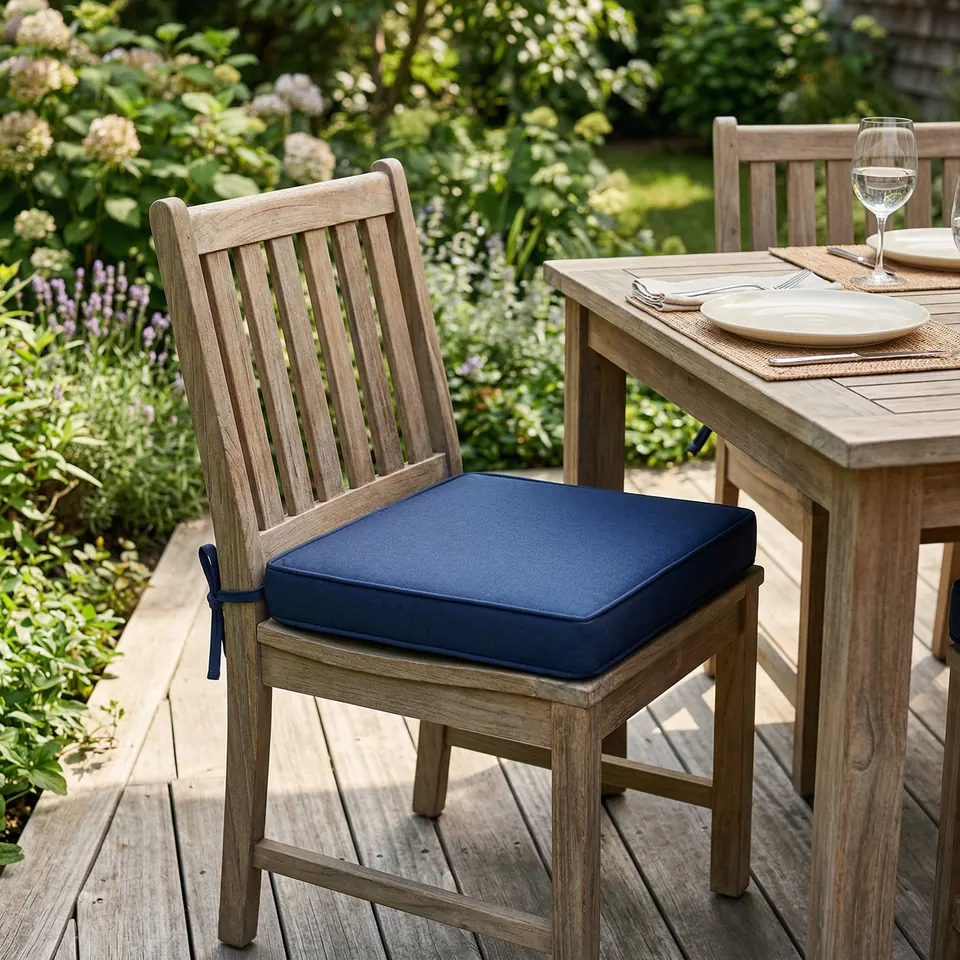
- Navy box seat pad
A boxed pad a few centimeters thick softens the seat without lifting diners too high.
- Navy fabric tie
Ties wrap the back posts so the pad stays put when the chair is pulled out.
- Self piping edge
Matching piping keeps the edges sharp without adding another color.
- White lunch table setting
White plates and a woven mat keep navy as the darkest note.
- Silvered deck boards
Gray teak and deck boards make navy look deeper and richer.
- Navy box seat padA boxed pad a few centimeters thick softens the seat without lifting diners too high.
- Navy fabric tieTies wrap the back posts so the pad stays put when the chair is pulled out.
- Self piping edgeMatching piping keeps the edges sharp without adding another color.
- White lunch table settingWhite plates and a woven mat keep navy as the darkest note.
- Silvered deck boardsGray teak and deck boards make navy look deeper and richer.
Measuring a tapered outdoor chair so the ties land right
Measure the front width
Corner to corner across the front edge of the seat. Outdoor dining chairs often taper, so write this number down on its own.
Measure the back width
Across the back of the seat, just in front of the posts. Keep it separate from the front width; never average the two.
Measure the depth
From the front edge back to the posts, down the middle. If the seat looks uneven, check the left and right sides too.
Mark the back posts
Note where each post meets the seat edge. That is where the ties go, and it is the detail that stops the pad sliding forward.
Photograph an old cushion
Replacing worn pads? Lay a tape measure along each side of the old cushion and take a photo from above. Send it with your numbers.
Four worn cushions, copied from photographs
A buyer in the US wrote to the workshop about four dining chairs whose seat and back cushions had worn thin. They wanted exact copies in cream and sent photos along with the dimensions. The shop confirmed it could replicate them and quoted per chair for a seat plus a back, shipping included.
Photographs beat memory every time. A tape measure along each side of the old pad, shot from above, shows the taper, the corners and the thickness in one picture. The full method is in dining chair pad measurements, and tie placement for chairs covers where the ties should land.
Cream on an outdoor lunch table, by the way, is braver than navy. I admire it from a safe distance.
On the cutting table
| Product | Tie-on dining chair pad, box edge |
|---|---|
| Fabric | Navy outdoor acrylic |
| Piping | Self piping, included at no extra charge |
| Ties | Optional extra, placed at the back posts |
| Non-slip bottom | Optional extra; leave it off for a reversible pad |
| Shape | Follows the seat's taper, no overhang |
| Thickness | Thin box that keeps diners at table height |
| Best for | Teak and slat-back dining chairs on decks and patios |

Have it made
Have this made — ask Maggie’s workshop
Numbers first, fabric second, piping last. Jot down what you have, and the workshop will go down the list with you, item by item. — Maggie
Leave your details and the workshop will call you to confirm measurements, fabric, foam and piping. No prices, dates or payment on this page: it is a request, not an order.
On a small deck, a tie-on chair pad earns its place with no overhang and no slide: ties at the back posts keep it on the chair when it's pulled out.
Maggie
Questions buyers ask next
How thick should an outdoor dining chair pad be?
Thin enough that diners still sit at the right height for the table. A slim boxed pad softens a hard teak seat without lifting anyone toward their plate. If your chairs already sit high for the table, go thinner rather than thicker.
Why choose navy for patio chair cushions?
Navy looks deep and rich against silvered teak and gray deck boards, and it hides food marks far better than cream or white. With a white table setting it stays the darkest note, which keeps a small outdoor dining area calm.
Can a tie-on chair pad be reversible?
Yes, as long as you leave off the non-slip bottom when you order. With the ties still at the back, you can turn the pad over when one side gets marked and tie it to the posts as before.
What is the easiest way to order replacement dining chair pads?
Photograph the old cushions with a tape measure laid along each side and send the dimensions with the photos. One buyer in the US ordered exact copies of four worn seat and back cushions this way.
Stitch straight — Maggie
More photographs to read
 Save
 Save
 Save
 Save
 Save
 Save