A Reading by CallumBench Cushions
Six custom bench cushion mistakes, seen from knee height on a teak bench
Callum starts with three common questions, then crouches beside a sage striped teak bench under a gray sky to show where each mistake would have shown.
 Save
The quick answer
The most common custom bench cushion mistake is measuring seat depth only at the center of a bench with shaped arms; measure at the arm too, because the two can differ. Others: back cushions taller than the arm line, a stepped drawing whose sides don't add up, and a thickness that pushes knees into the table.
The questions first: stepped shapes, a 2 in limit, matching backs
- A common question
My bench isn't a plain rectangle; it steps in. Can you make a cushion to that shape?
The workshop's answerYes, exactly, as long as the drawing adds up. One sketch showed a 31 in top plus two 2 in steps, which makes 35 in, while the bottom said 37 in; either the steps were 3 in each or the bottom was 35 in. Once corrected, choose Length as the longest edge (37 in) and Depth as the depth from that edge (24 3/4 in), upload the drawing and state the thickness.
- A common question
The nook cushion has to be 2 inches thick at most or my legs will hit the table. Can I change it after ordering?
The workshop's answerYes, if production hasn't started. That order was switched to 2 in (5 cm) thick before any cutting began.
- A common question
Can the back cushion be the same shape or size as the seat?
The workshop's answerYes. In the standard set the seat is bigger than the backrest, but the back can be made square like the seat, or both pieces can be made the same size.
Now, the reading
From three questions to one bench at knee height
Every one of those buyers caught a mistake before the scissors did. That's the only good time to catch one.
The stepped sketch didn't add up: a 31 in top plus two 2 in steps is 35 in, not 37. The nook buyer never checked thickness, then saw their legs would meet the table, and switched to 2 in (5 cm) while there was still time. The third assumed a back cushion has to be smaller than the seat. None of that is foolish. It's the weather of ordering, friend: predictable if you look up.
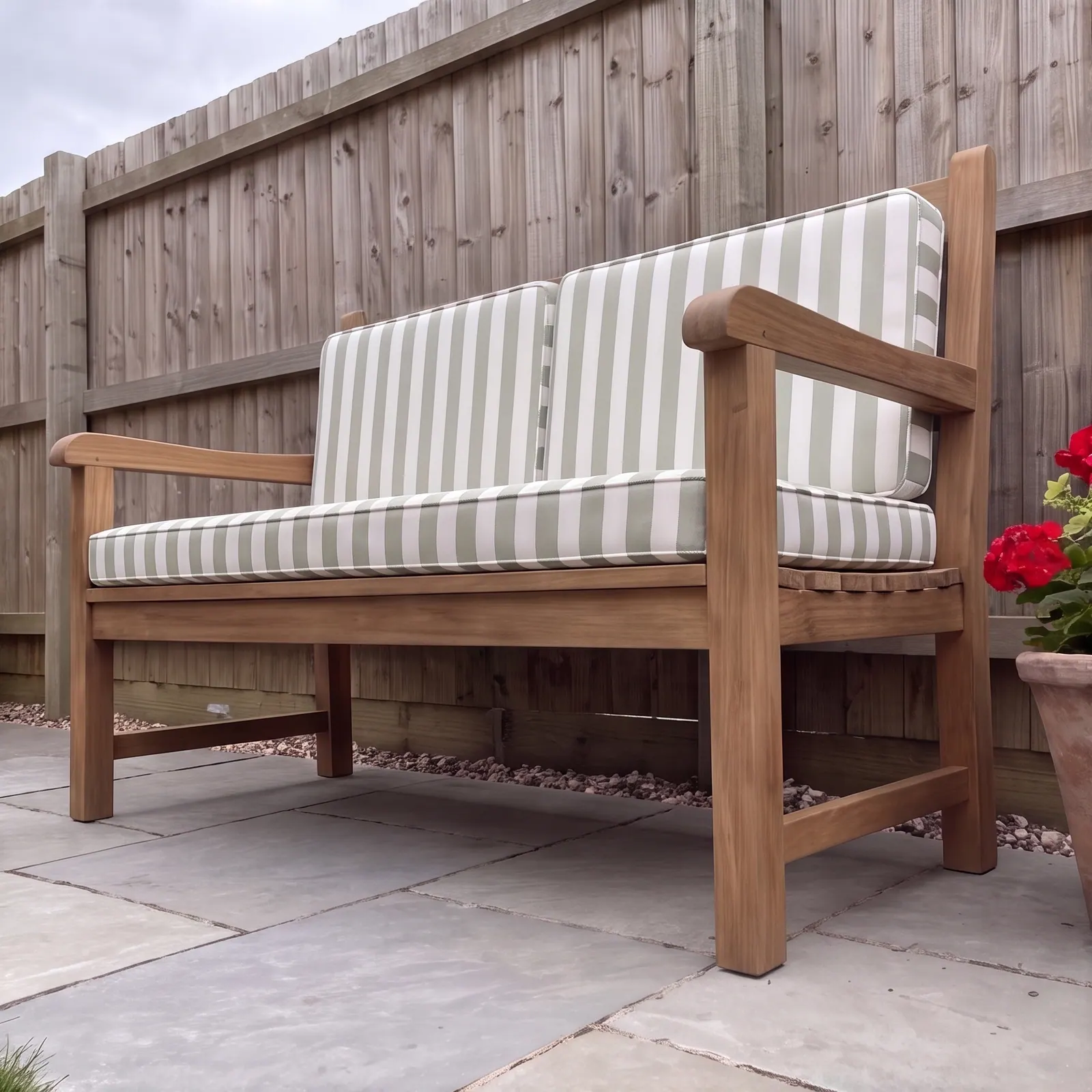
Now the bench. The camera sits low beside a teak bench with shaped arms, a tall silvered timber fence behind it and a gray sky over the top. From here you see the side of the seat cushion: a box edge with self piping, sitting just above the teak seat rail. The honey front leg frames it and shows how slim that rail is.
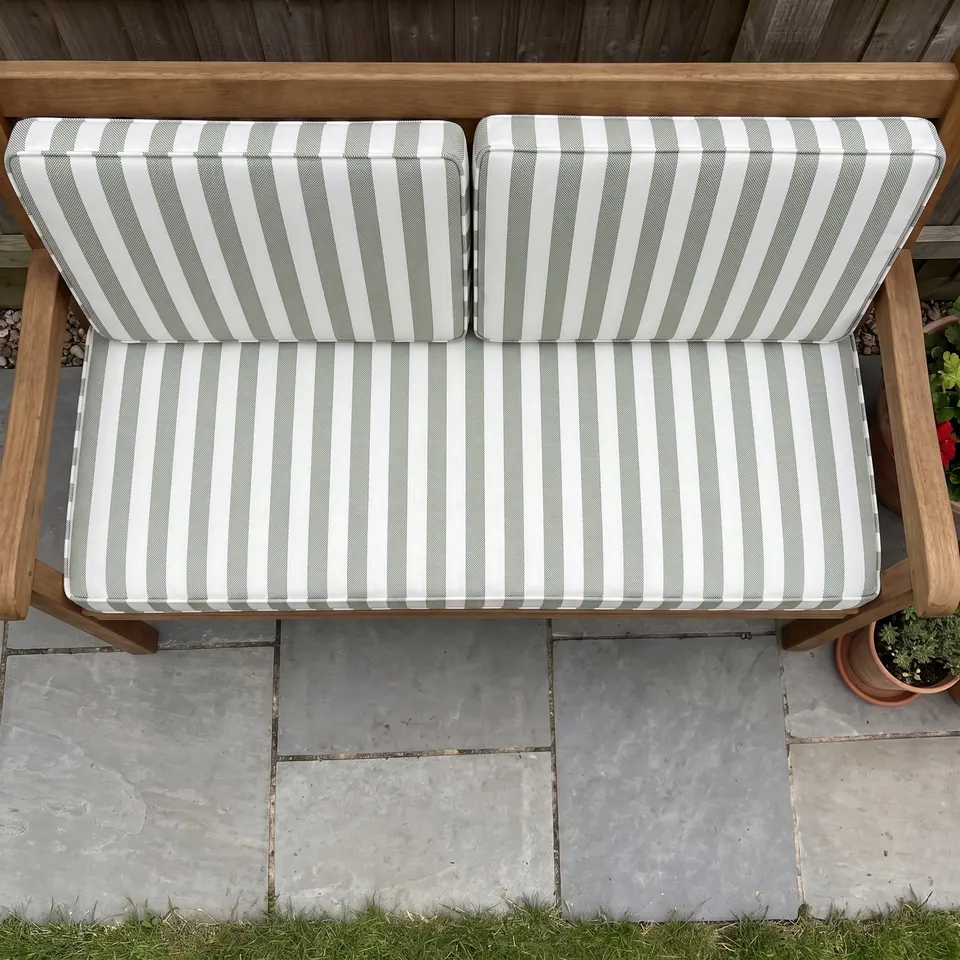
The back cushions lean in but stay below the arm line, so the carved arms still show. Pale sandstone paving, a gravel strip and one terracotta pot of red geraniums keep the palette quiet around the sage and white stripe. Silver fence boards are about the best backdrop a stripe could ask for. Rain doesn't negotiate, and a sky like this one tells you the cushion was chosen for it: a water-repellent membrane fabric, not a hopeful indoor weave. What does your bench measure at the arm?
Six mistakes this bench steps around
- Measuring seat depth only at the center. With shaped arms, measure at the arm and at the center; the two numbers can differ. How to measure a bench shows where.
- Back cushions taller than the arms. Keep them below the arm line so the carved teak stays in view; back cushion height has the details.
- Letting the seat hang past the rail. The piped box edge should sit just above the front rail, not droop over it.
- A stepped drawing that doesn't close. Add up every run before you send it; the long side must equal the top plus the steps.
- Never checking thickness against the table. Measure knee room first; a 2 in (5 cm) cushion was the fix for one nook. See banquette thickness and table height.
- Assuming the back must be smaller. A back can be made square like the seat, or the same size, if you ask.
A narrow bench with a two-fabric look
One buyer wrote in about a narrow bench, 12 x 36 3/4 in (30.5 x 93.5 cm). They wanted one plain fabric on the top and bottom, a stripe running around the sides, and piping from a third fabric chart.
Two fabrics mean extra cutting and labor. To cover it, the workshop had them order the next size up on the menu, 15 3/4 x 39 3/8 in (40 x 100 cm), and write the real size and every fabric code in the personalization note. A contrasting side panel adds real interest for a small extra cost, and a clear note keeps it from becoming a mistake of its own. The personalization note Pattern shows what to write. More benches like this sit in bench cushions and patio and porch cushions.
- Sizes
- 12 x 36 3/4 in (30.5 x 93.5 cm); ordered under the 15 3/4 x 39 3/8 in (40 x 100 cm) size
The lesson: A contrasting side panel adds interest for a small extra cost.
Pinned by Callum at knee height
Five pins from low down: the seat profile, the back cushion, the teak leg, the red geraniums and the tall fence.
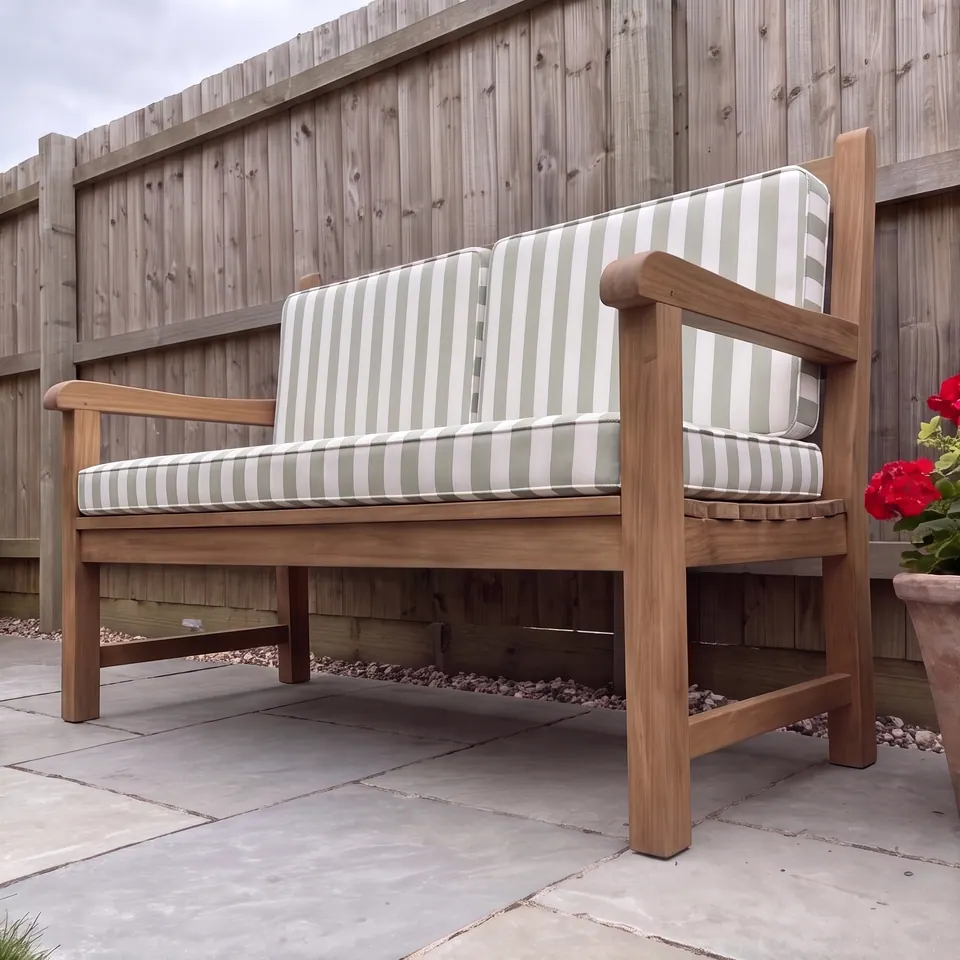
- Seat cushion profile
From knee height you see the box edge sitting just above the teak seat rail.
- Back cushion
The back cushions stay below the arm line so the shaped arms remain visible.
- Teak front leg
The honey leg frames the cushion and shows how thin the rail is beneath it.
- Red geraniums
A single pot of red flowers keeps the palette restrained around the sage.
- Tall timber fence
Silver fence boards give a neutral backdrop that lets the stripe stand out.
- Seat cushion profileFrom knee height you see the box edge sitting just above the teak seat rail.
- Back cushionThe back cushions stay below the arm line so the shaped arms remain visible.
- Teak front legThe honey leg frames the cushion and shows how thin the rail is beneath it.
- Red geraniumsA single pot of red flowers keeps the palette restrained around the sage.
- Tall timber fenceSilver fence boards give a neutral backdrop that lets the stripe stand out.
On the cutting table: the fence-side teak bench
| Cushion | Seat and back cushions for a teak garden bench with shaped arms |
|---|---|
| Fabric | Sage and white stripe, water-repellent membrane |
| Piping | Self piping |
| Edge | Box edge sitting just above the teak seat rail |
| Back height | Below the arm line so the carved arms show |
| Depth check | Measure at the arm and at the center |
| Thickness check | Allow knee room at a table; 2 in (5 cm) solved one nook |
| Backdrop | Silvered timber fence, pale paving, one pot of red geraniums |
| Best for | Garden and patio benches with shaped or carved arms |

Have it made
Have this made — ask Callum’s workshop
Sun, rain, salt. Say which of them your cushion will meet, and the workshop will plan around it. — Callum
Leave your details and the workshop will call you to confirm measurements, fabric, foam and piping. No prices, dates or payment on this page: it is a request, not an order.
On a teak bench with shaped arms, measure seat depth at the arm and at the center; the two numbers can differ.
Callum
Questions buyers ask next
Where should a garden bench cushion sit on the seat rail?
Just above it, with the piped box edge lined up on the front rail. A cushion that droops past the rail looks borrowed and catches on legs; one that stops short leaves hard teak under your knees.
How tall should back cushions be on a bench with arms?
Below the arm line, if the arms are worth seeing. On this teak bench the backs lean in without rising past the carved arms, which keeps the bench's outline readable from the side.
Can one bench cushion use two different fabrics?
Yes. One buyer had a plain fabric top and bottom, a stripe on the sides and piping from a third chart, all written into the personalization note. The extra cutting adds a small cost.
What backdrop suits a sage striped outdoor cushion?
Neutral, weathered surfaces: silvered fence boards, pale paving and gravel. Add one warm accent, like a pot of red geraniums, and the stripe stays the main event even under a gray sky.
Fair winds — Callum
More photographs to read
 Save
 Save
 Save
 Save
 Save
 Save