 Save
A Reading by ÉlodieMudroom & Entryway Bench Cushions
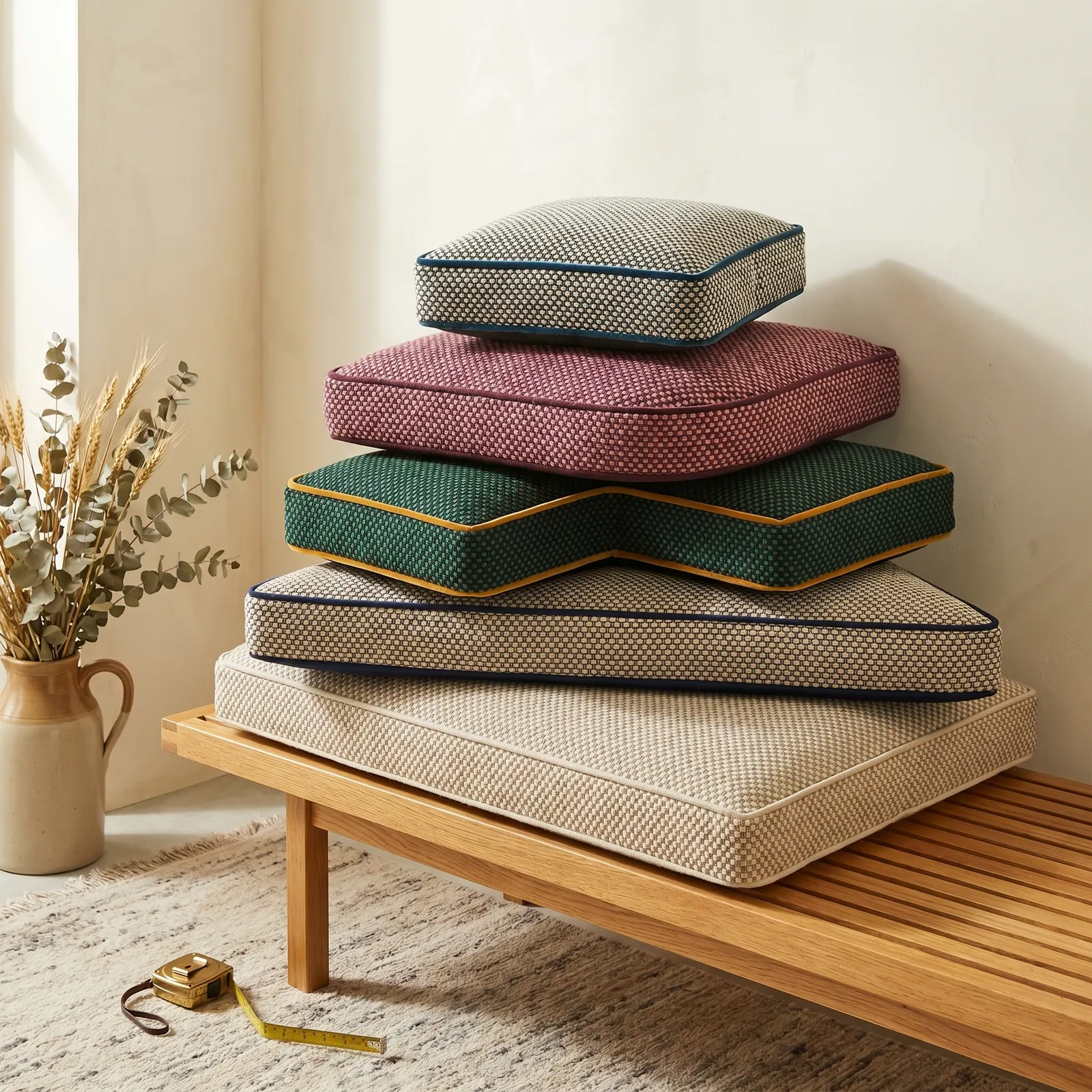
Five custom size cushions stacked on an oak bench, and what they teach a narrow hallway
Élodie reads a pile of dotted chenille cushions, square, trapezoid and long, for the color and cutting decisions that make a tight spot feel generous.
Squares, a trapezoid and long rectangles share one pile to show that any outline can be cut to order.

The quick answer
A custom size cushion can be cut to almost any outline, square, trapezoid or long rectangle, which is how a narrow hall or entry spot gets a seat that fits exactly. In this stack of five dotted chenille cushions, the palest is the largest and the darkest the smallest, and each piping color is chosen for its ground. Send a traced template for odd shapes.
The pile that reads like a floor plan
Five cushions, one bench, and not one of them the same shape.
Read the stack from the bottom, my friends, the way the eye climbs it. A long cream base with cream velvet cord. A taupe rectangle piped in navy. A forest green trapezoid, its angled sides traced in mustard. A rose square in self piping. On top, a small charcoal square outlined in navy so it doesn't blur into the pile. It's a lesson in cutting to order, and a lesson in making a small space look larger.
Pale where it is big, dark where it is small. The largest cushion is cream, the smallest charcoal. A narrow hallway works the same way: a long pale cushion widens a slim entry bench to the eye, while a dark accent stays small and deliberate. The eye sits down first, and it sits where the color is calm.
Piping draws the outline you want seen. Each cord is chosen for its ground: navy on light taupe, warm mustard on cool green, cream on cream where the base should simply rest. In a tight spot, a crisp outline shows exactly where the seat ends, so the space around it reads as clear floor, not clutter.
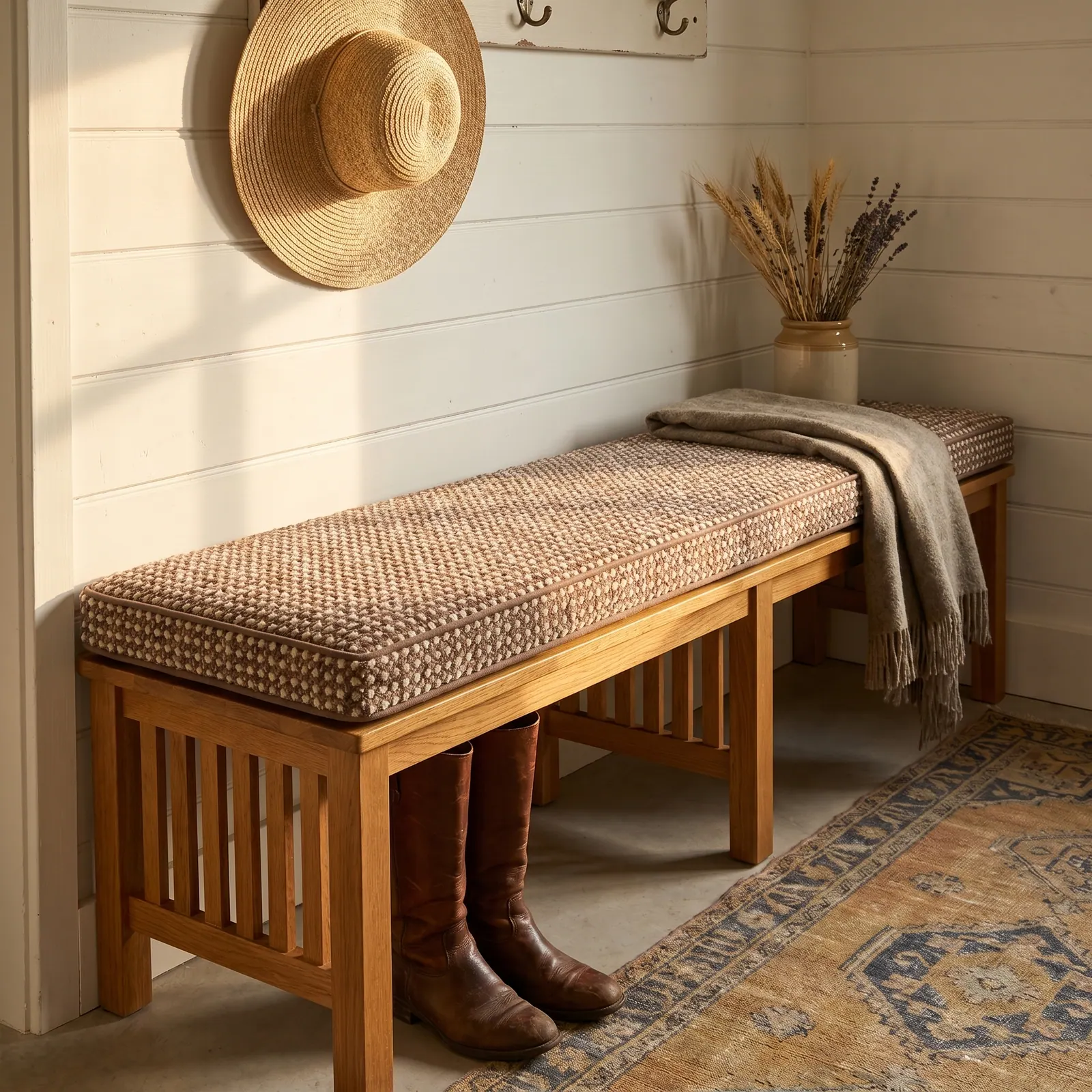
The props belong to the workroom, not the showroom. The brass tape measure says every piece was cut from a number. The dried wheat and eucalyptus in a stoneware jug carry taupe and green upward. The low-pile wool rug and the slatted oak bench keep everything low and light, and the sunny wall does the rest.
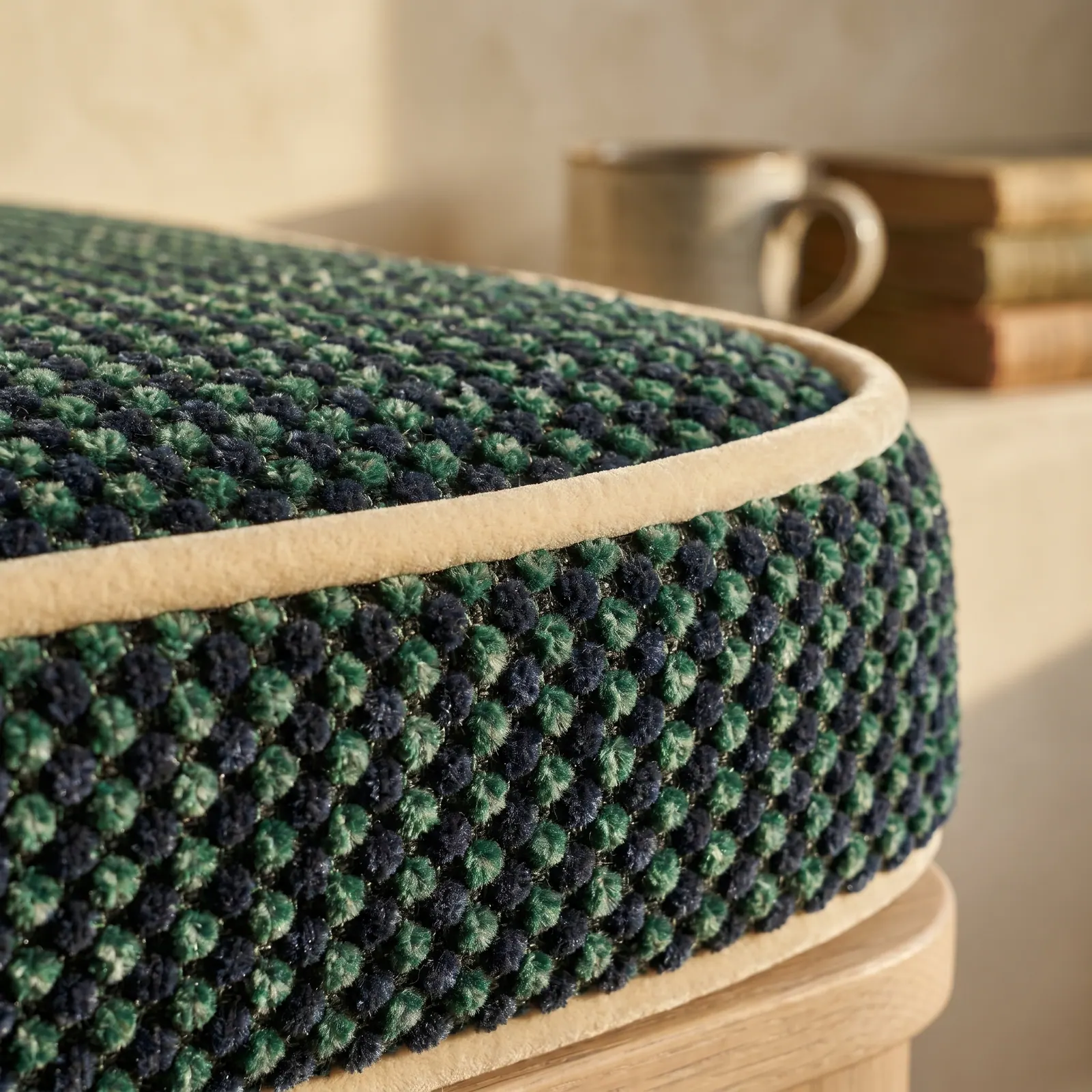
Dotted chenille is a woven texture, shelved with its patterned cousins under jacquard and damask. For a trapezoid like the green one, the trapezoid cushion calculator does the math, and any odd outline starts with a paper template. More entry seating lives in mudroom and entryway bench cushions.
What is the narrowest spot in your house that still wants a seat?
Pinned by Élodie: five outlines, five piping calls
Five pins climb the stack, one per cushion, each naming the piping color chosen for its ground.
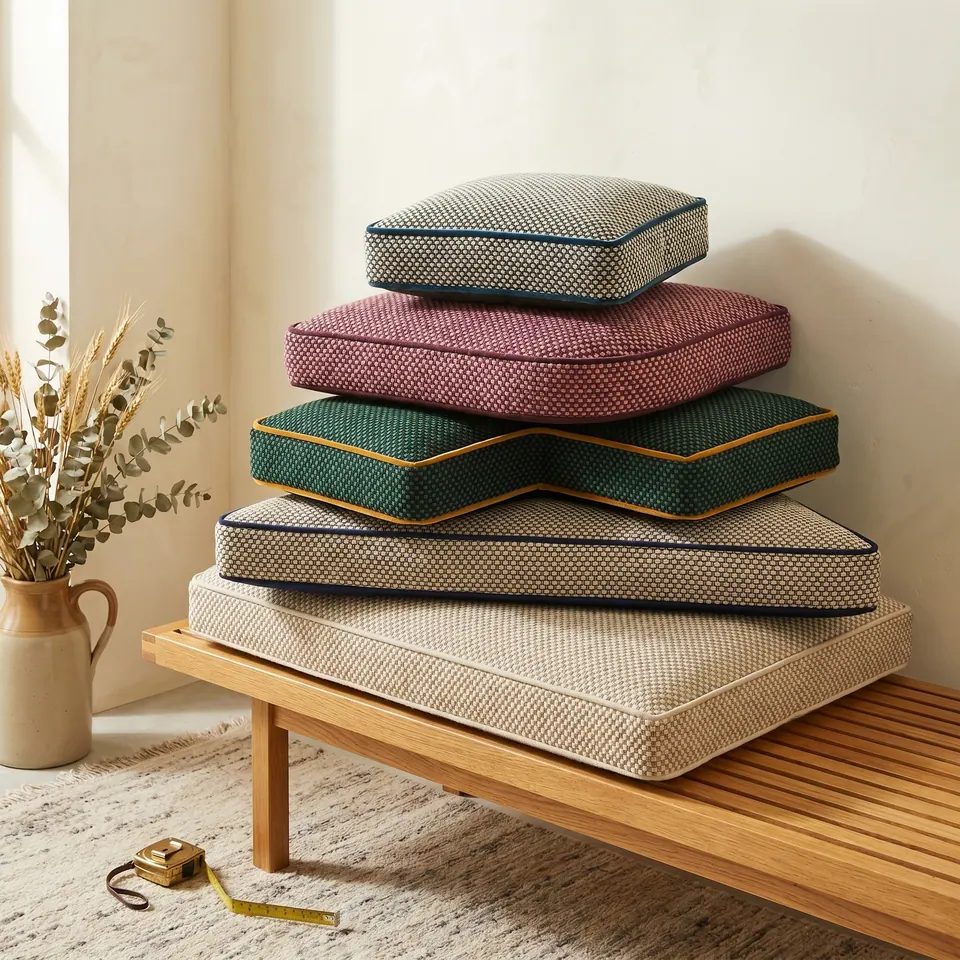
- Small charcoal square
Navy piping outlines the smallest piece so it doesn't blur into the pile.
- Rose square
Self piping keeps the rose cushion soft between darker neighbors.
- Green trapezoid
Mustard cord traces the angled sides so the trapezoid reads clearly.
- Taupe rectangle
Navy piping on taupe adds a tailored line to a neutral.
- Long cream base
The largest cushion sits at the bottom with cream piping to anchor the stack.
- Small charcoal squareNavy piping outlines the smallest piece so it doesn't blur into the pile.
- Rose squareSelf piping keeps the rose cushion soft between darker neighbors.
- Green trapezoidMustard cord traces the angled sides so the trapezoid reads clearly.
- Taupe rectangleNavy piping on taupe adds a tailored line to a neutral.
- Long cream baseThe largest cushion sits at the bottom with cream piping to anchor the stack.
Which shape in the stack fits which tight spot
| Cushion in the stack | Piping | A narrow spot it could fill |
|---|---|---|
| Long cream base | Cream velvet cord | A slim entry or hallway bench |
| Taupe rectangle | Navy | A short bench beside a door |
| Green trapezoid | Mustard cord | A seat that tapers toward a wall or a bay |
| Rose square | Self piping | A stool or a single chair |
| Small charcoal square | Navy | A step, a landing pad or a child's perch |
Seventeen and a half inches at the bottom of a slide
A grandparent in the US wrote to the workshop about a small, steep problem: a slide attached to a child's loft bed, with a hard landing at the bottom.
The answer was a landing pad cut to 17.5 x 12 in (44 x 30 cm), 4 in (10 cm) thick, in fabric 923. Two 18 in (46 cm) straps were sewn at the corners of the 17.5 in side so the pad could be tied on and stay put. The workshop added the straps at no extra charge.
Seventeen and a half inches is not much cushion. It is exactly enough when it is tied down. Tie straps turn a small cushion into a secure one, and in a narrow spot, a little seat that slides is worse than none. The ties and non-slip Pattern shows where straps go.
- Sizes
- 17.5 x 12 x 4 in (44 x 30 x 10 cm), two 18 in (46 cm) straps
- Fabric
- 923
The lesson: Tie straps turn a small cushion into a secure landing pad.
Buyer questions: swatches by mail, washing the covers, and how long it takes
- A common question
Can I get fabric samples so I can judge the colors in my own light?
The workshop's answerYes. There's no showroom, so samples go out by mail for a small shipping fee. Choose the Fabric Sample option on the tufted floor cushion listing, then message the colors you'd like to see, for example beige, brown or olive in linen or corduroy. The workshop sends as many as you need, or every color.
- A common question
Does the cover come off, and can it go in the washing machine?
The workshop's answerYes. Covers are fully zippered and removable. Machine wash at 86°F (30°C) on a gentle cycle, air dry with no tumble dryer, and iron on low if needed. Non-slip pads in particular don't tolerate the dryer.
- A common question
How long does a custom cushion take to make and reach me in the US?
The workshop's answerProduction time depends on the order, because each cushion is handmade and hand sewn, and express courier delivery follows dispatch. Ask the workshop for both times in writing before you order.
On the cutting table: the five-shape stack
| Cushions | Five box cushions, each cut to its own outline |
|---|---|
| Shapes | Long rectangle, rectangle, trapezoid, two squares |
| Fabric | Dotted chenille in cream, taupe, forest green, rose and charcoal |
| Piping | Cream velvet, navy, mustard cord and self piping |
| Setting | Slatted oak bench, low-pile wool rug, sunny wall |
| Cover care | Zippered; wash at 86°F (30°C) on gentle, air dry |
| Lead time | Confirm making and delivery times in writing with your quote |
| Best for | Narrow halls, entry benches and odd-shaped seats |

Have it made
Have this made — ask Élodie’s workshop
Color is easier to settle in a conversation than on a screen. Tell the workshop about the room and the light it gets, and the fabric choice follows. — Élodie
Leave your details and the workshop will call you to confirm measurements, fabric, foam and piping. No prices, dates or payment on this page: it is a request, not an order.
In a narrow hall, put the palest color on the biggest cushion and the darkest on the smallest; the pale seat widens the whole spot to the eye.
Élodie
Questions buyers ask next
Can one order mix squares, trapezoids and long rectangles?
Yes. Each cushion is cut to its own outline, so a single order can combine shapes. Send the measurements for every piece, and a traced paper template for anything that isn't a plain rectangle.
What cushion color makes a small entryway feel bigger?
A pale, warm neutral like cream on the largest seat reads lighter and wider. Keep darker colors for small accents, and use a crisp piping line so the edge of the seat stays clear against the floor.
Why would each cushion in a set get a different piping color?
Piping works hardest when it contrasts with its own ground. Navy on taupe, mustard on green and cream on cream each give the right amount of outline, so every shape in a mixed set reads clearly.
With color and care — Élodie
More photographs to read
 Save
 Save
 Save
 Save
 Save
 Save