 Save
A Reading by HarlanCorner Floor Cushions & Poufs
Measuring a corner floor cushion: the orange stripe beside the china cabinet
A burnt orange stripe in the leftover corner of a dining room. Before the color and the pillows, there are two walls and a tape measure, and they have to agree.
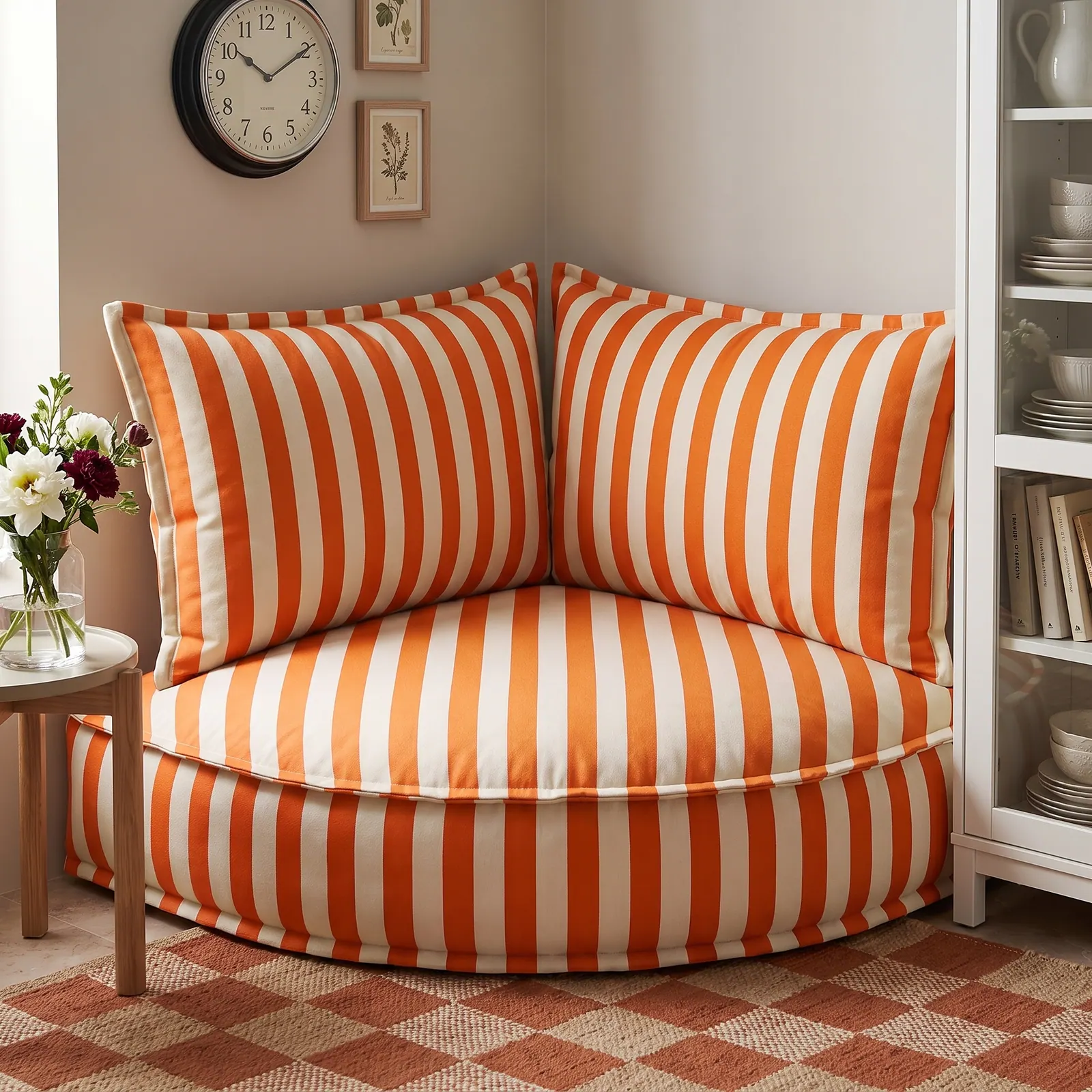
Burnt orange stripes in a dining-room corner, with botanical prints, a wall clock and a vase of white and burgundy flowers.

The quick answer
To measure for a corner floor cushion, run the tape along each wall from the inside corner to where the seat should stop, at floor level, and check that the walls meet square. Large corners have a second limit: fabric roll width, about 55 in (140 cm), decides whether a big seat can be cut in one continuous piece.
The corner beside the china cabinet
Every dining room has a corner nobody sets a chair in. This one sits between the wall and a white glass-front cabinet stacked with plates and bowls, and somebody finally put it to work.
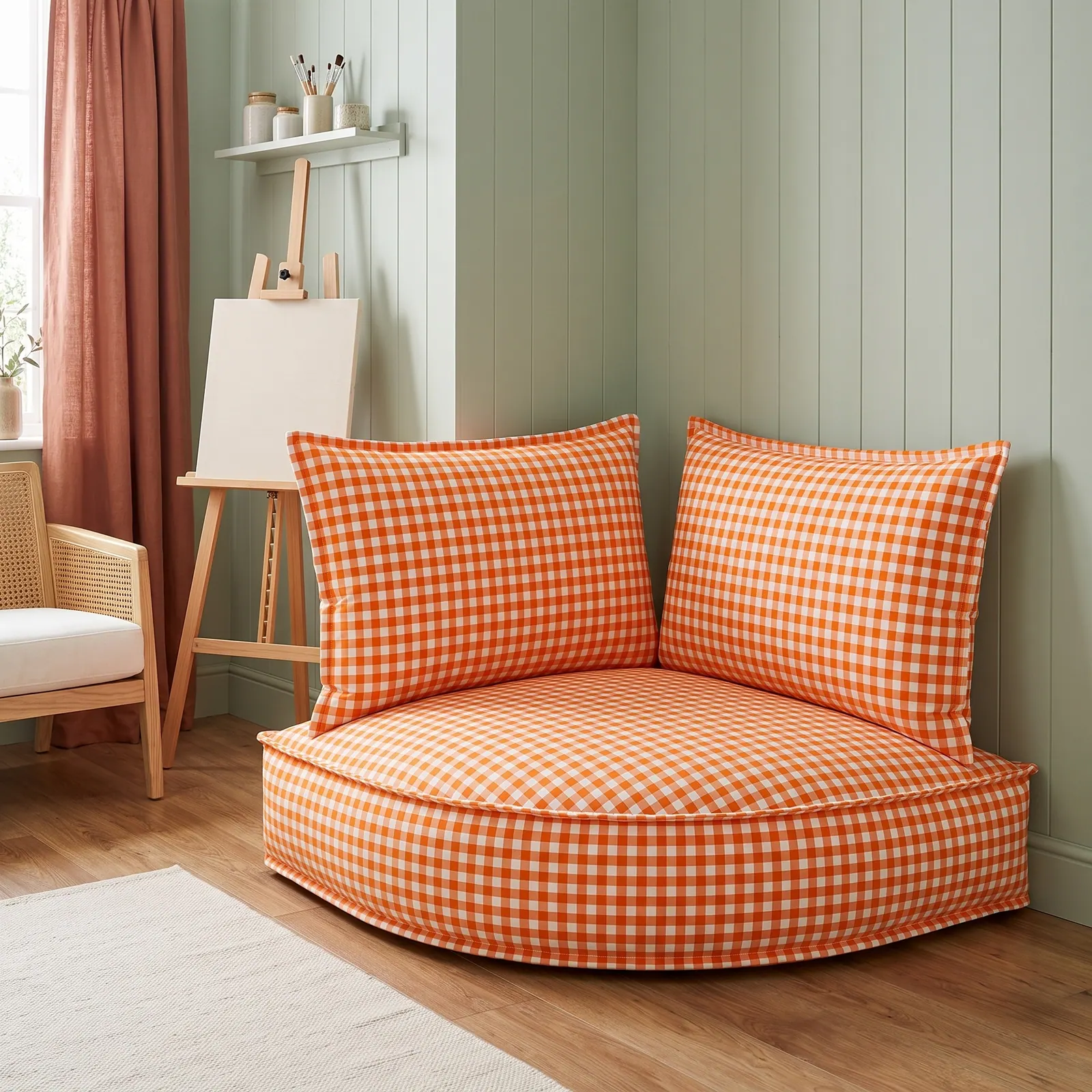
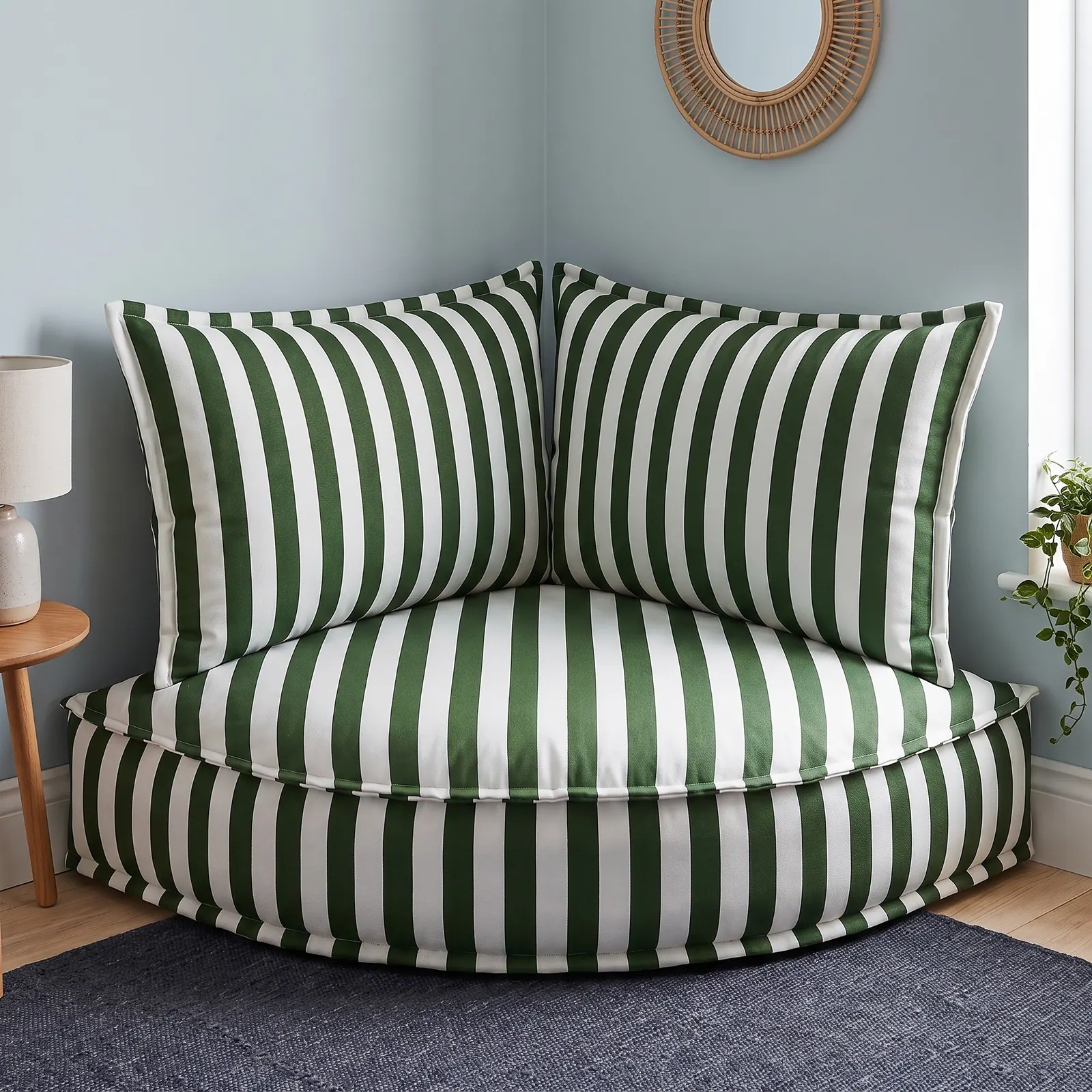
A corner floor cushion goes into a corner the way a drawer goes into a chest: it has to fit the opening, not the idea of one. The seat is boxed, with contrast ivory piping that draws a clean line around the burnt orange and cream stripes. Two striped backrest pillows lean on the walls with their stripes running up and down, and they lift the eye toward the black-rimmed clock and the two botanical prints above.
The color is handled with a light touch. The orange stripe answers the orange checkerboard rug in a different pattern, so the corner looks coordinated without looking matched out of a catalog. The clock is black, the prints are green and cream, and together they keep the orange from running the room. A round wood side table holds white and burgundy flowers at shoulder height, handy for a cup of coffee after dinner.
Warm lamp light deepens the orange a shade past what daylight shows. That suits a dining room. People sit there in the evening.
A seam is a promise, my friend, and so is a measurement. Get the measurement right and the seam can keep its word. What stands beside your leftover corner: a cabinet, a radiator, a door that swings?
More shapes like this are in the corner floor cushion atlas. The stripe comes from the workshop's striped cotton and ticking range, and eating-corner ideas gather under kitchen nook cushions.
Pinned by Harlan: the striped corner floor cushion
Five pins, from the striped seat to the glass cabinet that set the size of the corner.
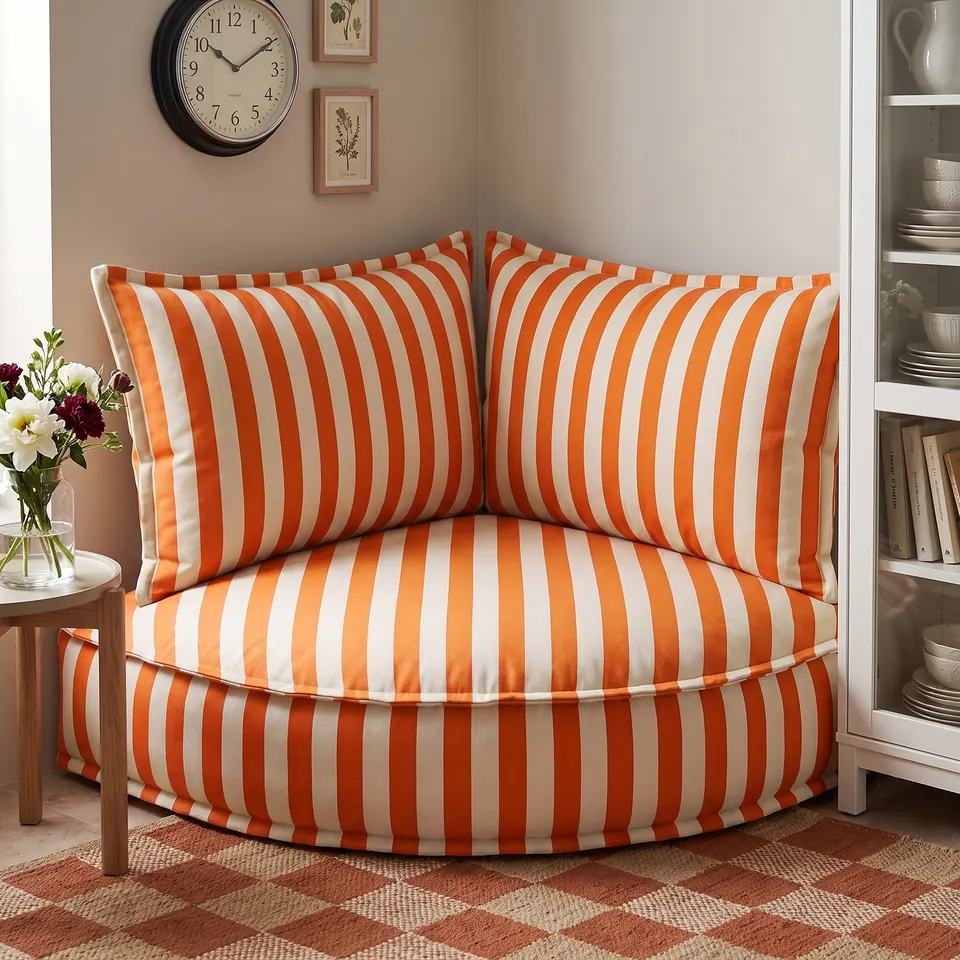
- Burnt orange stripe seat
The stripe repeats the rug's color in a different pattern, coordinated but not matchy.
- Left backrest pillow
Vertical stripes lift the eye toward the clock and prints.
- Wall clock
Black, cream and green accessories keep the orange from being overdone.
- Flowers on side table
A small table at shoulder height holds flowers or a cup after dinner.
- Glass china cabinet
The pouf turns the leftover corner beside the cabinet into a place to sit.
- Burnt orange stripe seatThe stripe repeats the rug's color in a different pattern, coordinated but not matchy.
- Left backrest pillowVertical stripes lift the eye toward the clock and prints.
- Wall clockBlack, cream and green accessories keep the orange from being overdone.
- Flowers on side tableA small table at shoulder height holds flowers or a cup after dinner.
- Glass china cabinetThe pouf turns the leftover corner beside the cabinet into a place to sit.
Measuring this exact seat, and where people go wrong
Start in the inside corner
Hook the tape into the corner at floor level, where the cushion will sit, and run it along the first wall to where the seat should stop. Measuring at hand height, above the baseboard, is an easy way to end up long.
Measure the second wall on its own
Do not assume the two sides match. Walls in older houses wander, and a cabinet or door frame can shorten one side.
Mind what stands beside it
Stop the seat short of the cabinet so its doors still open and the backrest pillow doesn't lean on glass.
Check the corner is square
If the walls don't meet at a true right angle, add the depth measured at the exact center of the corner and send a photo. That makes it a custom shape.
Ask about the roll width
Fabric comes on rolls about 55 in (140 cm) wide. A very large corner may not fit in one continuous piece in every fabric. Striped fabrics like this one are 100% cotton, and on a long piece the stripes run front to back.
Measure the old cushion last, if at all
A tired cushion has spread. Measure the floor and the walls, not the thing you are replacing.
On the cutting table: the dining-room corner
| Piece | Corner floor pouf with two backrest pillows |
|---|---|
| Fabric | Burnt orange and cream striped cotton |
| Piping | Contrast ivory |
| Edge | Box |
| Placement | Leftover dining-room corner beside a glass-front cabinet |
| Measure | Each wall from the inside corner, at floor level |
| Odd corners | Add the center depth and a photo |
| Size limit | Fabric roll about 55 in (140 cm) wide |
| Best for | Dining and kitchen corners, after-dinner seats |

Have it made
Have this made — ask Harlan’s workshop
Fabric has a temper and foam has a memory. Better to settle both in a conversation than to guess at them alone. — Harlan
Leave your details and the workshop will call you to confirm measurements, fabric, foam and piping. No prices, dates or payment on this page: it is a request, not an order.
52.75 in (134 cm) a side, and a roll of velvet
A buyer messaged the workshop wanting a velvet corner cushion in cream, with sides of 52.75 in (134 cm) each. A generous corner, and it ran straight into a limit most people never think about.
Fabric comes off a roll, and rolls run about 55 in (140 cm) wide. The velvet's width meant the seat could not be cut in one continuous piece. A soft fabric just fit inside the limits, so the cushion was made in cream soft fabric instead.
Measure your walls first, then ask which fabrics your size allows. The method is laid out in corner floor cushion quarter-circle sizing, and cushion measurements: length, depth, thickness covers the rest.
Buyer questions: walls, totals and dates
- A common question
Does a floor sofa have to sit against a wall, or will it slide around in the middle of a room?
The workshop's answerIt doesn't need a wall. Metal support bars along the sides and back hold the backrests upright so it stands on its own, and the back is covered in the same fabric as the rest. A rug or carpet underneath helps stop sliding.
- A common question
Is the price on the listing the whole price, or will there be extra fees when it arrives?
The workshop's answerCheck the shipping line on your quote or listing before you pay: it states delivery to your address, and some listings charge it separately. One past US quote included delivery in the listed price, but read the total for your own order rather than assuming it.
- A common question
Can I have it by a specific date?
The workshop's answerTell the workshop the date before you order and ask it to confirm in writing whether it can be met. Shipping time comes after dispatch, and public holidays can hold pickups at the carrier, so leave a few days of margin.
Measure a corner floor cushion at floor level, from the inside corner along each wall, where the seat will sit, not at hand height above the baseboard.
Harlan
Questions buyers ask next
What if my corner walls aren't square?
Measure along each wall, then take the depth at the exact center of the corner. Send those numbers with a photo; a corner that is not a true right angle is cut as a custom shape rather than a standard quarter-round.
How big can a one-piece corner floor cushion be?
The limit is the fabric roll, about 55 in (140 cm) wide. A 52.75 in (134 cm) corner fit in a soft fabric but could not be cut from velvet in one continuous piece. Ask about roll width before choosing fabric for a large corner.
Should a corner floor cushion match the rug?
Match the color, not the pattern. Here a burnt orange stripe answers an orange checkerboard rug, while black, cream and green accessories keep the orange from taking over the room.
Will a corner floor cushion slide on a wood floor?
A rug underneath is the simplest fix, the same advice the workshop gives for freestanding floor sofas. Pressing the two straight sides into the walls also holds a corner seat in place.
Sit well. — Harlan
More photographs to read
 Save
 Save
 Save
 Save
 Save
 Save