A Reading by CallumChaise Lounge & Sunbed Cushions
What goes inside a striped sunbed cushion by the family pool
Three loungers, three stripes, one long wet summer. Callum writes about the part nobody photographs: the foam under the fabric, and why a pool deck asks more of it than a den ever will.
 Save
The quick answer
A sunbed cushion by a pool needs firm foam that keeps its shape under wet swimsuits every day, plus a cover that sheds water. The workshop fills seats with about 2 lb/ft³ (32 kg/m³) high-resilience foam wrapped in polyester wadding. Standard thickness is 4 in (10 cm), with 6 or 8 in on request; more foam also raises you off the frame.
Portland ·
Friend,
A letter from the pool deck, about the part you can't see
The stripes in this photo get the attention, and they've earned it. But I'm writing about what sits under them, because a sunbed cushion lives or dies on its foam.
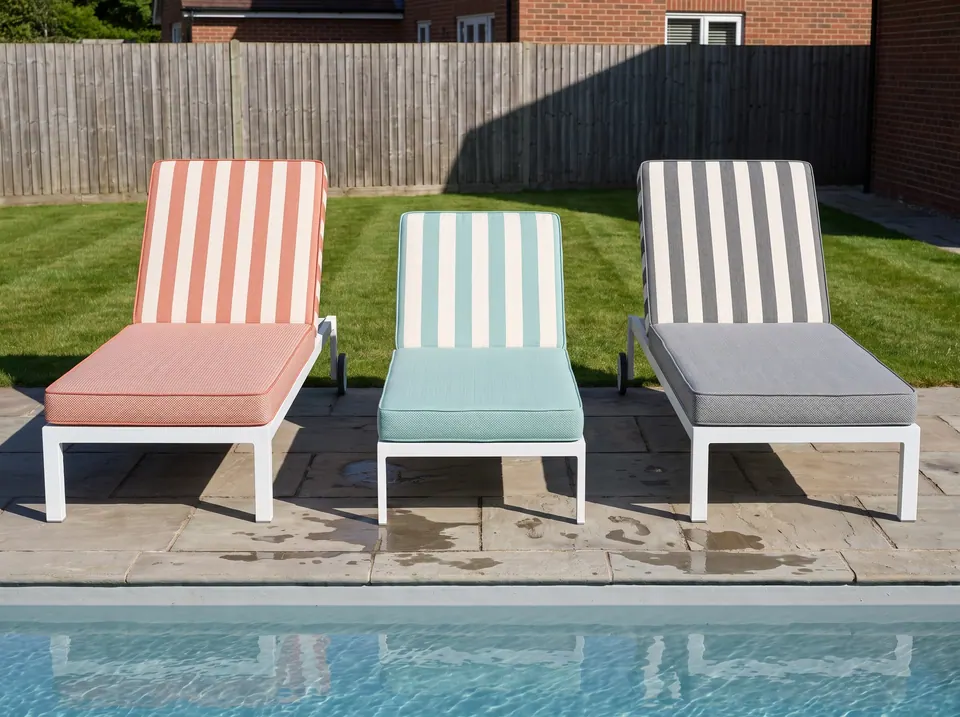
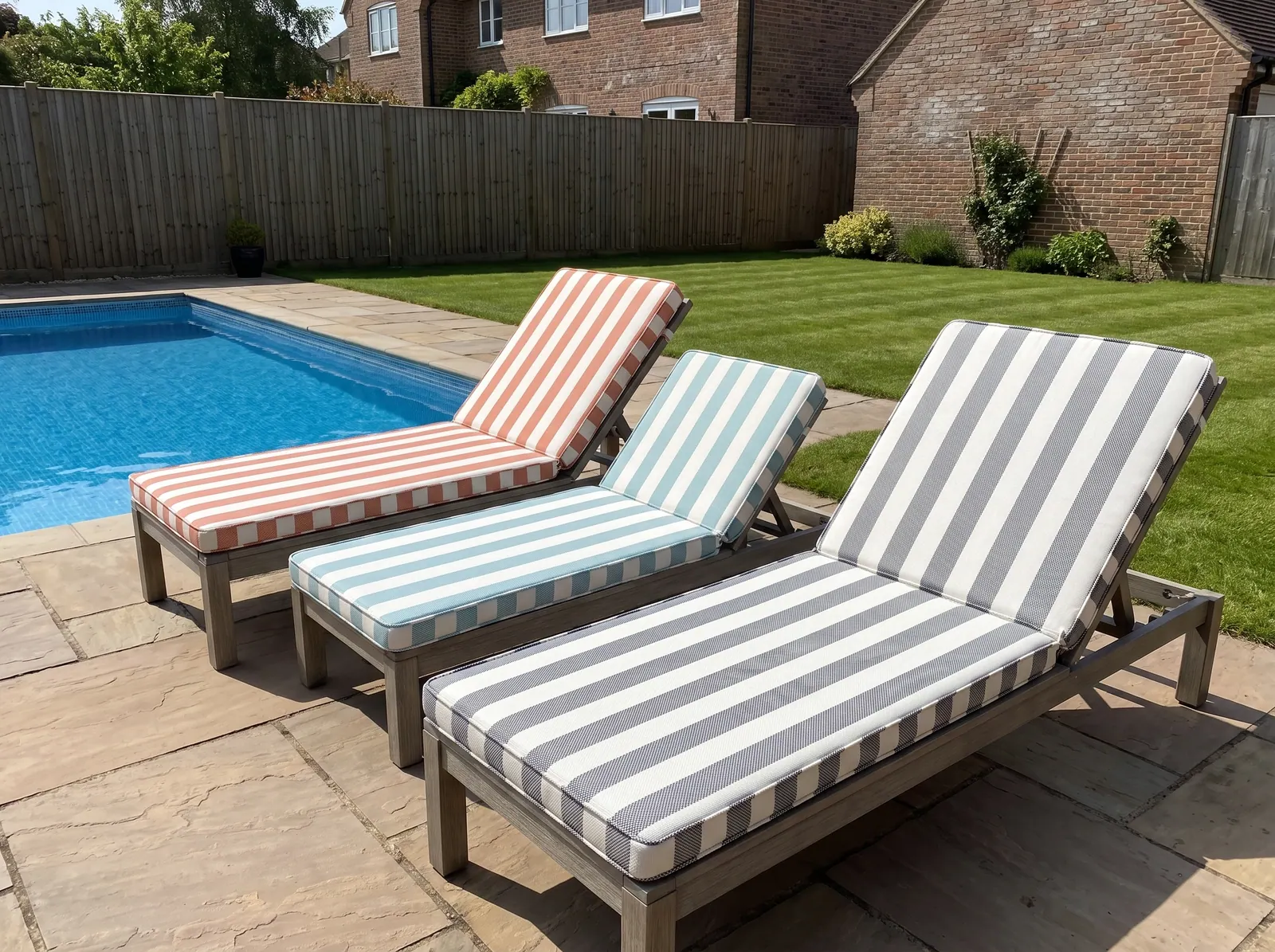
Look at the set first. Three weathered loungers stand on a diagonal along the pool, so every cushion shows at once. Coral runs across the backrest furthest away and pulls the eye across the terrace. Pale aqua sits on the smaller middle lounger and answers the water. Gray on white, in front, matches the sandstone paving and holds the group down.
One stripe width across all three is what makes it a set; change the width and you have three cushions from three different summers. The silver-gray timber takes every color without a fight.
The mown lawn, the fence panels and the brick houses behind say backyard, not resort. That matters more than the colors. A backyard pool means kids, dripping towels and cushions left out after the last swim. More loungers live under chaise and sunbed cushions.
Pinned by Callum: five marks on the pool terrace
Five pins, from the coral backrest at the far end to the silver-gray timber that carries all three stripes.
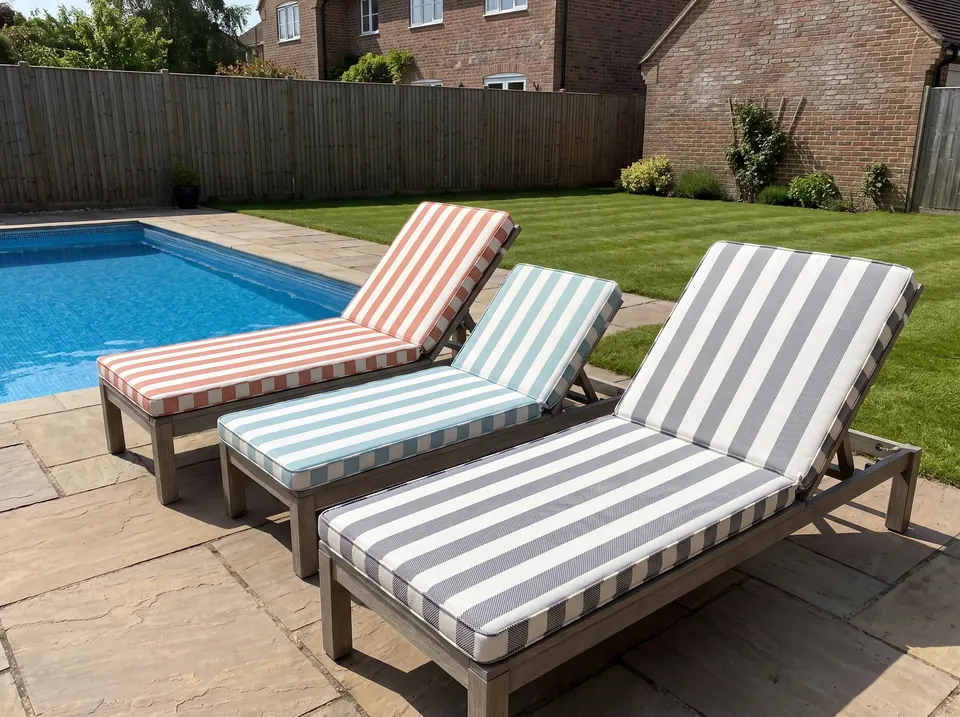
- Coral stripe backrest
The warmest stripe sits furthest back, drawing the eye across the whole set.
- Aqua stripe cushion
The smaller middle lounger gets a pale aqua that echoes the pool.
- Gray stripe seat
Gray and white in front grounds the group and matches the paving.
- Pool edge
Loungers angled to the pool look relaxed rather than lined up.
- Weathered wood frame
Silver-gray timber suits all three stripe colors at once.
- Coral stripe backrestThe warmest stripe sits furthest back, drawing the eye across the whole set.
- Aqua stripe cushionThe smaller middle lounger gets a pale aqua that echoes the pool.
- Gray stripe seatGray and white in front grounds the group and matches the paving.
- Pool edgeLoungers angled to the pool look relaxed rather than lined up.
- Weathered wood frameSilver-gray timber suits all three stripe colors at once.
Firm foam, because a wet swimsuit sits heavy
Each of these cushions takes a dripping body several times a day. Soft foam folds under that and puts a hip on the slats by August. The workshop builds seats on about 2 lb/ft³ (32 kg/m³) high-resilience foam, firm enough to hold its shape for years, wrapped in polyester wadding so the surface doesn't feel like a board. Foam density in lb/ft³ and kg/m³ explains the numbers.
Thickness is the other half. The standard is 4 in (10 cm); 6 or 8 in (15 or 20 cm) can be ordered. On a lounger, more is not automatically better: every inch lifts you further from the frame and moves the spot where the backrest meets your shoulders. The foam firmness finder helps you choose.
Then the cover. A water-repellent membrane sheds a splash and a spilled drink. It does not turn foam into a life jacket. Water-repellent is a promise; waterproof is a contract. If your loungers stay out through summer storms, read up on dry-fast foam for outdoor cushions first.
What does your lounger measure from the slats to the backrest hinge? That number decides your thickness more than any catalog does.
Twelve inches of foam under a camper ceiling
A buyer in the US wrote to the workshop about two cushions for the top bunk of a camper, each 71 x 28 in (180 x 71 cm), in beige: a linen look or a velvet. The workshop sent the velvet chart, a dark beige and a lighter beige side by side, and pointed out that the cushion in the photo they liked was 12 in (30 cm) thick. They kept the 12 in.
On a floor, fine. In a top bunk it is a headroom question. Measure from the bunk base to the ceiling, subtract the foam, and sit up in the space that's left before you order.
Same rule on the pool deck, only lower down: thickness decides where your body ends up. Camper builds live under boat and RV cushions, and chaise lounge and sunbed cushion sizes covers the lounger measurements.
Buyer questions: humidity, wind and a stripe that reads black
- A common question
It gets very humid where I live. Will a chenille cover hold up outdoors, or will it grow mold?
The workshop's answerChenille isn't a fabric for cushions that live outside, and high humidity makes that worse. Choose one of the outdoor-performance fabrics instead; they resist moisture, mildew and mold far better.
- A common question
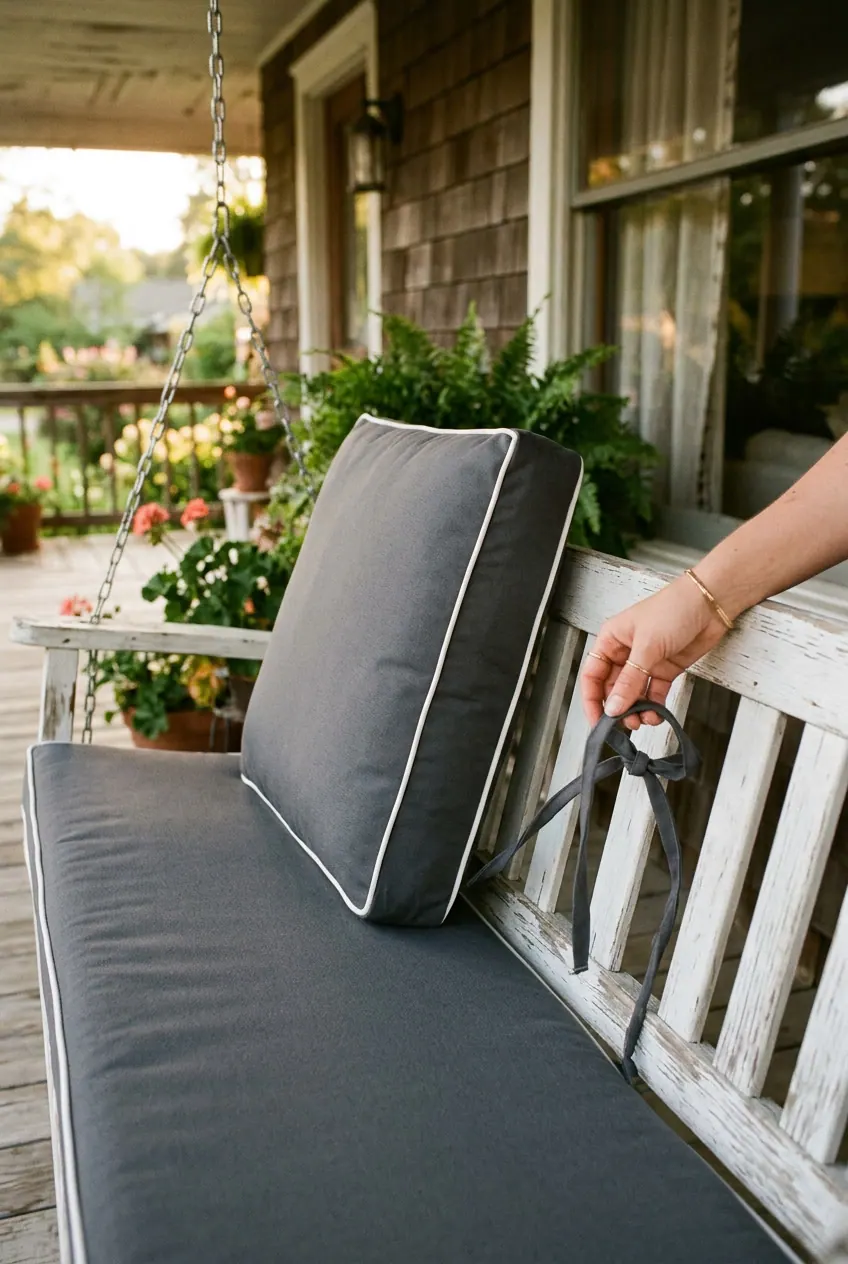
Can you put ties on outdoor cushions so the wind can't carry them off?
The workshop's answerYes. Ties can go on the sides, including long ties for beaches and windy decks. Write the request in the order notes, and add a sketch if they need to sit on a particular side.
- A common question
In the striped outdoor fabric, is the dark stripe black, charcoal or navy?
The workshop's answerIn the stripe lines the dark stripe is a dark blue, though from across a patio it can read as black. The workshop sends close-ups and photos of finished pieces, and if the tone has to be certain, order a sample first.
On the cutting table: three lounger cushions, one stripe
| Product | Seat-and-backrest sunbed cushions for three wooden loungers |
|---|---|
| Fabric | Water-repellent outdoor membrane, wide stripes in coral, pale aqua and gray on white |
| Piping | Self piping cut from the same stripe |
| Edge | Box edge |
| Foam | about 2 lb/ft³ (32 kg/m³) high-resilience foam in a polyester wadding wrap |
| Thickness | 4 in (10 cm) standard; 6 or 8 in (15 or 20 cm) on request |
| Fastening | Side ties on request, long ties for windy decks |
| Cover | Zippered on the back edge, removable for washing |
| Best for | Family pool terraces in full summer sun |

Have it made
Have this made — ask Callum’s workshop
Short list: size, sun hours, how fast it has to dry. The workshop goes through it with you. — Callum
Leave your details and the workshop will call you to confirm measurements, fabric, foam and piping. No prices, dates or payment on this page: it is a request, not an order.
A sunbed cushion that takes wet swimsuits all summer needs firm foam first: 32 kg/m³ high-resilience foam keeps hips off the lounger slats.
Callum
Questions buyers ask next
How firm should a pool lounger cushion feel?
Firm enough that a seated adult never feels the slats. High-resilience foam at about 2 lb/ft³ (32 kg/m³) holds its shape under daily use, and a polyester wadding wrap softens the surface so the cushion feels padded rather than hard.
Is a thicker sunbed cushion always the more comfortable one?
No. Each extra inch of foam raises you further from the frame and shifts where the backrest meets your back. Start from the standard 4 in (10 cm) and go to 6 or 8 in (15 or 20 cm) only if the lounger sits low.
Can every lounger in a set wear a different color?
Yes. Keep one stripe width and one background across the set and vary only the stripe color. The loungers here carry coral, pale aqua and gray on white, and the terrace still reads as one planned scheme instead of three separate purchases.
Fair winds — Callum
More photographs to read
 Save
 Save
 Save
 Save
 Save