A Reading by NateL-Shaped Corner Bench Cushions
A cognac L-shaped bench cushion under a boho window, and the corner that got counted twice
Nate reads a sunny corner bench in cognac faux leather and walks through one buyer's L-shaped order: the leg that was missing, the split that made sense, and the overlap nobody subtracted.

 Save
The quick answer
Order an L-shaped bench cushion as two separate pieces and take the corner overlap off one leg only. Two pieces handle and sit more neatly than one connected L. Measure each leg to the wall, let one leg own the corner, and subtract the seat depth, 17.7 in (45 cm) on this bench, from the other, or the shorter cushion arrives too long.
On the cutting table: two box cushions for one L-shaped bench
| Piece | L-shaped bench cushion, cut as two box cushions |
|---|---|
| Long leg | 98.4 x 17.7 in (250 x 45 cm), runs into the corner |
| Short leg, as first measured | 54.3 x 17.7 in (138 x 45 cm) |
| Short leg, overlap off (worked example) | About 36.6 x 17.7 in (93 x 45 cm) |
| Fabric | Cognac faux leather, self piping |
| Thickness | 3 in (7.5 cm), the size most bench buyers choose |
| Foam | High-density, about 2.0 lb/ft³ (32 kg/m³), medium-firm |
| Tolerance | About 1/2 in on a handmade cushion |
| Best for | A window corner that has to work as the room's sofa |

Have it made
Have this made — ask Nate’s workshop
Every edge and both diagonals, to the nearest 1/4 in. If the numbers do not close, the workshop will say so on the call. — Nate
Leave your details and the workshop will call you to confirm measurements, fabric, foam and piping. No prices, dates or payment on this page: it is a request, not an order.
Half an L, one missing run and a corner counted twice
A buyer wrote in about an L-shaped built-in bench. Her first order covered one leg only: 54.3 x 17.7 in (138 x 45 cm). The shop caught it before cutting and asked the obvious question. Where was the 98.4 x 17.7 in (250 x 45 cm) straight run?
Next choice: one connected L, or two cushions? The shop advised two. Separate pieces are easier to handle, and they sit more neatly in a corner than one big L-shaped piece.
Here is where it slipped. When she split the L, both legs kept their full length to the wall, so the corner square was counted twice. The shorter cushion came out too long.
The fix was practical. The shop explained that a local upholsterer could cut the foam down and shorten the cover. It also refunded part of a correctly sized reorder and did not ask for the first cushion back. The rule that came out of it: one leg owns the corner, the other stops at its edge.
How to split an L-shaped bench cushion into two pieces
Measure the long leg into the corner
98.4 in (250 cm) here. That piece owns the corner square.
Measure the short leg to the wall
54.3 in (138 cm) here, written down as measured.
Subtract the depth once
Take 17.7 in (45 cm) off the short leg, leaving about 36.6 in (93 cm). Measure twice; the fabric remembers.
Sketch and label both pieces
If the sketch shows an overlap, so does the order.
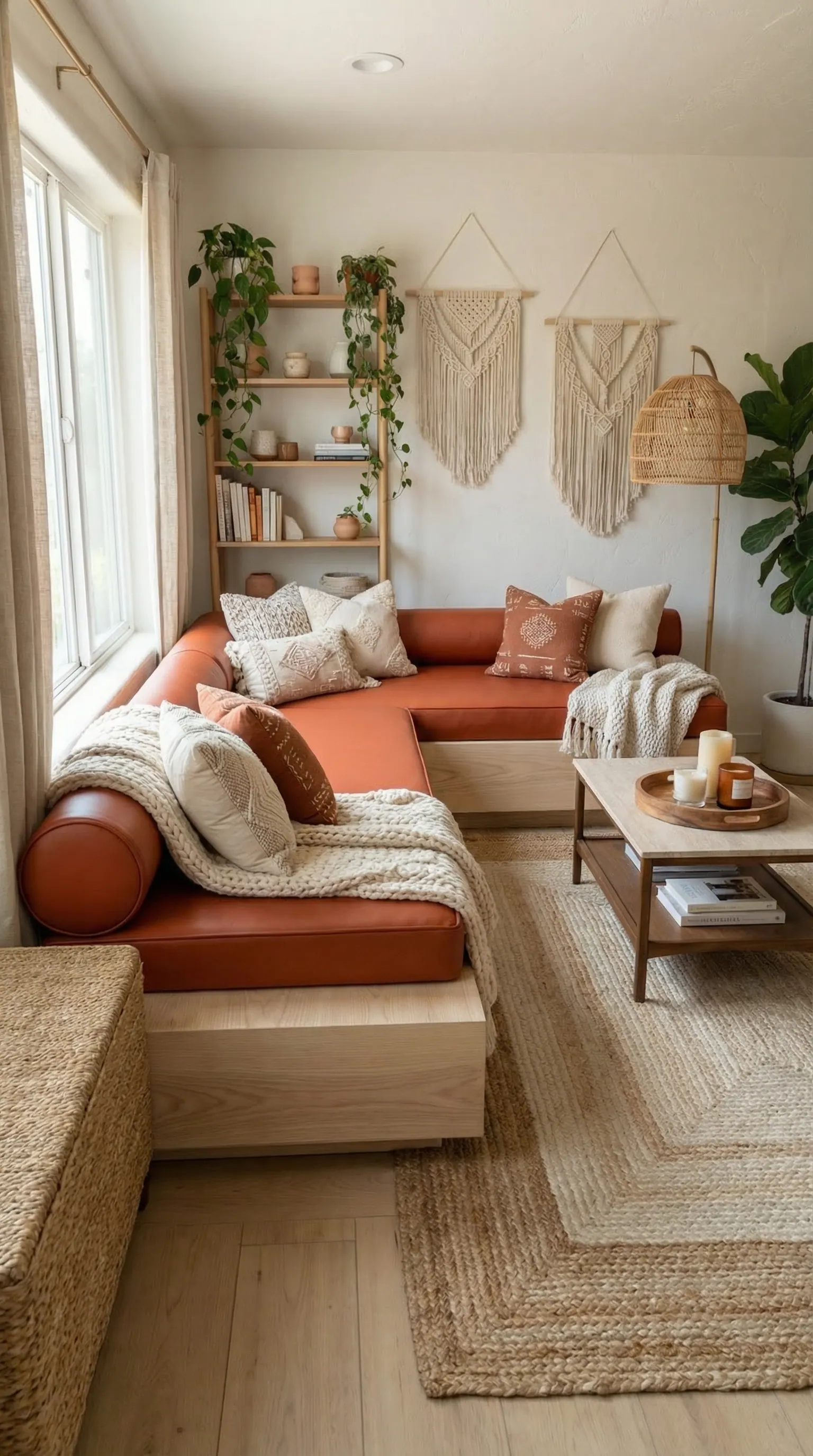
Reading the photo: a bench that has to behave like a sofa
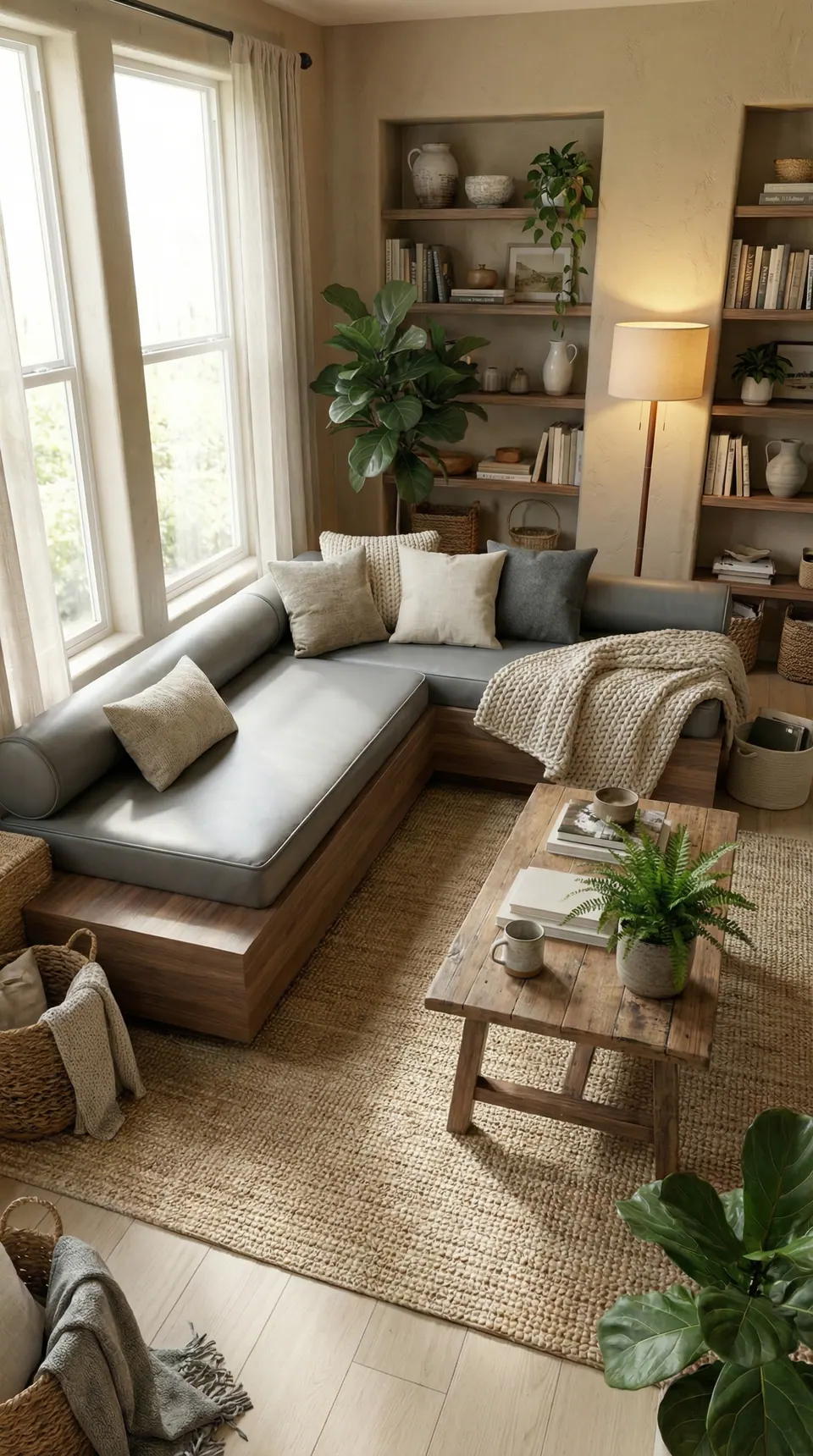
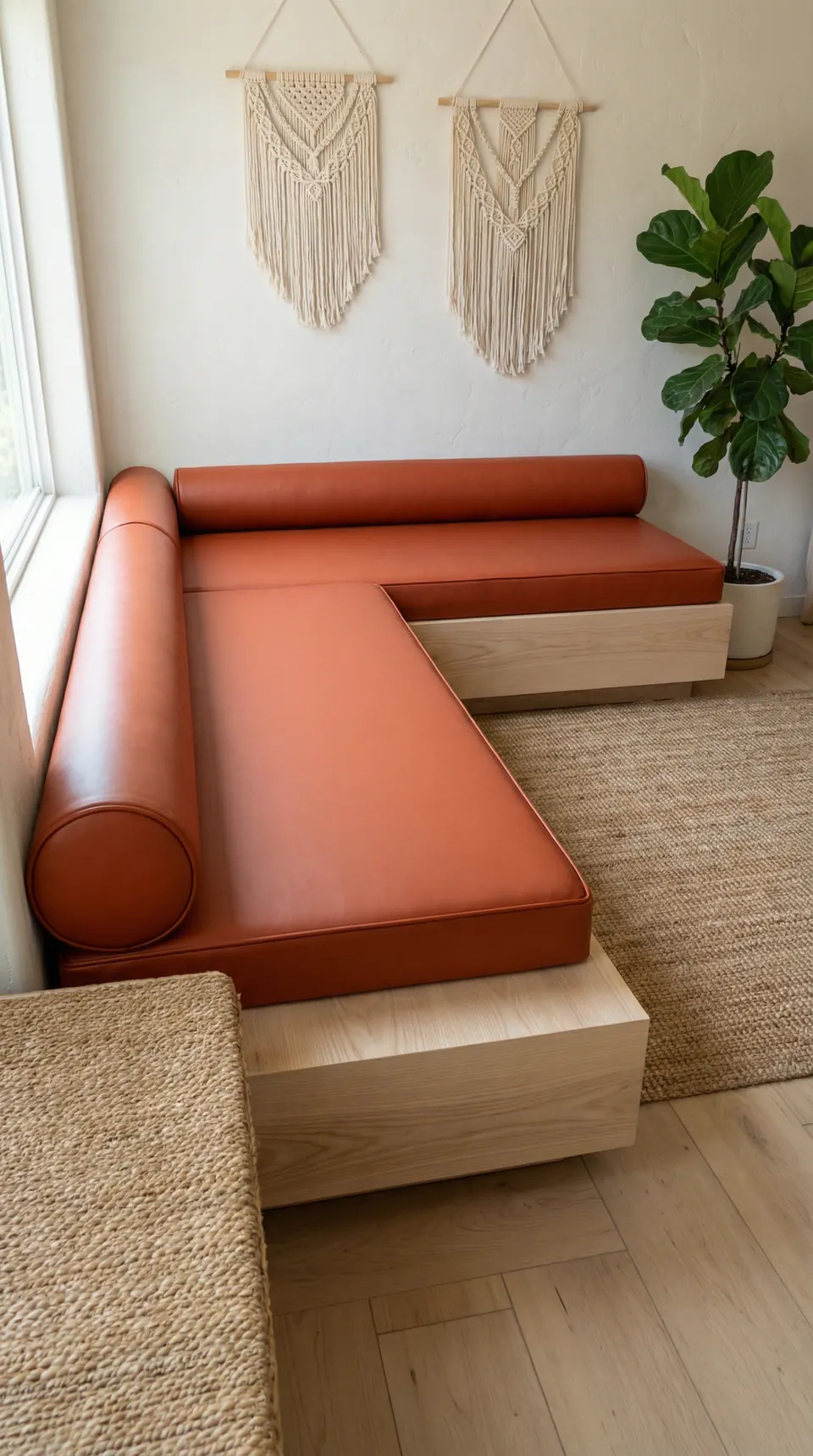
Start with the proportion, partner. The long run hugs the wall under the window, the short run turns toward the glass, and both sit on a pale ash base. Depth and thickness are modest, so the L reads as furniture, not a mattress on a ledge. It has to: this bench is the room's only sofa.
The edge is boxed with self piping. Cognac cord on cognac faux leather outlines every corner without adding a second color. On a smooth, slightly glossy surface that line is all that tells your eye where the box ends, so it has to run straight.
Golden afternoon sun through linen curtains warms the cognac toward caramel. A leather-look seat can feel cool, so everything around it is woven: a braided jute rug, a rattan lantern lamp, a seagrass ottoman, macramé on the wall. The smooth seat reads as the one polished piece in a soft room.
The pillows climb in three strengths of one warmth: terracotta velvet, a kilim print mixing terracotta with cream, plain cream bouclé. A cognac bolster closes the open end by the window. Two cream knit throws cover the front edge, where a bench wears first. The coffee table is pulled in at seat height, and that single move turns a bench into a sofa.
The idea to copy: put the pillows on the same order as the cushions. Buyers who pick pillow colors later from photos are the ones who tell the workshop a piece arrived darker than expected. See the L-shaped cushions atlas, the faux leather shelf and the corner joint pattern before you draw yours. Which leg of your bench runs into the corner?
Pinned by Nate: the cognac faux leather L-bench
Five pins, from the bolster at the window end to the coffee table pulled in at seat height.
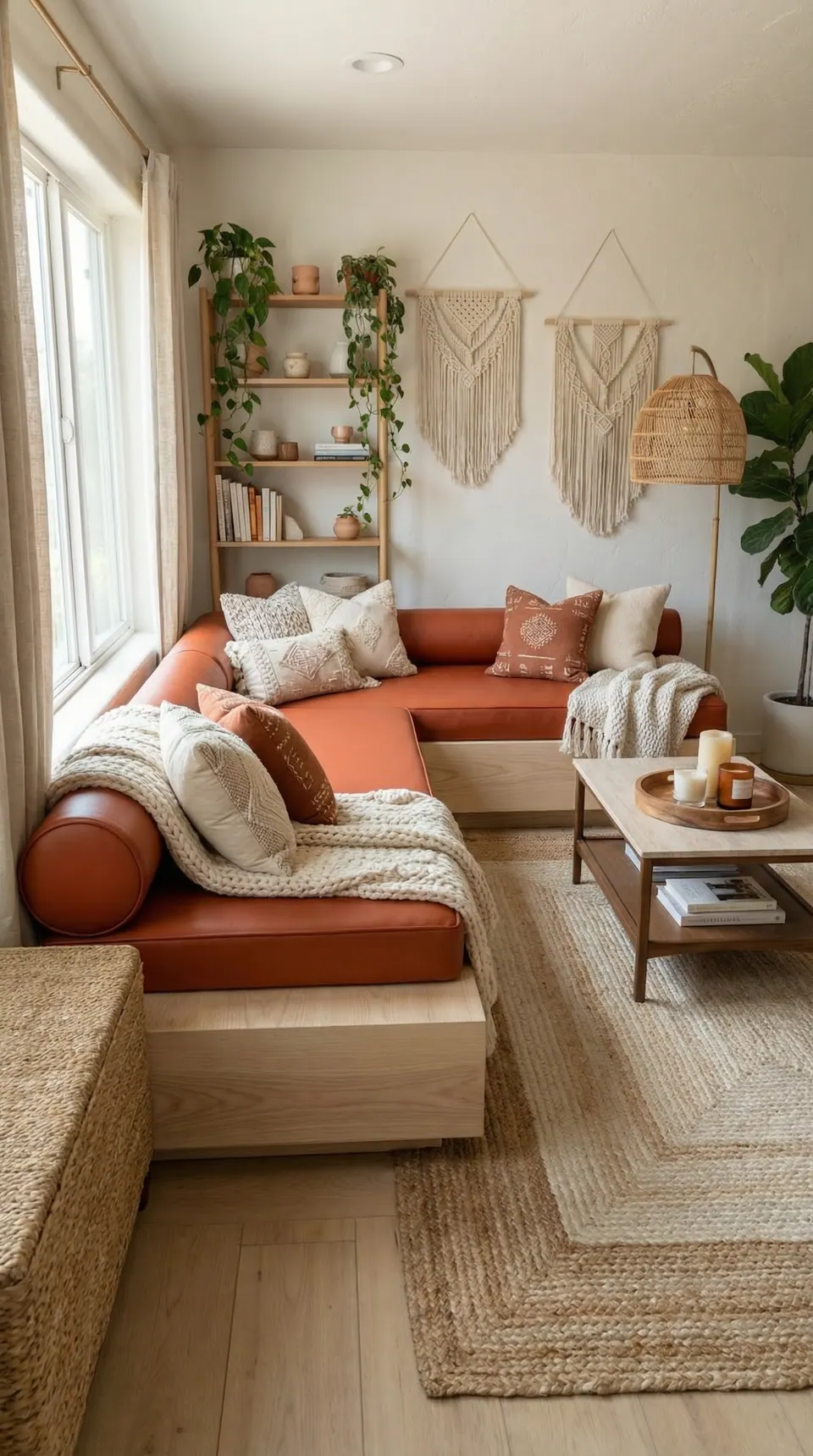
- Window-end bolster
The bolster closes the open end by the window so nobody slides off the short run.
- Front seat run
A knit throw lies over the front edge, the spot that takes the most wear.
- Kilim-print pillow
A patterned pillow in the same terracotta ties the cushion to the rug and pottery.
- Rattan floor lamp
Woven lamp and jute rug make a smooth leather-look seat feel at home in a boho room.
- Coffee table tray
A table pulled close at seat height makes the L work as a sofa, not just a bench.
- Window-end bolsterThe bolster closes the open end by the window so nobody slides off the short run.
- Front seat runA knit throw lies over the front edge, the spot that takes the most wear.
- Kilim-print pillowA patterned pillow in the same terracotta ties the cushion to the rug and pottery.
- Rattan floor lampWoven lamp and jute rug make a smooth leather-look seat feel at home in a boho room.
- Coffee table trayA table pulled close at seat height makes the L work as a sofa, not just a bench.
Buyer questions: size, foam and thickness
- A common question
My made-to-measure bench cushion came out about an inch off from the size I ordered. What should I do?
The workshop's answerGive it 3 to 4 days out of the box first, because foam and cover settle after unpacking. Then send a photo of the whole cushion in place plus close-ups with the tape measure readable along each side. Handmade cushions carry a small tolerance, and about 1/2 in is treated as normal before the shop reviews a fair fix.
- A common question
What density is your foam? Our kitchen nook gets heavy daily use and I want something commercial grade.
The workshop's answerThe seats use high-density foam at about 2.0 lb/ft³ (32 kg/m³) with a medium-firm feel. At 3 in thick on chair and bench seats, it stays comfortable but firm enough to hold its shape over time.
- A common question
For a velvet bench, what thickness looks structured but still sits comfortably?
The workshop's answerMost buyers pick 3 in (7.5 cm), which the shop considers the best thickness for bench cushions. One firm, boxed 84.5 x 23.6 in (214.5 x 60 cm) velvet cushion used same-fabric piping, high-density foam, a Dacron wrap and a hidden zipper suited to a home with pets.
An L-shaped bench cushion cut as two pieces needs the corner overlap taken off one leg, or the shorter cushion arrives too long.
Nate
Questions buyers ask next
Which leg of a two-piece L-shaped cushion should run into the corner?
Pick one and write it down. Letting the long leg run into the corner is easy to measure, because the short leg then stops against its front edge. Subtract the long leg's seat depth from the short leg and say in the note which piece owns the corner.
Can cognac faux leather work in a boho room full of woven textures?
Yes, when the textures around it do the softening. Here a braided jute rug, a rattan lamp, a seagrass ottoman and knit throws surround the smooth cognac seat, so its sheen reads warm rather than cold in afternoon light.
What is the bolster doing at the window end of the bench?
Closing the open end. An L-bench has one short run with nothing to lean on, and a firm bolster in the same cognac gives an armrest there and keeps pillows and people from sliding off toward the window.
± 1/4 in — Nate