A Reading by HanaDaybed Cushions & Covers
A charcoal daybed cushion, read from ten feet and from ten inches
A soft block on a hard block. From the door it is one shape. Up close, a fine pale fleck and two kinds of metal.

 Save
The quick answer
A daybed cushion reads well from across a patio when its edge is square and its color is one dark tone, like charcoal on concrete. Order it to the frame, not the old cushion, and measure at the widest and thickest points. A standard twin is 38 x 75 in (96.5 x 190.5 cm), and 3 to 4 in (7.5 to 10 cm) suits a seat.
Three daybed questions, before the photograph
- A common question
I'm getting a daybed frame and want two cushions on top so it looks and sits like a couch. What sizes do I order?
The workshop's answerThe shop can't take measurements from a product link, so work from the mattress size. A standard twin is 38 x 75 in (96.5 x 190.5 cm): split it into two equal cushions of 38 x 37.5 in (96.5 x 95 cm), placed as two orders. For a daybed seat, 3 to 4 in (7.5 to 10 cm) thick works well.
- A common question
I only need covers, no cushions, for two twin mattresses of different heights. Can you do that?
The workshop's answerYes. Place one order per size and write the exact dimensions and color in the notes, for example 74 x 38 x 10 in and 74 x 38 x 8 in (188 x 96.5 x 25 cm and 188 x 96.5 x 20 cm). The shop can hold the first cover and ship both together.
- A common question
Could you make an extra-firm daybed mattress from natural materials only, like a wool and cotton futon with no foam?
The workshop's answerNo. The shop doesn't make the mattress itself. It does make the mattress covers, cushions and pillows for a daybed, including one with a trundle.
Now, the reading
From 10 feet, a charcoal daybed cushion is one dark block
Stand at the sliding door and look out. You see one shape.
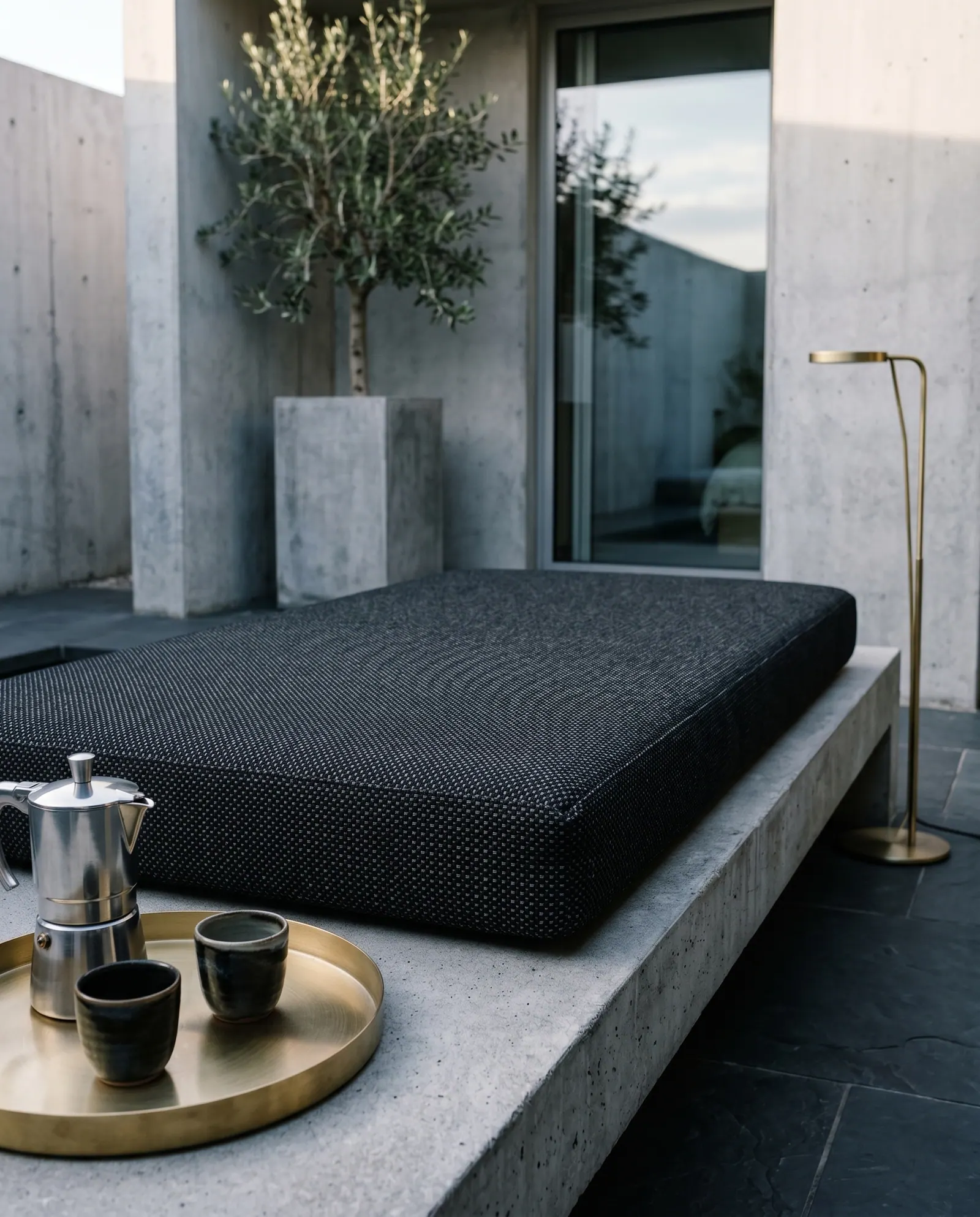
A charcoal daybed cushion on a cast concrete ledge. The box edge is square and thick, so its top line runs parallel to the concrete and its corners sit where the concrete's corners sit. Nothing wobbles.
The piping is self piping, the same charcoal as the top. From across the terrace it draws the outline once, quietly. A pale welt would draw it twice.
Color does the rest. Charcoal sits close to the slate floor and darker than the walls, so the concrete looks warmer beside it. In cool evening light, that small warmth matters.
This is the ten-foot test. Step back until the details disappear. What is left should be a clear shape and one color. If that holds, the close-up can only add.
Pinned by Hana: the charcoal daybed on the terrace
Five pins, from the square charcoal edge to the olive that softens the concrete.

- charcoal daybed cushion
A thick square-edged block matches the hard lines of the concrete.
- brass tray
The cushion stops short of the ledge front to leave room for a tray.
- moka pot
Polished steel adds a second metal without adding color.
- brass floor lamp
Brass repeated on lamp and tray is the only accent in the scene.
- olive in concrete planter
A silvery olive softens walls of raw concrete.
- charcoal daybed cushionA thick square-edged block matches the hard lines of the concrete.
- brass trayThe cushion stops short of the ledge front to leave room for a tray.
- moka potPolished steel adds a second metal without adding color.
- brass floor lampBrass repeated on lamp and tray is the only accent in the scene.
- olive in concrete planterA silvery olive softens walls of raw concrete.
From ten inches: fleck, brass, steel
Now walk up to the ledge.
The weave has a fine pale fleck. You only see it close, and it is the reason the charcoal does not look flat. The slate tiles underfoot use the same trick.
The cushion stops short of the ledge front. That strip of bare concrete holds a brass tray, a steel moka pot and two dark espresso cups. A seat and a table in one piece of concrete. When you measure a ledge, decide first what you will set on it. Then measure only the part you will sit on.
Brass appears twice, on the tray and on the slim floor lamp. It is the only accent, and repeating it makes it look chosen. The moka pot adds a second metal with no color at all. The olive tree in its concrete planter brings a silvery green that softens the walls.
More pieces like this live in the daybed cushion atlas and among the patio and porch cushions. The charcoal weave belongs to the outdoor acrylic family. If you are comparing waterproof outdoor cushions, read water-repellent versus waterproof first.
What will you set on your ledge?
One dark cushion. One metal, twice. One gap for the cup.
A twin cover, measured a second time
A buyer in the US wrote to the workshop about a twin daybed. She wanted a zippered velvet slipcover with piping for the mattress, and she measured it at 75 x 38 x 8.75 in (190.5 x 96.5 x 22 cm).
The cover arrived too small. The shop agreed to remake it and asked for one thing: photos of the tape measure on each side.
The photos told the story. The mattress was 75.5 x 40 x 9.5 in (192 x 101.5 x 24 cm). Half an inch longer, two inches wider, three-quarters of an inch taller.
The shop suggested 75.5 x 39 x 9.5 in so the new cover would not look loose. She chose 76 x 40 x 9.75 in (193 x 101.5 x 25 cm) to be safe. Both answers were reasonable. Piping and fabric thickness leave no room for error, so measure a mattress at its widest and thickest points. The method is in daybed mattress cover measurements.
On the cutting table: the terrace daybed
| Piece | Outdoor daybed cushion, rectangular box |
|---|---|
| Fabric | Charcoal woven outdoor acrylic with a fine pale fleck |
| Edge | Thick, square box edge matched to the concrete lines |
| Piping | Self piping in the same charcoal |
| Placement | Stops short of the ledge front to leave room for a tray |
| Seat thickness | 3 to 4 in (7.5 to 10 cm) suits a daybed seat |
| Twin reference | 38 x 75 in (96.5 x 190.5 cm) |
| Measure at | Widest and thickest points, tape photographed on each side |
| Best for | Modern terraces and patios |

Have it made
Have this made — ask Hana’s workshop
A good size is a quiet thing. You notice it only when it is wrong. Let the workshop check yours first. — Hana
Leave your details and the workshop will call you to confirm measurements, fabric, foam and piping. No prices, dates or payment on this page: it is a request, not an order.
A daybed cushion that reads from ten feet needs one dark color and a square box edge. The fleck and the piping are for the person sitting on it.
Hana
Questions buyers ask next
How thick should a daybed cushion be for sitting?
For a daybed used as a seat, 3 to 4 in (7.5 to 10 cm) is the range the workshop suggests. On a hard concrete or masonry ledge, lean toward the thicker end, because there are no springs or slats underneath to give.
Why pair a charcoal cushion with a concrete ledge?
Charcoal sits close to slate and darker than concrete, so pale walls look warmer beside it. From across a terrace the cushion and the ledge read as one clean shape: a soft block resting on a hard block.
Should a ledge cushion cover the whole ledge?
Not always. Decide what the ledge must also hold, like a tray or a cup, and order the cushion to the part you will sit on. Here the cushion stops short of the front edge, and the bare strip becomes a side table.
Does piping matter on a minimal outdoor cushion?
Yes, especially from a distance. Self piping in the same charcoal draws the outline once and quietly. A pale contrast welt adds a second bright line around the edge, and that line is what the eye finds first from across the terrace.
— Hana
More photographs to read
 Save
 Save
 Save
 Save
 Save
 Save