A Reading by MaggieDining Chair Cushions & Pads
A burgundy velvet chair cushion with ties on a rattan bistro chair, and the foam inside it
Maggie takes her notebook to a café terrace and works out what goes inside a thin, shaped pad that has to sit still on slippery cane.

 Save
The quick answer
A chair cushion with ties for a rattan bistro chair should be a firm, fairly thin pad cut from a paper template, thick enough to cover the woven rim but not so soft it spreads. Firm foam keeps the shaped edge and the piping line crisp, and long ties knotted round the frame stop it sliding on smooth cane.
Notes from a café terrace
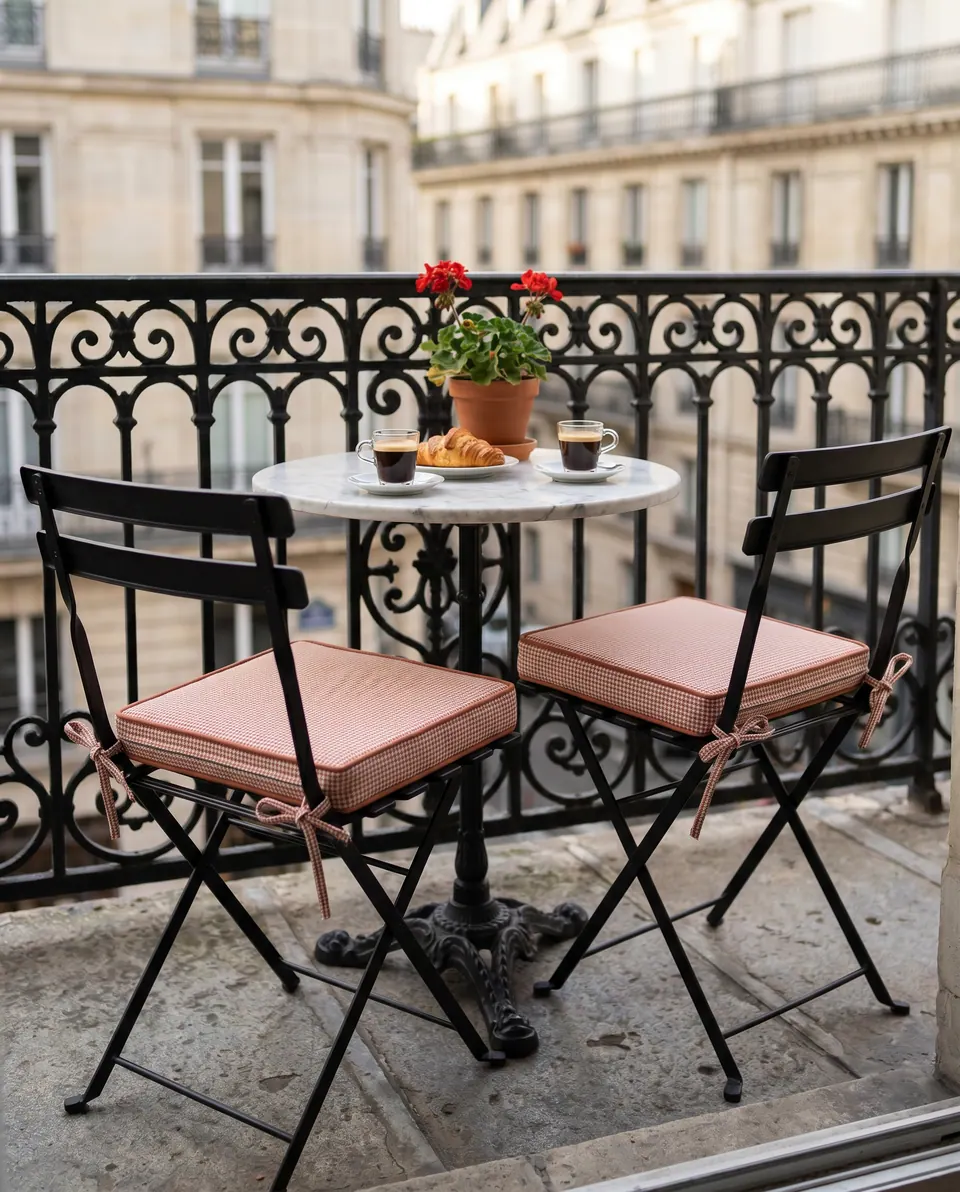
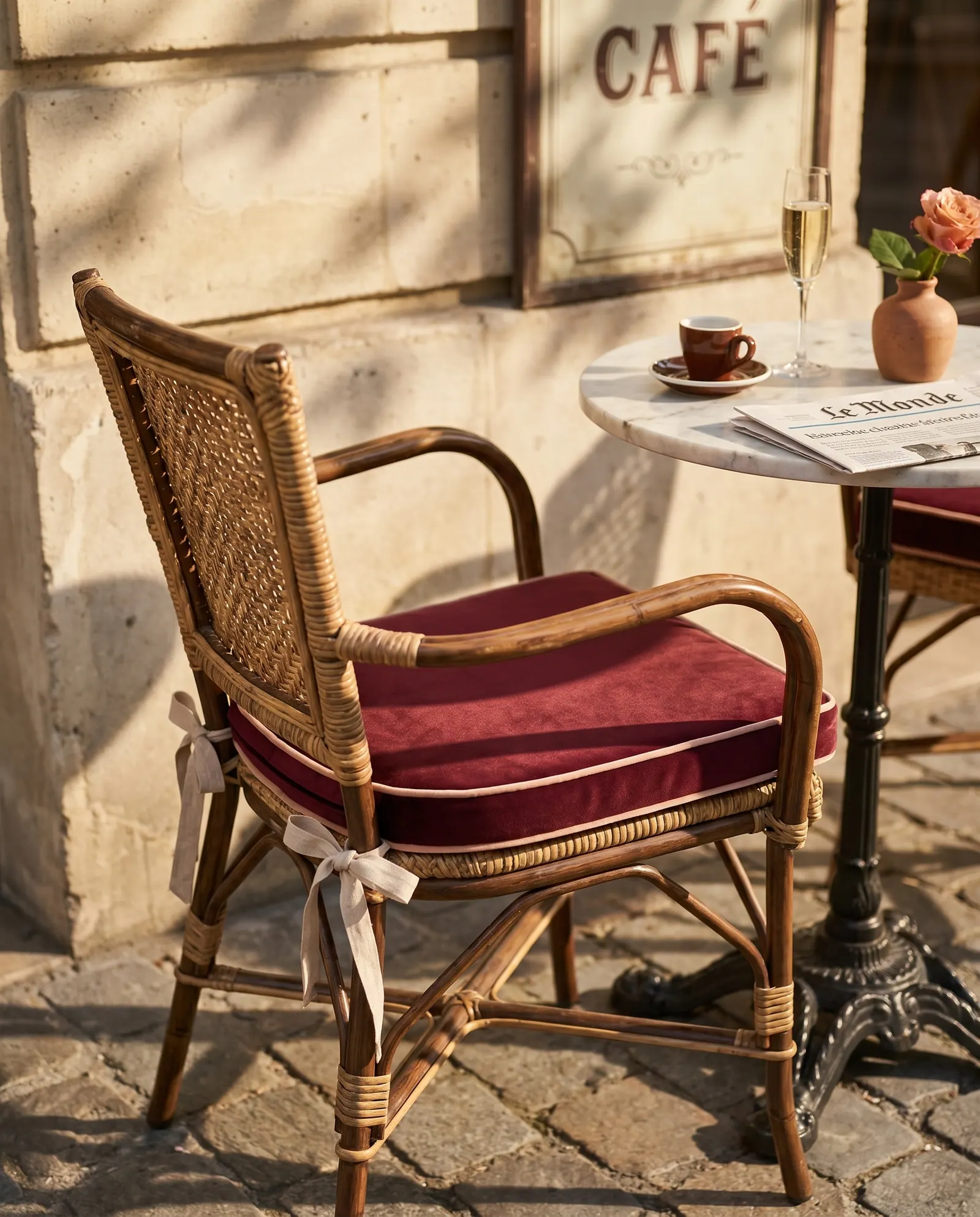
Right, then. A rattan bistro armchair on cobblestones, a round marble table on a cast-iron base, an espresso, a glass of sparkling wine, a folded newspaper. Somebody intends to stay a while, and the chair pad has to agree.
The pad is burgundy velvet with blush pink piping, and it is not a rectangle. Rattan seats are rounded at the front and narrower at the back, so this one was cut from a paper template and follows the curve. A square pad on a round seat leaves two sad triangles of cane showing. I made that mistake early on, and the customer mentioned it every summer after.
The blush welt does real work. Burgundy against honey rattan is the classic café pairing, but dark velvet melts into dark cane in shadow. A pale piping line draws the shape so you can read it. The peach rose in the terracotta bud vase repeats the blush and ties the table to the chair.
Then the bows. Champagne ribbon ties, left long and floppy on purpose, hold the pad on smooth rattan and soften a busy, woody frame. Low sun on the stone makes the velvet glow warm instead of brown.
What does your chair seat measure at the front, and at the back? Write both down before anything else. The photograph can't show what is inside the pad, so that comes next. More pads like this sit among our dining chair cushions and bistro chair cushions, many of them in velvet.
Pinned by Maggie
Five pins, from the template-cut velvet pad to the peach rose that echoes its piping.
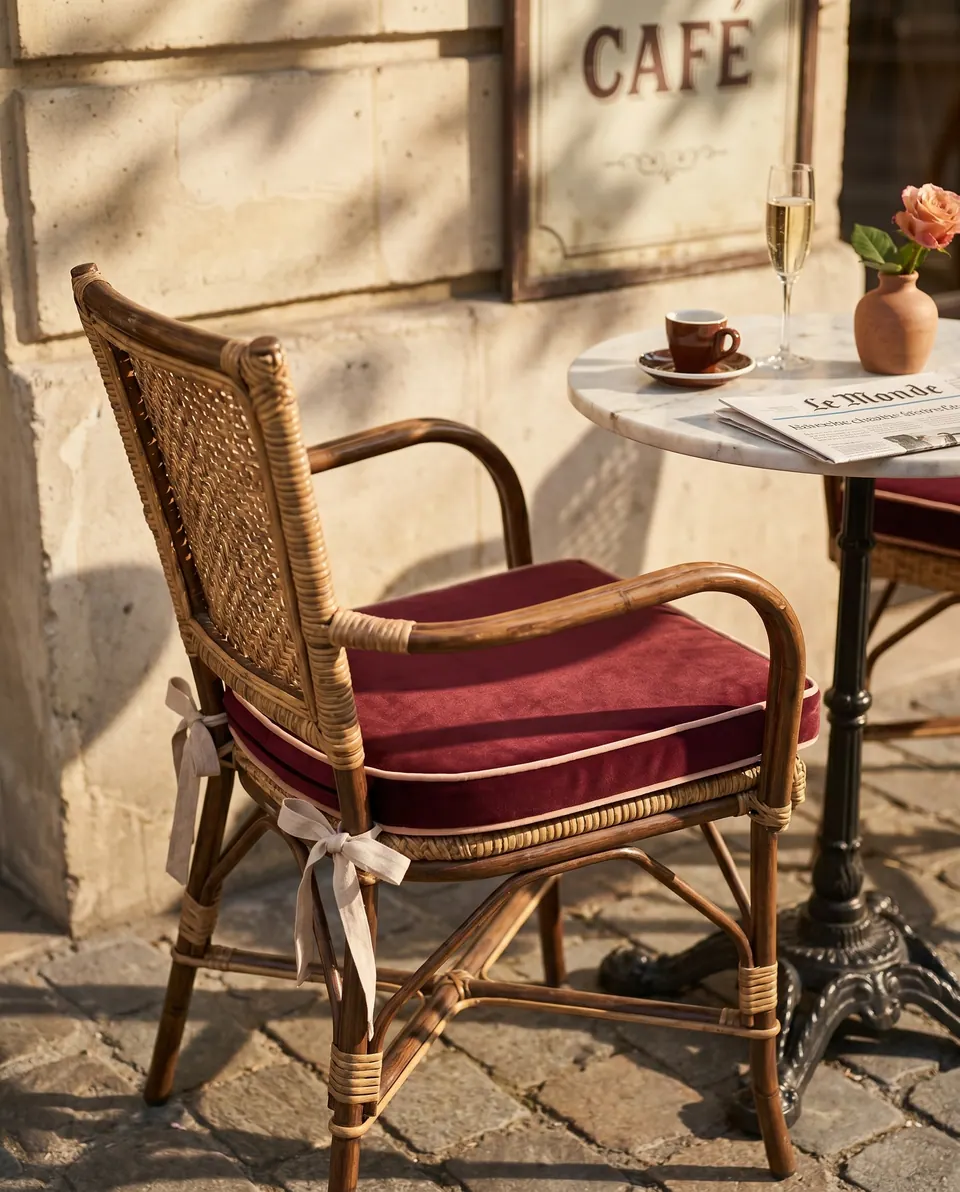
- Burgundy velvet pad
The pad follows the rounded front of the rattan seat, so it's cut from a paper template, not a plain rectangle.
- Ribbon bow
Long, soft ties knotted round the frame keep the pad from sliding on smooth rattan.
- Blush pink piping
A pale welt outlines the dark velvet so the shape shows against the dark cane.
- Espresso and marble table
Small café props tell you this is a chair for a long coffee.
- Peach rose
The rose picks up the blush of the piping and ties table to chair.
- Burgundy velvet padThe pad follows the rounded front of the rattan seat, so it's cut from a paper template, not a plain rectangle.
- Ribbon bowLong, soft ties knotted round the frame keep the pad from sliding on smooth rattan.
- Blush pink pipingA pale welt outlines the dark velvet so the shape shows against the dark cane.
- Espresso and marble tableSmall café props tell you this is a chair for a long coffee.
- Peach roseThe rose picks up the blush of the piping and ties table to chair.
Inside the pad, layer by layer
Paper template first
Trace the seat, mark where the uprights meet it, and send the drawing. The template sets the shape of the foam before anyone talks firmness. The paper template Pattern shows how.
Firm foam for a thin pad
A chair pad has little depth to spare. Firm, high-density foam holds the rounded front and keeps you off the cane; soft foam flattens and lets the rim through. The foam firmness finder helps you choose.
A wrap for the edge
Ask for a Dacron wrap over the foam when you want a firm core with a softer top. It rounds the edge so the velvet drapes rather than creasing at the corners.
Enough depth to clear the rim
The pad should sit above the woven rim of the seat, not in it. Measure how far the rim rises before you settle on a thickness.
Ties where the frame can hold them
Mark the uprights on your template so the ties land where a knot can grip. Long ties can be bowed loosely and still hold.
Nineteen inches deep on paper, short in real life
A buyer in the US sent three tape-measure photos of a dining chair seat that was wider at the front than the back: 21 in (53 cm) across the front, 19 to 20 in (48 to 51 cm) across the back, and 19 in (48 cm) deep.
The workshop looked hard at those photos before cutting anything. A 19 in depth stopped short of the front edge of the seat and would have left a gap. So the workshop asked. The buyer checked, agreed the depth was too short, and the cushion was made flush with the front edge.
The old cushion had ended early, and the tape had followed it. Measure depth all the way to the front edge of the seat, dear, not to where the last cushion gave up. The dining chair pad Pattern walks through the rest.
- Sizes
- 21 in (53 cm) front, 19 to 20 in (48 to 51 cm) back, depth extended to the front edge
The lesson: Measure depth all the way to the front edge of the seat, not just to where the old cushion ended.
Buyer questions: piping, ottomans and curves
- A common question
Does piping cost extra on a chair cushion?
The workshop's answerNo. Same-color piping is free, and every quoted price already includes it.
- A common question
Could I buy only the ottoman from the floor sofa set, and how big is it?
The workshop's answerYes. The ottoman is 39 x 39 in (99 x 99 cm) and is made in the color you choose, for instance brick to match a sofa you already have. It doesn't need metal bars.
- A common question
My cushion has a curved top and rounded corners. How do I measure that?
The workshop's answerFor a curved top, send three numbers: how far each side edge runs straight before the curve starts, the width where the curve begins, and the total height from the bottom edge to the highest point. For rounded corners, measure how far from the corner the curve starts along both edges, for example 8 in (20 cm) each way, and add photos.
On the cutting table: a notebook page for a bistro pad
| Pad | Shaped box-edge chair pad with ties |
|---|---|
| Pattern | Paper template of the seat, uprights marked |
| Shape | Rounded front, narrower back |
| Fabric | Burgundy velvet |
| Piping | Contrast welt in blush pink |
| Filling | Firm high-density foam; Dacron wrap for a softer top |
| Thickness | Enough to clear the woven rim |
| Ties | Long champagne ribbon ties, bowed round the frame |
| Best for | Bistro chairs on a patio, porch or breakfast corner |

Have it made
Have this made — ask Maggie’s workshop
Numbers first, fabric second, piping last. Jot down what you have, and the workshop will go down the list with you, item by item. — Maggie
Leave your details and the workshop will call you to confirm measurements, fabric, foam and piping. No prices, dates or payment on this page: it is a request, not an order.
A chair cushion with ties for a rattan bistro chair starts as a paper template, because rattan seats are rounded at the front and narrow at the back.
Maggie
Questions buyers ask next
Why does a rattan chair need a shaped cushion?
Rattan and bistro seats are usually rounded at the front and narrower at the back. A rectangular pad leaves cane showing at the front corners and overhangs at the back, so the pad is cut from a paper template of the seat instead.
What foam suits a thin chair pad?
Firm foam, because a thin pad has little depth to spare. A firm core holds a shaped edge and keeps you off the woven rim; a Dacron wrap on top softens the feel and rounds the corners.
Why use contrast piping on a dark velvet cushion?
Dark velvet can disappear against a dark frame or in shadow. A pale welt, like blush pink on burgundy, outlines the pad so its shape reads clearly, and it can pick up a color elsewhere on the table.
Do long ties really hold a cushion on rattan?
Yes, when they are knotted round the frame at the uprights. Smooth rattan lets a pad slide, and long ties can be bowed loosely and still grip. Mark the uprights on your template so the ties land in the right place.
Stitch straight — Maggie
More photographs to read
 Save
 Save
 Save
 Save
 Save
 Save