The Cutting Table · a question, worked through
Are there cutouts you can't make, like a thin notch or a vent hole?
Most shapes can be drawn. A few cannot be sewn. The difference is usually a matter of width.
Pinned by Hana
The quick answer
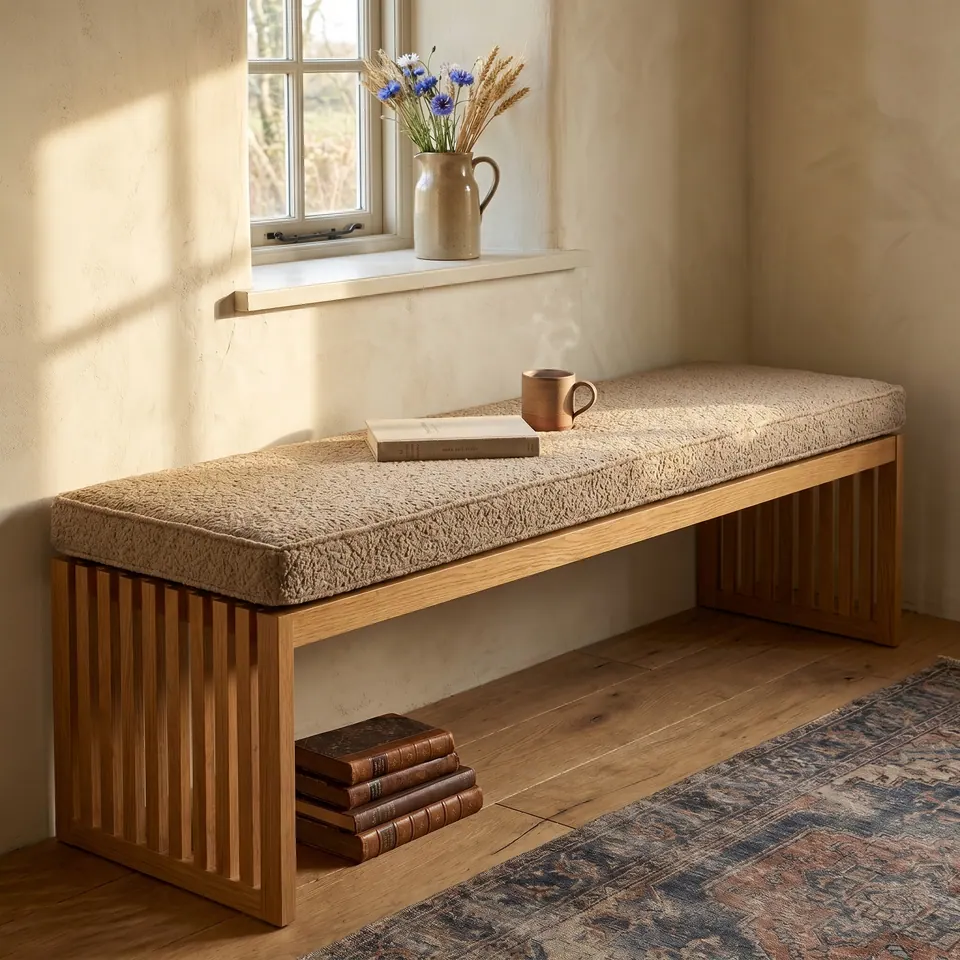
Yes, two kinds of cutout don't work: a notch too narrow to sew, such as a recess around a thin middle board on a bench, and small round holes for floor vents. Neither holds its shape. Instead, the cushion edge runs straight past a narrow recess, or the cushion is split into separate pieces so the vents stay uncovered.
Get a quote for a bench cushion
Key facts
- A notch too narrow to sew cannot hold its shape.
- For a narrow recess, the recommended fix is a straight cushion edge that runs past it.
- Cutouts for small round floor vents are not made.
- The workaround for vents is several pieces: an L-shaped cushion plus a separate piece between the vents.
- Wider notches, for posts or bench legs, are redrawn as a template for your approval before cutting.

Have it made
Have Hana’s workshop cut this for you
A good size is a quiet thing. You notice it only when it is wrong. Let the workshop check yours first. — Hana
Leave your details and the workshop will call you to confirm measurements, fabric, foam and piping. No prices, dates or payment on this page: it is a request, not an order.
Why a thin notch won't keep its line
A notch asks the cover to turn several corners in a small space. When that space is very narrow, the fabric and foam cannot settle into it. It will not hold its shape.
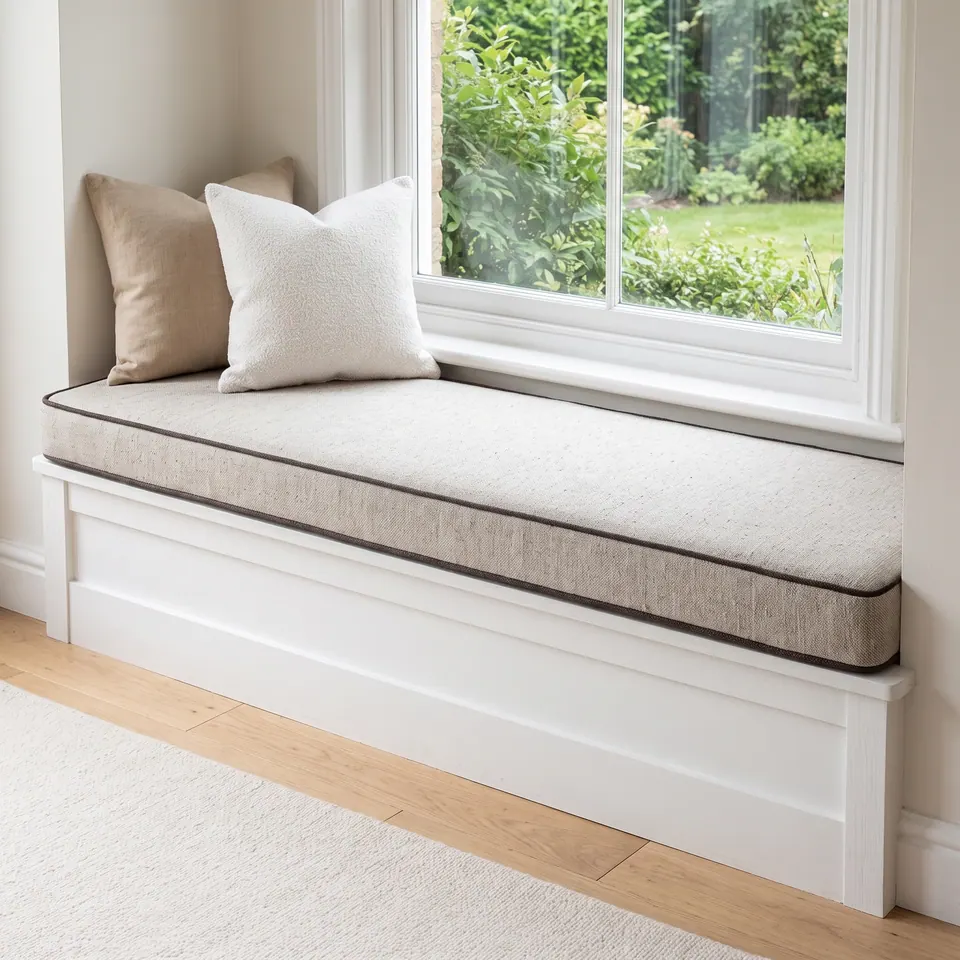
So the workshop does not force it. For a recess around a thin middle board, the cushion runs straight past. You fill in your measurements on the example template, and the board simply shows.
Wider cutouts are different. Posts, casings and bench legs are notched all the time; the notched cushion Pattern shows how to mark them, and the glossary defines the parts. What sits in the middle of your bench?
A floor mat and two round vents
A buyer in the US wanted a floor mat with holes for small round floor vents. The holes could not be made.
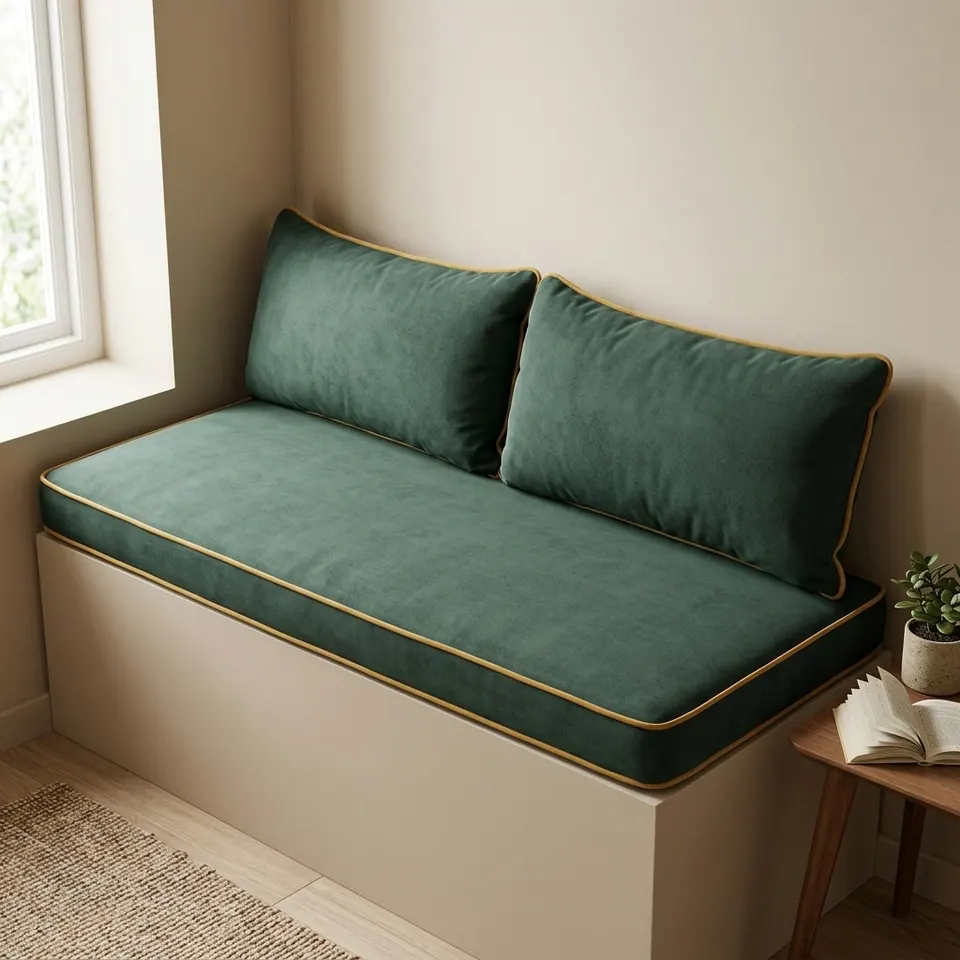
The mat was offered in pieces instead: an L-shaped cushion, plus a separate piece between the vents. The vents stayed open. The floor cushion stayed whole where it mattered.
Drawing the straight-edge version
Measure the full run
Take the bench length and depth as if the recess were not there.
Note what you are skipping
Mark where the thin board or recess sits, so the edge can pass it cleanly.
Mark every real notch
For posts or legs, give each notch's width, depth and position, with photos. The custom shape drawing Pattern helps.
Approve the template
The shop redraws it as a template and sends it for your approval before cutting.
Small round holes for floor vents can't be sewn into a cushion; split the mat into an L-shape plus a separate piece between the vents.
Hana
Three lines to keep
A straight edge. A second piece. An open vent.
Buyer questions
- A common question
Can the cushion drop into the narrow recess around the thin board in the middle of my bench?
The workshop's answerNot reliably. A notch that narrow can't be sewn and still hold its shape. Run the cushion straight past the recess, as the example template shows, and fill in your measurements on that guide.
- A common question
Could you cut holes in a floor mat so my vents stay open?
The workshop's answerNo, cutouts for small round floor vents couldn't be made. The mat was offered in pieces instead, an L-shaped cushion plus a separate piece between the vents, so the vents stay uncovered.
- A common question
Can you cut a cushion to fit around a post, a pillar or bench legs?
The workshop's answerYes. Draw the cushion with each notch's width, depth and position marked, and add photos. The shop redraws it as a template for your approval before cutting. Leg notches and ties are both available.
- A common question
Can you make a custom-shaped floor cushion for a corner or a reading nook?
The workshop's answerYes. Send the shape, measurements and a few room photos before ordering; for curves, the shop needs the two straight sides. Any size-based customization fee is confirmed up front.
Questions buyers ask next
If a round hole can't be sewn, can a whole round cushion be made?
Yes. Round cushions are made; give the diameter and thickness, such as 16 in (41 cm) across at 4 in (10 cm) thick, with a reference photo. It is the small hole inside a cushion that won't hold, not the circle itself.
Do I have to draw the bench template myself?
No. Fill in your measurements on the workshop's example template, or send a sketch with each notch's width, depth and position plus photos. The shop redraws it and sends the template for your approval before anything is cut.
How do I measure a floor mat that goes around vents in pieces?
Treat each piece as its own cushion. In the vent case the mat became an L-shaped cushion plus a separate piece between the vents, so give the size of every part and a photo showing where the vents sit.