CushionGuide

A Reading by ÉlodieBench Cushions

Three custom bench cushions, one stripe: a close reading of bouclé and weave

In a tight crop on oak, Élodie studies how a teal woven stripe meets two plain bouclés with no cord between them, and why the finishing lives in the corners.

The quick answer

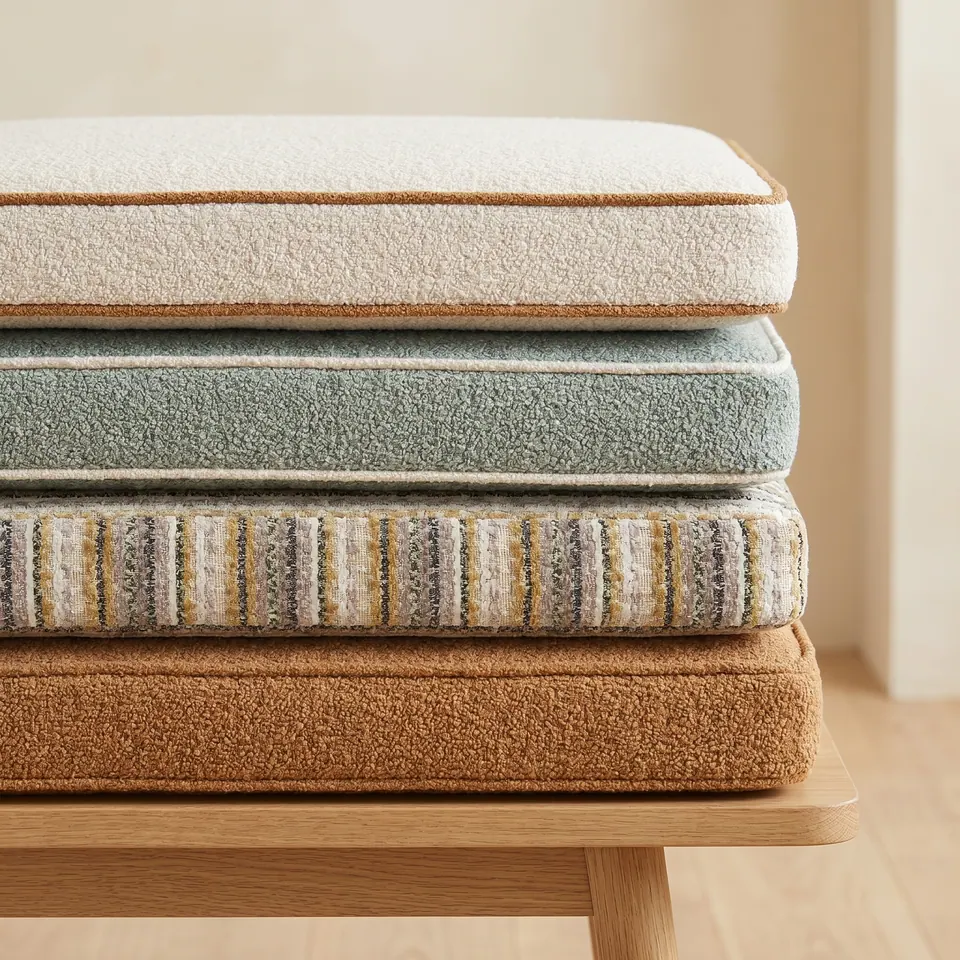
A striped bench cushion sits best between plain bouclé when its calmest color repeats in the solids, as the sage base does here. The stack is unpiped with box edges, so each seam folds into the loop pile. If you like pattern but hesitate, put the stripe on one cushion and repeat its quietest shade in bouclé.

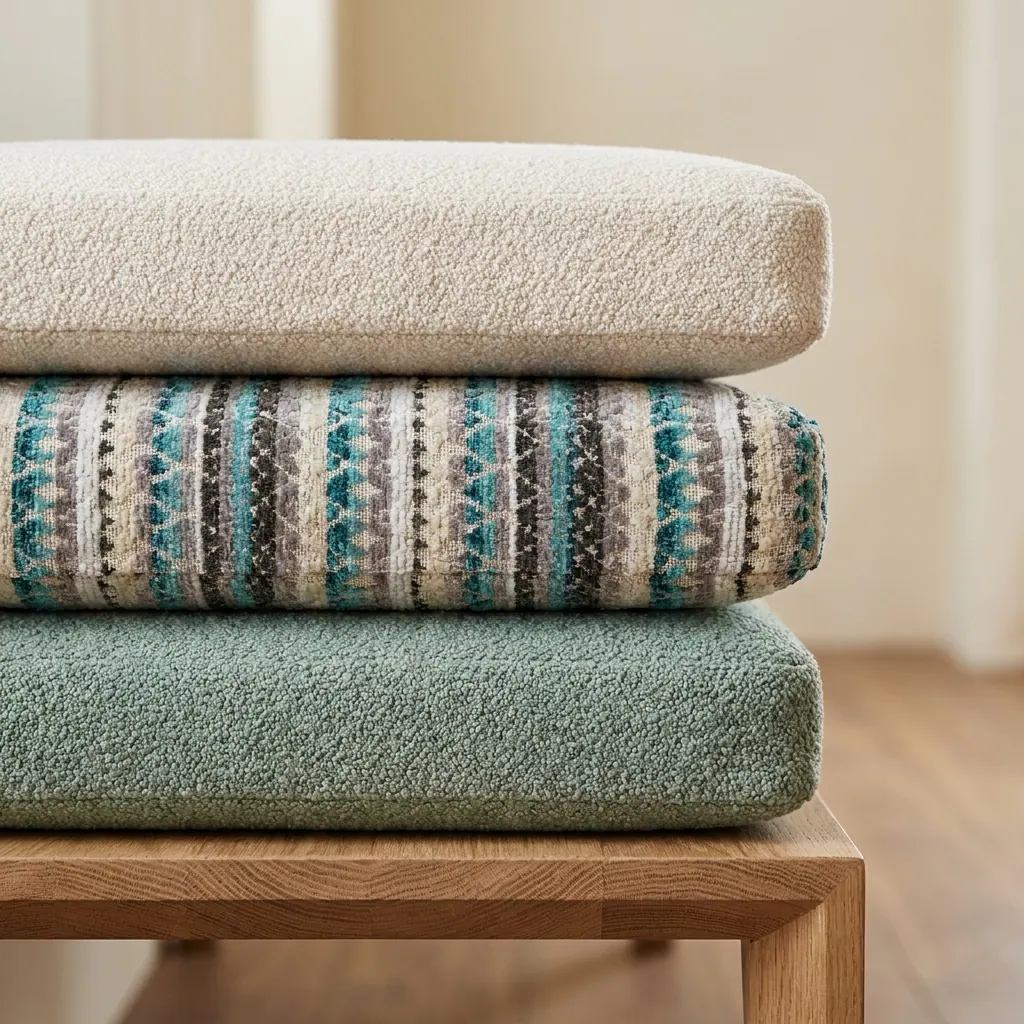
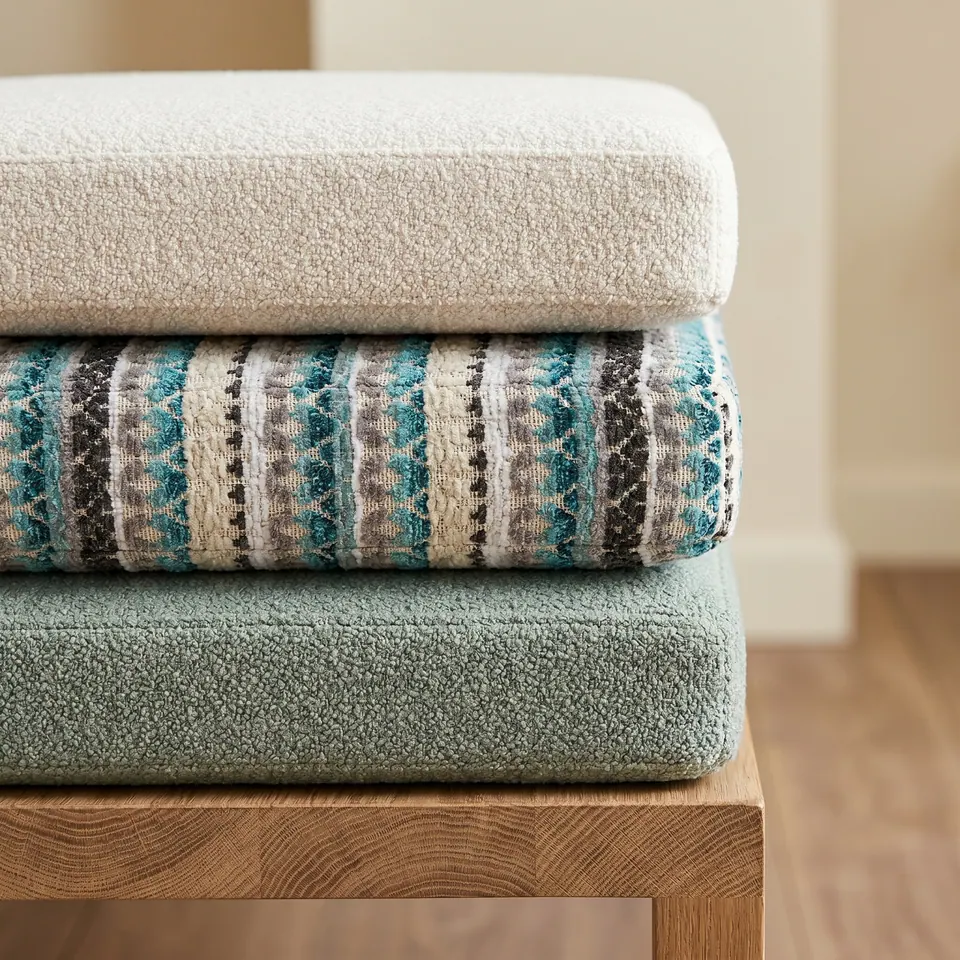
Tight crop of a teal and charcoal woven stripe cushion stacked between cream and sage bouclé cushions on oakSave
A closer look at how a woven stripe sits between two plain bouclés with no piping at all.
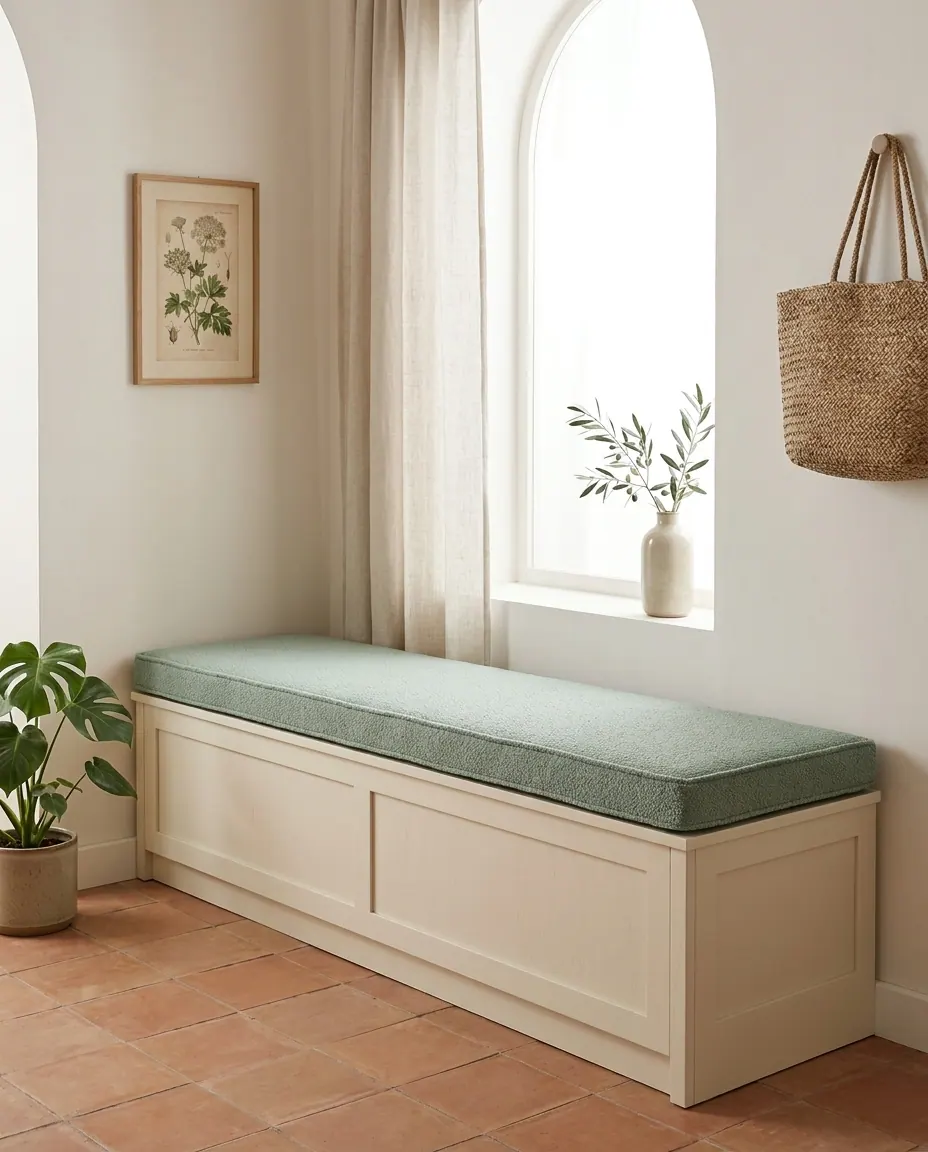
Sage green bouclé box cushion with matching piping on a cream storage bench, terracotta tiles and an arched windowSave
Sage bouclé with tailored self piping tops a cream storage chest in a Mediterranean-style entrance.
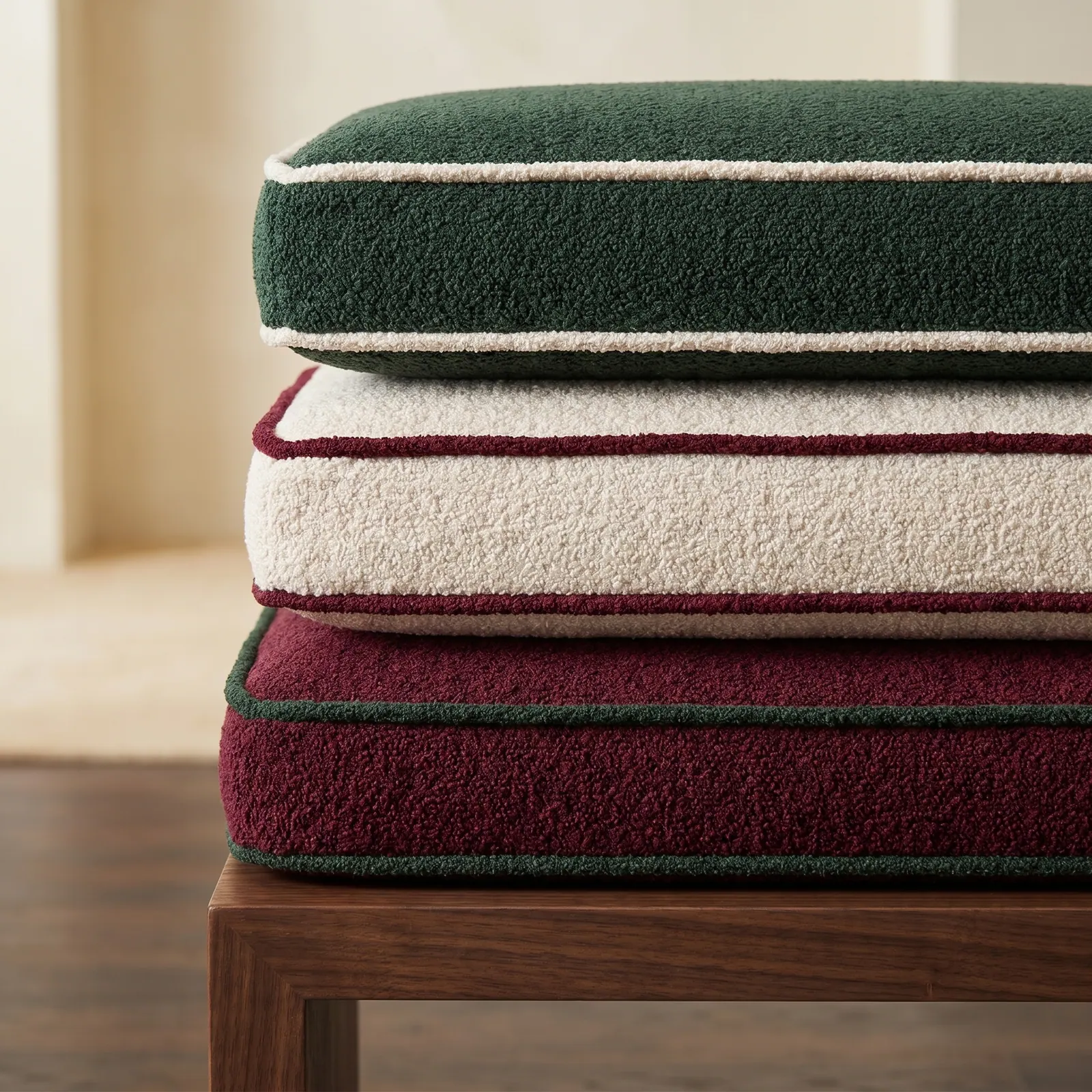
Stacked forest green, cream and burgundy bouclé box cushions with contrasting piping on a walnut benchSave
Three bouclé cushions trade colors for their piping: forest with cream, cream with burgundy, burgundy with forest.
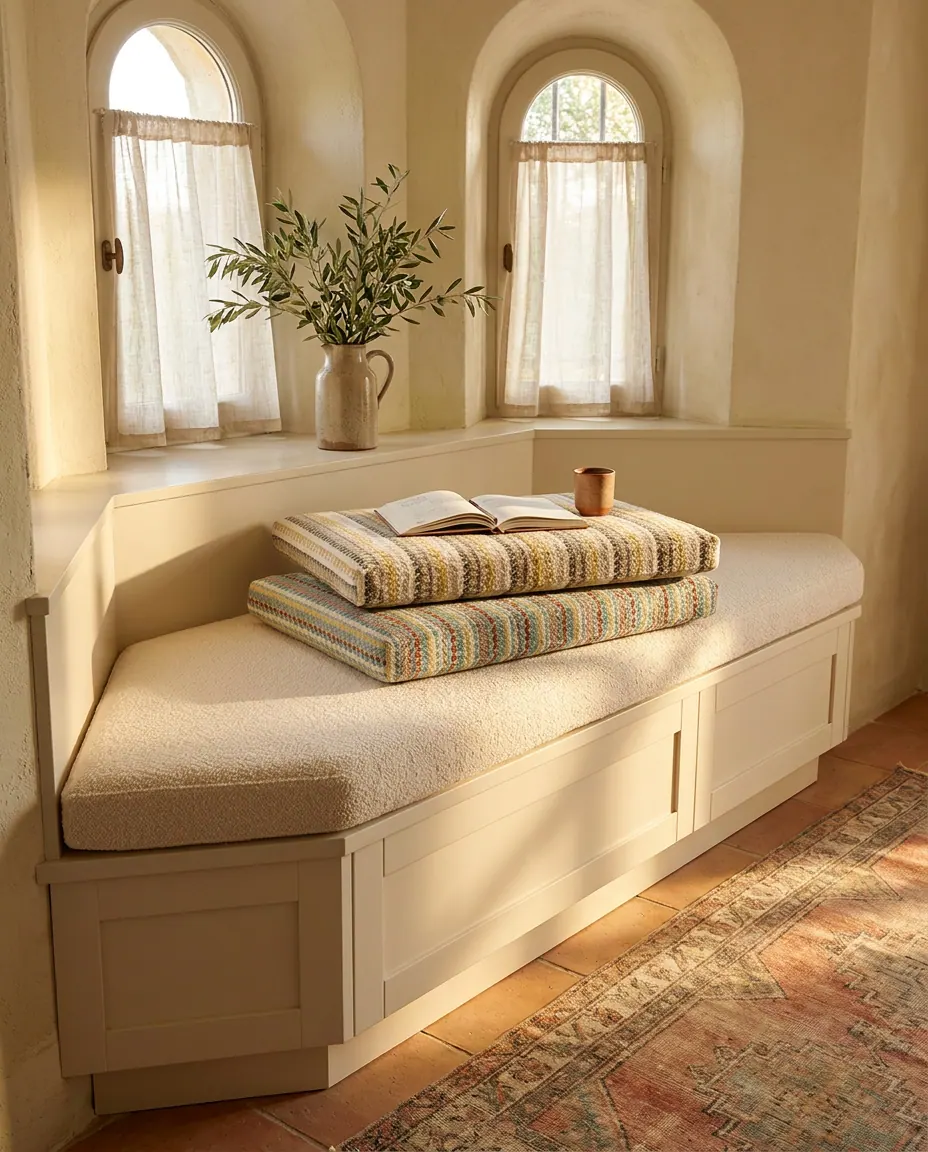
Cream bouclé trapezoid cushion on a built-in bay window seat with two striped pads, olive branches and arched windowsSave
The seat pad follows the angled bay; two striped pads on top bring in mustard, sage and blue.
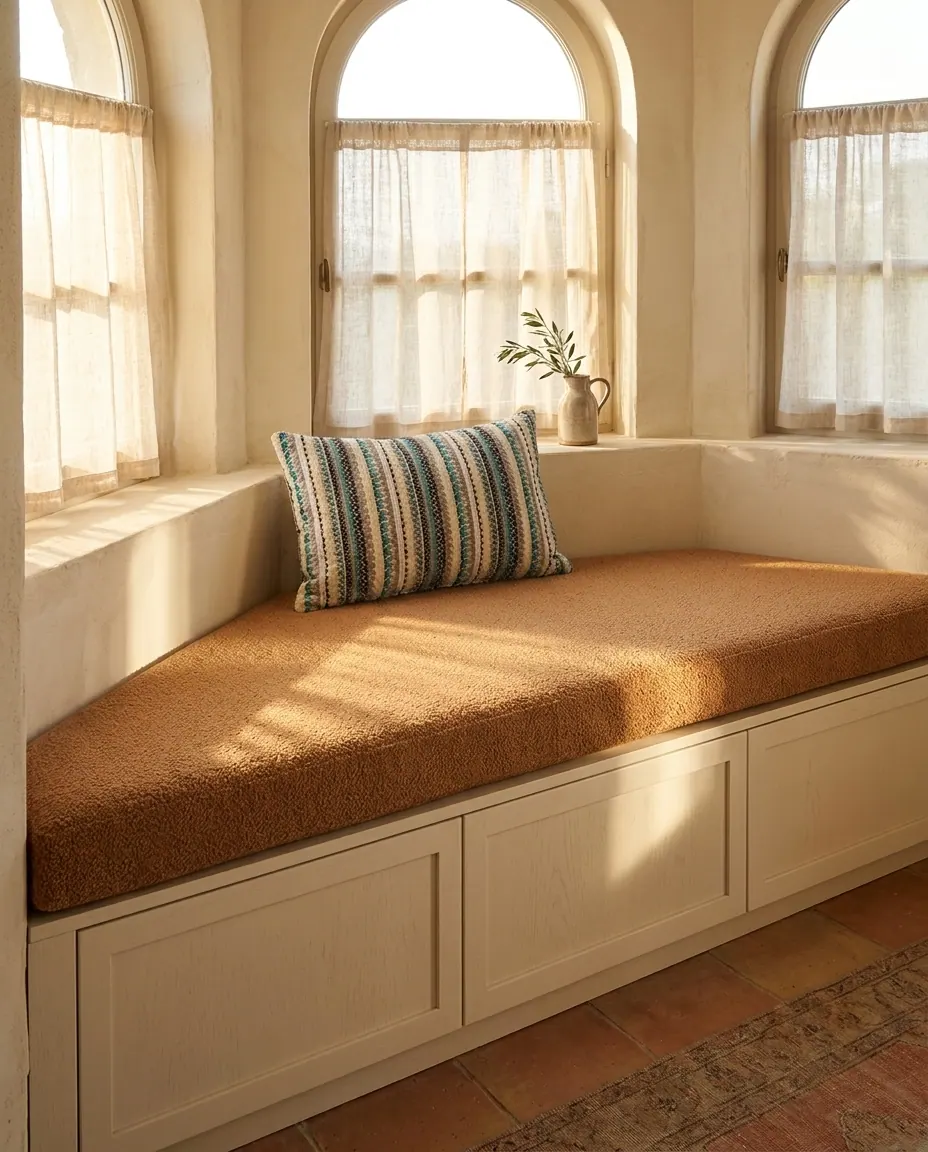
Caramel bouclé bay window seat cushion with a teal and cream striped pillow in low golden sunlight under arched windowsSave
Golden-hour sun rakes across a caramel bouclé bay cushion, with one teal striped pillow for contrast.
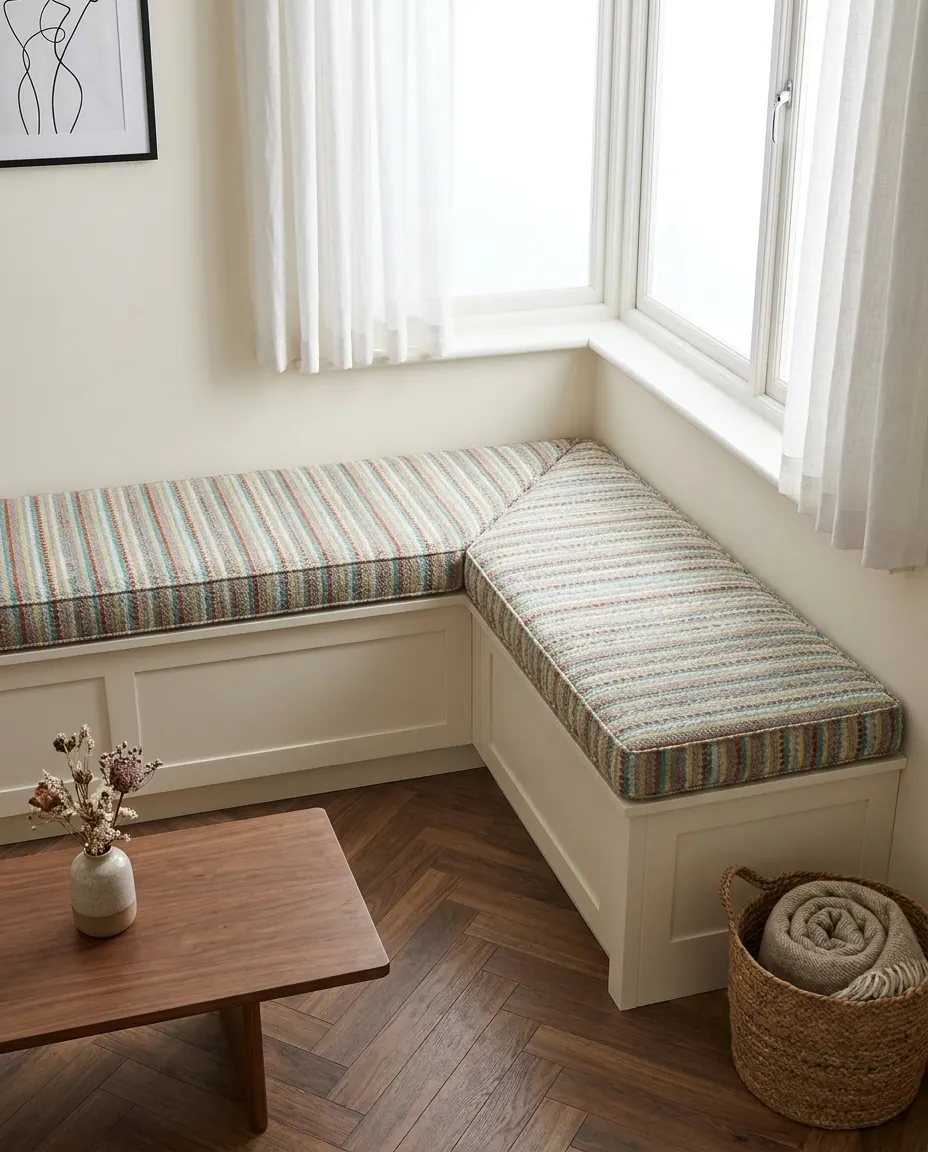
Two multi-stripe chenille box cushions meeting at a diagonal on a cream L-shaped storage bench in a window cornerSave
Two striped cushions meet on a clean diagonal across a cream L-shaped storage bench tucked into a window corner.
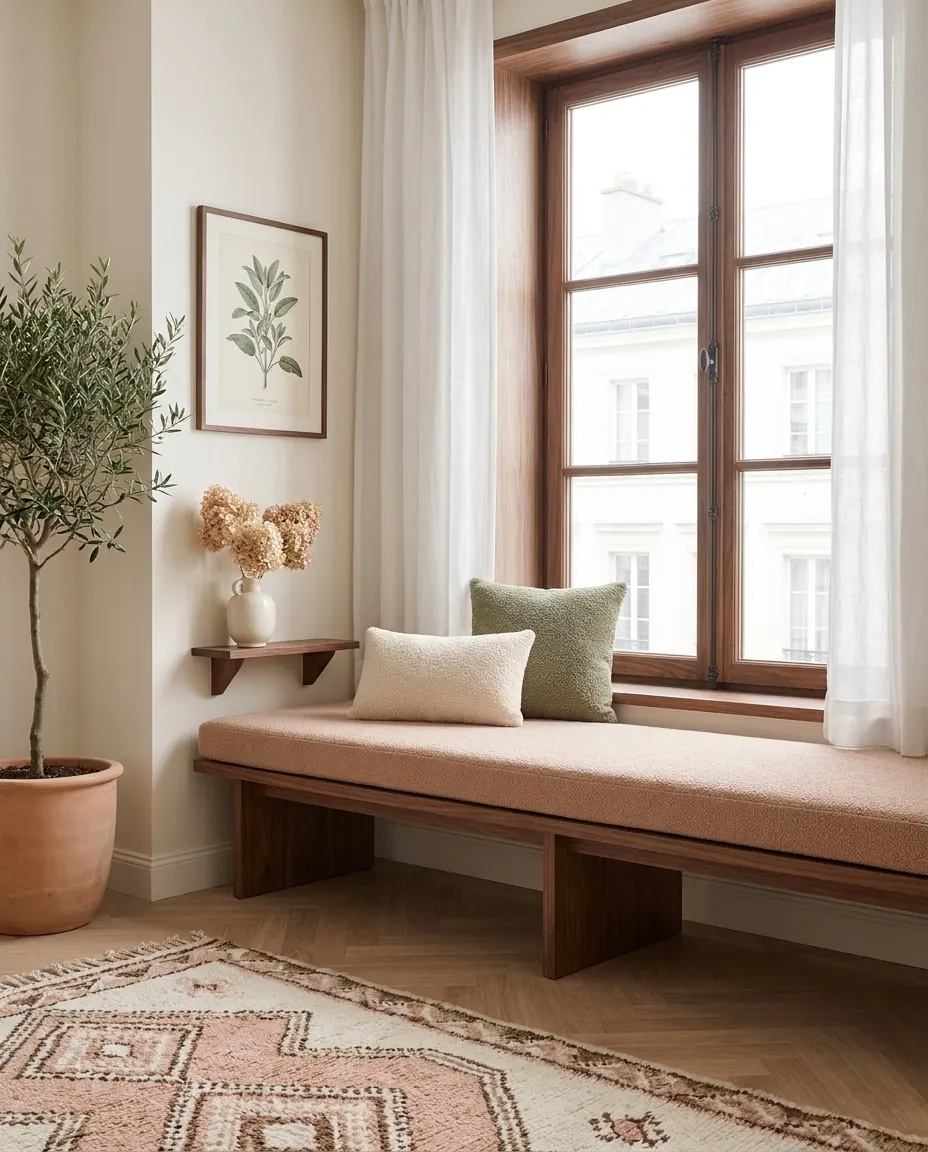
Blush tan bouclé cushion on a walnut window bench with cream and sage pillows, dried hydrangeas and a pink Moroccan rugSave
Blush tan bouclé softens a walnut window bench, with dried hydrangeas and a pink rug carrying the color around the room.

Pinned by Élodie at the oak bench

Four pins, top to bottom: cream bouclé, the teal and charcoal stripe, sage bouclé and the plain oak rail.
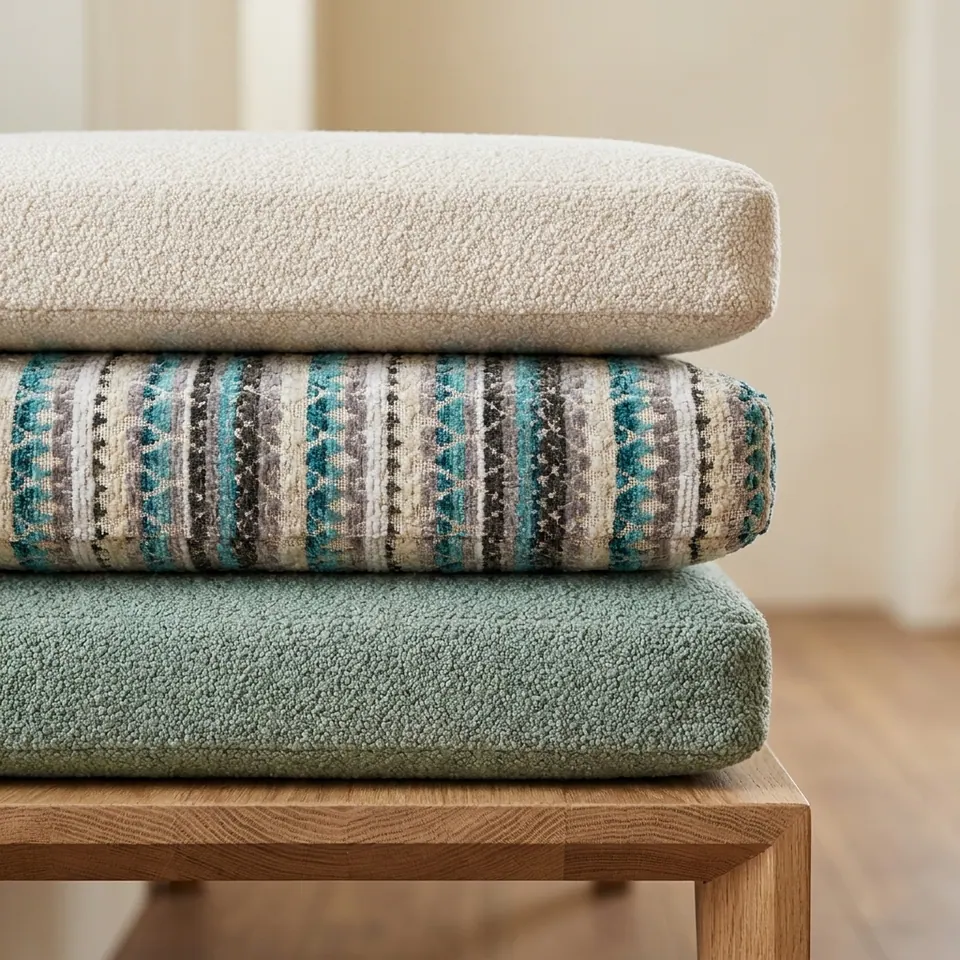
Pinned: Tight crop of a teal and charcoal woven stripe cushion stacked between cream and sage bouclé cushions on oak
  1. Cream bouclé layer

    The cream top catches the brightest light and frames the pattern below.

  2. Teal and charcoal stripe

    Chenille-like ridges in teal and charcoal give the stack its only pattern.

  3. Sage bouclé layer

    Sage falls into slight shadow and echoes the stripe's green cast.

  4. Oak bench rail

    A plain oak bench keeps the focus on how the three textures meet.

  1. Cream bouclé layerThe cream top catches the brightest light and frames the pattern below.
  2. Teal and charcoal stripeChenille-like ridges in teal and charcoal give the stack its only pattern.
  3. Sage bouclé layerSage falls into slight shadow and echoes the stripe's green cast.
  4. Oak bench railA plain oak bench keeps the focus on how the three textures meet.

Read the corners before the colors

Look at the corners first. That is where the handwork shows.

There is no piping anywhere in this stack. On bouclé, the seam of a box edge folds back into the loops and nearly disappears, so each block reads as one soft volume. Unpiped bouclé is less forgiving than it looks: a corner that is not eased shows every pucker, and a stripe that is not laid level shows every wander. Here the corners stand square and the stripe runs true.

The eye sits down first, and here it sits in the middle. The cream top catches the brightest light from the doorway. The sage base falls into slight shadow. Between them the woven stripe carries all the color: teal and charcoal ridges with a chenille-like depth, the only pattern in the frame.

Sage is the stripe's calmest note, repeated as a solid. That is the quiet craft of the stack: one patterned cushion and two plain ones that each borrow a color from it. The same three fabrics could dress a window seat, a hall bench and a pair of dining chairs and still agree.

The oak bench is plain on purpose, with nothing carved or turned to compete with the meeting of three textures. What would you stack on your own bench cushion, my friends?

Swatch strip: the five colors of the stack

  • Cream bouclé#EDE6D8Top layer; takes the doorway light and frames the stripe below.
  • Teal weave#2F6F6DThe only pattern, raised in chenille-like ridges.
  • Charcoal thread#3B3D3FGives the stripe its depth and keeps the teal from turning sweet.
  • Sage bouclé#A3AE8EBase layer in soft shadow; echoes the green cast of the stripe.
  • Oak rail#B98A58Warm, plain wood that lets the textures do the talking.

A real project

One long piece at 103.5 inches, and a sketch turned into a list

A buyer messaged the workshop about an extra-long single bench. They needed 103.1 in (262 cm) of cushion, or two pieces of 51.6 in (131 cm). The workshop recommended two pieces; the buyer chose one long cushion, 15.75 in (40 cm) deep, and before production the length was adjusted to 103.5 in (263 cm).

They were happy with it and came back. This time the list was longer: four seat cushions and six softer back cushions at 21.7 x 25.6 in (55 x 65 cm), plus an L-shaped chaise cushion whose six sides ran 39.4, 19.7, 41.3, 11.8, 17.7 and 27.6 in (100, 50, 105, 30, 45 and 70 cm).

Their sketch was drawn in millimeters. The workshop converted it to centimeters, wrote the sides out one by one, and confirmed the list with the buyer before quoting. That is hand-finishing too, only on paper. For the first question, one piece or two sets out the trade-offs.

Sizes
103.5 x 15.75 in (263 x 40 cm); seat and back cushions 21¾ x 25½ in (55 x 65 cm); chaise sides 39.4/19.7/41.3/11.8/17.7/27.6 in (100/50/105/30/45/70 cm)

The lesson: Convert a buyer's sketch into a clear side-by-side list before quoting.

Buyer questions: beds, borrowed fabric and hanging backrests

  1. A common question

    Can the big L-shaped floor sofa be laid out as a bed, or a conversation pit?

    The workshop's answer

    Yes. The cushions can be laid out flat so the L-shaped sofa works as a bed.

  2. A common question

    I have a designer fabric in mind for my banquette cushions. Can you use it?

    The workshop's answer

    Send the fabric name and your project details, and the workshop will look for the closest match in its own range, since cushions are made from the workshop's own fabrics.

  3. A common question

    Can you build a headboard-style backrest that mounts on a French cleat?

    The workshop's answer

    No. The cushions have no rigid board inside, so they cannot hang on a French cleat. Ties can be sewn to the top corners so the backrest hangs from hooks or a rail. It is made like the back pillows: a removable piped cover with shredded foam about 4 in (10 cm) thick, or a solid foam core wrapped in fiber for a firmer, flatter panel.

On the cutting table: the 3-cushion bouclé and stripe stack

PiecesThree stacked bench cushions on an oak bench
TopCream bouclé, box edge
MiddleTeal and charcoal woven stripe with chenille-like ridges
BaseSage bouclé, box edge
PipingNone; seams fold into the loop pile
Pattern ruleOne striped cushion, solids borrowed from its colors
LightBacklit from a bright doorway, warm and close
Best forBenches, window seats and chairs that should match without repeating

Order this cushion

Have it made

Have this made — ask Élodie’s workshop

Describe the room at four in the afternoon: the floor, the wall, the one color you love. That is where a good fabric choice begins. — Élodie

Leave your details and the workshop will call you to confirm measurements, fabric, foam and piping. No prices, dates or payment on this page: it is a request, not an order.

Fabric · Foam · Pipingwhat the workshop will confirm with you

Fabric
Cream bouclé
Foam
The core: its density and thickness set the feel.
Piping
None; seams fold into the loop pile
Only for this request: no marketing calls or texts. Outside the US, add the country code.
In inches: length × depth × thickness, plus any angles or cut corners.

* Required. A member of the workshop team will call you to talk it through; nothing is charged and nothing is made until you have agreed on every detail with them.

We use these details only to answer this request and make your cushion: your name and contact details, the cushion details and photos you send, the page you came from and the ad or link that brought you, if any. The workshop that makes the cushions receives them. We don't sell them or share them for advertising, and we delete requests after 24 months. Privacy notice for requests.

Nothing is made or charged until you approve the details.

Want to pick the shape and add photos? Use the full quote form

A striped bench cushion between two plain bouclés works when one solid repeats the stripe's calmest color, like sage bouclé under a teal weave.

Élodie

Questions buyers ask next

Should bouclé bench cushions have piping?

Not always. On bouclé the seam of a box edge folds into the loop pile, so an unpiped cushion looks soft and continuous. Choose piping when a long cushion needs a sharp outline, or when you want a contrast color.

How do I mix one striped cushion with plain ones?

Put the stripe on a single cushion and repeat its calmest color in the plain pieces. Here sage bouclé echoes the green cast of a teal and charcoal weave, and cream adds light without a third hue.

Is one long bench cushion better than two shorter ones?

Both work. One piece gives an unbroken line; two pieces are easier to handle, fit and wash. For a very long bench the workshop may recommend two, as it did for a 103 in (262 cm) run.

Can the same fabrics dress a bench, a window seat and dining chairs?

Yes, and a stripe-plus-solids scheme makes it easy. Use the stripe once per room and the solids everywhere else, and every seat reads as part of one family without looking repeated.

With color and care — Élodie