A Reading by ÉlodieBench Cushions
Three velvet bench cushions, read from ten feet and from ten inches
Élodie writes a letter about a stack of blush, cobalt and mustard velvet: which details carry across a room, which only reward the person sitting down, and how one wine-red cord does both.

 Save
The quick answer
On a custom velvet bench cushion, color blocks and contrast piping are the details that read from across a room, while self piping, pile sheen and small pull tabs only show up close. Choose the body color for the ten-foot view, then decide whether the edge should draw a line (contrast piping) or disappear (self piping).
New Orleans ·
My friends,
A letter about three cushions and one wine-red line
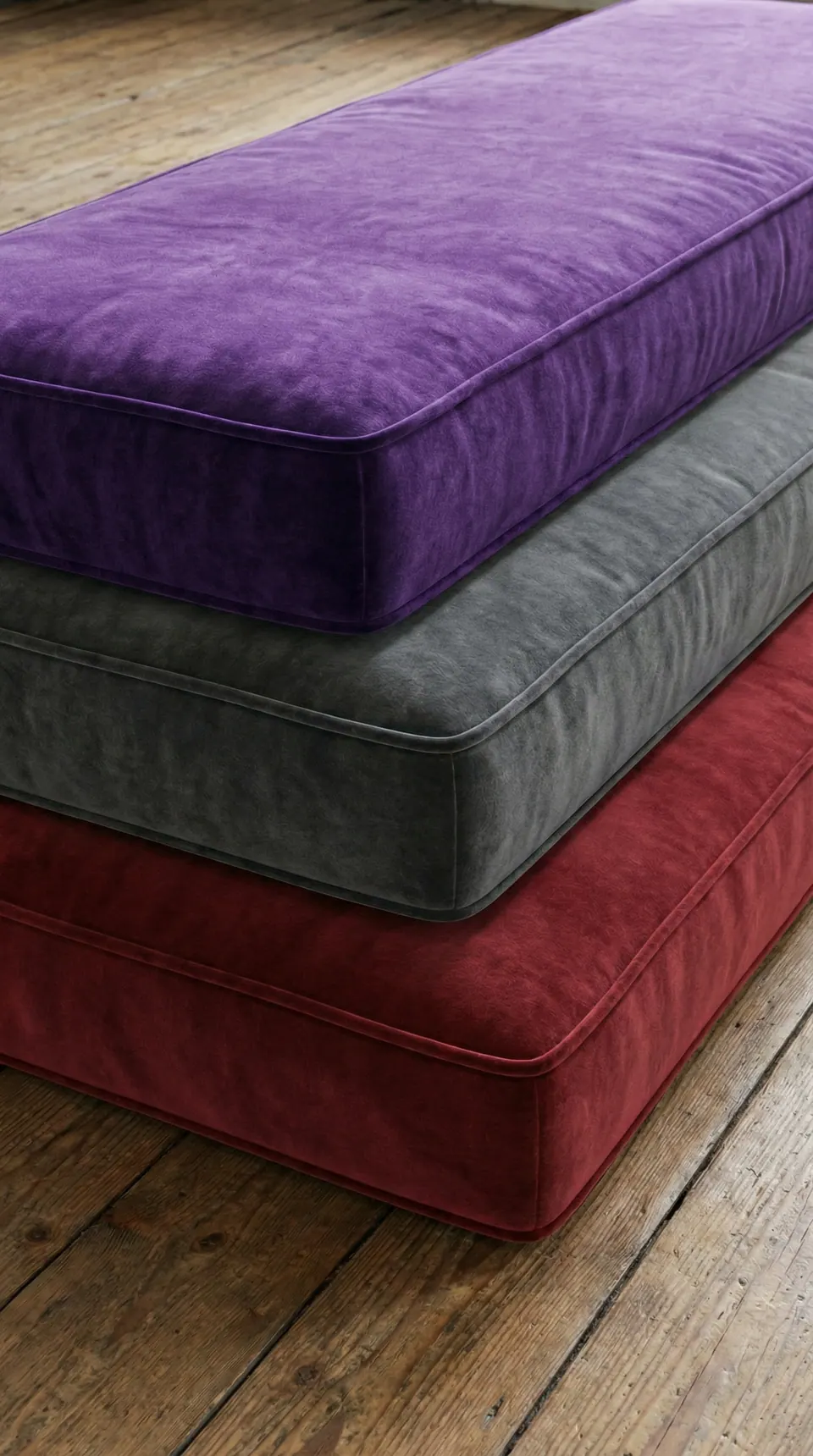
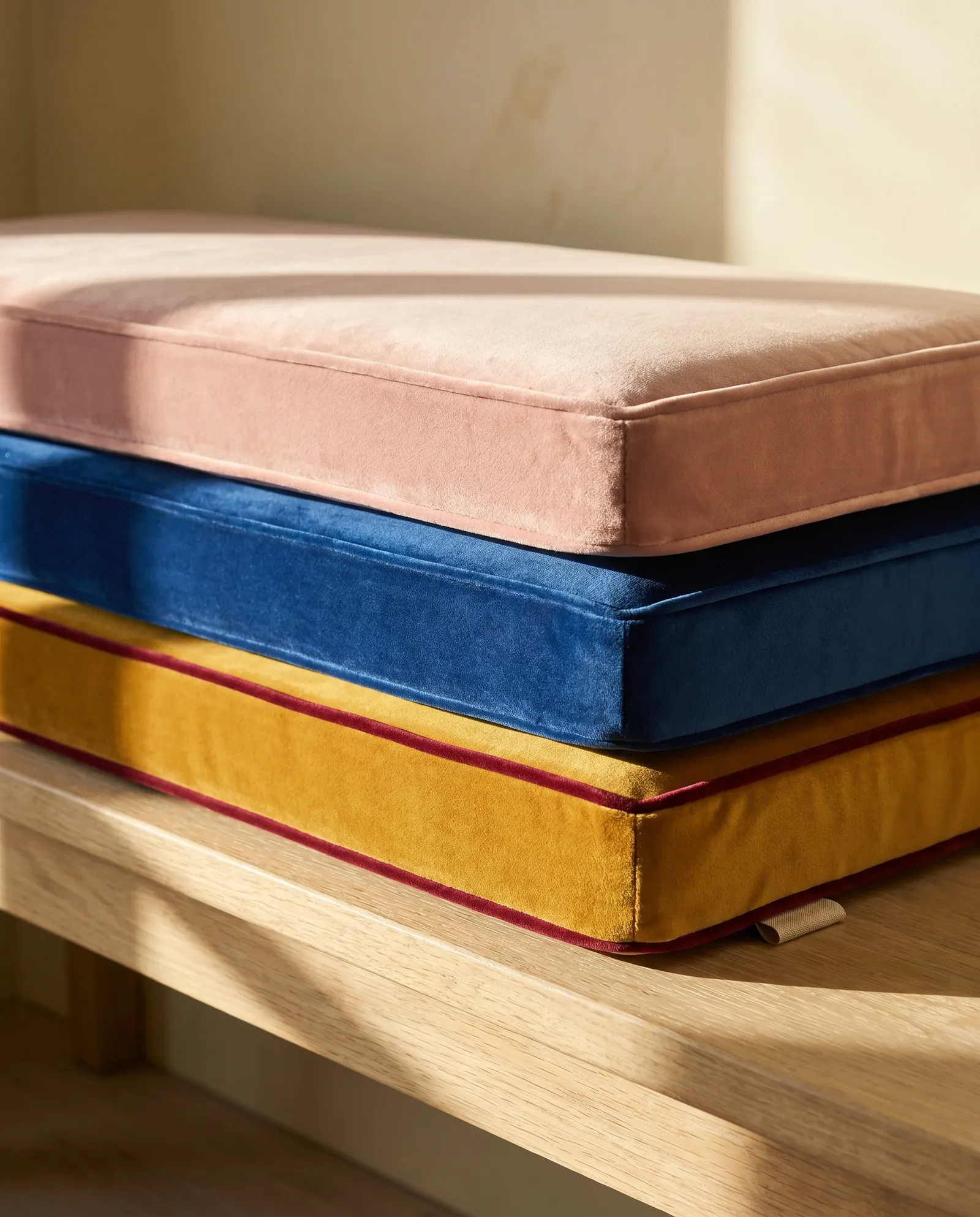
Stand in the doorway first. From ten feet, this photograph is three bands of color stacked on pale oak: blush, cobalt, mustard. Nothing else. The eye sits down first, and here it sits on the mustard, because that is the only cushion wearing a drawn line.
That line is a burgundy cord, and it is the one decision in the picture that works at both distances. Across the room it frames the lowest velvet bench cushion like the edge of a painting. Up close it is a round, tight welt with its own small shadow underneath.
The blush and the cobalt made the opposite choice. Both are self piped, so their edges stay the color of their faces. From the doorway you cannot see that piping at all, and that is the point: the color stays whole.
Pinned by Élodie on the oak bench
Five pins, from the self-piped blush crown to the wine-red cord, the pull tab and the pale oak underneath.
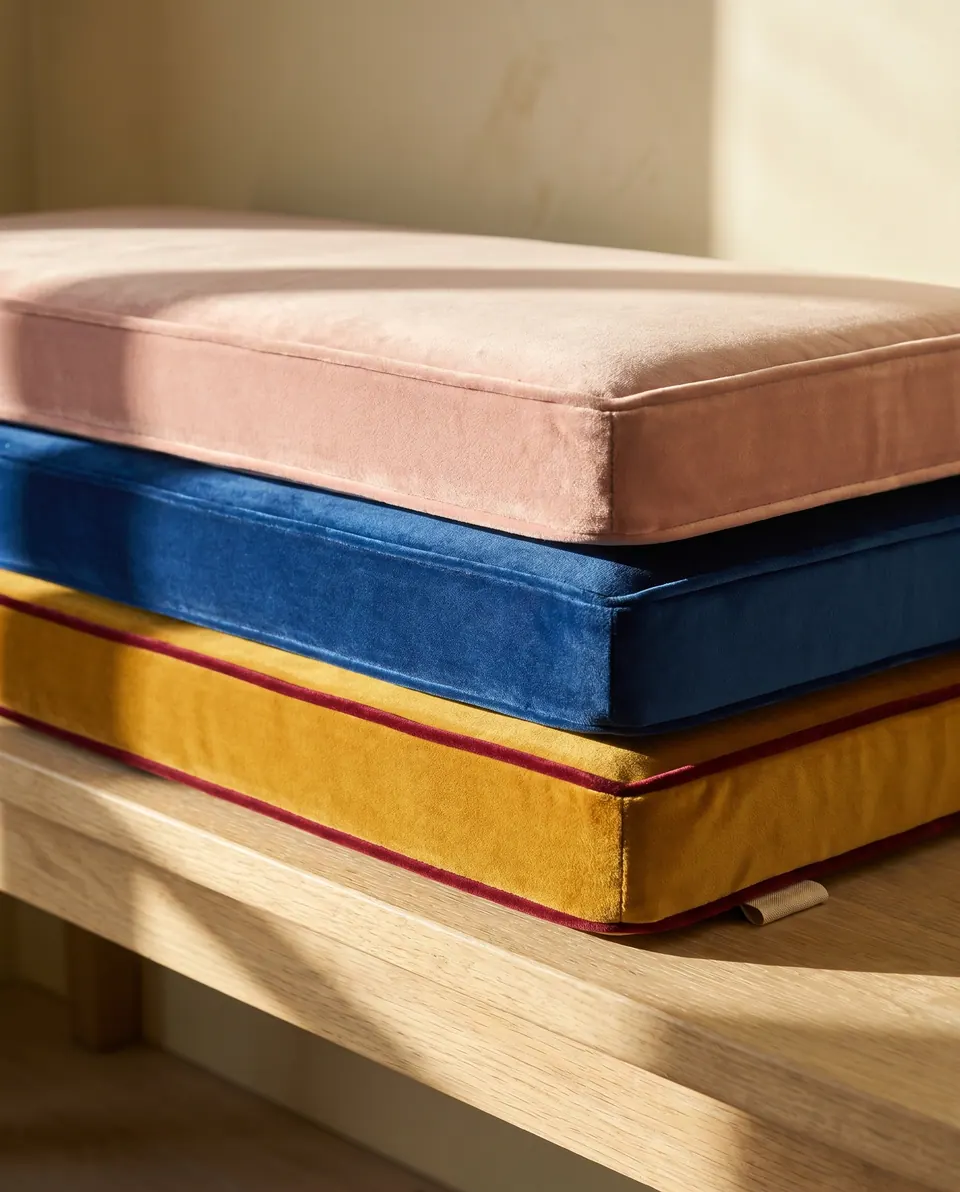
- blush self-piped top
Blush piping matched to the body keeps the palest cushion soft and unbroken.
- cobalt velvet middle
The shaded side of the cobalt shows how deep velvet goes when light falls away.
- wine-red contrast piping
A burgundy cord on mustard frames the bottom cushion like a picture edge.
- fabric pull tab
A small tab at the base helps lift a heavy box cushion off the bench.
- oak bench top
Pale oak lets all three saturated velvets read at full strength.
- blush self-piped topBlush piping matched to the body keeps the palest cushion soft and unbroken.
- cobalt velvet middleThe shaded side of the cobalt shows how deep velvet goes when light falls away.
- wine-red contrast pipingA burgundy cord on mustard frames the bottom cushion like a picture edge.
- fabric pull tabA small tab at the base helps lift a heavy box cushion off the bench.
- oak bench topPale oak lets all three saturated velvets read at full strength.
What only the close-up gives you
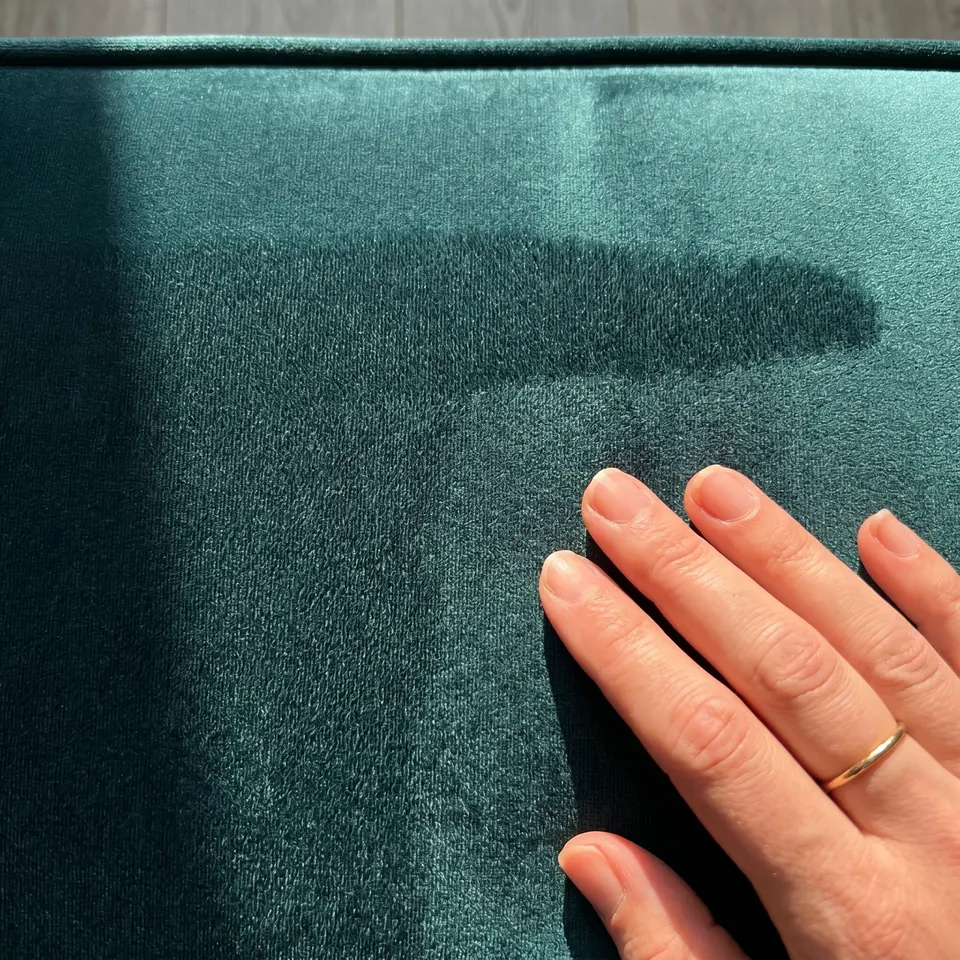
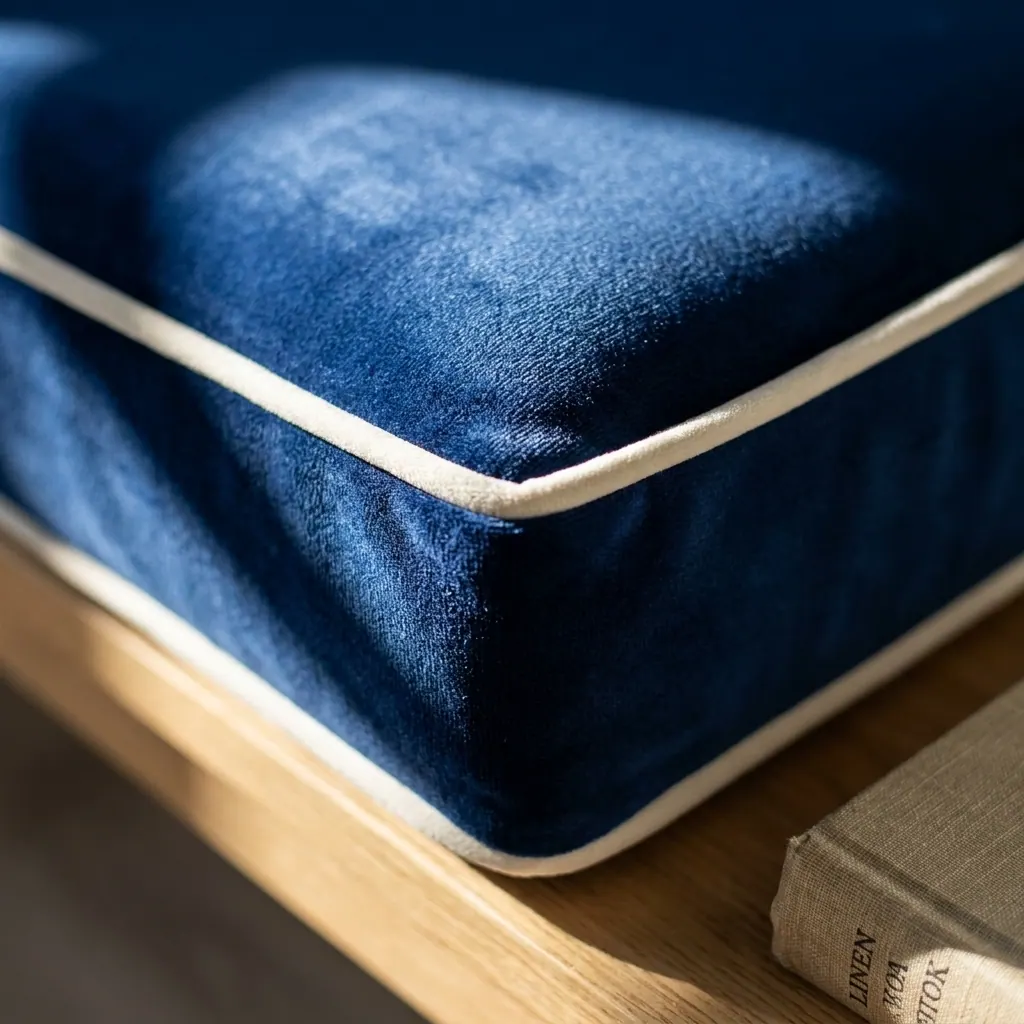
Walk closer and the velvet starts to talk. The light here is low late-afternoon sun, raking in from the side, and it shows why anyone chooses velvet at all. The cobalt glows almost electric on its lit crown and falls to deep ink on the shaded side. Same cloth, two colors, an inch apart.
Then the small things. A cream pull tab sits at the base of the stack, a little loop that helps lift a heavy box cushion off the bench. Nobody sees it from the door. Everybody who lives with the cushion is glad of it.
And the oak: pale, plain, nearly blond. It is the quiet ground that lets three saturated velvets read at full strength. Set this stack on dark walnut and the cobalt would sink into it.
The idea to borrow for two benches or a set of stools: order three related tones and give only one of them a contrast cord. The piping guide walks through matched, contrast and none.
The gray that looked almost black
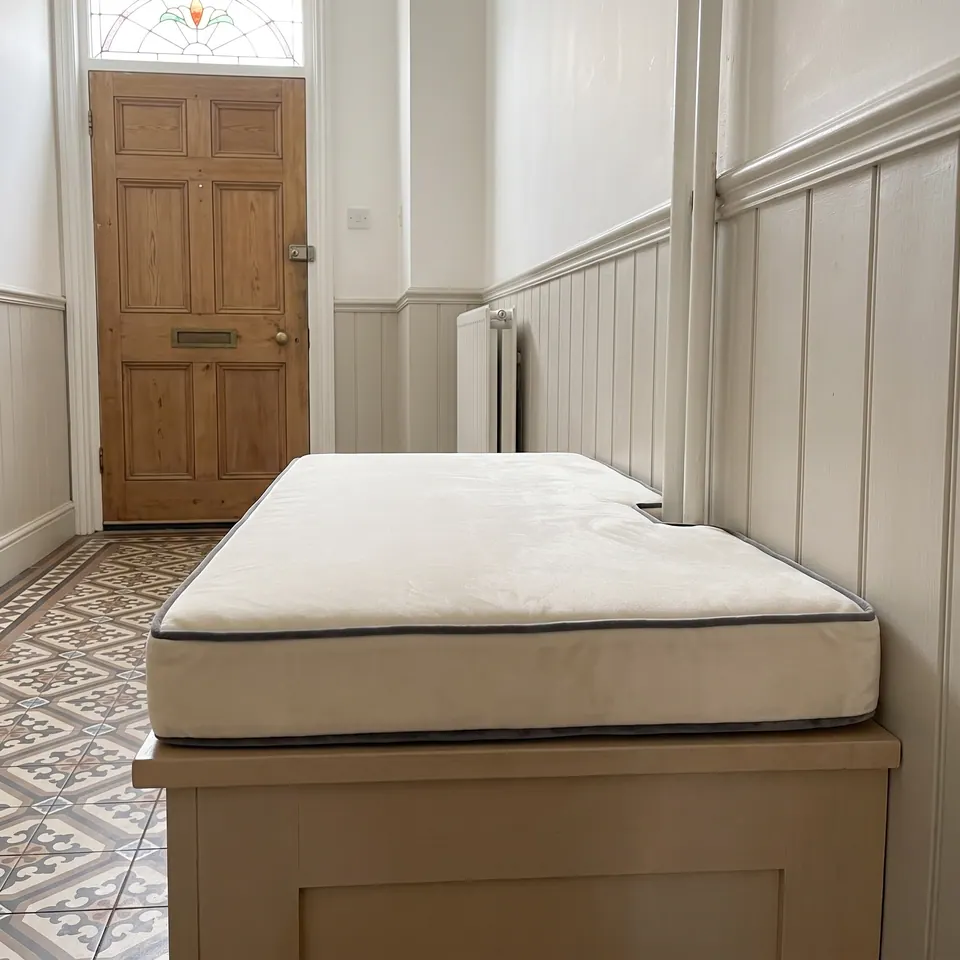
A buyer wrote in about a tufted velvet cushion for a dining bench that sits beside gray chairs she already owned. Her first measurement was 44 x 19 3/4 in (112 x 50 cm). The workshop gave her three thicknesses to weigh, about 4, 8 and 12 in (10, 20 and 30 cm), and she chose 4 in (10 cm) as plenty for a bench.
Then she re-measured, which I always applaud. The final order was a 43 1/4 x 18 7/8 x 4 in (110 x 48 x 10 cm) seat and a 43 1/4 x 19 3/4 x 2 in (110 x 50 x 5 cm) backrest.
The color is where distance mattered. The first gray she picked looked almost black, nothing like her chairs. The workshop suggested a lighter gray from the same velvet chart, one that sits beside the chairs like family. Grays are the hardest color to judge on a screen, so read screen versus daylight before you commit to one.
- Sizes
- 43 1/4 x 18 7/8 x 4 in (110 x 48 x 10 cm) seat + 43 1/4 x 19 3/4 x 2 in (110 x 50 x 5 cm) backrest
The lesson: For benches, 4 in (10 cm) is usually enough; save thicker builds for floor seating.
A contrast piping cord is the one bench cushion detail that reads from ten feet and from ten inches; self piping disappears on purpose.
Élodie
Buyer questions: piping, linen and the backrest question
- A common question
Can the piping be a different color, or even a different fabric, from the cushion itself?
The workshop's answerYes. Piping can be cut from any fabric on the charts, not only the linens. Buyers have paired beige linen with forest green velvet piping, beige linen with bordeaux, one green with a neighboring green, and a cream soft fabric with gray. Write both fabric codes in the personalization box.
- A common question
Is your linen pure linen? I'd rather have a natural fiber than polyester.
The workshop's answerThe standard linen fabrics are blends, not 100% linen. For a natural fiber there is a 100% cotton linen-look fabric. There is also a sturdy, high-quality acrylic linen, which the workshop recommends for hard-working projects.
- A common question
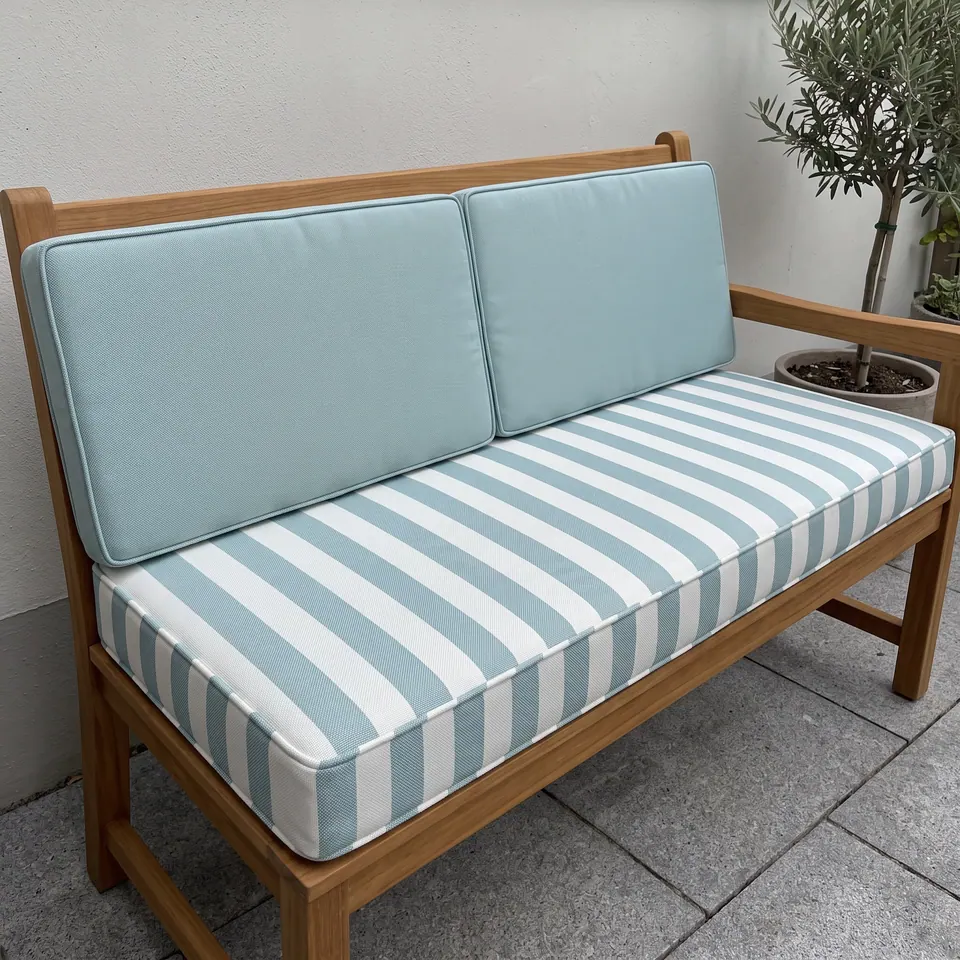
How much more is a full set with a backrest than the seat cushion alone?
The workshop's answerLess than people expect on a single bench. On a 78 x 27 in (198 x 69 cm) banquette, adding a matching backrest raised the quote by about 30 percent. A 53 x 75 in (135 x 190 cm) piece went up by about half with backrests, and two kitchen-bench cushions, about 55 1/2 x 27 in and 56 1/4 x 27 in, nearly doubled once backrests and armrests were added to both.
On the cutting table: the stacked trio
| Cushions | Three velvet box cushions of equal depth, stacked |
|---|---|
| Colors | Blush on top, cobalt in the middle, mustard at the base |
| Piping | Self piping on blush and cobalt; burgundy contrast cord on mustard |
| Edge | Box edge with crisp corners |
| Detail | Cream fabric pull tab at the base for lifting |
| Base | Light oak bench top |
| Light | Low, warm side light that shows the velvet pile |
| From a past order | 43 1/4 x 18 7/8 x 4 in (110 x 48 x 10 cm) tufted seat with a 2 in (5 cm) backrest |
| Best for | Benches and stool sets seen from across a room |

Have it made
Have this made — ask Élodie’s workshop
Color is easier to settle in a conversation than on a screen. Tell the workshop about the room and the light it gets, and the fabric choice follows. — Élodie
Leave your details and the workshop will call you to confirm measurements, fabric, foam and piping. No prices, dates or payment on this page: it is a request, not an order.
Questions buyers ask next
Does a velvet box cushion show two shades of one color?
Often, yes. Velvet's pile catches light on the top face and falls into shadow on the sides, so a box cushion can read pale on its crown and deep on its edges. Judge a swatch by tilting it toward a window, not only flat.
Should every cushion in a colored set have contrast piping?
Usually not. When several colors already sit together, give a contrast cord to one cushion and self-pipe the rest. The outlined piece becomes the anchor the eye finds first, and the others keep their color unbroken.
Is 4 inches thick enough for a velvet bench cushion?
For most benches, yes. A 4 in (10 cm) cushion is the usual choice for a dining or window bench, and one buyer chose it over 8 and 12 in (20 and 30 cm) options. Save the thicker builds for floor seating.
What is the small fabric tab at the base of a box cushion for?
It is a pull tab: a short loop sewn into the seam so your fingers have something to hold when lifting a heavy box cushion off a bench or out of a stack, instead of tugging at the piping.
With color and care — Élodie
More photographs to read
 Save
 Save
 Save
 Save
 Save
 Save