A Reading by ÉlodieBench Cushions
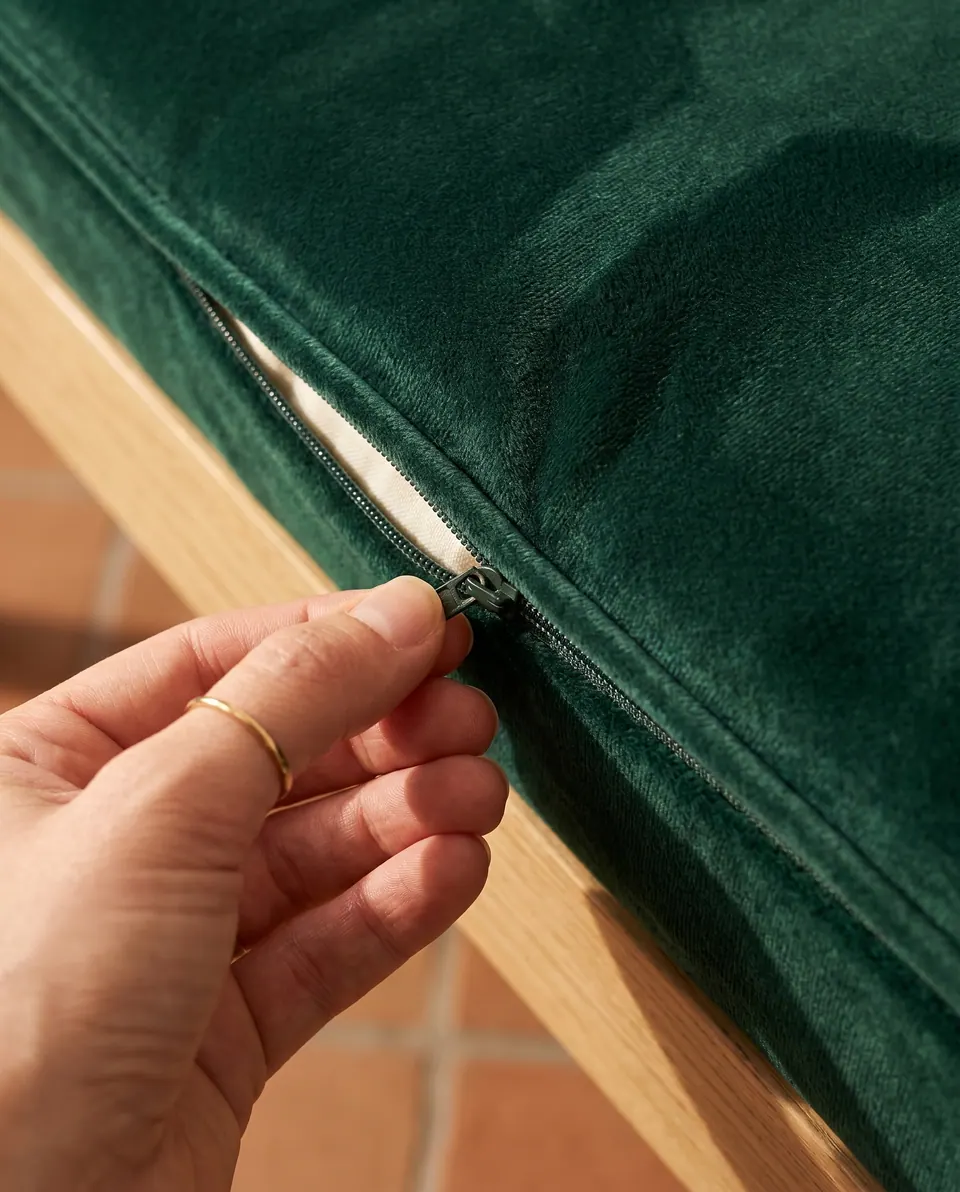
A hand on teal-green velvet: what a custom bench cushion is worth spending on
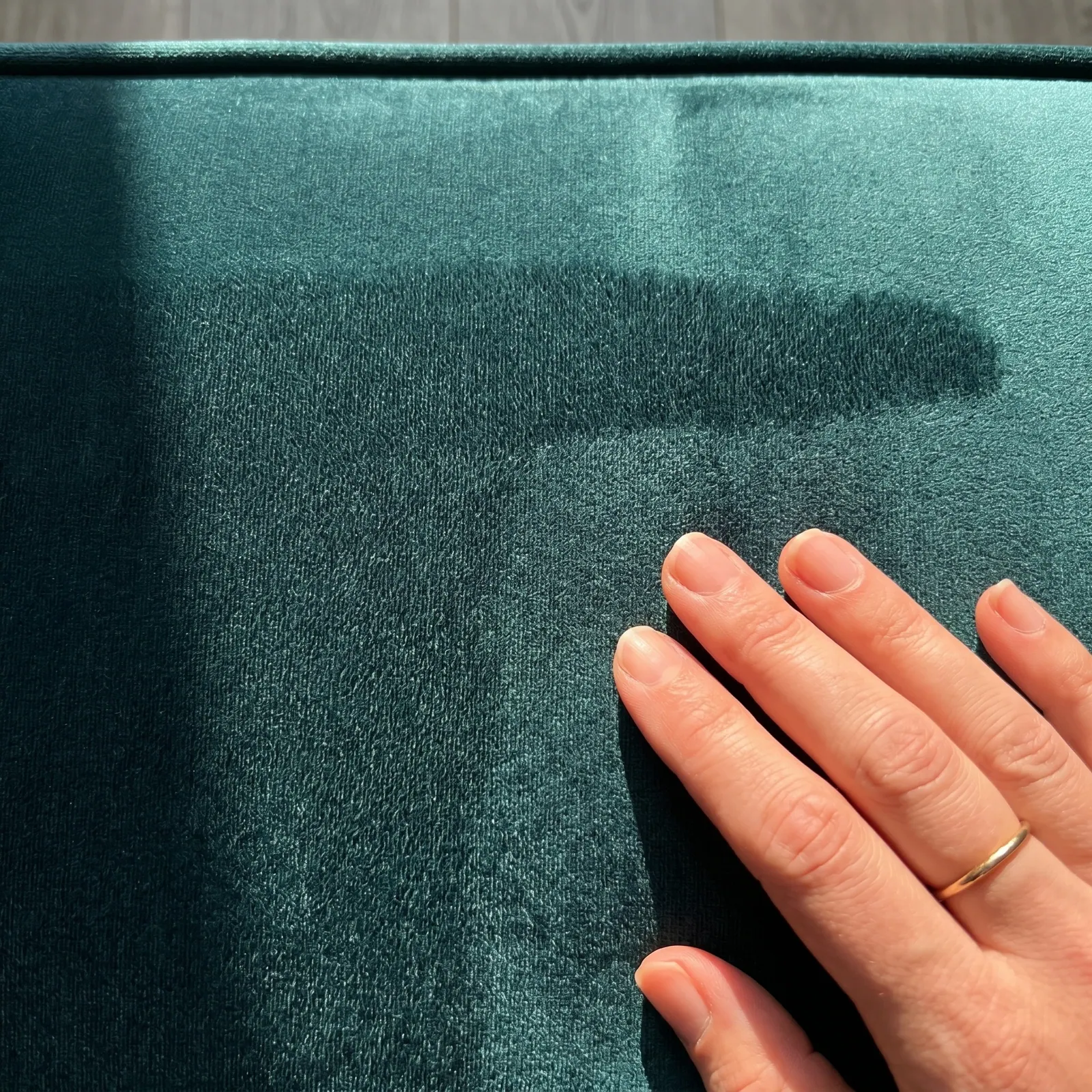
Sun, a band of shadow, a thin gold ring and a hand at rest. A close-up this intimate says more about value than any price list, so I kept notes.

 Save
The quick answer
On a custom bench cushion, spend on the parts you touch and measure: a durable fabric, correct dimensions and back foam at least 2 in (5 cm) thick. Save on extras such as contrast piping. A mid-tone velvet like this teal green hides pressure marks better than very dark or very pale shades, and a stroke of the palm lifts flattened pile.
Notebook, page one: a hand, a ring and a stripe of shadow
Five fingers tell you more about a velvet bench cushion than five paragraphs of product copy. Here a hand rests on the top panel of a teal-green cushion in full sun, and the fingertips barely sink. That is short, dense pile, and it stands back up under a stroke of the palm.
Now follow the band of window shadow across the top. In the sun the teal reads as a bright sunlit jade; in the shade it drops to a deep peacock. Same cloth, two colors. Velvet pile catches light on its tips and holds shadow between them, which is why no photograph on a phone ever shows it quite right. Daylight never lies; your screen sometimes does.
The thin gold ring is a small human detail. It keeps the picture honest rather than staged, and it gives your eye a fixed size to measure the pile against. Along the top of the frame runs the self-piped box edge, cut from the same teal as the body, so nothing pulls attention from the surface.
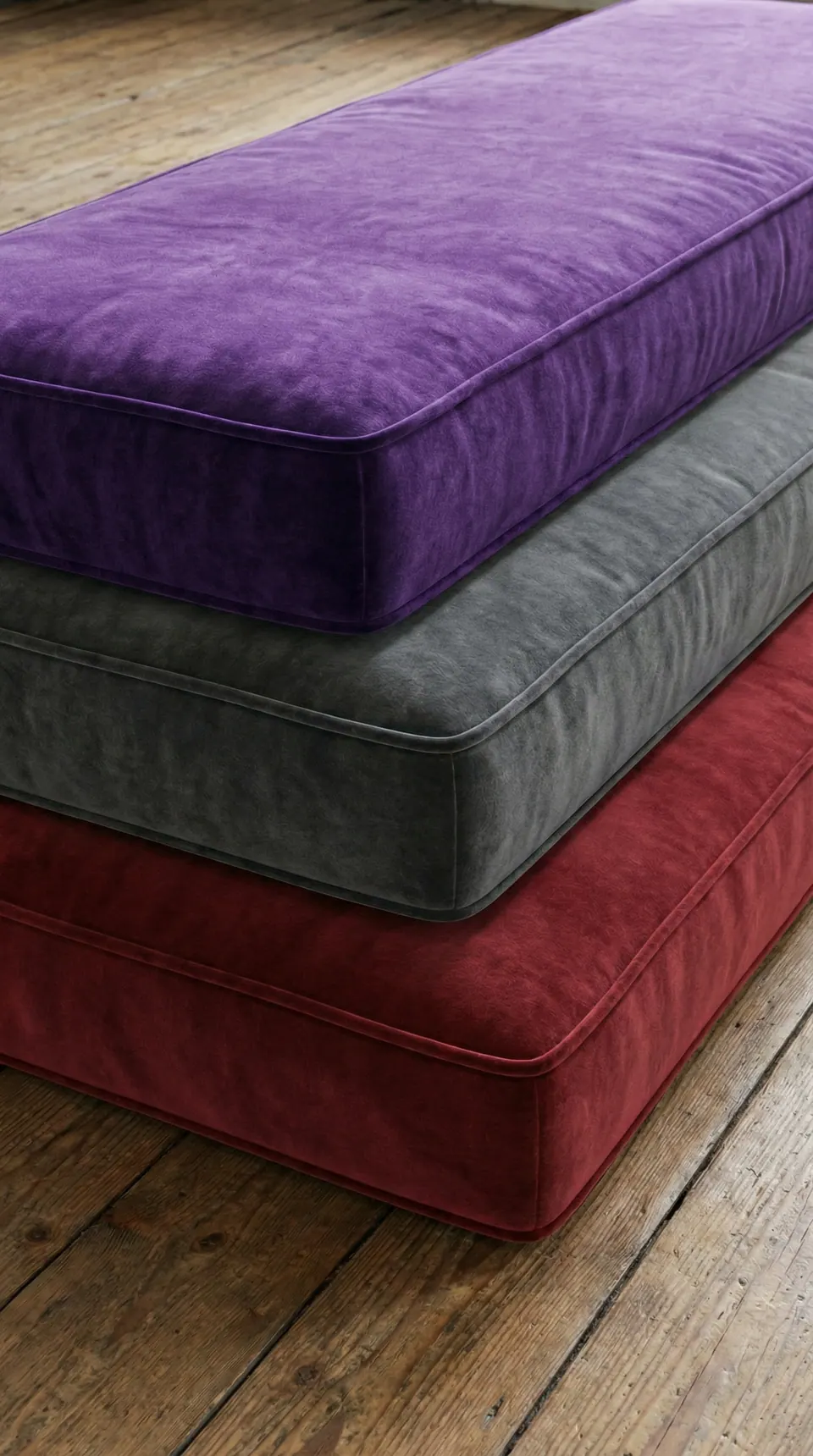
Self piping is also the thrifty choice, my friends: one fabric, nothing to coordinate, nothing to date the cushion later. Look at the whole family of velvet fabrics in daylight before you settle on a shade, and keep our velvet care notes close once it arrives.
Pinned by Élodie: four notes on the pile
Four pins mark the hand, the ring, the shadow and the piping, and each one is a clue to how this velvet will live.
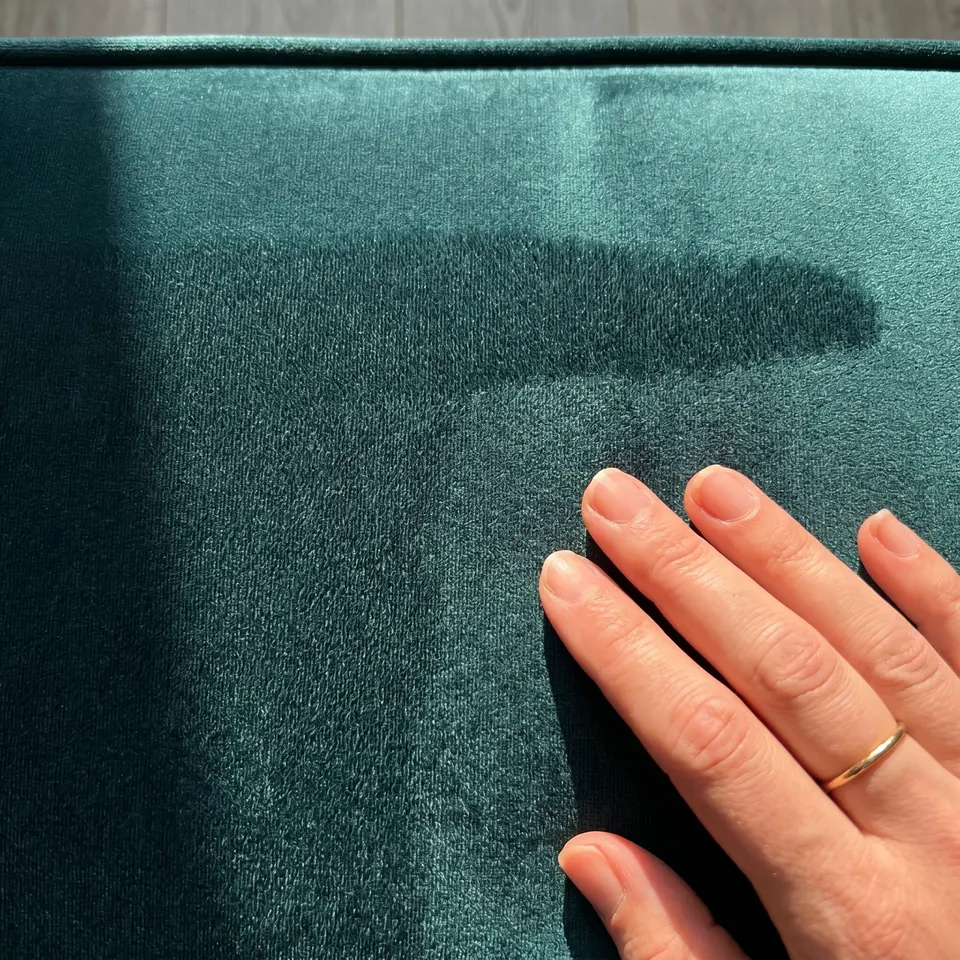
- hand for scale
Fingers resting on the pile show how short and dense the velvet is.
- gold ring
A small personal detail makes the texture shot feel real rather than staged.
- shadow on pile
The shadow band shows how velvet shifts shade between light and dark.
- self-piped edge
Matching piping along the top keeps attention on the fabric surface.
- hand for scaleFingers resting on the pile show how short and dense the velvet is.
- gold ringA small personal detail makes the texture shot feel real rather than staged.
- shadow on pileThe shadow band shows how velvet shifts shade between light and dark.
- self-piped edgeMatching piping along the top keeps attention on the fabric surface.
The ledger: where a velvet bench cushion earns its money
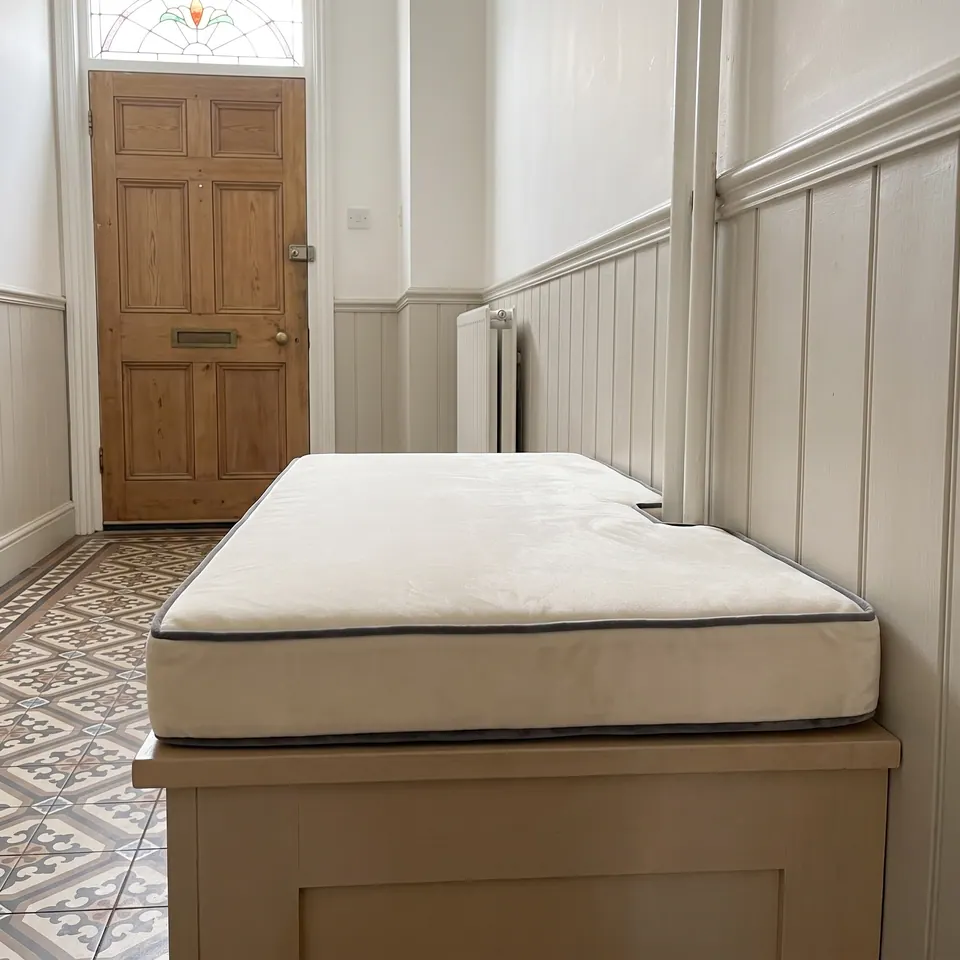
- Spend on measuring. A cushion 15 in (38 cm) short of a 70 in (178 cm) space can be rescued with fillers, but measuring twice costs nothing.
- Spend on foam. Never order a back cushion thinner than 2 in (5 cm); thinner foam flattens and loses its structure.
- Spend on the cloth you touch every day. The workshop's velvet is a polyester performance velvet with a removable, machine-washable cover.
- Save on piping. Self piping in the body color never needs a second decision.
- Save on worry. A mid-tone such as teal hides pressure marks better than very dark or very pale velvet.
- Save on layout agonizing. When two layouts are quoted at the same price, choose the one that suits how you sit.
The office bench that asked for thinner backs
An office team wrote to the workshop about a built-in bench with an angled backrest and a seat only 16 in (41 cm) deep. They wanted back cushions just 1 to 1.5 in (2.5 to 4 cm) thick, so the seat would not become too shallow to use.
The workshop said no, kindly. Its minimum is 2 in (5 cm), because thinner foam flattens and loses its structure, and it recommended foam-filled backs instead. Then it quoted two layouts at the same price: three seat cushions at 54 3/8 x 15 3/4 in (138 x 40 cm) with three long backs at 54 3/8 x 11 3/4 in (138 x 30 cm), or the same three seats with five short backs at 15 3/4 x 11 3/4 in (40 x 30 cm).
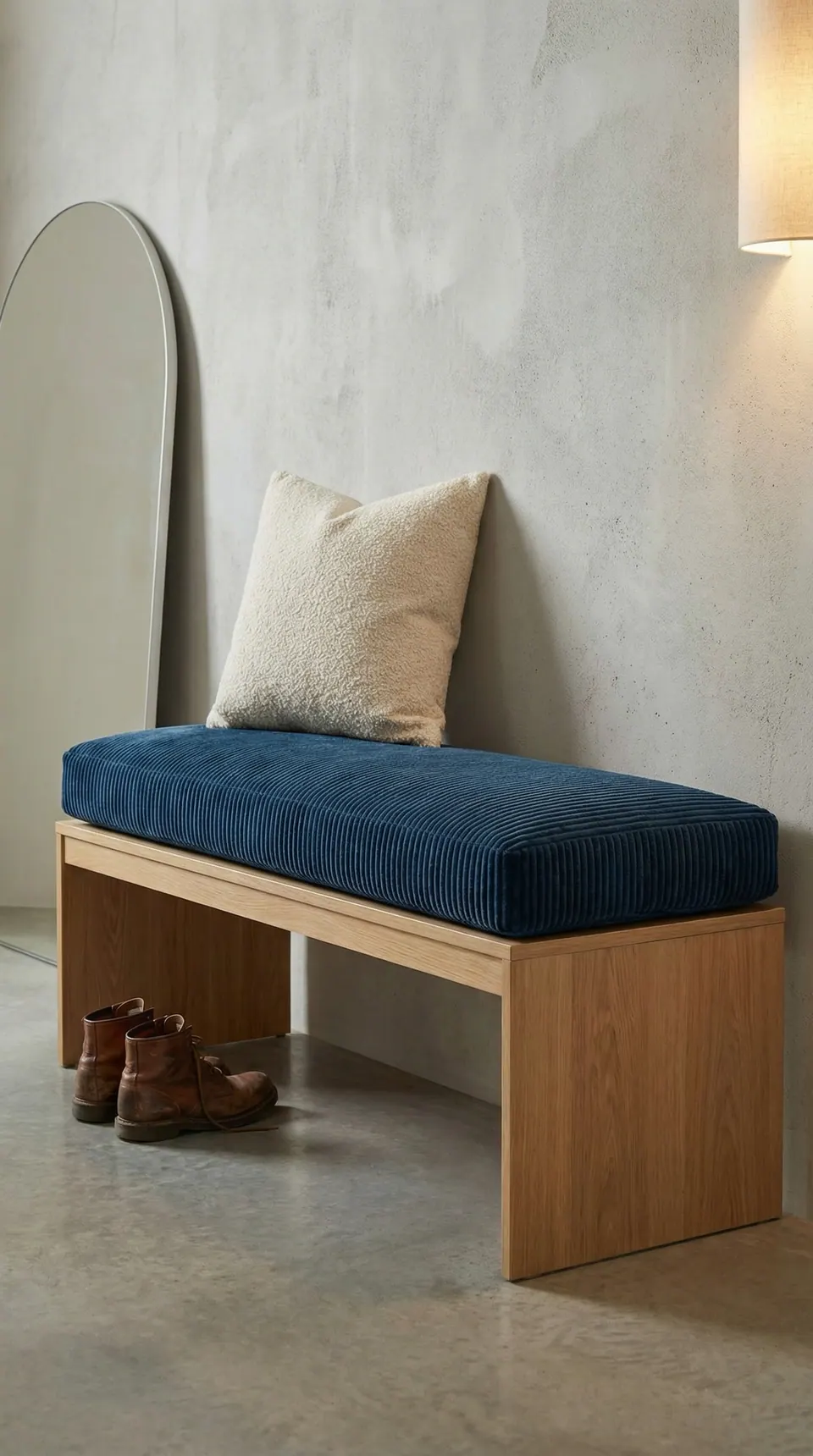
That is the longevity lesson in one bench. A back that is too thin saves half an inch of seat on day one and gives up its support soon after. On a shallow seat, a 2 in foam-filled back is the honest compromise, and the price did not care which layout they chose. Which layout would you pick for your own bench? Our bench cushions show both.
Buyer questions: three measuring lessons that protect a budget
- A common question
I measured wrong and my cushion came out about 15 in short of a 70 in space. Can I send it back and reorder?
The workshop's answerReturns are possible, but return shipping is costly and the workshop does not provide return labels. Instead it offered small filler cushions: two 7.5 in (19 cm) seat pieces and two 7.5 in back pieces, one of each at either end, so the main cushion stays centered. The price for the four fillers was reduced, too.
- A common question
My bay window has two extra edges, so it is closer to a hexagon than a trapezoid. Can you still make the cushion?
The workshop's answerYes. Send the length of every side or a simple sketch, and the workshop turns it into a template for you to check. Then choose the length and width range that fits, for example 78 in and 22 in, and write the full shape in the personalization box: front, back, angled sides, end sides and depth.
- A common question
We just had a window seat built. How do I measure it for a cushion?
The workshop's answerMeasure the front edge wall to wall in a straight line, then the back edge along the window, which is often shorter, then the depth front to back on the left and right if it varies. Measure each side on its own if the walls are angled. Use a rigid tape on the seat itself: length is side to side, width is front to back. Send a top-view sketch with each number on its edge, plus a photo, and the workshop checks the shape.
On the cutting table: the ledger for this velvet
| Product | Box bench cushion, rectangular top panel |
|---|---|
| Fabric | Velvet with a short, dense pile in teal green |
| Piping | Self piping in the body color |
| Edge | Box edge |
| Light | Direct sun crossed by a band of window shadow |
| Back cushion minimum | 2 in (5 cm), foam-filled |
| Care | Stroke flattened pile upright; covers machine wash at 86°F (30°C) |
| Best for | Indoor benches that get daily use |

Have it made
Have this made — ask Élodie’s workshop
A fabric reads one way at noon and another at dusk. Mention your light, and the workshop will weigh it with you. — Élodie
Leave your details and the workshop will call you to confirm measurements, fabric, foam and piping. No prices, dates or payment on this page: it is a request, not an order.
A velvet bench cushion in a mid-tone like teal hides pressure marks better than very dark or very pale velvet, and a stroke of the palm lifts the pile.
Élodie
Questions buyers ask next
Does velvet on a bench cushion keep the marks where people sit?
Velvet can show pressure marks where the pile is pushed flat, but a stroke of the palm usually lifts it again. A mid-tone such as teal green hides pressing better than very dark or very pale velvet.
What is the thinnest back cushion foam worth ordering?
2 in (5 cm). The workshop will not go thinner for backs because thinner foam flattens and loses its structure. On a shallow 16 in (41 cm) bench, a 2 in foam-filled back keeps support without stealing much seat depth.
Should a built-in bench get long back cushions or several short ones?
Price may not decide it: one office bench was quoted the same for three long backs or five short ones. Long backs look calmer along a wall; short backs lift out one at a time.
Why does one velvet cushion look like two colors in a photo?
Velvet pile catches light on its tips and holds shadow between them, so the same cushion reads lighter in sun and deeper in shade. It is the nature of pile, not a dye fault; judge the color from a sample in daylight.
With color and care — Élodie