A Reading by MaggieBench Cushions
Custom bench cushion corners, read up close: a letter on mixing stripes, plains and texture
No room, no props, just three corners on a pale floor. That's where a tailor learns the most, and where you can learn to put a stripe beside a plain without the bench shouting.

 Save
The quick answer
To mix patterns on a custom bench cushion, use one stripe, one plain and one texture, and let a single piping color thread through all three. A heathered linen-look plain bridges a stripe and a flat solid. Stripe colors are woven into the cloth and can't be changed, but the piping color can.
Newport ·
Dear reader,
A letter from the piping bench
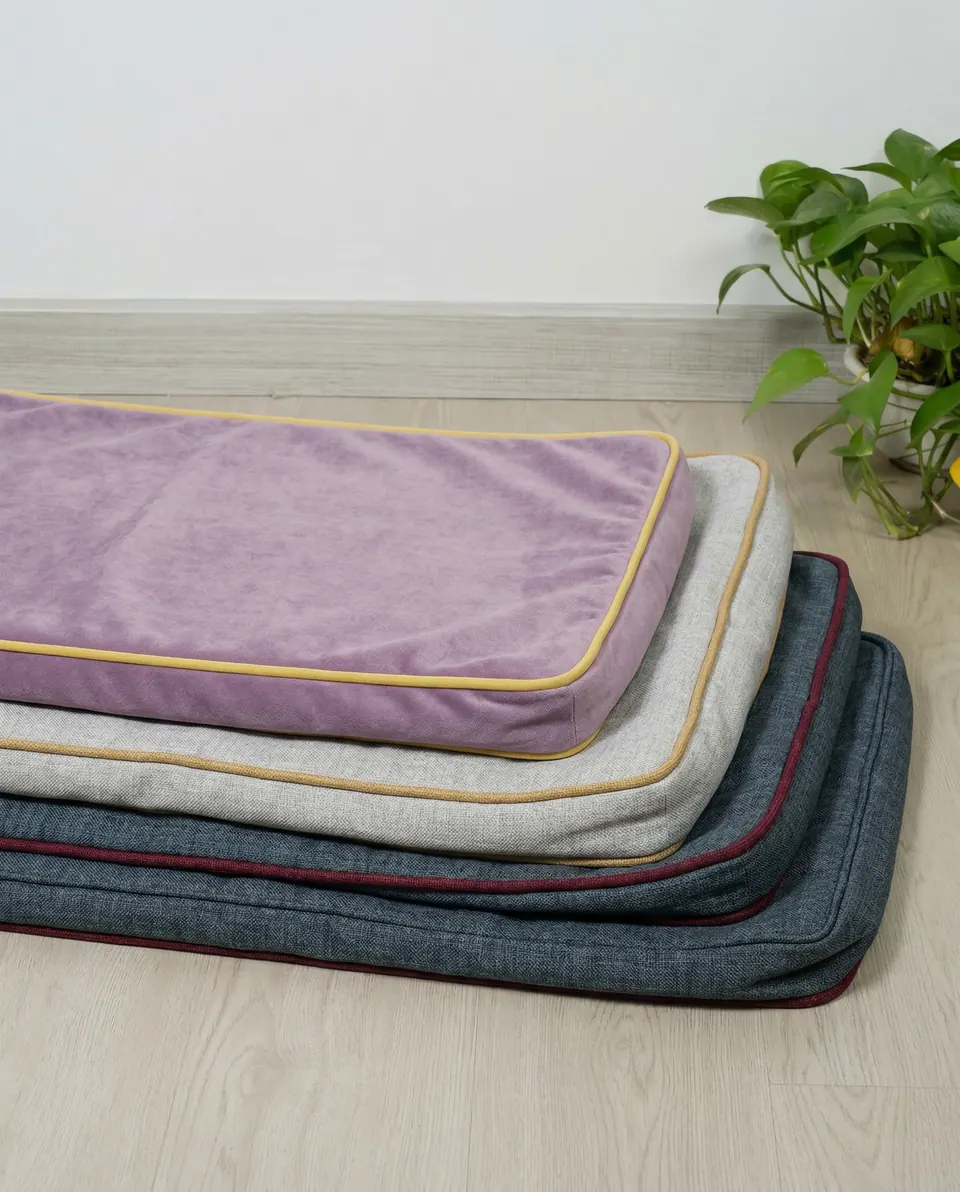
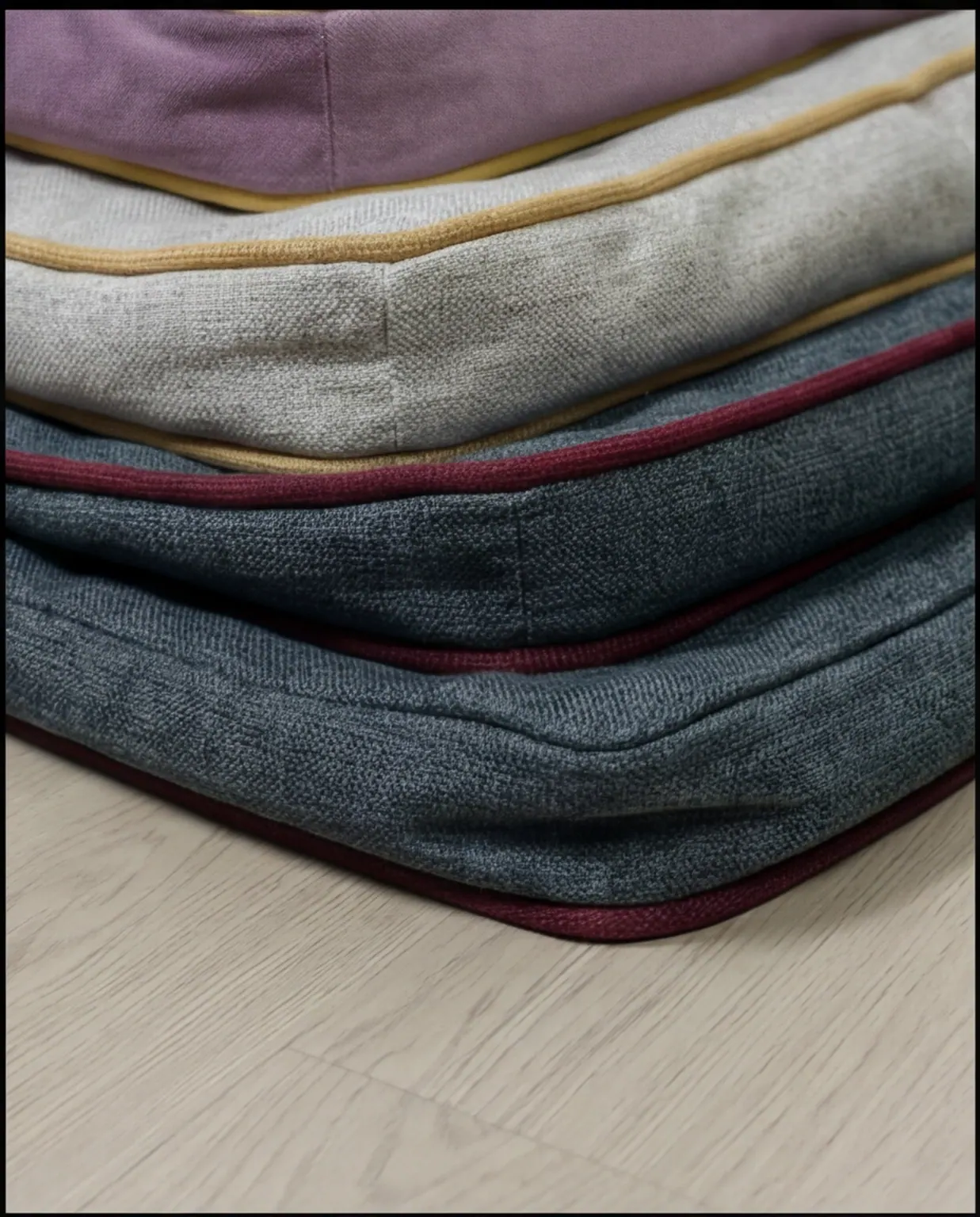
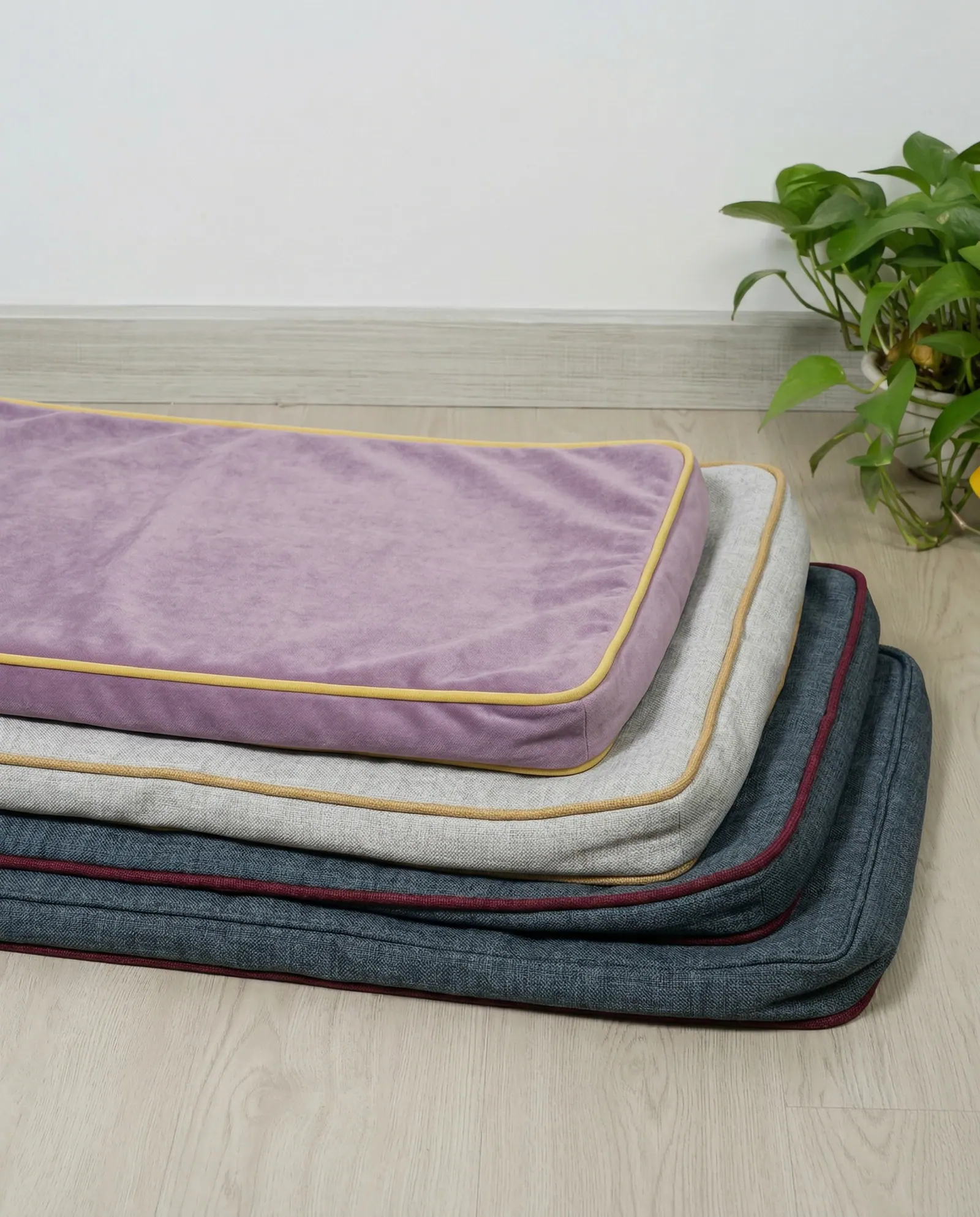
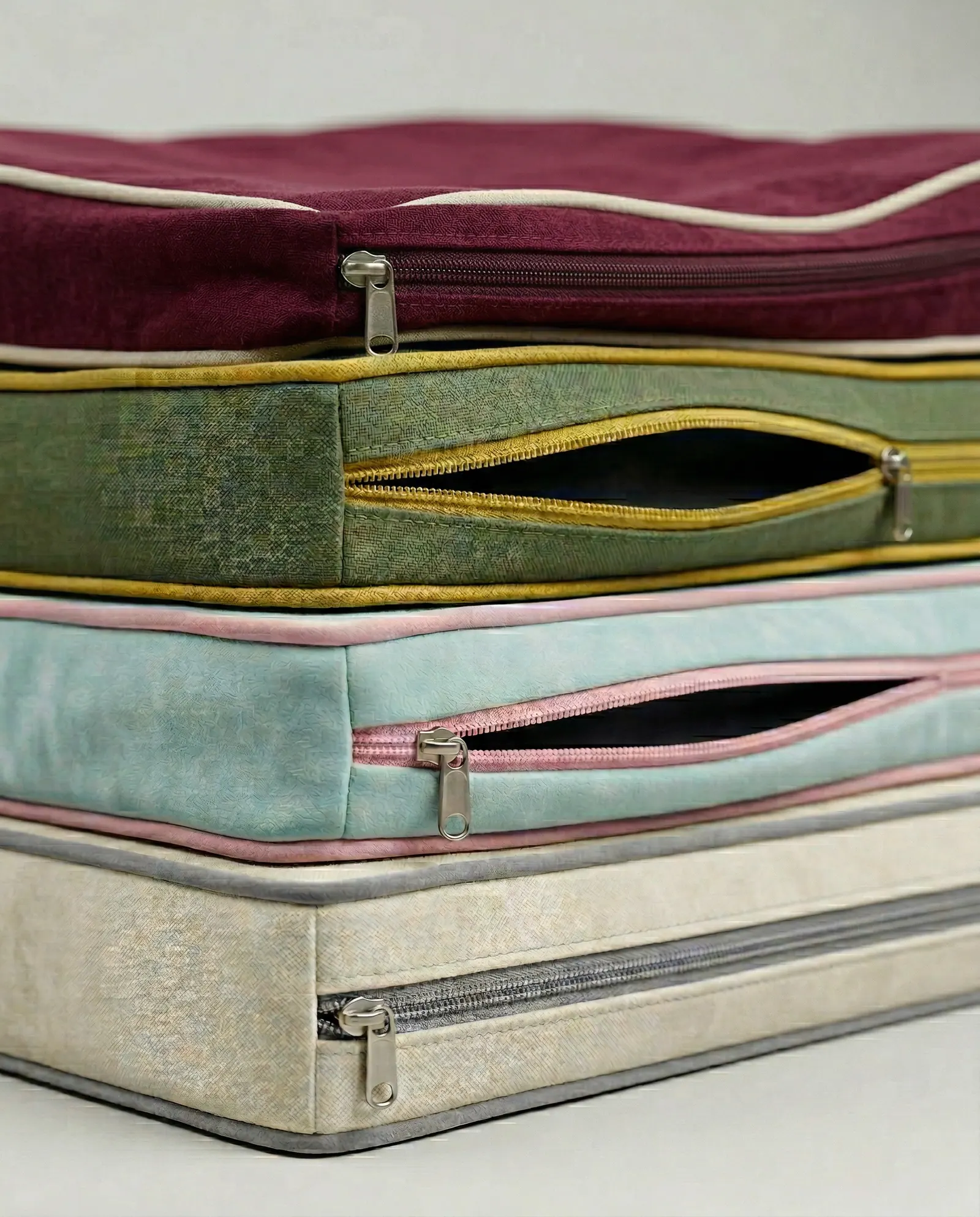
Before you mix a stripe into a room, look at a cushion corner up close. This photograph has no room in it at all, only three stacked custom bench cushion corners on a pale floor, and it's the most useful picture in my drawer.
Start with the weave. The pale gray and slate pads are a heathered linen-look fabric: tiny flecks of lighter and darker thread instead of one flat dye. When you're mixing patterns, that fleck counts as a pattern. It's why a heathered plain sits happily beside a stripe, while a dead-flat solid can look like a hole in the bench.
Then the piping. Gold runs along the gray seam, wine red along the slate. The gold cord sits right on the seam line without a wobble; the wine red shows only when light catches the edge, the more grown-up pairing of the two. At the rounded corner the cord was eased around the curve with no puckers. A straight welt is a kind of honesty. A smooth curved one is honesty with good manners.
A confession: years ago I piped a striped seat in a matched welt and its plain back cushions in a contrast. It looked designed by two committees who weren't speaking. Pick one piping idea per bench and repeat it; our Pattern on piping choices lays out all three.
My rule, kept for decades: one stripe, one plain, one texture, and one color threading through all three. The piping is usually that thread. What are you trying to mix on your bench?
Pinned by Maggie: five things a corner gives away
Five pins mark the heathered gray weave, the gold and wine red cords, the slate linen-look and the eased rounded corner.
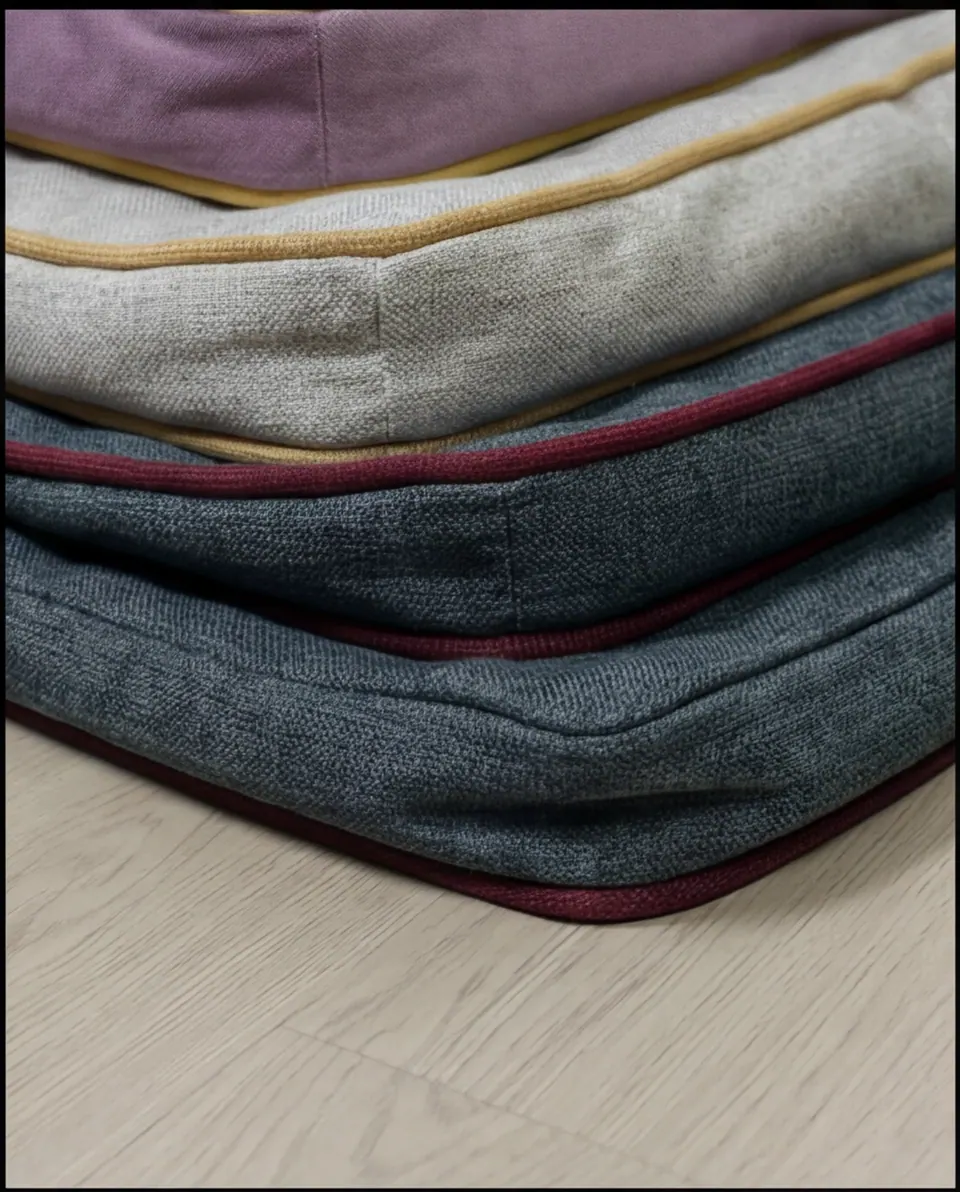
- Heathered gray weave
Tiny color flecks rather than a flat dye make this weave forgiving in daily use.
- Gold piping
The cord sits right on the seam line with no wobble.
- Wine red piping
Only shows when light catches the edge, a quiet, grown-up pairing.
- Slate linen-look
A mid-dark tone that hides marks on a well-used bench.
- Eased rounded corner
Piping eased around the curve without puckering shows careful sewing.
- Heathered gray weaveTiny color flecks rather than a flat dye make this weave forgiving in daily use.
- Gold pipingThe cord sits right on the seam line with no wobble.
- Wine red pipingOnly shows when light catches the edge, a quiet, grown-up pairing.
- Slate linen-lookA mid-dark tone that hides marks on a well-used bench.
- Eased rounded cornerPiping eased around the curve without puckering shows careful sewing.
My checklist for mixing stripes, plains and texture
- One stripe per seating area; let the plains and textures do the rest.
- Stripe colors are woven in, so choose from stripes that exist rather than ordering your own two colors.
- Take the piping color from the stripe and run it along the plain pieces.
- Use a heathered or slubby plain to bridge a busy print and a flat solid.
- Order swatches of all three together and judge them side by side on the bench, in daylight.
One 90 in cushion, one lost sample pack and a rush bolster
A buyer in the US first asked about a 102 x 18 in (259 x 46 cm) cushion for an extra-long built-in bench. The workshop offered two 51 in (130 cm) halves but confirmed one piece was possible, which is the sort of straight answer I like.
They ordered samples first. The first pack was lost by the carrier and sent again. They chose a light green linen, confirming a tone slightly lighter than its neighbor on the card, and ordered a single 90 x 18 in (229 x 46 cm) cushion.
They loved how comfortable it was and came back for a matching round bolster, 6 in (15 cm) in diameter and 67.5 in (171 cm) long, paying a rush fee so it reached the carrier within 2–3 days for an event.
Two notes for your list. A long bench can be one continuous cushion. And order fabric swatches before committing to a subtle green.
Buyer questions: an S-curve, a 2 in pad and a stripe that can't be re-colored
- A common question
Could you make a bench cushion with an S-shaped curved edge, like an ogee?
The workshop's answerAt first the workshop said no, because a complex S-curve risks not fitting exactly. When the buyer supplied a full template, the most experienced master craftsman agreed to take it on. It cost more than a plain trapezoid of the same size, and the finished cushion was delivered and loved.
- A common question
Can you make a really thin cushion, 2 or 3 inches?
The workshop's answerYes. A windowsill cushion was quoted at exactly 2 in (5 cm) high so the window above could still close. Thinner cushions can also cost less, which is why buyers sometimes drop from 6 in to 4 in, as with a 48 x 20 x 4 in (122 x 51 x 10 cm) seat.
- A common question
Can I pick the two stripe colors myself and add a third color for the piping?
The workshop's answerNot the stripes: they're woven into the fabric, not sewn on, so their colors are fixed by the cloth. A different piping color is no problem. When one buyer wanted brown stripes and none existed, the workshop pointed them to the closest stripe, a beige one.
On the cutting table: three corners, two cords
| Product | Bench cushion pads, rectangle, box edge |
|---|---|
| Fabric | Heathered linen-look in pale gray and slate blue, with a lilac pad in the stack |
| Piping | Contrast: gold on gray, wine red on slate |
| Corners | Rounded, with the cord eased around the curve |
| Stripes | Colors woven in and fixed; piping color is free |
| Long benches | One continuous piece possible, e.g. 90 x 18 in (229 x 46 cm) |
| Matching bolster | 6 in (15 cm) diameter x 67.5 in (171 cm) |
| Best for | Benches that mix a stripe, a plain and a texture |

Have it made
Have this made — ask Maggie’s workshop
Have the tape measure handy when they call. Old cushions shrink and sag; the seat underneath does not. — Maggie
Leave your details and the workshop will call you to confirm measurements, fabric, foam and piping. No prices, dates or payment on this page: it is a request, not an order.
Mix a bench cushion like a good dinner table: one stripe, one plain, one texture, and one piping color threading through all three.
Maggie
Questions buyers ask next
What makes a heathered linen-look easier to live with than a flat solid?
The small flecks of lighter and darker thread break up the surface, so lint, crumbs and shadows blend in instead of standing out. The same flecked surface reads as a gentle texture, which helps a plain sit comfortably next to a stripe.
How can you judge the sewing on a piped cushion from a photo?
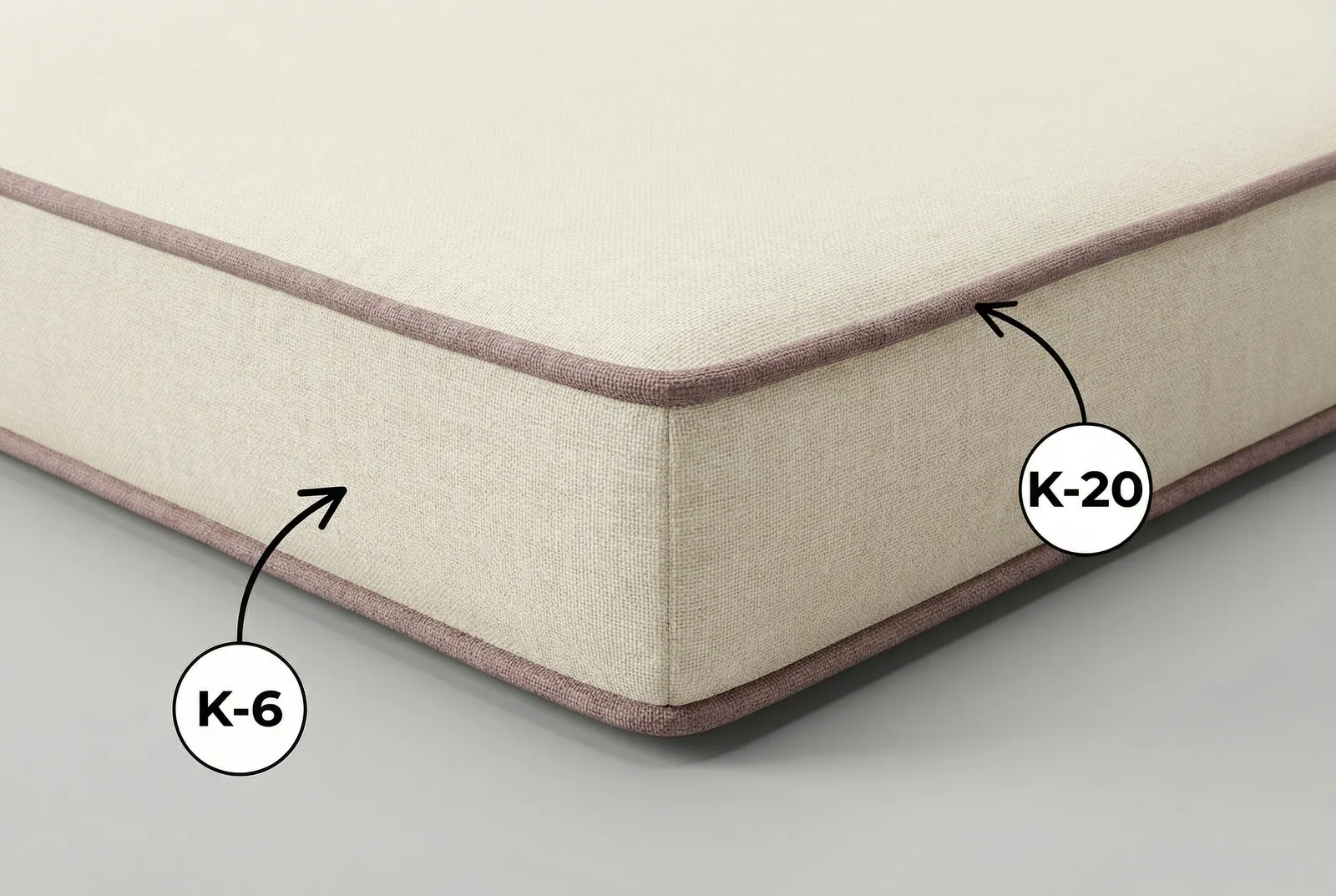
Zoom in on the corners. The cord should sit exactly on the seam line and follow a rounded corner without puckers or flat spots. A welt that drifts off the seam or bunches at the curve tells you the sewing was rushed.
Should bench cushion piping match the stripe or the plain fabric?
Either can work, but choose one idea for the whole bench and repeat it. Pulling the piping color from the stripe and running it along the plain pieces ties the two fabrics together without adding a new color.
Stitch straight — Maggie
More photographs to read
 Save
 Save
 Save
 Save
 Save
 Save