 Save
A Reading by Élodie
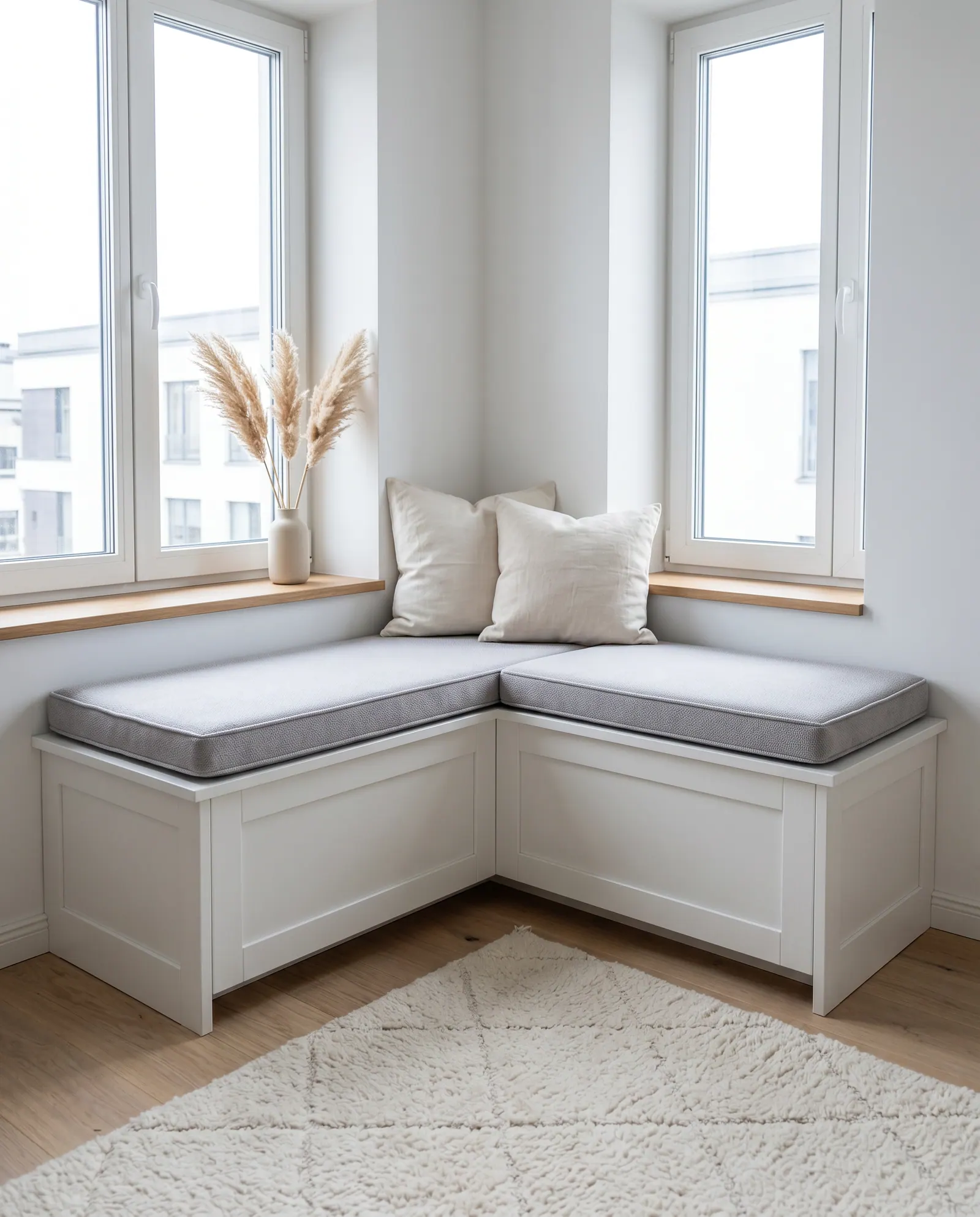
A silver-gray pet friendly cushion corner, and the two soft props that frame it
Pewter, oatmeal and a little leaf green. A corner photograph in which the props agree to stand back.

Swatch strip measured from the photograph
- mist#d2d1d124%
- oatmeal#aaa59f24%
- umber#665c5319%
- deep walnut#433a3117%
- taupe#857e7515%
The quick answer
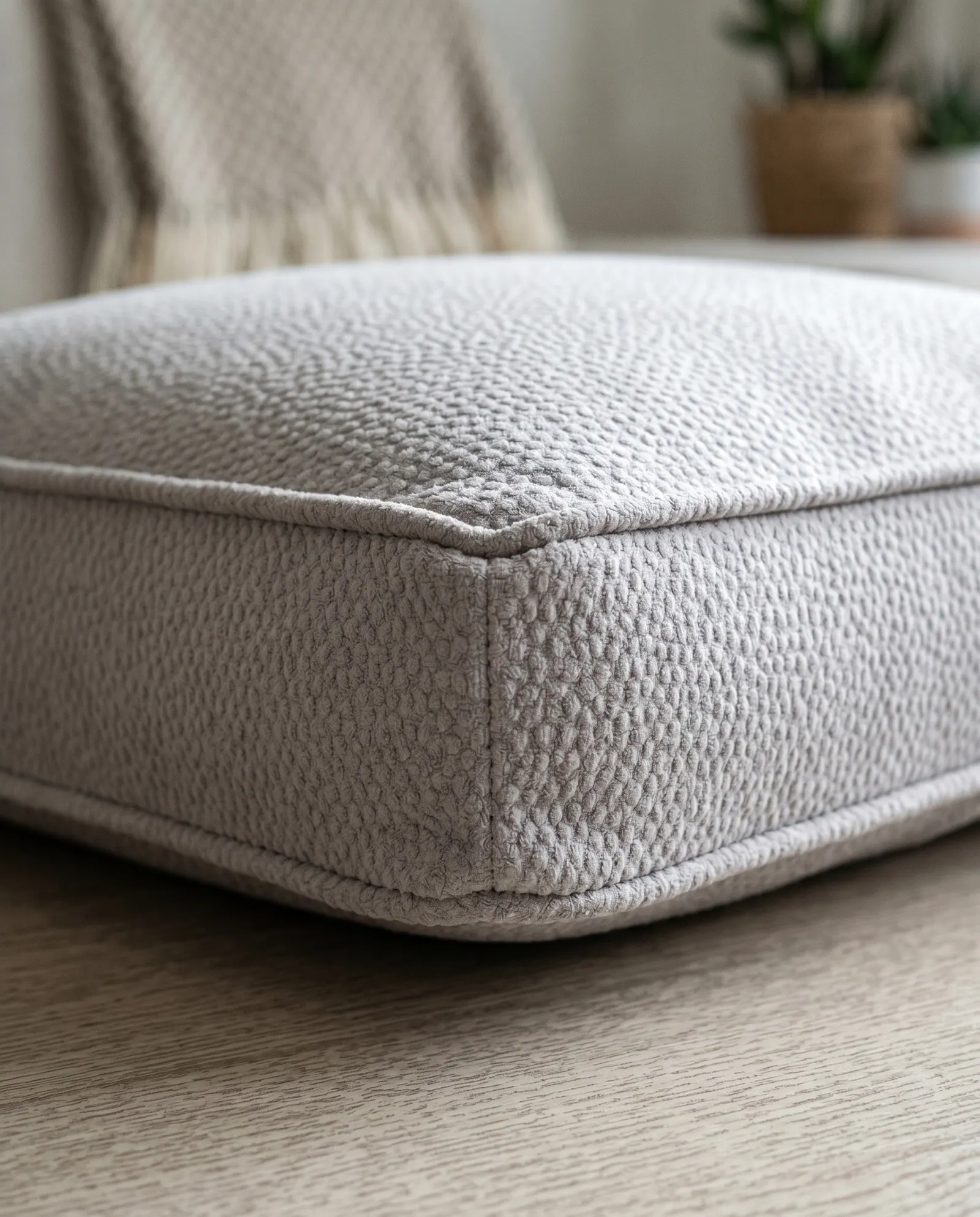
In a close-up of a pet friendly box cushion, the props should stay soft so the stitching leads: here a cream fringed throw and a plant in a woven basket sit out of focus behind a silver-gray corner. To copy it, use one textile and one living green, keep both behind the edge you want seen, and light the corner from the side.
The corner's palette, prop by prop
Five colors, and each one has a job.
- Silver gray pebble weave#A9AAABThe cushion. A pebble texture scatters soft light, so the surface reads calm and even.
- Oatmeal cream fringe#E8E0CEThe throw. Warmer than the gray, so the corner never turns cold.
- Basket straw#B99B6BThe woven basket, a second small-scale texture that echoes the weave.
- Leaf green#5F7A4BThe plant. The only living color, kept small and blurred.
- Pale oak#D8C4A2The surface. Light wood lets the gray read silver rather than steel.
Why the throw and the plant are out of focus
The sharpest thing in this photograph is a seam, and everything else was arranged to let it be.
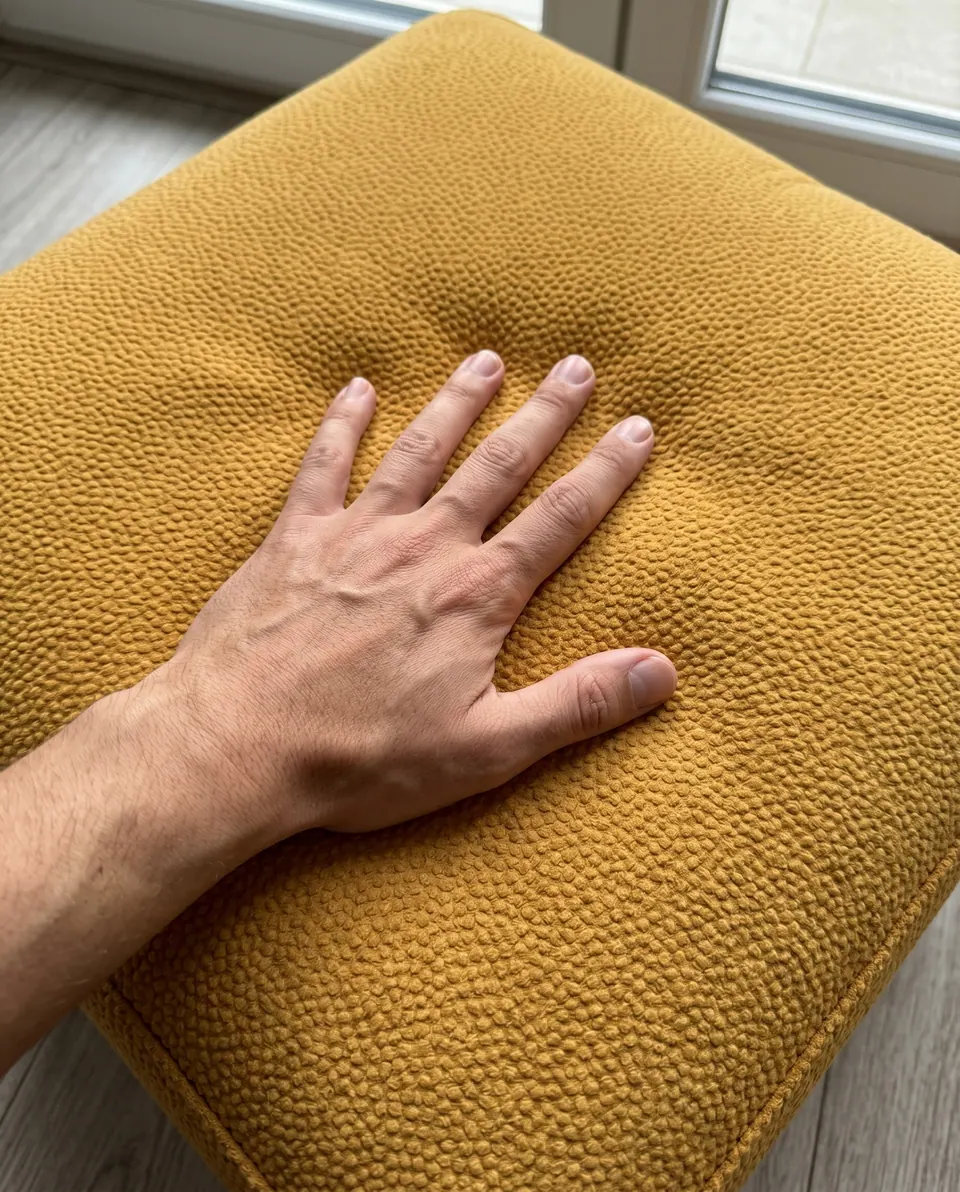
It is a close-up of one box corner on pale oak. The fabric is a silver-gray pebble weave from the performance and pet-friendly family. Two welts of self piping, one on the top edge and one on the base, meet the corner squarely with no bunching. The side wall, the gusset, is straight and taut, which tells you the foam and the cover were cut to the same size.
Now the props, my friends. A cream fringed throw sits behind on one side, a plant in a woven basket on the other, both deliberately soft. The throw adds warmth, because a cool gray alone on pale wood can feel clinical. The basket repeats the small-scale texture of the weave in straw. The leaves are the one living color. Neither prop is sharp, so neither competes with the stitching.
To copy it at home or for a photo of your own cushion:
- One textile and one plant. No more.
- Both behind the corner, never in front of it.
- Soft side light from a window, no lamp.
- Props warmer than the cushion, so gray reads silver.
What would you put beside your corner? Daylight never lies; your screen sometimes does. See more pet-ready shapes under pet-friendly cushions, and read box edge vs knife edge for how the welts work.
Pinned by Élodie: four marks of a good corner
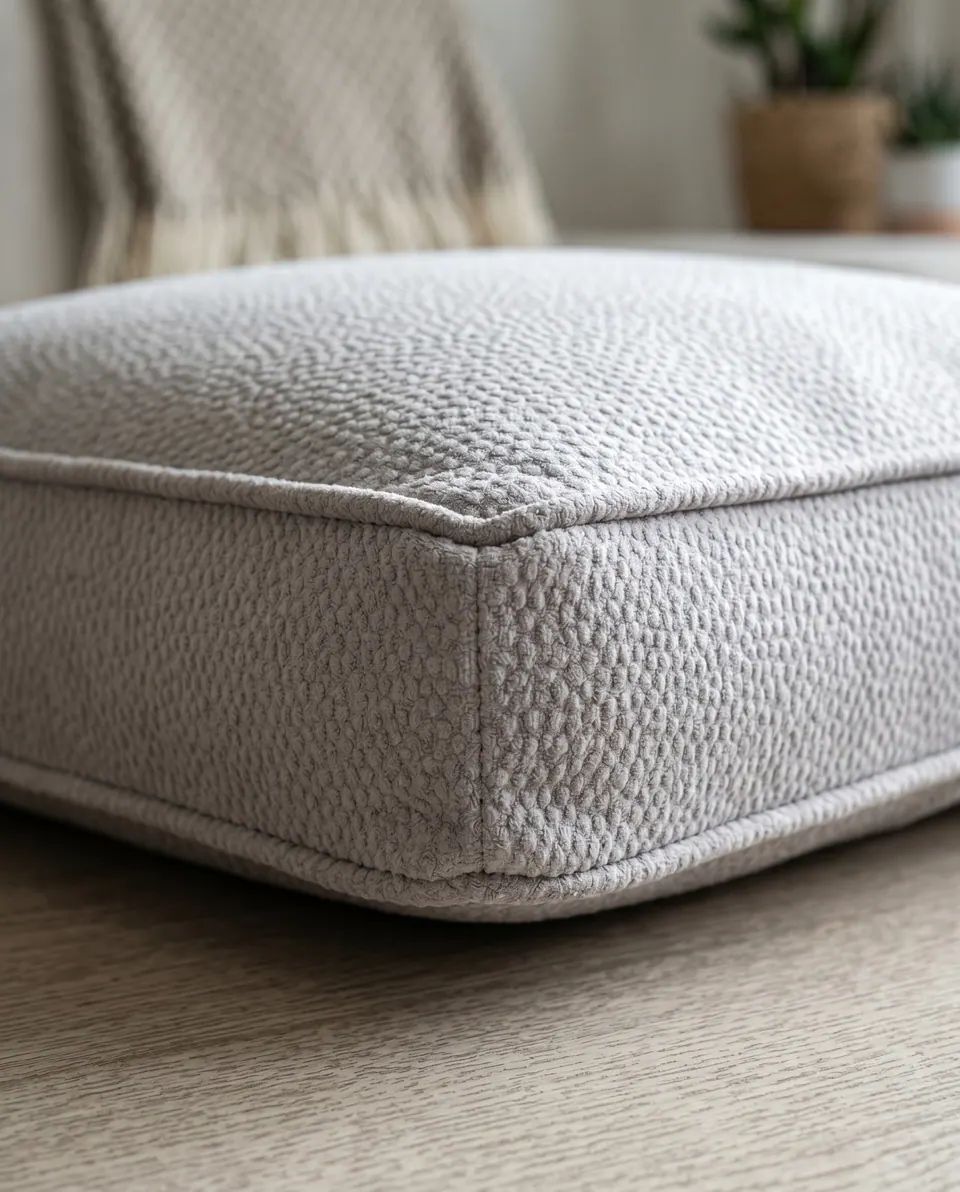
Four pins, from the top welt turning the corner to the bottom welt on the base.
- Piped box corner
The top welt turns the corner cleanly with no bunching, the sign of a well-cut gusset.
- Side gusset
A straight, taut side wall shows the foam fills the cover fully.
- Bottom piping
A second welt on the base edge keeps the shape square top and bottom.
- Pebble surface
The pebble pattern stays regular across the top panel.
- Piped box cornerThe top welt turns the corner cleanly with no bunching, the sign of a well-cut gusset.
- Side gussetA straight, taut side wall shows the foam fills the cover fully.
- Bottom pipingA second welt on the base edge keeps the shape square top and bottom.
- Pebble surfaceThe pebble pattern stays regular across the top panel.
Mint cushions at 7 inches, then two bolsters
A buyer in the US had a wood-frame couch whose seat and back cushions were worn out. She sent photos and the size: 71 x 25 in (180 x 64 cm), 7 in (18 cm) thick. The workshop made the seat and backrest 7 to 8 in (18 to 20 cm) thick in mint, matching the originals so the seat height would not change.
She loved them and came back for two cylinder side bolsters, first at 27 in, then corrected to 22 in (56 cm). When a tufting button later came loose, the workshop sent her a video showing how to sew it back on. The Pattern on replacement sofa seat cushions walks through the same thickness rule.
Buyer questions: the boxes you fill in at checkout
- A common question
The listing won't let me check out until I fill in personalization. What goes there?
The workshop's answerJust your phone number. The delivery company uses it to reach you, and nothing is printed on the cushion.
- A common question
Can I see real fabric samples first, and how do I ask for particular colors?
The workshop's answerYes. Samples come through a separate fabric-samples listing, where you pay only the sample shipping; some listings also offer 'fabric sample' as an option. Write the codes you want, for example L-57, L-58, L-79 and L-80, in the note to seller or the personalization box, and they are sent together.
- A common question
I need the cushion by a certain date. Can you rush it?
The workshop's answerUsually, if you order promptly. The workshop marks the order urgent, puts it first in production and can ship express. Write the deadline in the personalization box and send a message right after ordering; a deadline raised late is harder to meet.
On the cutting table: the gray corner
| Detail | Box cushion corner, close-up |
|---|---|
| Fabric | Silver-gray pebble performance weave |
| Piping | Self piping on the top and bottom edges |
| Side wall | Taut and straight: foam and cover cut to the same size |
| Props | Cream fringed throw, plant in a woven basket, both blurred |
| Surface | Pale oak |
| Light | Soft and diffused, from the side |
| Replacement rule | Match the original thickness so seat height stays put |

Have it made
Have this made — ask Élodie’s workshop
Color is easier to settle in a conversation than on a screen. Tell the workshop about the room and the light it gets, and the fabric choice follows. — Élodie
Leave your details and the workshop will call you to confirm measurements, fabric, foam and piping. No prices, dates or payment on this page: it is a request, not an order.
Ask a cushion maker for a close-up of one box corner: two welts meeting squarely and a side wall with no ripples say more about fit than any room photo.
Élodie
Questions buyers ask next
What does piping on both edges of a box cushion do?
A welt on the top edge and another on the base define both faces, so the cushion keeps a square profile top and bottom. In self piping the same color as the body, the edges read crisp without drawing an outline.
Why photograph a cushion close-up against a blurred background?
So the eye goes to the workmanship: the corner, the welts and the side wall. Soft, out-of-focus props like a throw or a plant say it is a home without competing with the stitching you are trying to judge.
Is a pebble-textured gray weave a sensible pet friendly cushion fabric?
It is a practical choice: a textured surface tends to show small marks less than a flat solid, and a mid-tone silver gray sits between pale and dark coats. No fabric stands up to every claw, so read the fabric family notes first.
How thick should replacement couch cushions be?
As thick as the originals. One wood-frame couch had 7 in (18 cm) cushions, so the new seat and back were made 7 to 8 in (18 to 20 cm) thick to keep the seat height where it was.
With color and care — Élodie
More photographs to read
 Save
 Save
 Save
 Save
 Save
 Save