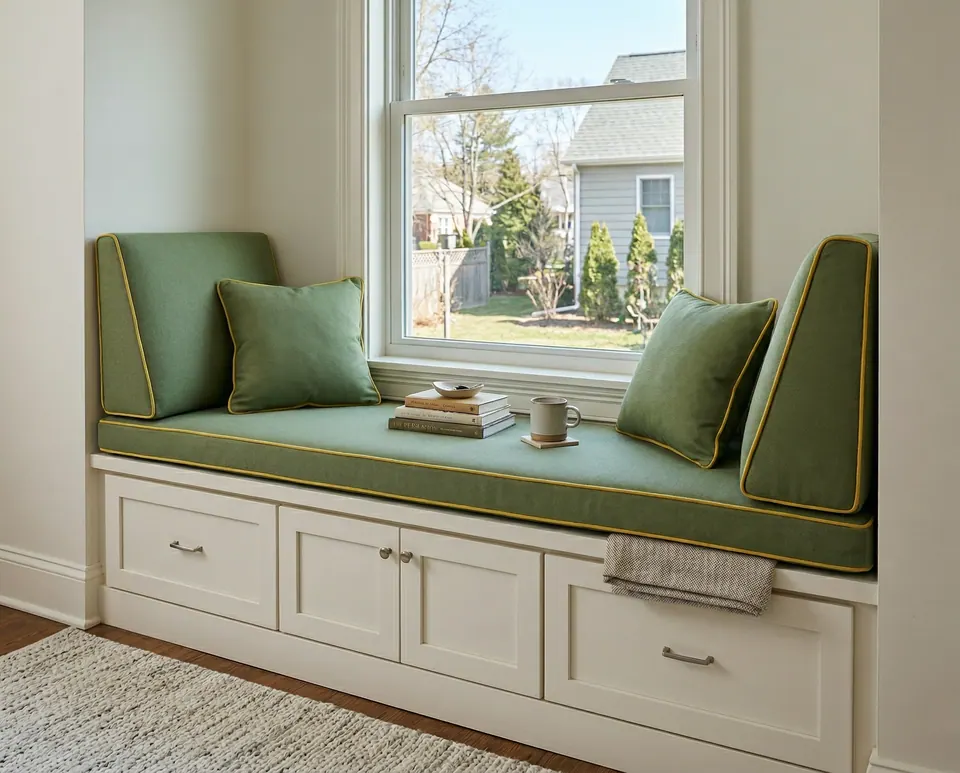
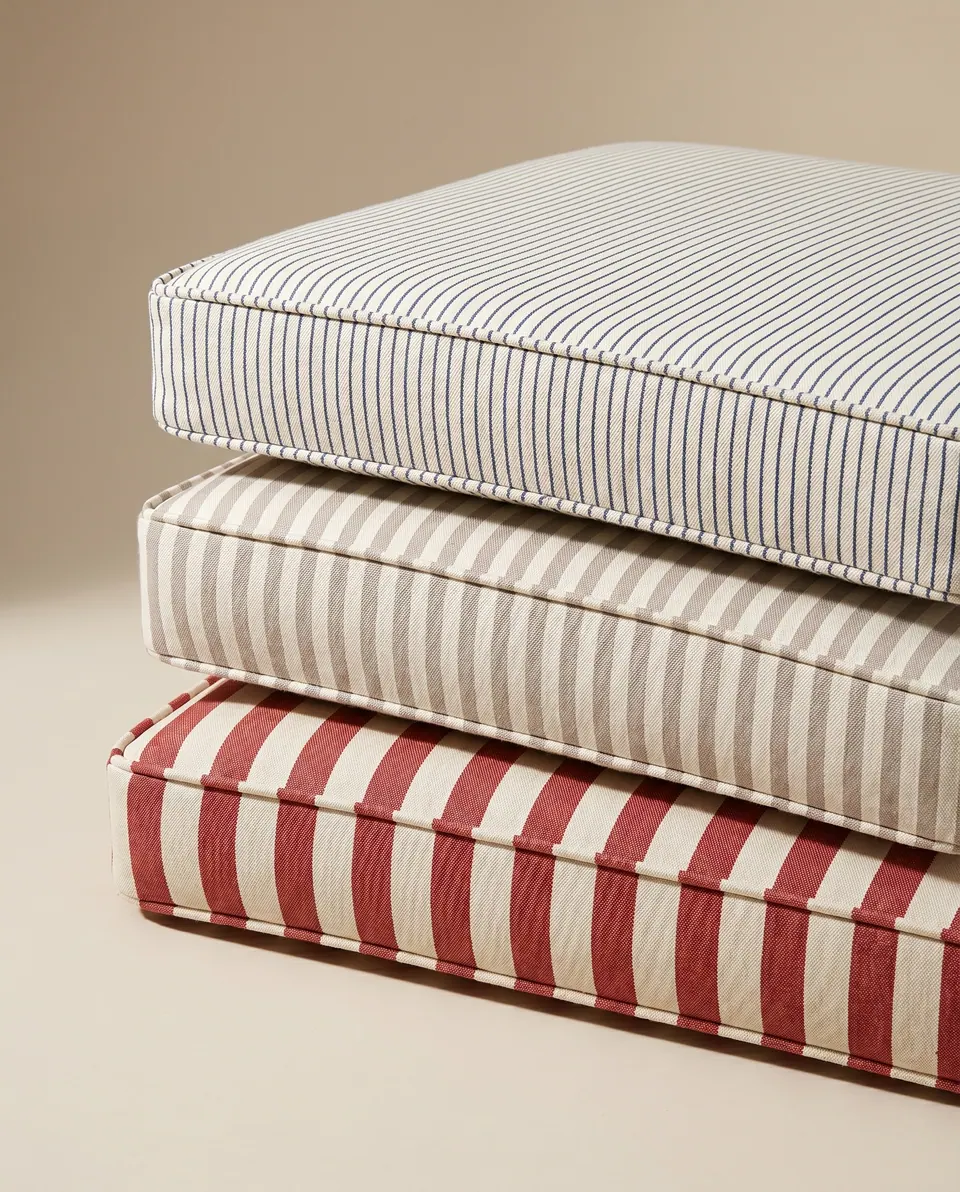
A Reading by NateBench Cushions
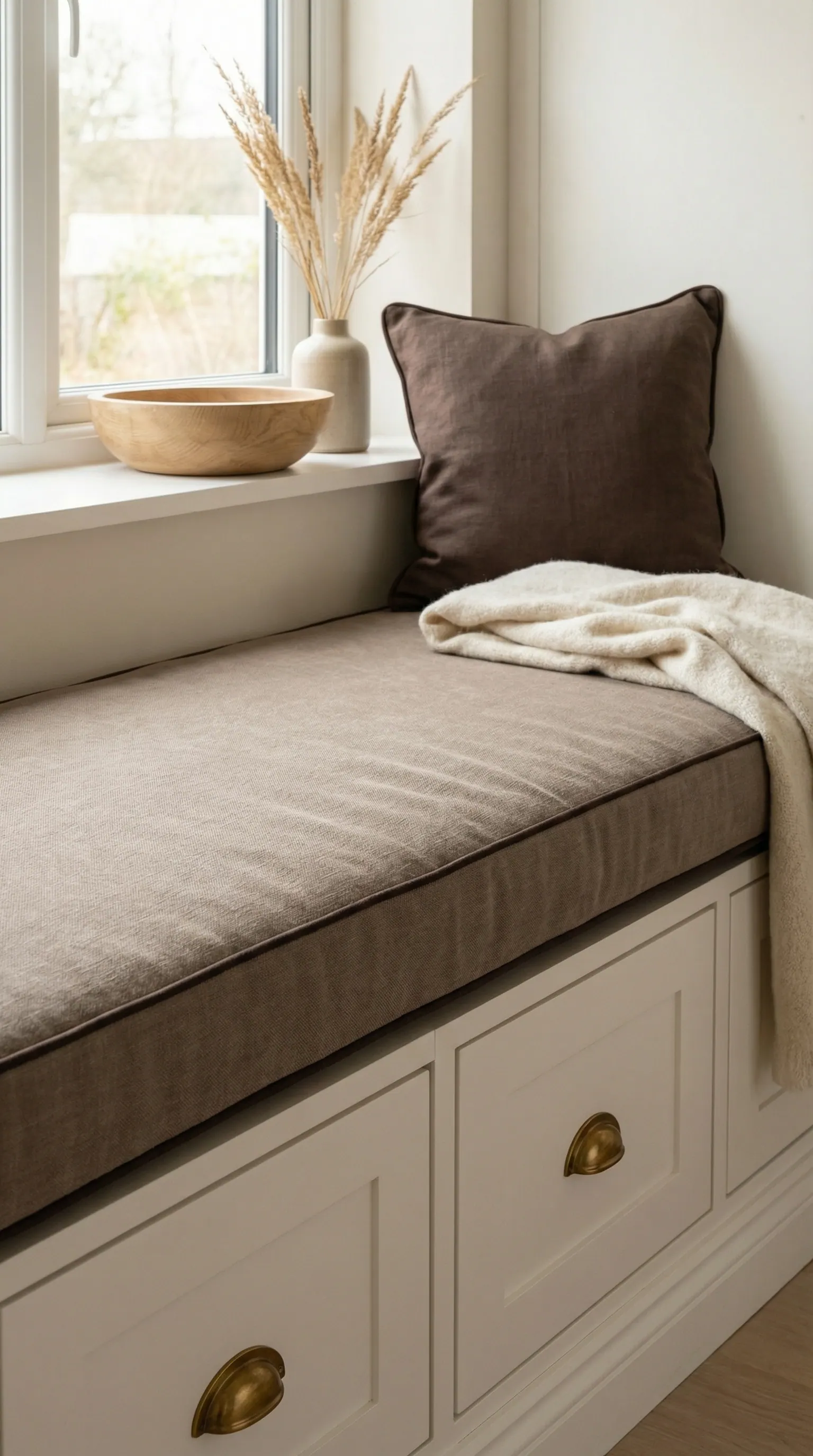
Anatomy of a custom bench cushion in sand and chocolate brown
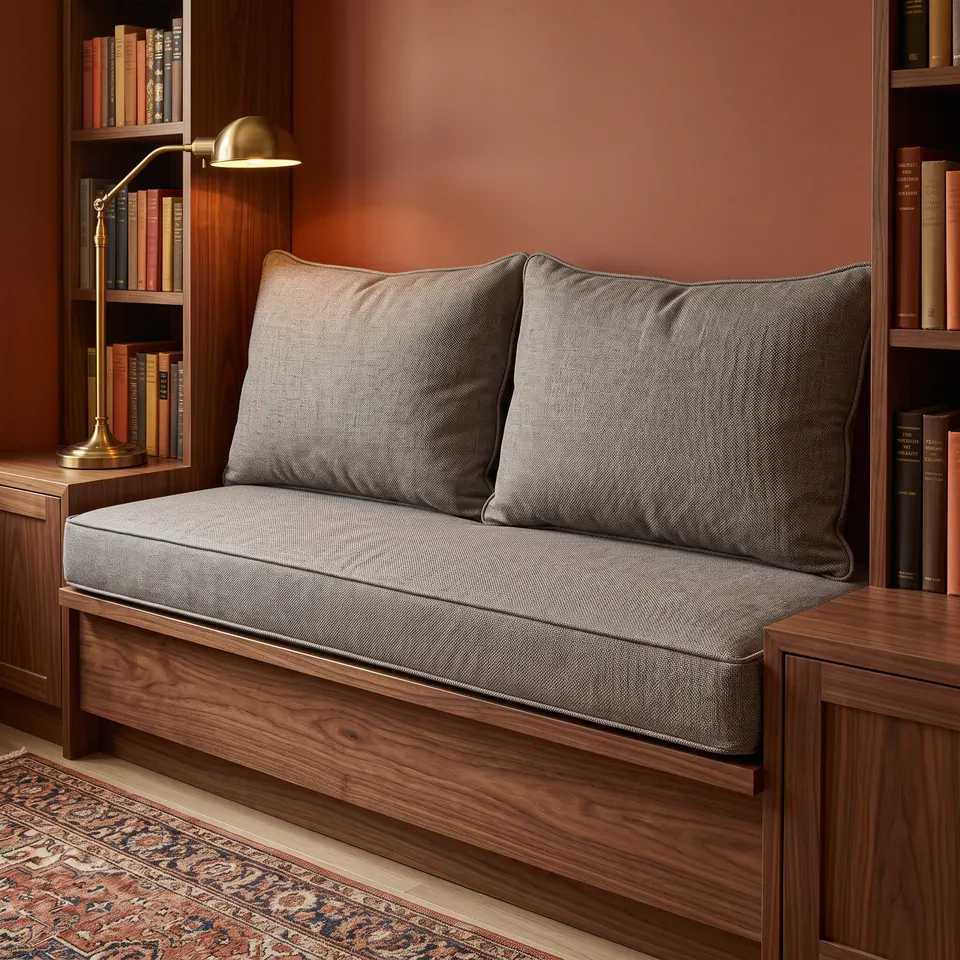
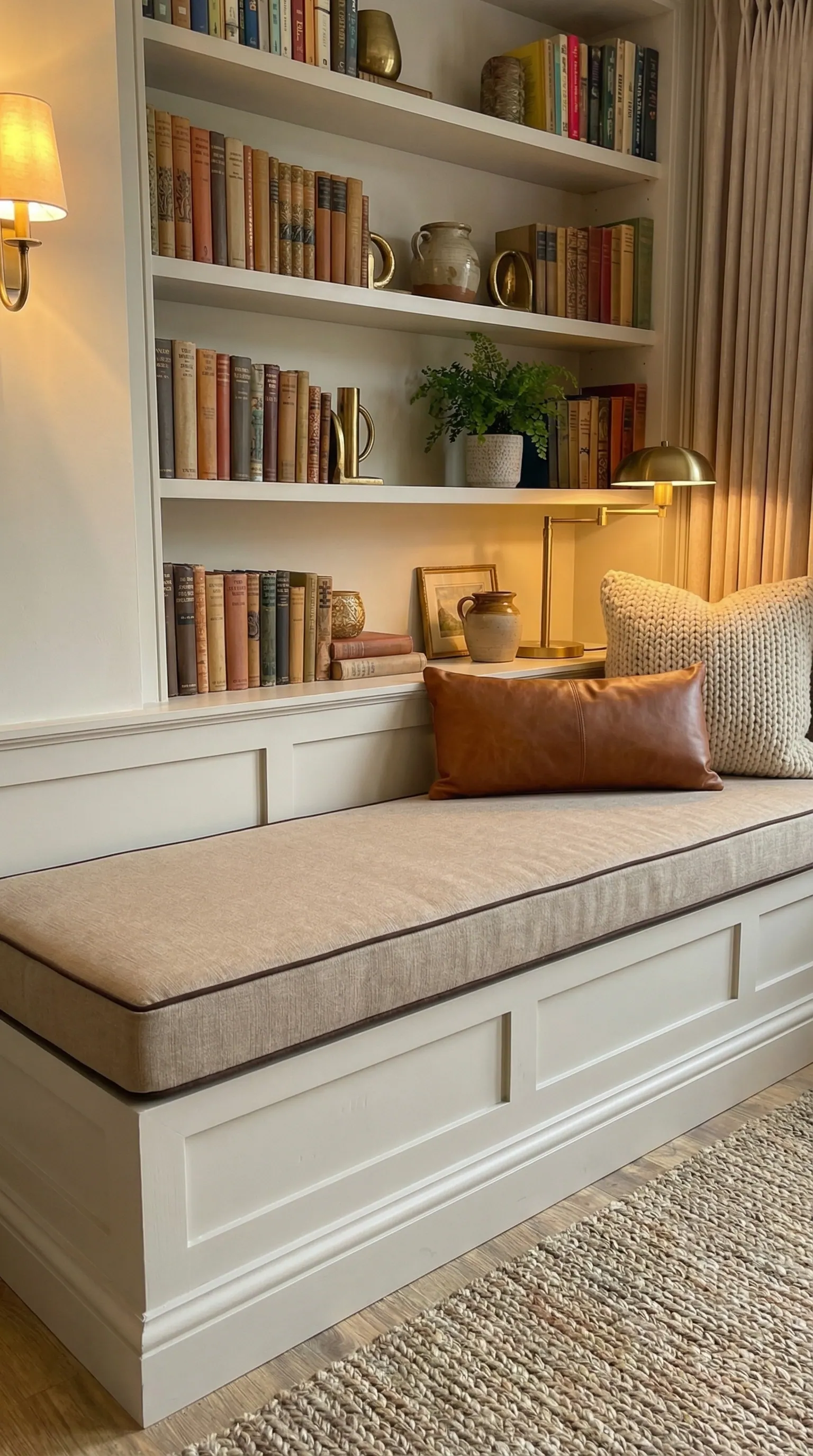
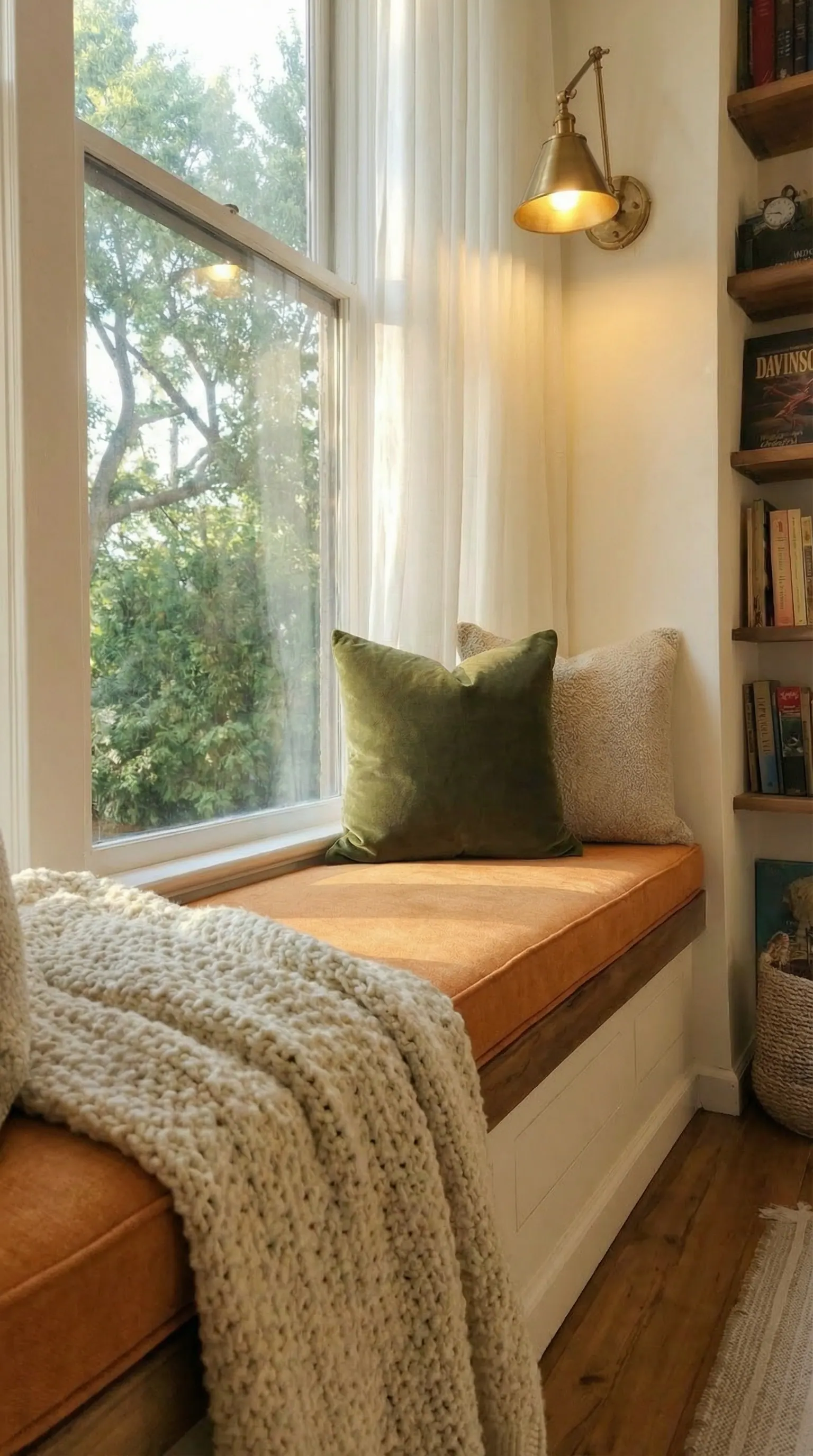
Six layers of color between a jute rug and a brass lamp, and one brown line holding them in register. I read this library bench from the floor up, the way I read a drawing.

 Save
The quick answer
A sand linen-look custom bench cushion with chocolate brown piping works in a wood-and-leather reading nook because the sand sits close to old book pages and the brown repeats the spines and the leather. Cut a long built-in bench as one continuous piece so no seam lands where you sit, and test the swatch under your evening lamp.
The cushion, cut open
Cover fabric. A removable, zippered cover. Machine wash at 86°F (30°C) on a gentle cycle and air dry.
Piping. A fabric-covered cord sewn into the seams. It sits on the seam line, so it does not change the size.
Fiber wrap. Polyester fiber (Dacron) batting around the foam: it fills the cover out and softens the edges.
Foam core. About 2.0 lb/ft³ (32 kg/m³) high-resilience foam, firm to medium-firm, cut to the ordered size.
Zipper. Along the back band, as hidden as possible. The zipper side faces down or toward the wall.
Base panel. The underside of the cover. A non-slip fabric backing can cover the whole of it instead.
Pinned by Nate: five points on the drawing
Five pins, from the one-piece sand seat to the brass sconce that lights the far end of the bench.
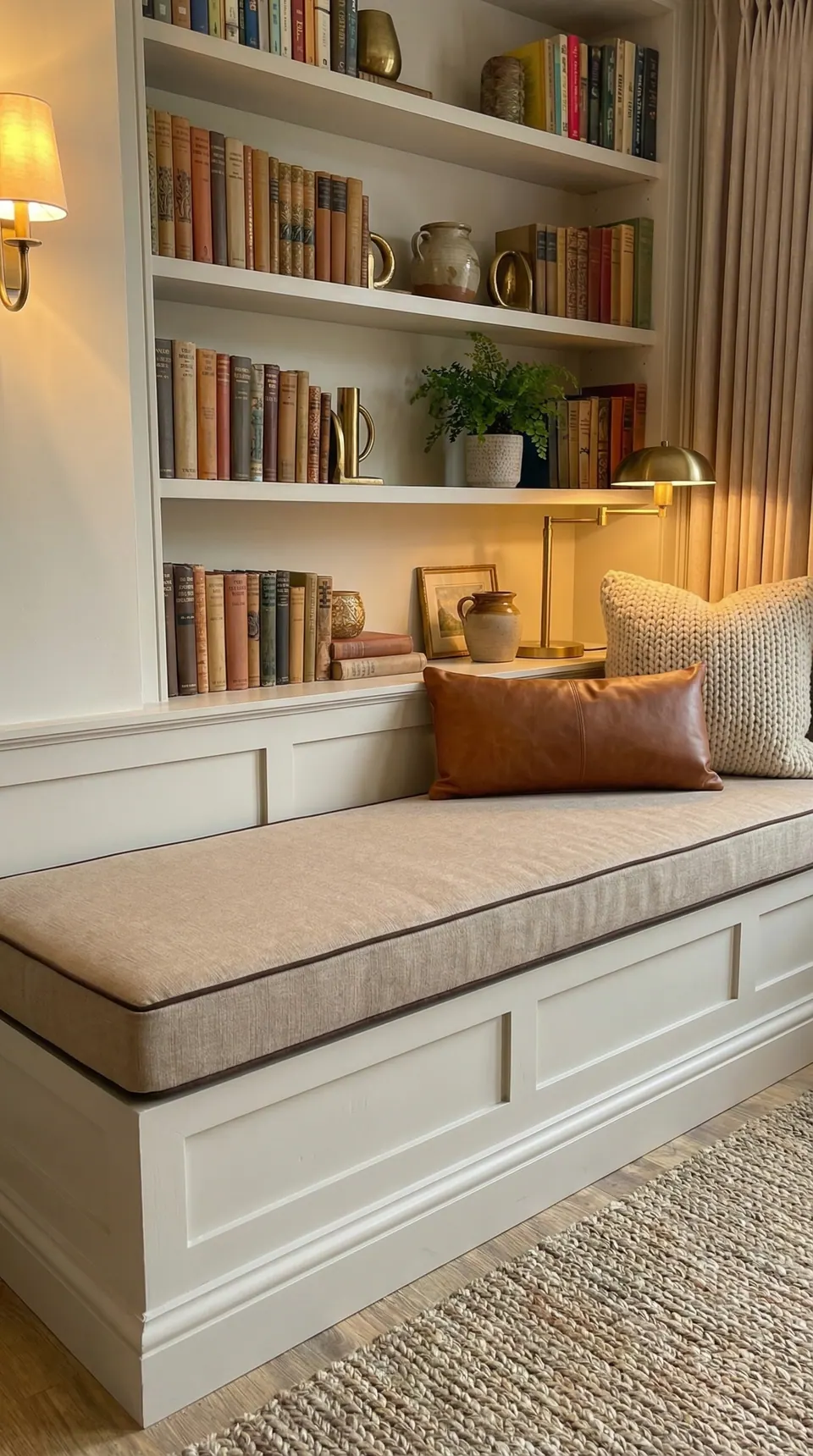
- Sand seat top
One continuous cushion avoids a seam across a bench this long.
- Chocolate piping
Brown piping echoes the leather and old book spines and outlines the seat in lamplight.
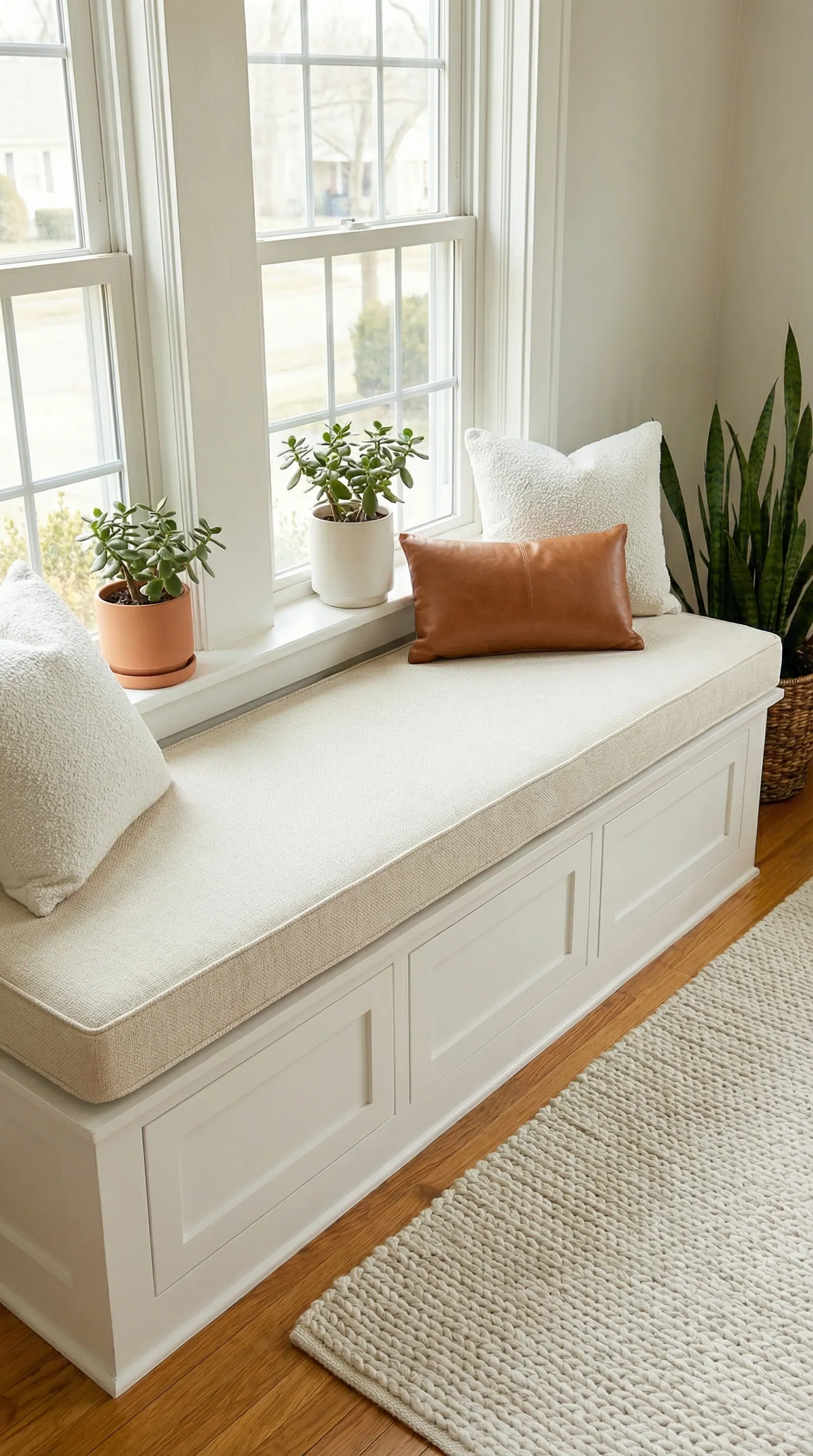
- Leather lumbar
Cognac leather against a matte weave is the classic library contrast.
- Brass desk lamp
Warm lamplight makes the sand fabric glow; test your sample under a bulb too.
- Brass sconce
Wall lights at both ends make the bench usable for evening reading.
- Sand seat topOne continuous cushion avoids a seam across a bench this long.
- Chocolate pipingBrown piping echoes the leather and old book spines and outlines the seat in lamplight.
- Leather lumbarCognac leather against a matte weave is the classic library contrast.
- Brass desk lampWarm lamplight makes the sand fabric glow; test your sample under a bulb too.
- Brass sconceWall lights at both ends make the bench usable for evening reading.
The cross-section, floor to lamp
| Layer | Color | Job it does |
|---|---|---|
| 1. Floor | Jute rug, straw tan | Keeps the base casual so the library never turns stiff |
| 2. Seat top | Sand linen-look weave | Sits one step away from the color of old book pages |
| 3. Front edge | Chocolate brown welt | Draws the seat outline when the room goes dim |
| 4. Pillows | Cognac leather, cream cable-knit | Smooth against matte, chunky knit against flat weave |
| 5. Shelves | Cloth-bound spines, stoneware, one green plant | Supplies the browns the piping repeats |
| 6. Light | Two brass fixtures, a full-length linen curtain | Warms the sand at night, softens it at noon |
Why the welt is chocolate and not cream
On a drawing, the part is light and the dimension line is dark. This custom bench cushion works the same way. The sand top is the part. The chocolate piping is the line that tells you where it stops.
That matters after sunset. Under the brass desk lamp and the pleated sconce, sand fabric warms up and drifts toward the color of the books behind it. A cream welt would drift right along with it, and the seat would lose its edge. Brown holds. It repeats the old cloth spines on the shelves and the cognac leather lumbar, so it reads as part of the room instead of trim added on top.
Proportion next. The bench runs the full width of the shelving, and the cushion runs with it as one continuous piece. No seam across the middle, which is exactly where two readers end up sitting. The box edge stays modest, so the cushion tucks below the first shelf instead of crowding it.
Every prop carries a load. The cognac lumbar is the one smooth surface against a matte weave. The chunky cable-knit pillow matches the sand in value, so it adds texture without adding a color. The potted plant is the only green, set high on the shelves. The linen curtain filters daylight so the sand does not go flat at noon.
The test I make everyone run: tape the swatch to the bench, look at it at 9 p.m. under your own bulbs, then again at breakfast. More on that in screen versus daylight color. The weave comes from the linen-look family, the bench sits with the other bench cushions, and you can size one in the bench cushion builder.
What color do the spines on your shelves turn at night?
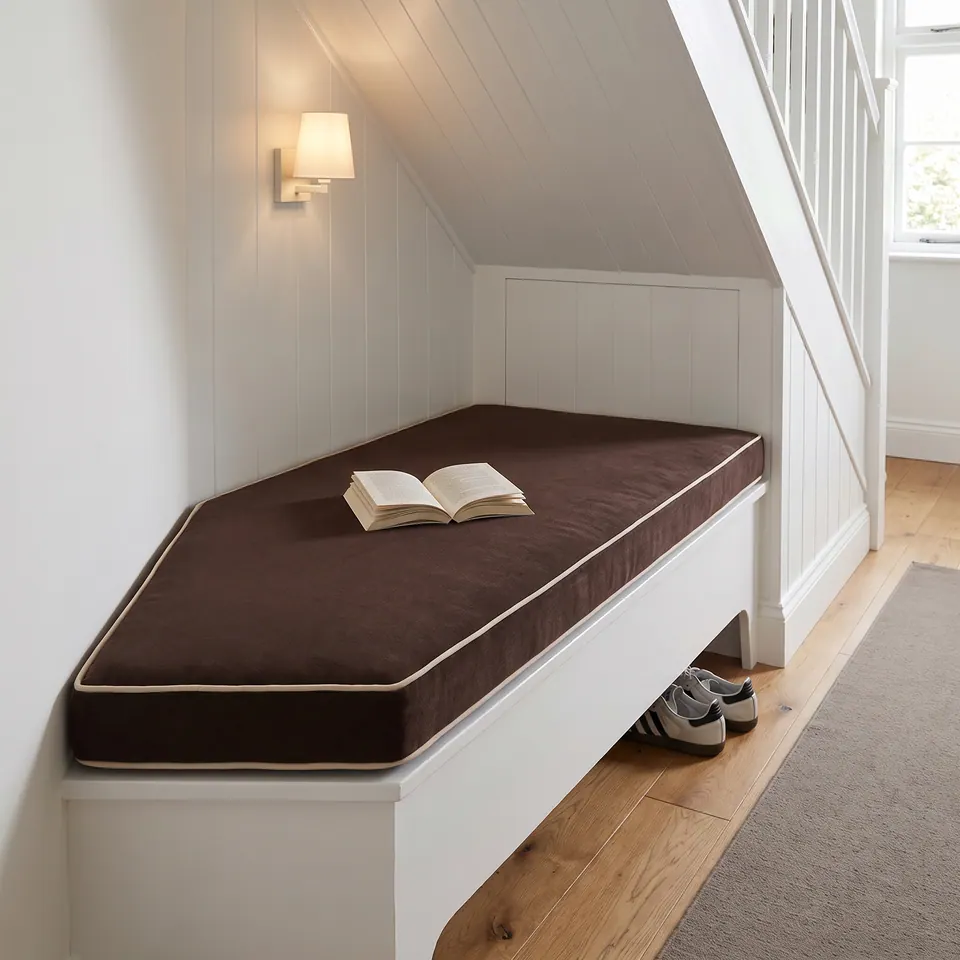
A 117 3/4 in bench with one curved end
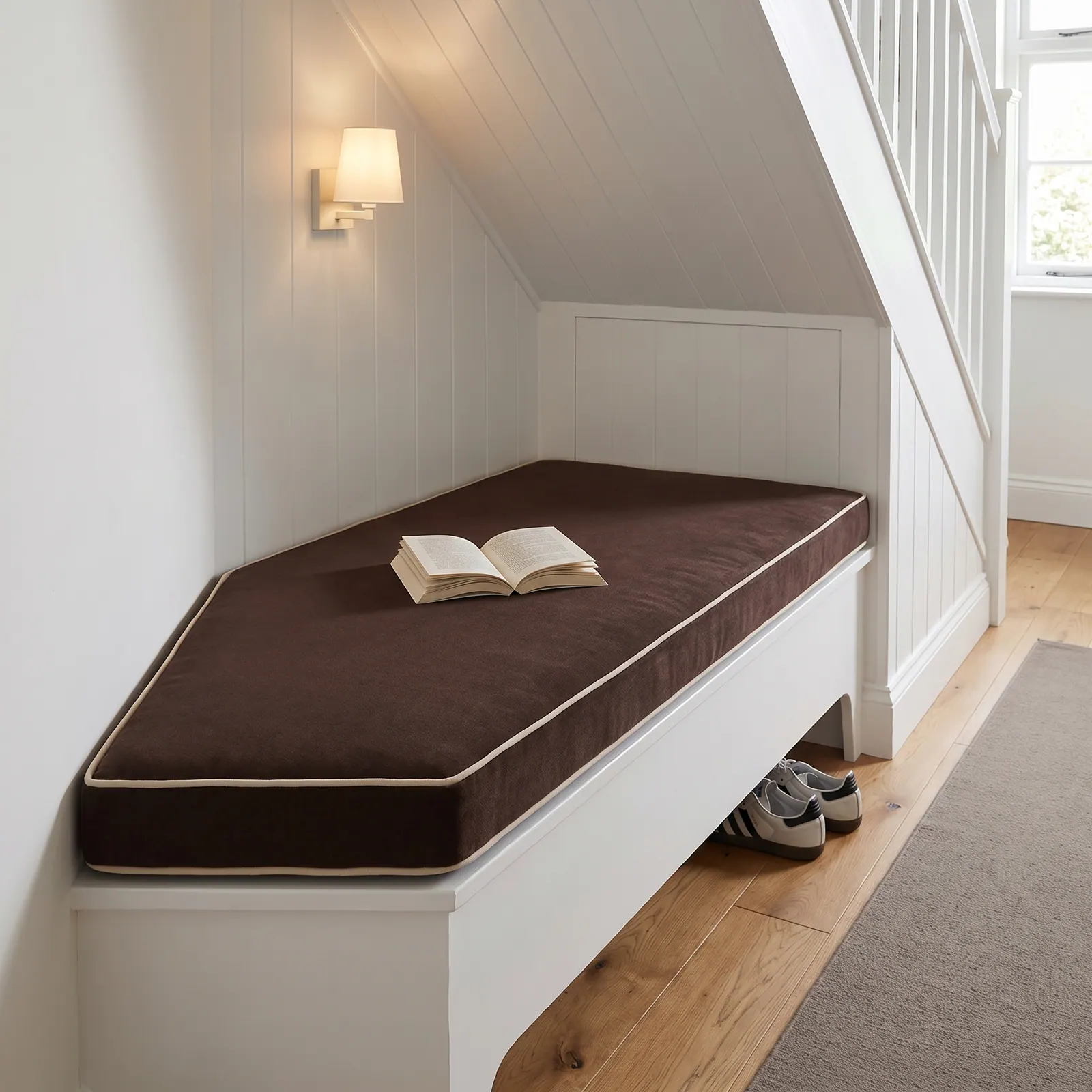
One buyer wrote in with a family bench 117 3/4 in (299 cm) long, one end curved, and kids in the house. The shop moved it to the custom-shape option and asked for a drawing.
Two numbers go on that drawing for the curve, partner. The curve depth, from the top of the curve to the bottom. The curve span, between where the curve starts and where it ends. Straight length alone buys you a rectangle with a bite missing. The method is in curved cushion measurements.
The bench could be made as one piece or split in two, and at that length both are reasonable; one piece or two walks through the trade-off. For the kids, the shop explained that its velvet, its linen and its own fabric family all wash at 86°F (30°C), and that velvet is the easiest of the three to spot-clean.
Measure twice; the fabric remembers.
Buyer questions: bench questions with numbers in them
- A common question
I don't have the original cushions anymore. Could you make a wedge-shaped back cushion or two for my bench?
The workshop's answerYes. Send a reference photo or a simple diagram of the wedge with its dimensions, and the shop quotes it together with the seat cushion.
- A common question
My kids' pillows keep slipping into the gap between the mattress and the wall. Can a cushion fill that gap?
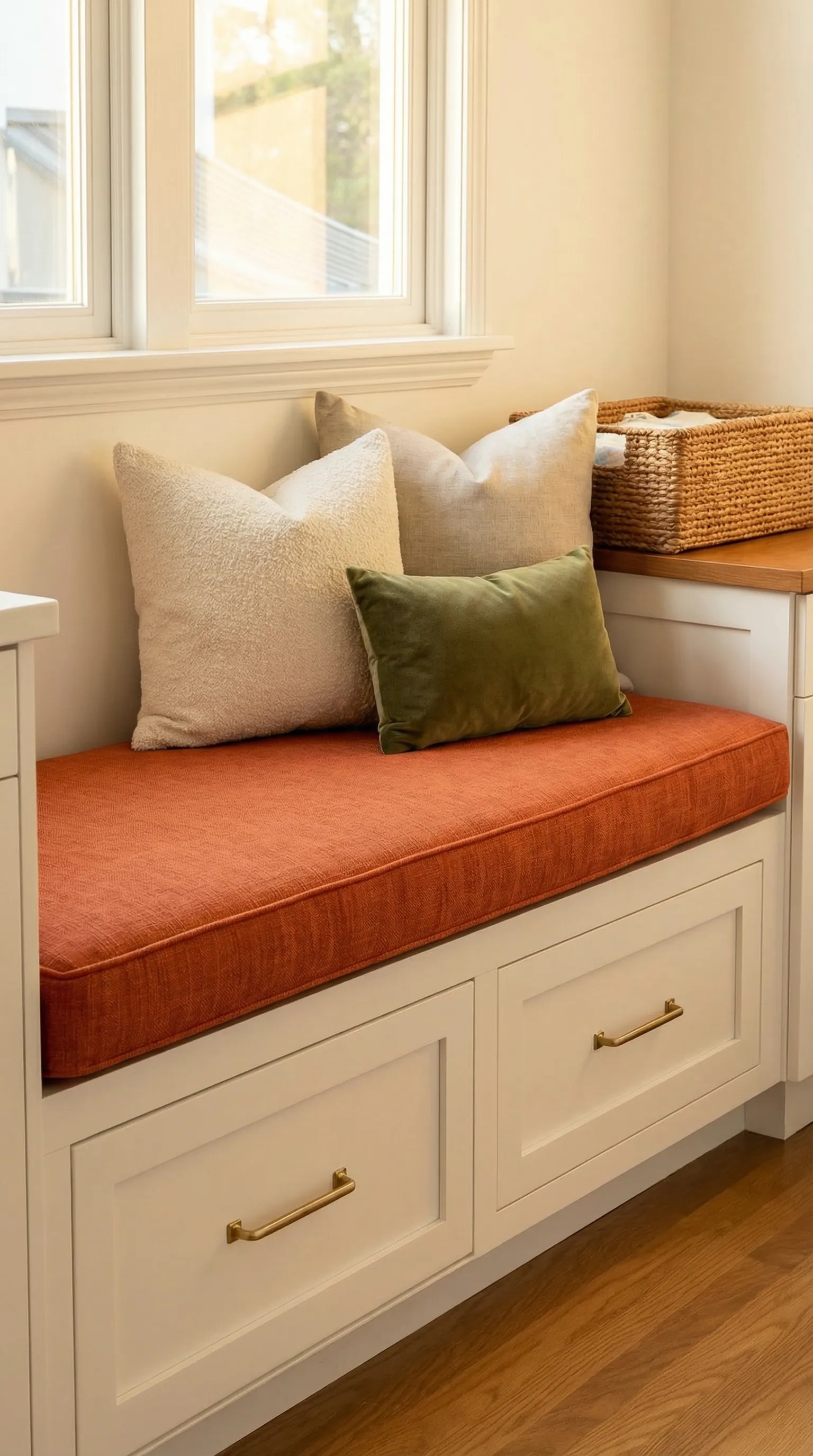
The workshop's answerYes. For a 4 in (10 cm) gap and a height of about 17 in (43 cm), kept low enough to clear a light switch, the shop made a bench-style cushion 4 in (10 cm) thick and 17 in (43 cm) high. Measure the length, order through the bench cushion listing and choose the non-slip base at checkout so it stays firmly in place.
- A common question
Can the top and bottom of my bench cushion be one fabric and the sides another?
The workshop's answerYes. Two fabrics mean extra cutting and labor, so there is a small added charge. For a 12 x 36 3/4 in (30.5 x 93.5 cm) cushion, the buyer selected the 15 3/4 x 39 3/8 in (40 x 100 cm) option and wrote the exact size plus the top, side and piping fabric codes in the personalization note.
On the cutting table: the library bench
| Piece | Built-in bench cushion, one continuous rectangle |
|---|---|
| Fabric | Sand linen-look weave, matte |
| Edge | Box edge, kept low under the first shelf |
| Piping | Contrast welt in chocolate brown |
| Pillows | Cognac leather lumbar, cream cable-knit square |
| Long benches | 117 3/4 in (299 cm) offered as one piece or two |
| Curved ends | Drawing with curve depth and curve span |
| Washing | Covers wash at 86°F (30°C) |
| Best for | Library nooks read in by lamplight |

Have it made
Have this made — ask Nate’s workshop
Every edge and both diagonals, to the nearest 1/4 in. If the numbers do not close, the workshop will say so on the call. — Nate
Leave your details and the workshop will call you to confirm measurements, fabric, foam and piping. No prices, dates or payment on this page: it is a request, not an order.
A cream welt disappears under a warm lamp. Chocolate piping keeps drawing the edge of a sand bench cushion long after sunset.
Nate
Questions buyers ask next
Why does chocolate piping suit a sand bench cushion?
Brown piping repeats the darkest browns already in a library nook, such as book spines and leather, so it reads as part of the room. It also keeps the seat outline visible under warm lamplight, when a sand top drifts toward the color of its surroundings.
Should a long built-in bench cushion be one piece?
One continuous piece avoids a seam where people sit, which is why this library bench has one. Very long runs can still be split for handling; a 117 3/4 in (299 cm) family bench was offered either way.
How do I measure a bench that has a curved end?
Draw the bench and add two numbers for the curve: its depth, from the top of the curve to the bottom, and its span, between where it starts and ends. Add the straight length and order through the custom-shape option.
± 1/4 in — Nate
More photographs to read
 Save
 Save
 Save
 Save
 Save
 Save