A Reading by HarlanBolster Pillows
Three bolster pillows crossed on a white daybed, and the room they remade
A room does not always need new furniture. Sometimes it needs three good rolls of cloth and somebody patient with a tape measure.
 Save
The quick answer
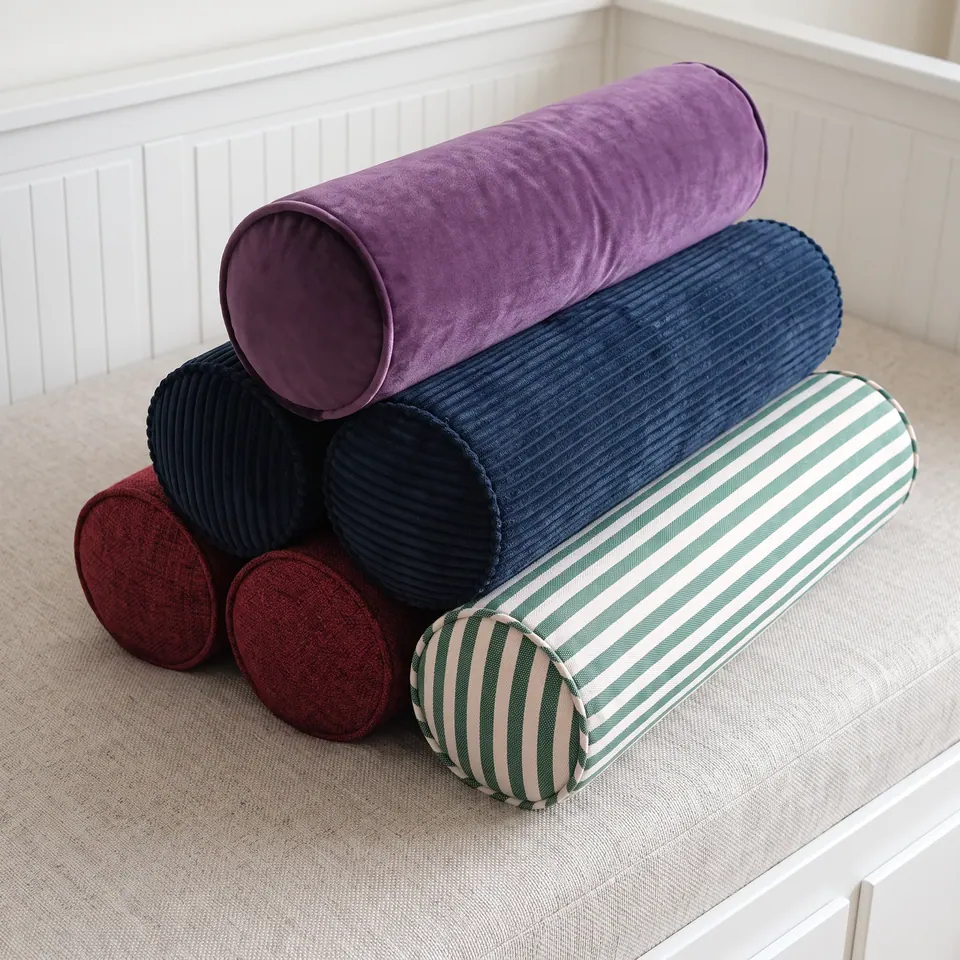
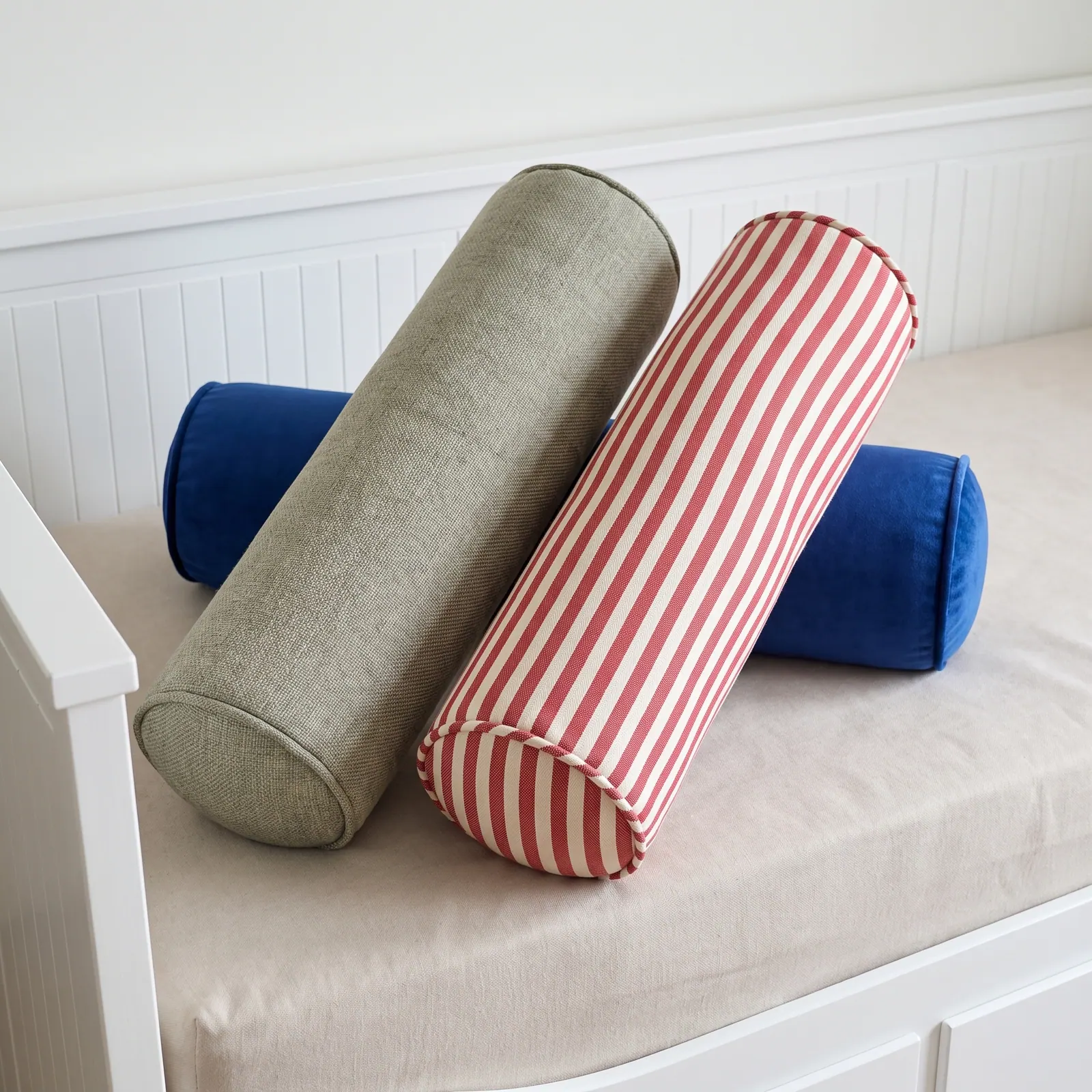
Bolster pillows are the quickest real makeover a daybed can get: three rolls in different fabrics, one shared length, and the room changes. Here a sage herringbone, a red and ivory stripe and a cobalt velvet share the space between the end posts. Measure between the posts first, keep one diameter across the set, and vary only the cloth.
One bolster, cut open at 7 x 20 in
Cover cloth. One of three here: sage herringbone, red and ivory stripe, or cobalt velvet. Each roll gets its own fabric; the set shares one size.
Self piping. A cord covered in the roll's own cloth, sewn as a ring at each end. It keeps a mixed set looking planned.
Fiber wrap. Polyester fiber batting around the core, so the roll stays round and the cover fills out to the seam.
Round core. Cut to the diameter. For back support the workshop recommends a soft fill, so the roll gives a little when you lean.
Zipper. Along the length, on the underside, so it lies against the seat.
End cap. A flat round cut to the diameter. On a stripe, cut it so the bands stay centered across the circle.
Before and after, with nothing else moved
Picture this daybed before the bolsters came. White beadboard back, white frame, a pale linen mattress cushion. Clean as a fresh sheet, and about as interesting.
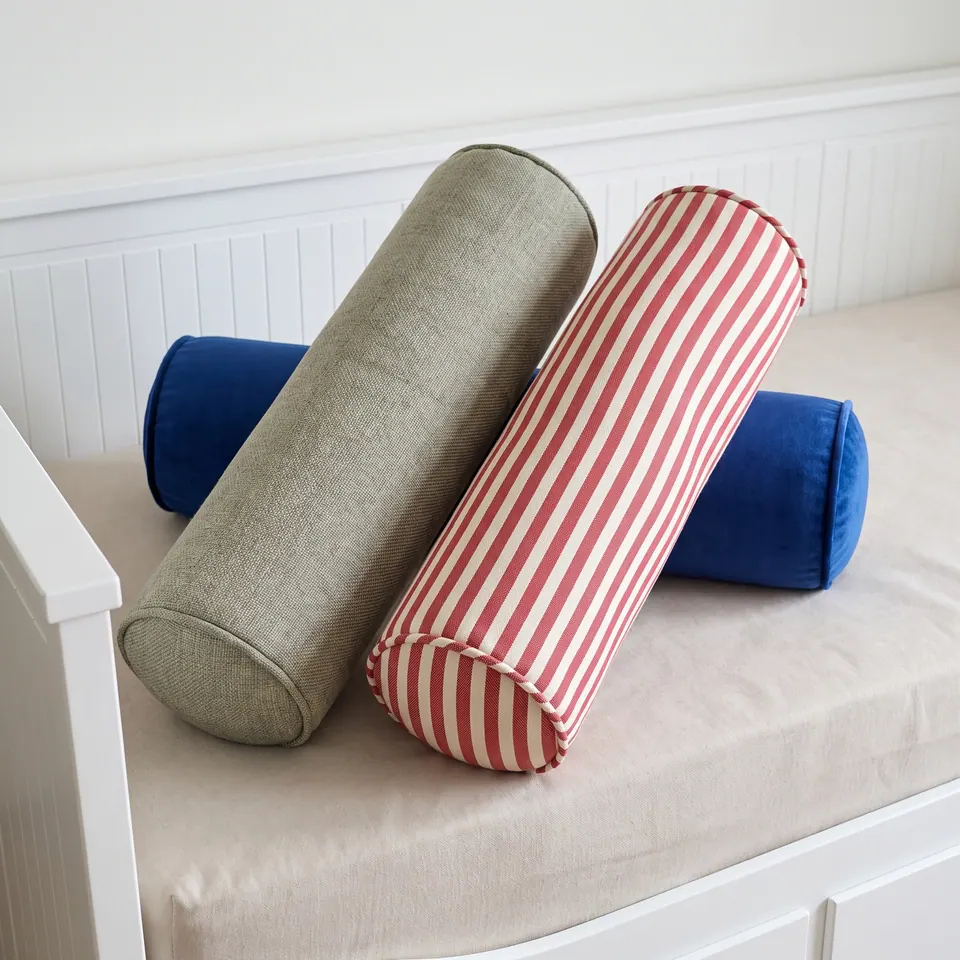
Now look at it after. Three bolster pillows thrown on together: a sage herringbone, a red and ivory stripe, a cobalt blue velvet. Nothing else in the room had to change.
The styling is loose on purpose. The two front rolls cross in an X over the cobalt one, so all three end caps and all three fabrics show at once. Laid in a tidy row, you would only ever see one end of each.
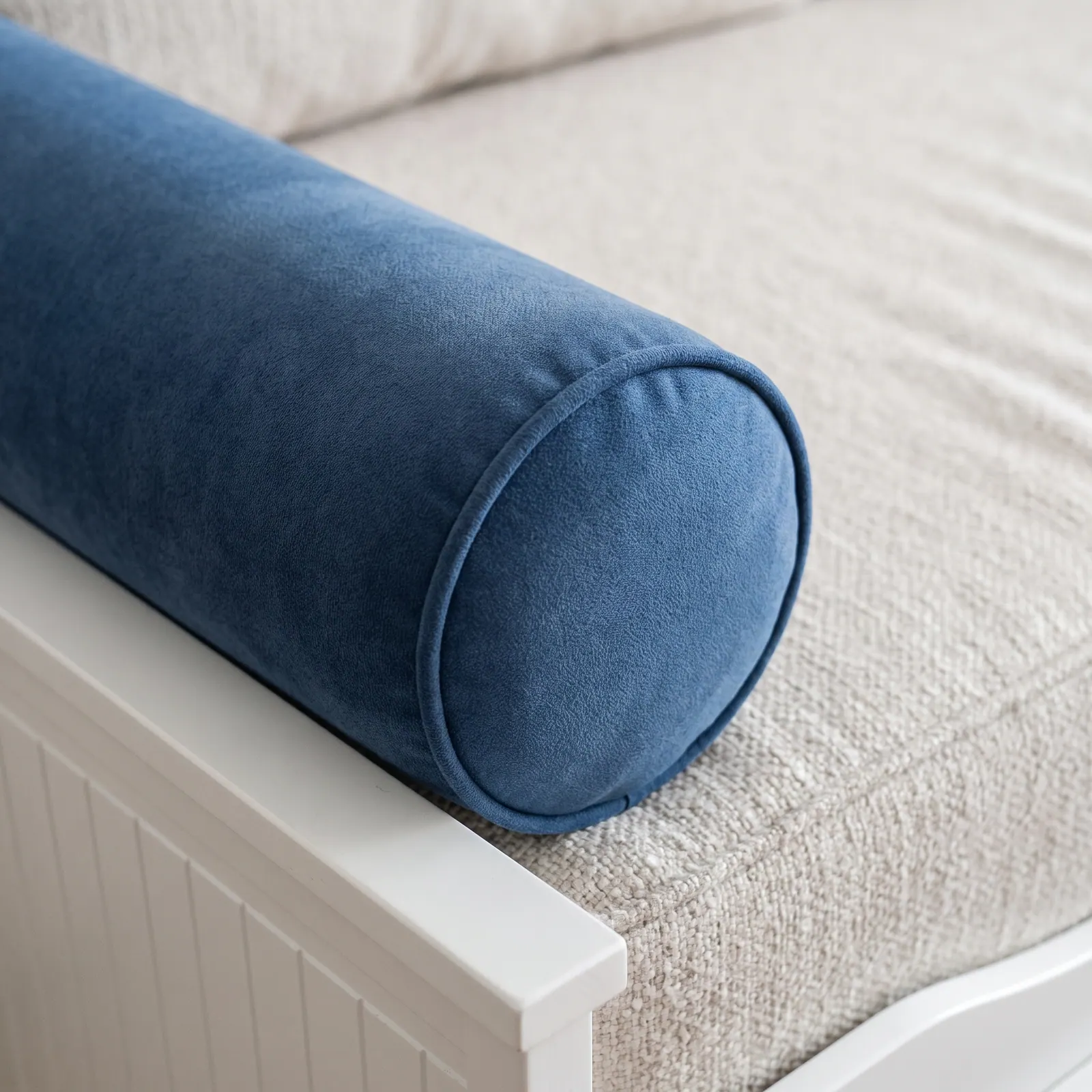
Read the colors the way you would read a family at the supper table. Sage and cobalt are both cool, so they sit quiet. The red stripe is the only warm voice, and it pulls the eye to the middle. The cobalt is the one pile fabric of the three; it throws a little sheen behind two matte weaves.
The herringbone is a fine fellow. From across the room it reads as solid sage. Come closer and the weave turns into texture.
Every roll carries self piping, a ring at each end in its own cloth. That is what keeps three fabrics from looking like three accidents. A seam is a promise, and here it is kept six times.
The white beadboard does the rest: grooved paneling in plain white gives three strong fabrics one quiet wall to stand against. If yours is an IKEA Hemnes, the daybed cover guide has its numbers; either way, daybed cushions is the next stop.
Pinned by Harlan: five places to look twice
Five pins, from the sage herringbone end to the daybed post that sets every roll's length.
- Sage herringbone end
A fine herringbone weave reads as a solid from afar and as texture up close.
- Red stripe end cap
Stripes radiate across the flat end, so cut the cap carefully to keep them centered.
- Cobalt velvet bolster
The one pile fabric in the trio adds sheen behind the two matte weaves.
- Beadboard back panel
White grooved paneling gives three different fabrics one neutral backdrop.
- Daybed end post
Measure between the end posts first; all three rolls share one length to fit inside them.
- Sage herringbone endA fine herringbone weave reads as a solid from afar and as texture up close.
- Red stripe end capStripes radiate across the flat end, so cut the cap carefully to keep them centered.
- Cobalt velvet bolsterThe one pile fabric in the trio adds sheen behind the two matte weaves.
- Beadboard back panelWhite grooved paneling gives three different fabrics one neutral backdrop.
- Daybed end postMeasure between the end posts first; all three rolls share one length to fit inside them.
Remaking a daybed around three rolls
- Measure between the end posts first. Every roll shares that one length, so all three sit inside the frame.
- Pick one diameter for the set. Mixed fabric looks planned; mixed sizes look like leftovers.
- Let one color be warm and the rest cool, or the other way round. Here the red stripe is the only warm note.
- Give each roll self piping at both ends, so a mixed set reads finished.
- Leave the mattress plain. The rolls carry the color; the seat carries the sitter.
A tapered cover, and why half an inch matters
A buyer in the US had a tapered chair cushion, 17 in across the back and 19 in across the front, 19 in deep and 3.5 in thick. They wanted a new cover over the cushion they already had, and nothing more.
The workshop asked them to measure again and send a photo, and I would have asked the same. On a tapered cover, half an inch at the front edge decides whether the cloth fits snug or bags at the corners. They re-measured, sent the picture, and the quote came back for the cover alone. They chose one linen for both the body and the piping.
That is a makeover too, my friend. Same chair, same filling, new skin. The cover-only guide walks through it.
- Sizes
- 17 in back, 19 in front, 19 in deep, 3.5 in thick
- Fabric
- One linen for body and piping
The lesson: Re-measure an old cushion before ordering a cover; half an inch at the front edge matters on a tapered shape.
Buyer questions
- A common question
Do the covers come off so I can wash them?
The workshop's answerSeat, bench and sofa cushion covers are removable. The exception is the tufted linen floor cushion, whose cover stays on; for a floor cushion with a removable cover, the workshop points people to the kids' corduroy corner floor cushion.
- A common question
There's no listing for it, but can I get a bolster that matches a cushion I already bought?
The workshop's answerYes. Matching back-support pieces are made as a custom order in the same fabric. One swing-cushion buyer was offered a back pillow, soft or cushion style, plus two bolsters, all soft-filled for back support.
- A common question
I react to synthetic fibers. Is the corduroy pure cotton?
The workshop's answerNo, that corduroy is a cotton-polyester blend. The workshop offers 100% cotton fabrics instead, and quoted a custom-size sofa cover set in cotton for a buyer with the same concern.
On the cutting table: three rolls, one size
| Pieces | Three bolster pillows, one shared length |
|---|---|
| Fabrics | Sage herringbone weave, red and ivory stripe, cobalt blue velvet |
| Piping | Self piping ringing each end |
| Ends | Flat round end caps; stripe centered across the cap |
| Fill for leaning | Soft fill recommended for back support |
| Styling | Two front rolls crossed in an X over the cobalt one |
| Daybed | White beadboard frame with a pale linen mattress cushion |
| Measure first | Inside distance between the end posts |
| Drawing size | 7 in across, 20 in long, a bolster size from a past order |

Have it made
Have this made — ask Harlan’s workshop
Old upholsterers will tell you the real cutting happens in the conversation, long before the shears come out. Tell the workshop what you sit on, and they will talk it through with you. — Harlan
Leave your details and the workshop will call you to confirm measurements, fabric, foam and piping. No prices, dates or payment on this page: it is a request, not an order.
When ordering several bolster pillows, vary the fabric but keep one diameter and one length. A mixed set then looks planned, not leftover.
Harlan
Questions buyers ask next
How long should bolsters be to sit between the end posts of a daybed?
Measure the inside distance between the end posts at mattress height. That number, less a little ease so the rolls drop in without forcing, is your bolster length. Keep it the same for every roll in the set, whatever the fabric.
Can velvet and woven fabrics share one daybed?
Yes, and it helps. In this set the cobalt velvet is the only pile fabric, so it adds sheen behind the matte herringbone and stripe. One pile fabric among weaves reads as a choice; three would compete for the light.
Is crossing bolsters in an X practical for everyday use?
It is styling, not sitting. Crossed rolls show every end cap and fabric at once, which suits a guest room or a photograph. For daily lounging, lay them along the back and the arms, where they can support your back.
Sit well. — Harlan
More bolsters on daybeds, sofas and headboards
 Save
 Save
 Save
 Save
 Save
 Save