 Save
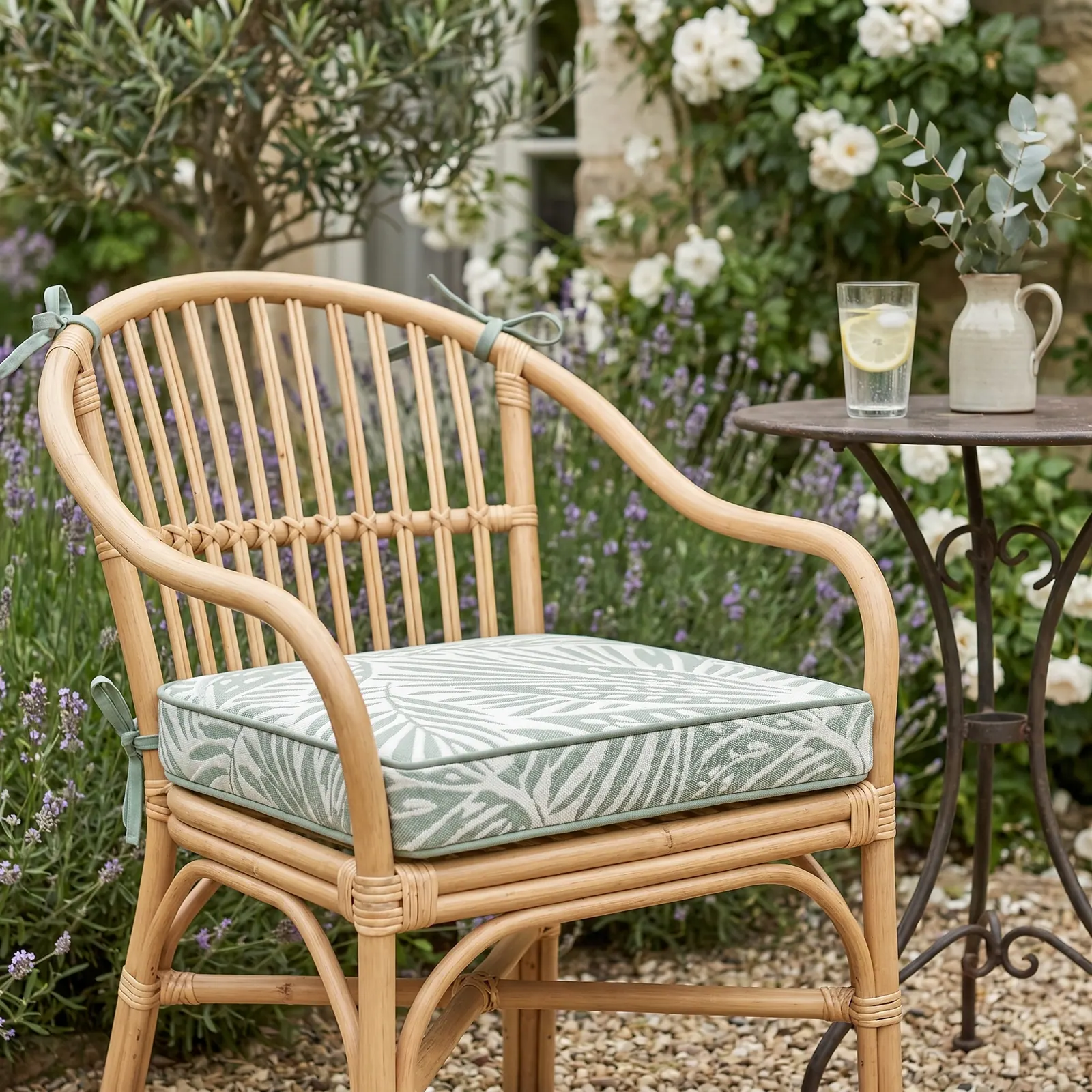
- Shaped seat cushion
The pad follows the chair's curved front so no rattan edge sticks out.
- Sage piping
Sage welt picks the pattern color and outlines the box shape.
- Ribbon tie
Solid sage ties wrap the back uprights and keep the cushion from shifting.
- Bistro table
Lemonade and a jug of eucalyptus repeat the soft green and cream.
- Lavender
Purple lavender is the one contrast color in a green-and-cream scene.
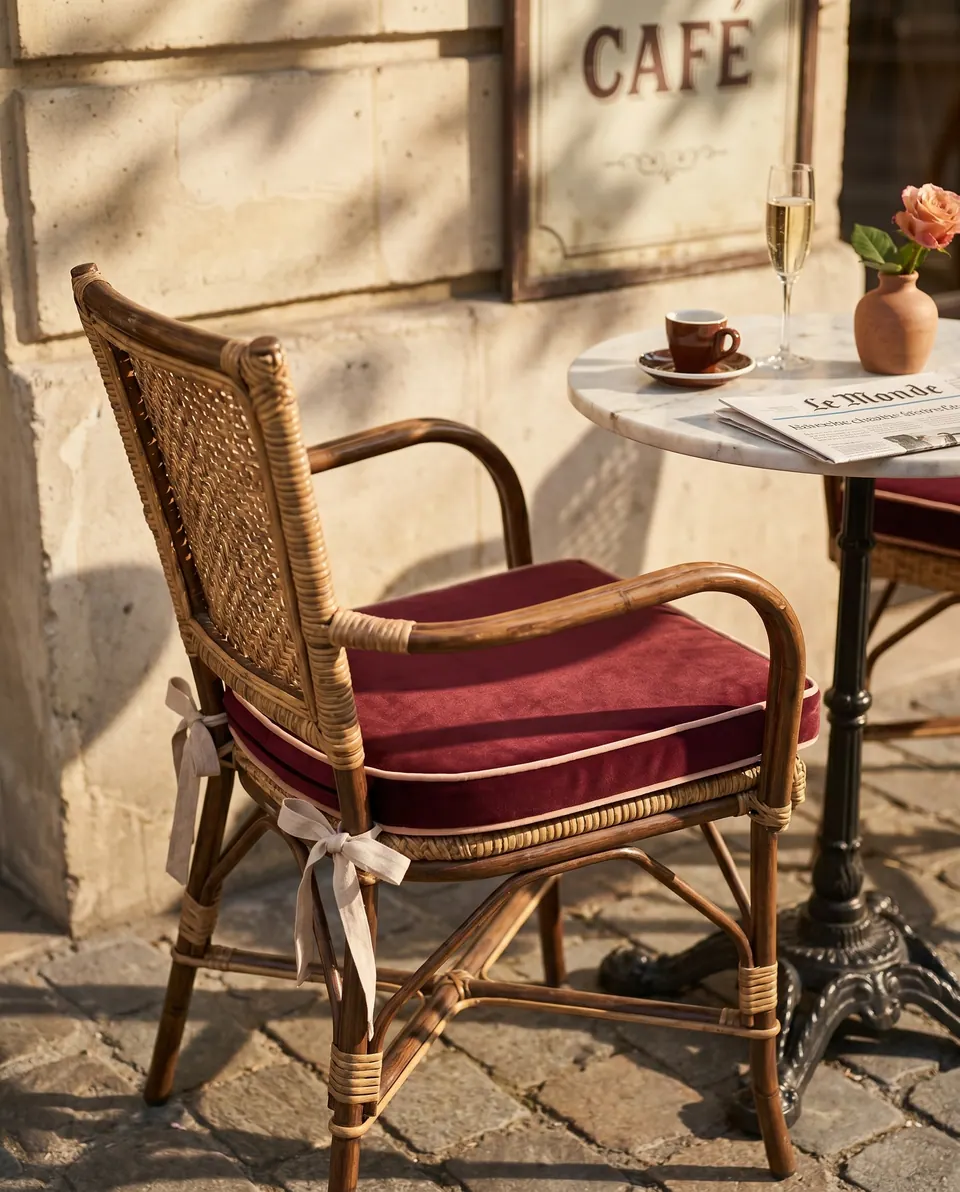
Plate Sage leaf box seat cushion with ribbon ties on a rattan garden chair
Sage ribbon ties and piping finish this shaped seat cushion for a bentwood rattan chair.
A Reading by MaggieDining Chair Cushions & Pads
A sage leaf chair cushion with ribbon ties, ordered right the first time
A curved rattan seat, a leaf jacquard, sage piping and sage ties. Four decisions, and every one of them belongs in the order note.

The quick answer
To get a tied chair cushion right the first time, send the exact seat shape with every edge measured, name the fabric code, say which corners get ties and whether ties and piping match, and write 'reversible' if both faces will be used. This sage leaf jacquard pad follows a curved rattan seat, with sage piping and sage ribbon ties.
Pinned by Maggie: a rattan chair, done properly
Five pins, from the shaped front edge to the one purple thing in the yard.
The numbers match the pins on the plate.
- Shaped seat cushionThe pad follows the chair's curved front so no rattan edge sticks out.
- Sage pipingSage welt picks the pattern color and outlines the box shape.
- Ribbon tieSolid sage ties wrap the back uprights and keep the cushion from shifting.
- Bistro tableLemonade and a jug of eucalyptus repeat the soft green and cream.
- LavenderPurple lavender is the one contrast color in a green-and-cream scene.
Why the ties are sage and not cream
Right, then. A curved rattan armchair is the fussiest seat in the yard to cushion, and this chair cushion with ties gets three things right.
Shape first. The pad follows the chair's rounded front, so no cane edge pokes out past it. A square pad on a round seat looks like a napkin dropped on a plate.
Then the welt. The piping is solid sage, lifted straight out of the leaf pattern, and it draws the box edge cleanly against the cream ground. Years ago I piped a leaf print in cream to keep it soft. It looked unfinished, and the customer was too polite to say so.
Then the ties. Sage ribbon wraps the back uprights and keeps the cushion from walking forward on slick rattan. Ties cut from the print would vanish into it; a solid pulled from the print looks deliberate. The Pattern on where to put cushion ties covers other frames.
The props finish the sentence. Lemonade and a cream jug of eucalyptus repeat the green and cream on the iron bistro table. Lavender is the one contrast, a purple nobody ordered and everybody needs. White roses keep it gentle.
The cloth is a leaf jacquard, the pattern woven in rather than printed on. If a chair like this lives outside all summer, choose the whole cushion in one outdoor fabric instead of mixing indoor and outdoor on one pad.
What does your seat measure across the front, dear, and across the back?
A lounge chair order split across two listings
A buyer in the US wrote in about a mid-century lounge chair. The seat was a trapezoid: 23 in (58 cm) wide at the front, 22 in (56 cm) at the back, 24 in (61 cm) deep and 4 in (10 cm) thick, not tufted, with the zipper at the back. The back cushion was a plain rectangle, 22 x 19 in (56 x 48 cm) at 3 in (8 cm).
Both pieces were reversible, so neither got a non-slip bottom. A grippy base only works on one face, and they meant to use both.
The workshop sent the seat to the trapezoid listing and the back to the rectangle listing, one shape each. Piping came included; ties and non-slip were optional extras, and the workshop said so before anyone paid a cent.
Tidy. Two listings, two shapes, and one word, reversible, doing a great deal of work. If your seat narrows toward the back, run the numbers through the trapezoid cushion calculator first.
The order-note checklist for a tied chair cushion
- Write the fabric code in the note, even when the photo seems obvious.
- Order a physical swatch first if the cushion must sit beside something you already own.
- One shape per listing: a trapezoid seat on the trapezoid listing, a rectangle back on the rectangle listing.
- Say 'reversible' if both faces will be used, so no non-slip base is added.
- Name the tie corners, and say whether the ties match or contrast with the piping.
- If the form takes only one photo, upload one and write 'drawings sent via message'.
Buyer questions: three drawings, velvet piping and a chair from a sofa
- A common question
The order form only lets me upload one photo, but I have three measurement photos. What do I do?
The workshop's answerUpload the one photo the form allows and write 'drawings sent via message' in the personalization box, then send all the photos in the order conversation. Merging them into one image works too.
- A common question
Can I pair a tough outdoor fabric body with indoor velvet piping on my dining chair cushions?
The workshop's answerIt can be made, but we advise against mixing an outdoor and an indoor fabric on the same cushion. If durability is the goal, choose an indoor fabric that stands up to heavy use for the whole cushion instead.
- A common question
Do you make a single-seat chair version of the modular floor sofa?
The workshop's answerYes. An ottoman with a backrest works as a lounge chair. Its layers are connected, so it lies flat or folds back into a chair. Give the color in the order note.
On the cutting table: the sage rattan seat
| Cushion | Shaped box seat pad for a bentwood rattan armchair |
|---|---|
| Fabric | Sage green and cream leaf jacquard |
| Piping | Contrast welt in solid sage |
| Edge | Box edge following the chair's curved front |
| Fastening | Solid sage ribbon ties around the back uprights |
| Setting | Gravel patio with lavender, white roses and an iron bistro table |
| Order note | Fabric code, exact shape, tie corners, piping and tie colors |
| Best for | Curved rattan, bentwood or bistro chairs |

Have it made
Have this made — ask Maggie’s workshop
Have the tape measure handy when they call. Old cushions shrink and sag; the seat underneath does not. — Maggie
Leave your details and the workshop will call you to confirm measurements, fabric, foam and piping. No prices, dates or payment on this page: it is a request, not an order.
On a curved rattan chair, a seat cushion with ties in one solid color taken from the print looks deliberate instead of an afterthought.
Maggie
Questions buyers ask next
What color should the ties be on a patterned chair cushion?
Pick one solid color from the pattern, as with the sage ties on this leaf jacquard. Ties cut from the print tend to disappear into it, while a solid pulled from the print looks deliberate and can match the piping.
How do I measure a chair seat with a curved front?
Trace the seat on paper, mark the front width, back width and depth on the tracing, and send the drawing. A pad that follows the curve keeps the frame's edge covered; a square pad on a round seat leaves corners hanging.
Where should the ties go on a rattan armchair?
Around the back uprights, from the two back corners of the seat pad. That holds the cushion against the slick rattan so it does not slide forward every time someone sits down or stands up.
Do I need a non-slip base as well as ties?
Not always. Ties hold a pad to the frame, while a non-slip base grips the seat surface. Skip the non-slip base on a reversible cushion, since it works on one face only, and ask for ties or grip in the order because both are optional extras.
Stitch straight — Maggie
More photographs to read
 Save
 Save
 Save
 Save
 Save
 Save