 Save
A Reading by MaggieBench Cushions
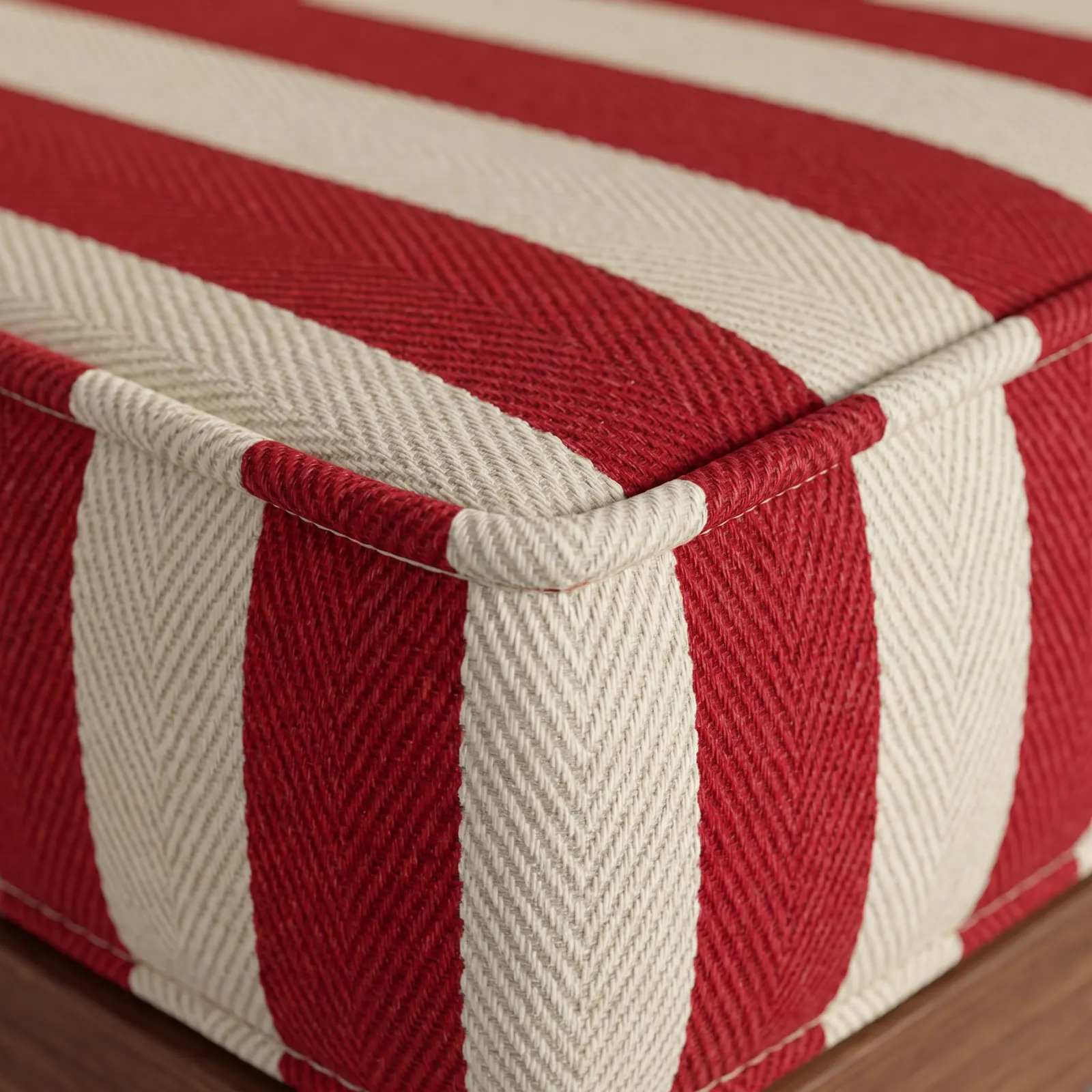
A red and cream herringbone stripe bench cushion, read at the corner
One corner, a strip of walnut and a stripe that turns the edge without losing count. I read it for what outdoor cushions taught indoor ones.
Up close, the herringbone twill in each stripe and the alternating red-and-cream welt are clearly visible.

The quick answer
A striped bench cushion looks tailored when the stripes on the top carry straight over the edge onto the gusset and the piping is cut from the same cloth. This red and cream herringbone twill does both, borrowing a dense weave and a wear-hiding self welt from outdoor cushions while keeping the soft hand of an indoor cotton.
The corner where the stripe keeps counting
A straight welt is a kind of honesty, and this corner tells the truth.
The close crop shows a striped bench cushion resting on a walnut frame. Top and gusset meet at a sharp turned corner, and the red bands on the gusset follow on from the red bands on the top. Nobody guessed where the stripe would land. Somebody planned it.
The piping is self piping, cut from the same striped cloth. Along the seam it alternates red and cream like a barber pole laid on its side. A solid contrast welt would draw a hard frame around the edge. This one keeps counting the stripe instead.
Look closer: every band is a herringbone twill. Twill weaves are denser than plain-weave cotton, which helps a cushion sat on every day hold its surface. That is the real quality shot, dear. Not the color. The weave.
I once chose a stripe by color alone, from across a showroom, and spent a winter regretting the weave. Which way do your stripes run now?
Pinned by Maggie at the corner
Five marks on the close-up, from the turned corner to the walnut frame underneath.
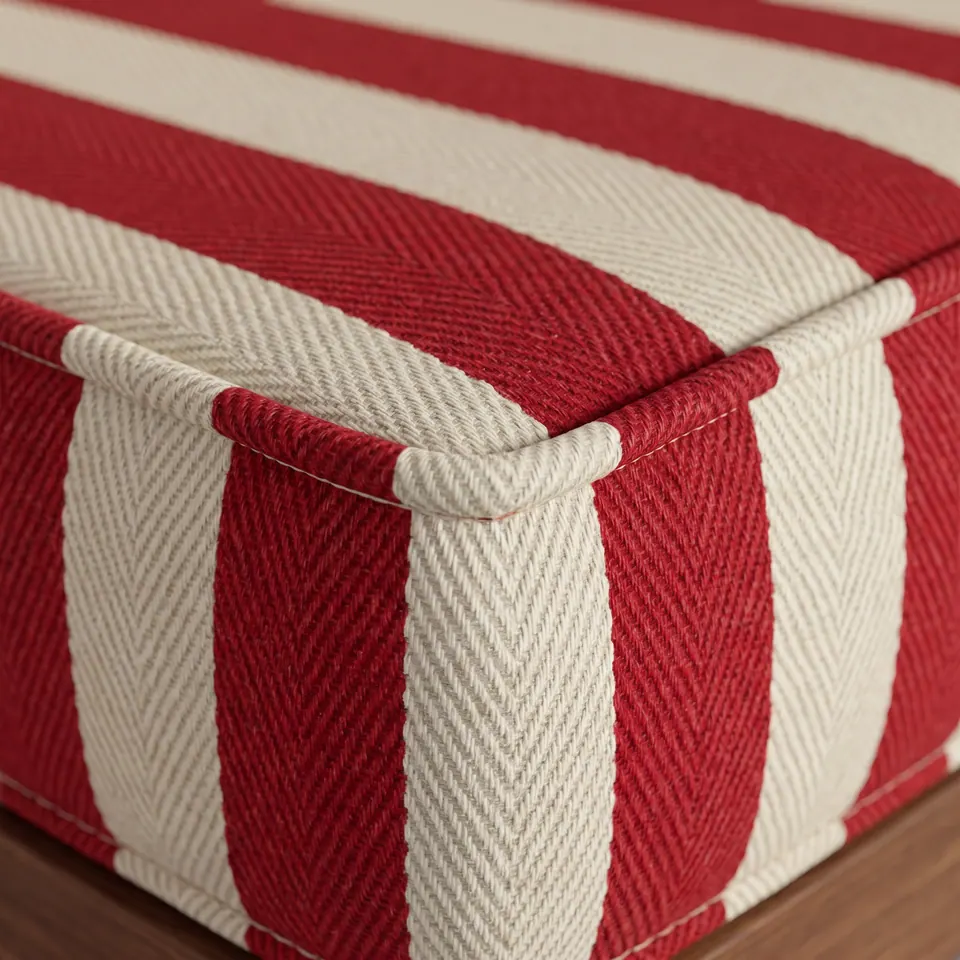
- Turned corner
Top and gusset meet at a crisp corner with the piping carried round in one piece.
- Cream herringbone
The twill weave shows in every stripe, a sign of a dense, hard-wearing cloth.
- Red stripe band
Red bands on the gusset follow on from those on the top.
- Self piping
Cut from the striped cloth, the welt alternates red and cream along the seam.
- Walnut frame
A glimpse of dark wood shows the cushion sits directly on the bench frame.
- Turned cornerTop and gusset meet at a crisp corner with the piping carried round in one piece.
- Cream herringboneThe twill weave shows in every stripe, a sign of a dense, hard-wearing cloth.
- Red stripe bandRed bands on the gusset follow on from those on the top.
- Self pipingCut from the striped cloth, the welt alternates red and cream along the seam.
- Walnut frameA glimpse of dark wood shows the cushion sits directly on the bench frame.
Borrow from the porch, keep from the parlor
Outdoor cushions are built for punishment; indoor ones for the hand. A good striped bench takes a little from each.
| Detail | Borrow from outdoor cushions | Keep from indoor cushions |
|---|---|---|
| Weave | A dense, tight cloth that holds its surface | A twill with a soft hand, not stiff canvas |
| Stripe | Bands that carry over the edge, like an awning | A scale and color made for a room: red on cream |
| Piping | A self welt that hides edge wear | Cut from the same cloth, so it reads tailored |
| Long runs | Sections you can lift and carry | Joins at a corner or midpoint, where the stripe can meet |
| Care | A cover that comes off | Covers in the range wash at up to 86°F (30°C) |
Fourteen feet of bay window, in two pieces
A buyer ordering for a relative sent the workshop a trapezoid that would make anyone reach for a second pencil. Top: 8 ft 7 in (262 cm). Bottom: 14 ft 10 1/2 in (453 cm). Depth: 29 in (74 cm). Sides: 2 ft 6 in (76 cm), with angled corners of 11 in (28 cm) and 5 1/2 in (14 cm). Five inches (13 cm) thick, in linen 07, with matching or contrast piping.
The workshop recommended two pieces rather than one, for durability and plain practicality; nobody wants to wrestle a 14-foot cushion into its cover. It asked for a sketch or photo to confirm the angles first.
Here is where indoor cushions should think like outdoor ones: in sections that can be lifted, turned and carried. Split any bay cushion over about 90 in (2.3 m) and join at a corner or the midpoint. The trapezoid cushion calculator checks the angles; one piece or two covers where to split.
- Sizes
- Top 8 ft 7 in, bottom 14 ft 10 1/2 in, 29 in deep, sides 2 ft 6 in, corners 11 in and 5 1/2 in, 5 in thick
- Fabric
- Linen 07
The lesson: Split any bay cushion over about 90 in (2.3 m) into sections, joining at a corner or midpoint.
What buyers asked about piping, linen and crooked walls
- A common question
Does piping cost extra, and can it be a different color from the cushion?
The workshop's answerPiping is included in the price, and a different piping color is free: write the piping code in the personalization. Single piping is standard; double piping can be requested. If you choose the same code for cushion and piping, the piping blends in instead of contrasting.
- A common question
What material are the K fabric codes, and can those covers be washed?
The workshop's answerThe K colors are linen fabrics. Their covers are removable and washable at up to 86°F (30°C), like the rest of the range. There are no close-up photos of the K fabrics, so go by the fabric chart or order samples.
- A common question
My house is old and nothing is square. What if my measurements don't quite add up?
The workshop's answerThe workshop checks that your drawing closes geometrically before cutting. If it doesn't, you'll be asked to re-measure specific edges and to measure both diagonals, corner to corner, to see whether the corners are square. A blank outline with each edge lettered A, B, C is available to fill in. A drawing that closes within 1/4 in is accepted, and you can set the depth for each section to allow for out-of-square walls.
On a striped bench cushion, the stripes on the top should carry straight over the edge onto the gusset; if they jump, the eye reads the seam first.
Maggie
On the cutting table
| Cushion | Bench cushion, box edge |
|---|---|
| Fabric | Striped cotton, red and cream herringbone twill (code N37) |
| Piping | Self piping cut from the stripe, red and cream alternating |
| Corner | Sharp turned corner; gusset stripes follow the top |
| Frame | Walnut bench |
| Weave | Twill, denser than plain weave |
| Long runs | Split over about 90 in (2.3 m) at a corner or midpoint |
| Best for | Mudroom and entryway benches used every day |

Have it made
Have this made — ask Maggie’s workshop
Have the tape measure handy when they call. Old cushions shrink and sag; the seat underneath does not. — Maggie
Leave your details and the workshop will call you to confirm measurements, fabric, foam and piping. No prices, dates or payment on this page: it is a request, not an order.
Questions buyers ask next
Should the piping on a striped bench cushion be cut from the stripe itself?
For a tailored look, yes. Self piping cut from the striped cloth alternates its colors along the seam and keeps the edge part of the pattern. A solid contrast welt draws a frame around the cushion, which suits plain fabrics better than busy stripes.
Is a herringbone twill stripe sturdy enough for a bench used daily?
It is a sound choice. A twill weave is denser than plain-weave cotton, which helps a cushion that is sat on every day hold its surface. Look closely at a sample: the herringbone should show clearly in every band.
At what length should a bay window cushion be split into sections?
Once a run passes about 90 in (2.3 m). A trapezoid measuring 14 ft 10 1/2 in (453 cm) along the bottom was recommended in two pieces for durability and practicality. Join the sections at a corner or the midpoint so the seam falls somewhere deliberate.
Stitch straight — Maggie