The Cutting Table · compared on the table
Should my piping match the cushion or be a contrast color?
Also asked as:Not sure what piping to pickYou think L25 piping is best?
Right, then. This question splits buyers almost exactly down the middle, which tells you there's no wrong answer, only a wrong reason.

 Save
The quick answer
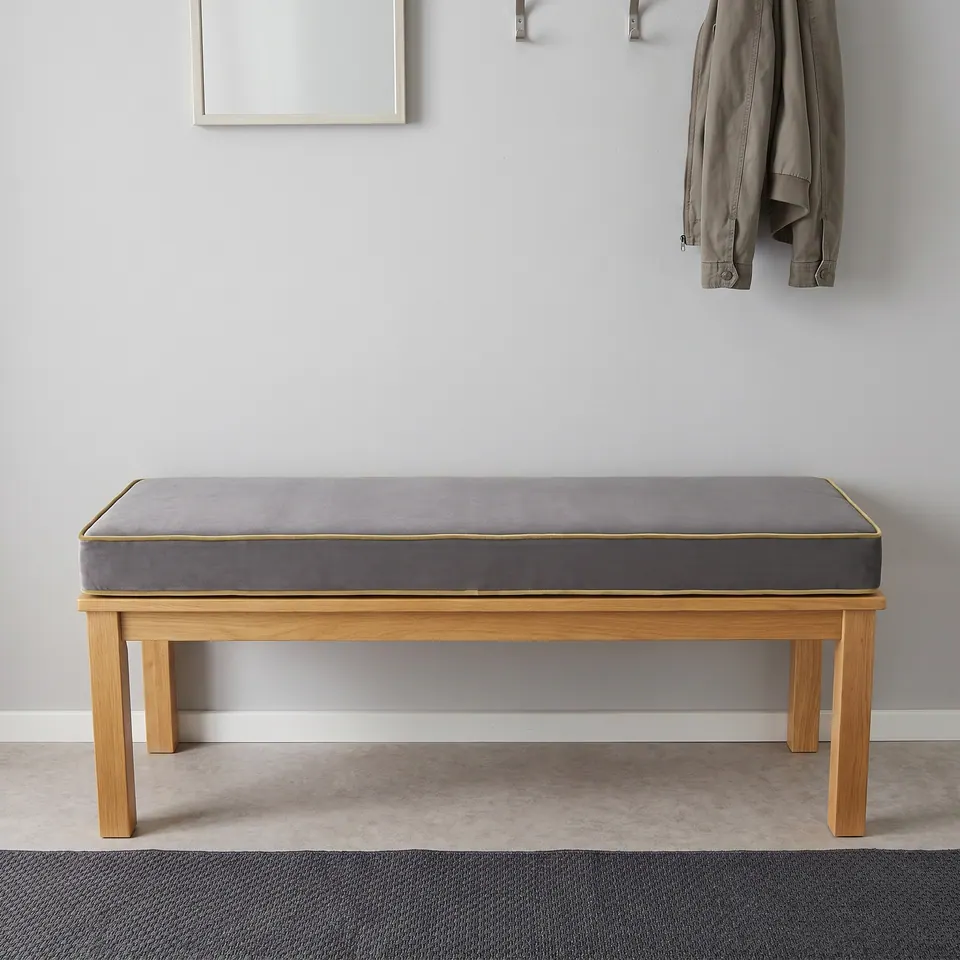
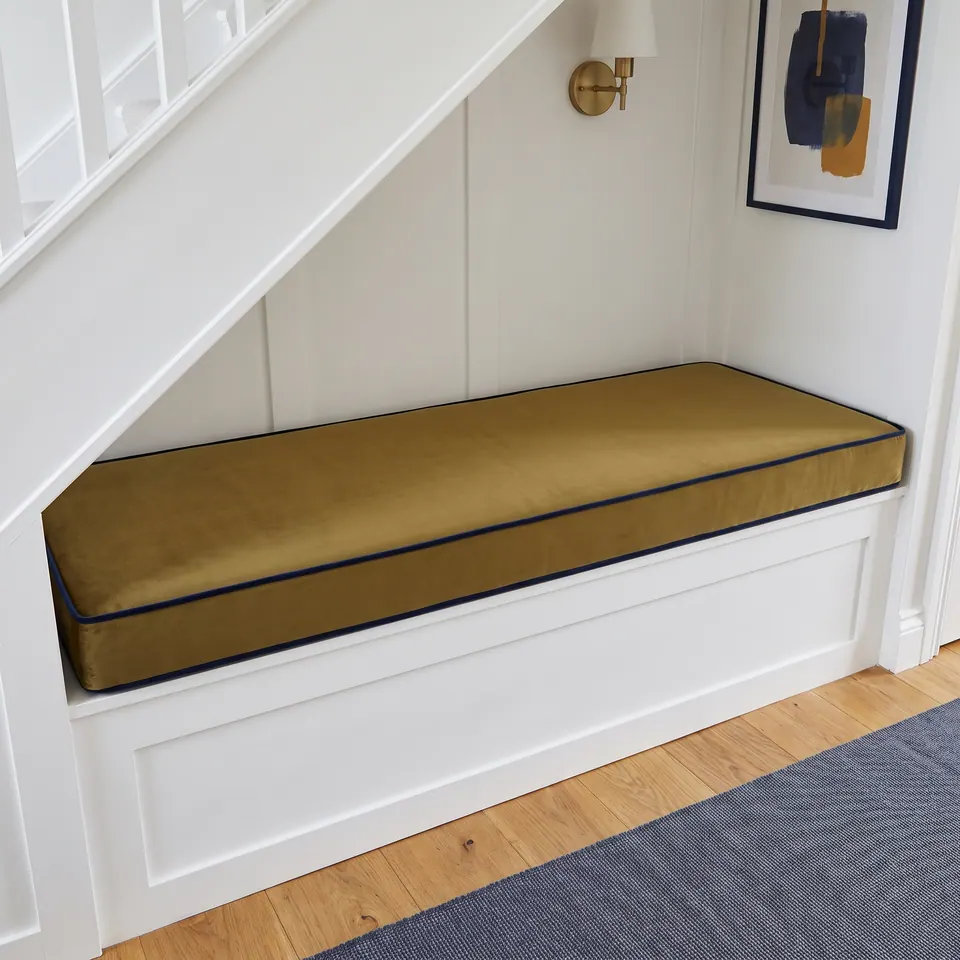
Either works: about half of custom cushion orders use matching piping and half use contrast. Matching piping in the same fabric is the lower-risk choice and the workshop's usual recommendation, because it gives a clean, seamless edge. Contrast piping frames the outline and makes the edges stand out. For a subtle middle ground, pick a piping code one shade darker than the body, such as L-44 with L-43.
Get a quote for a bench cushion
Matching, one shade darker, or contrast: what each piping does
| Piping choice | What you see | Best when | Risk |
|---|---|---|---|
| Matching (self) piping | A clean, seamless edge; the shape reads before the line | The fabric is the star, or you can't decide | Lowest |
| One shade darker, e.g. L-44 on L-43 | A quiet outline that sharpens the edge | You want definition without a second color | Low |
| Contrast color | A drawn frame around the top and bottom edges | One color in the room is worth repeating | Higher: every edge is on show |
| Mixed range, e.g. velvet piping on soft fabric | A change of texture more than of color | You want a tailored detail that catches light | Medium |
Key facts
- About half of custom cushion orders use matching piping and half use contrast.
- Matching piping cut from the same fabric is the workshop's usual recommendation.
- Contrast piping makes the cushion's edges stand out.
- A piping code one shade darker than the body, such as L-44 with L-43, gives a subtle outline.
- Fabric ranges can be mixed, for example a soft-fabric body with velvet piping.
- Matching pillows are made in the same fabric and quoted together with the cushions.
- Roughly 50% of orders choose matching piping and 50% contrast, and piping costs nothing extra either way.
- Contrast piping can be cut from more than 150 colors across the fabric charts.
- Single piping on the top and bottom edges is standard; cushions only 1 in (2 cm) thick are made without piping.
- Piped covers come off and wash at 86°F (30°C) max on a gentle cycle, matching or contrast alike.

Have it made
Have Maggie’s workshop cut this for you
Numbers first, fabric second, piping last. Jot down what you have, and the workshop will go down the list with you, item by item. — Maggie
Leave your details and the workshop will call you to confirm measurements, fabric, foam and piping. No prices, dates or payment on this page: it is a request, not an order.
Why I steer the undecided toward self piping
Matching piping is what the workshop recommends when a buyer can't make up their mind, and I agree with it. The welt is cut from the same fabric as the cushion, so the edge reads as one clean line and the color never argues with the room.
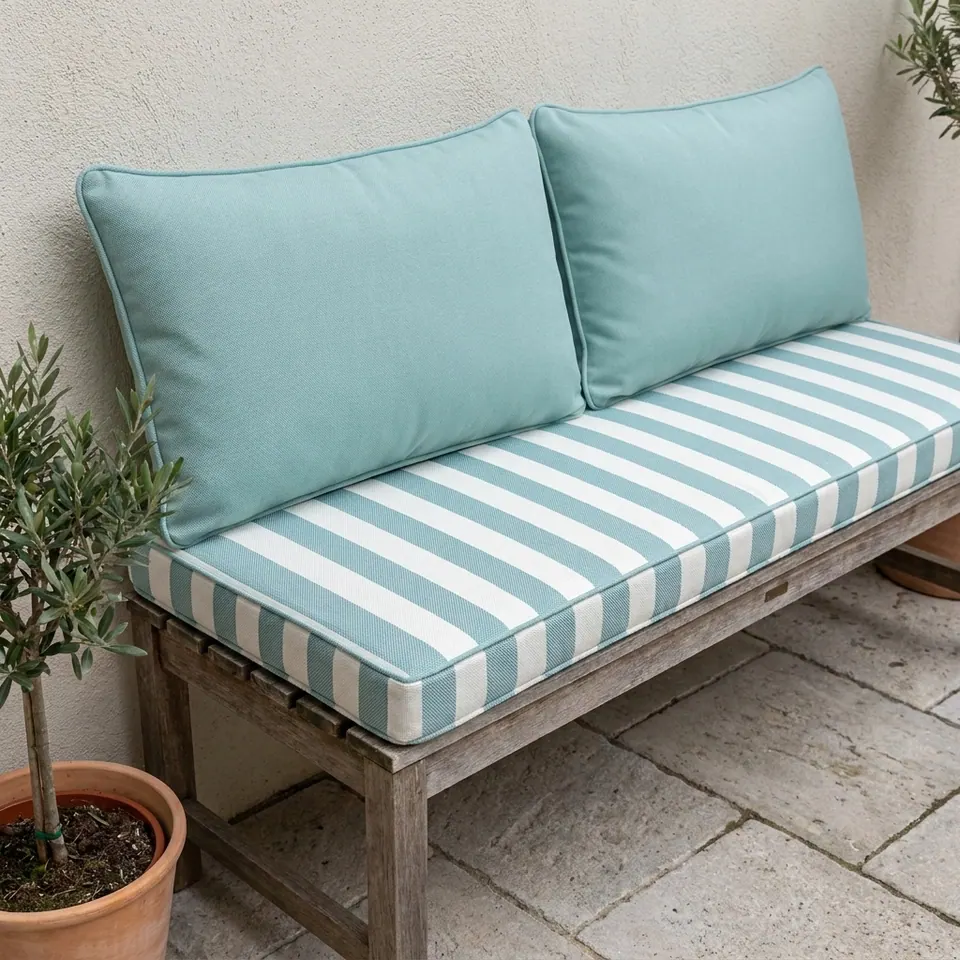
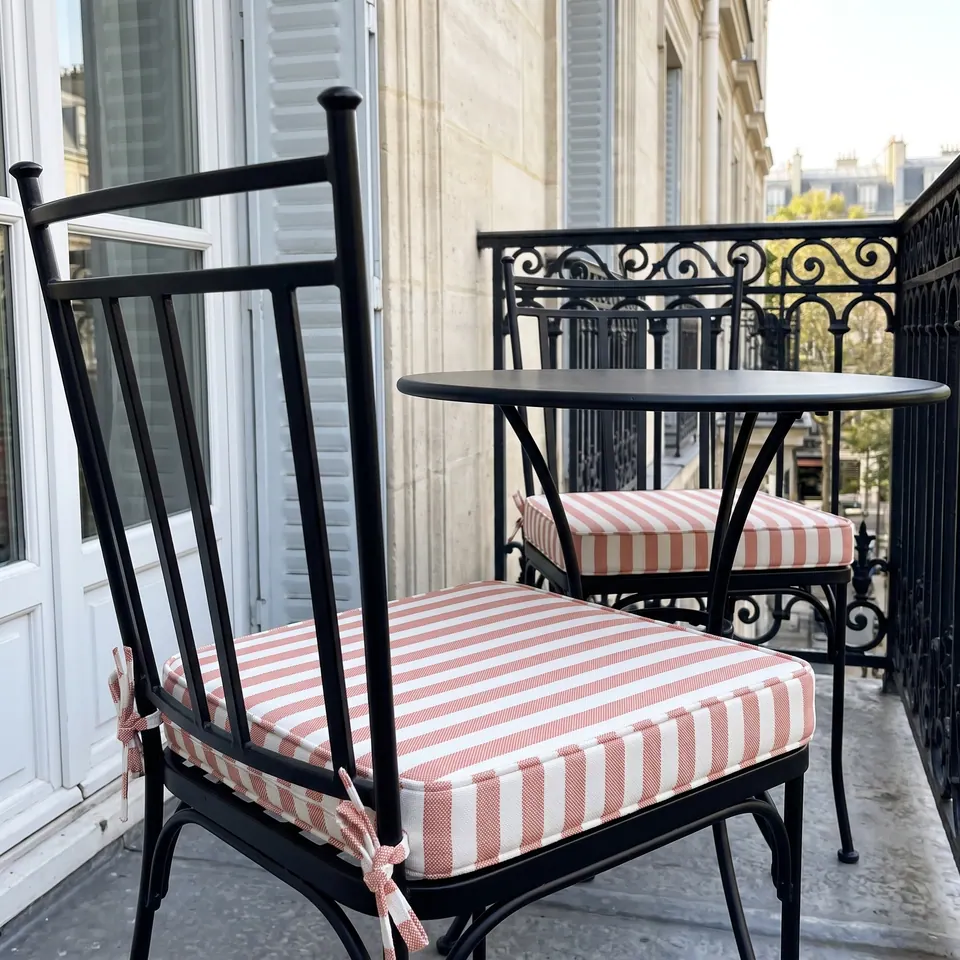
Contrast isn't a mistake; it's a statement. It outlines the top and bottom edges of a bench cushion like a pencil line around a drawing. Lovely when the color is pulled from something already in the room. Less lovely when it's a guess.
The quiet option sits between the two: order piping one code darker than the body. You get definition without a second color. Ranges can mix, too, such as velvet piping on a soft-fabric body, which changes the texture more than the hue. The piping Pattern lays all three side by side, and the bench cushion builder lets you try them.
What color is already doing the talking in your room?
Bench cushions, matching pillows and the 'too busy' worry
A buyer ordering bench cushions wrote to ask two things at once: could the workshop make pillows in the same fabric, and would piping on the cushions and on the pillows be too much?
Yes, and no. The pillows were offered in the same fabric so the set would be coordinated. Piping on both doesn't look busy as long as it stays in the same tone family; it ties the pieces together. The buyer was asked to send the pillow sizes with the cushion measurements, so the whole set could be quoted at once.
Piping one shade darker than the cushion, such as L-44 on an L-43 body, outlines the edge without adding a second color.
Maggie
Buyer questions
- A common question
I'm stuck between matching and contrast piping. What do most people choose?
The workshop's answerIt's close to an even split: about half of orders match and half contrast. Matching piping in the same fabric is the lower-risk, seamless look the workshop usually recommends, and a code one shade darker, such as L-44 with L-43, gives a subtle outline.
- A common question
Does a contrast piping color cost extra?
The workshop's answerNo. Piping is included in the price, and a contrast color from the fabric charts is free too. Only custom-color leather piping costs extra.
- A common question
Does the piping go around the top and the bottom of the cushion?
The workshop's answerYes. Piping runs around both the top and bottom edges, and both faces are the same fabric, so the cushion is reversible. You can even choose a different piping color for each side, such as L70 on top and L63 underneath.
- A common question
Can I skip the piping to bring the price down?
The workshop's answerYou can skip it: write 'no piping' next to your fabric code and the edges are sewn plain and flat. It won't lower the quote, though, because piping is already included in the price.
Questions buyers ask next
Can a tufted cushion have piping?
Not on tufted daybed backrests and armrests; those are switched to a plain style if you want piping everywhere. Non-tufted zippered covers have piping as standard, and cover-only orders, which are made plain rather than tufted, can be piped too.
How do I get one price for cushions and pillows together?
List the pillow sizes alongside your cushion measurements in the same message. The pillows are made in the same fabric as the cushions and the whole set is quoted at once, which also lets you settle the piping for every piece in one go.
Can the piping come from a different fabric range than the cushion?
Yes. Ranges can be mixed, for example velvet piping on a soft-fabric body, which adds a change of texture rather than a strong change of color. Write the piping code next to the body fabric code when you order.