A Reading by CallumChaise Lounge & Sunbed Cushions
Two sunbed cushions, one orange thread: a poolside pair and what the house can borrow
Two loungers, two fabrics, one color running through both. By the pool it is a style choice. In a camper, a sunroom or a living room it is a rule worth stealing.
 Save
The quick answer
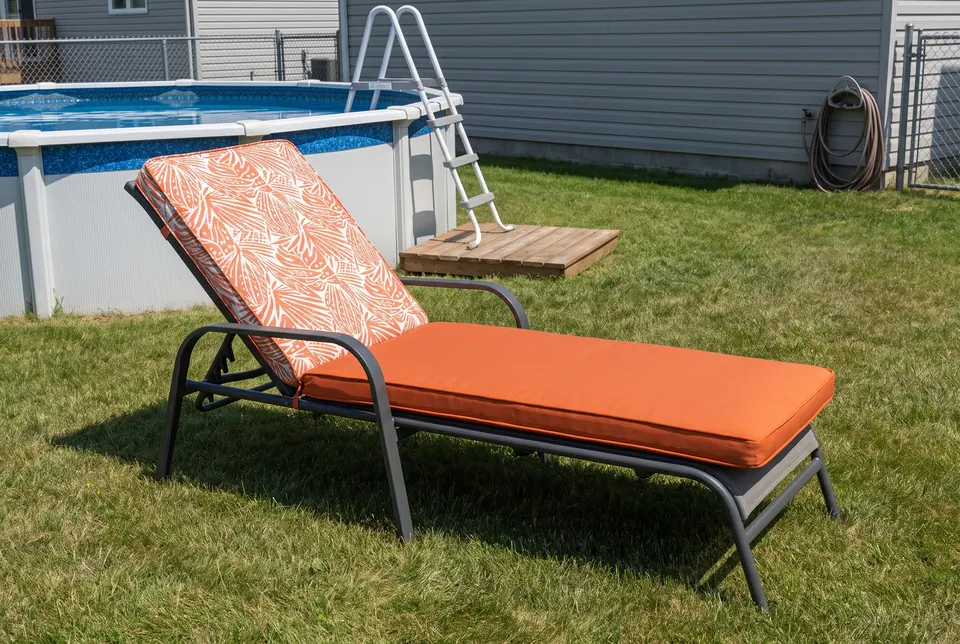
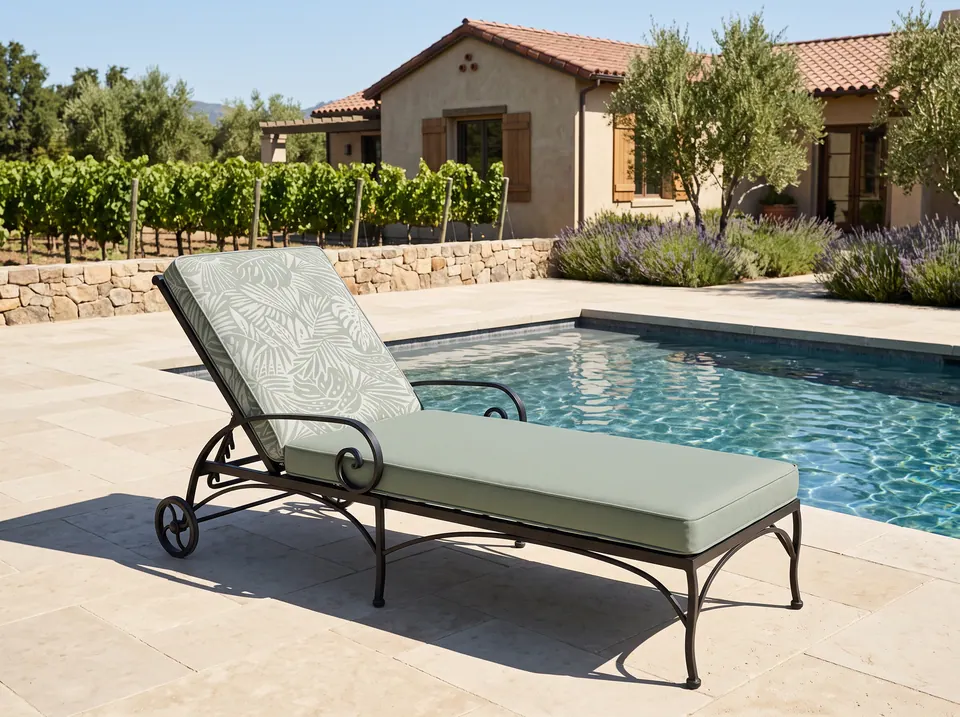
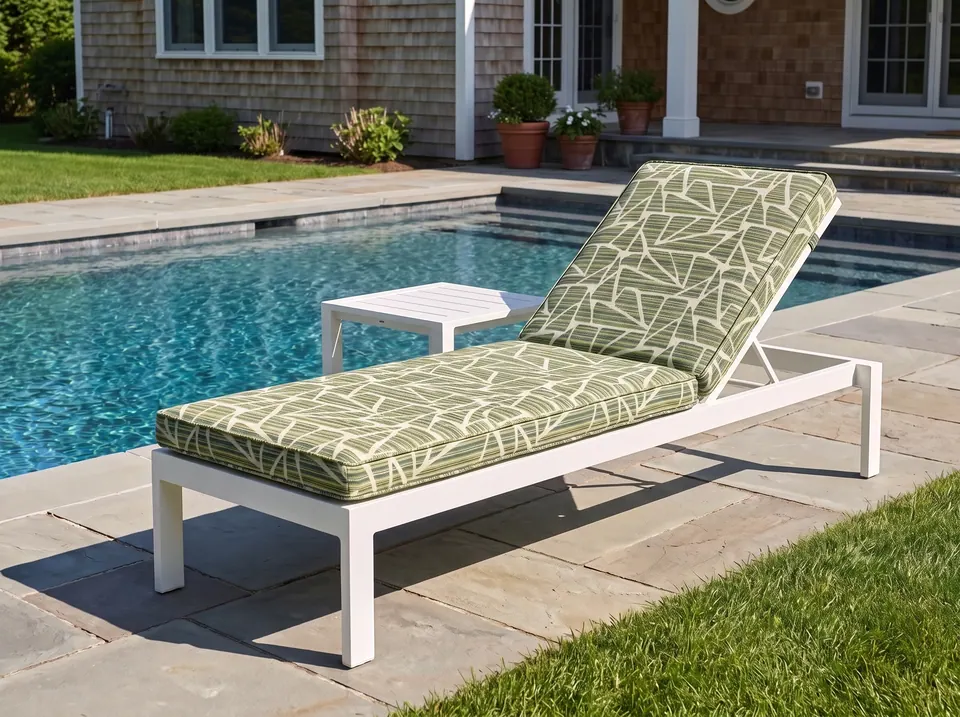
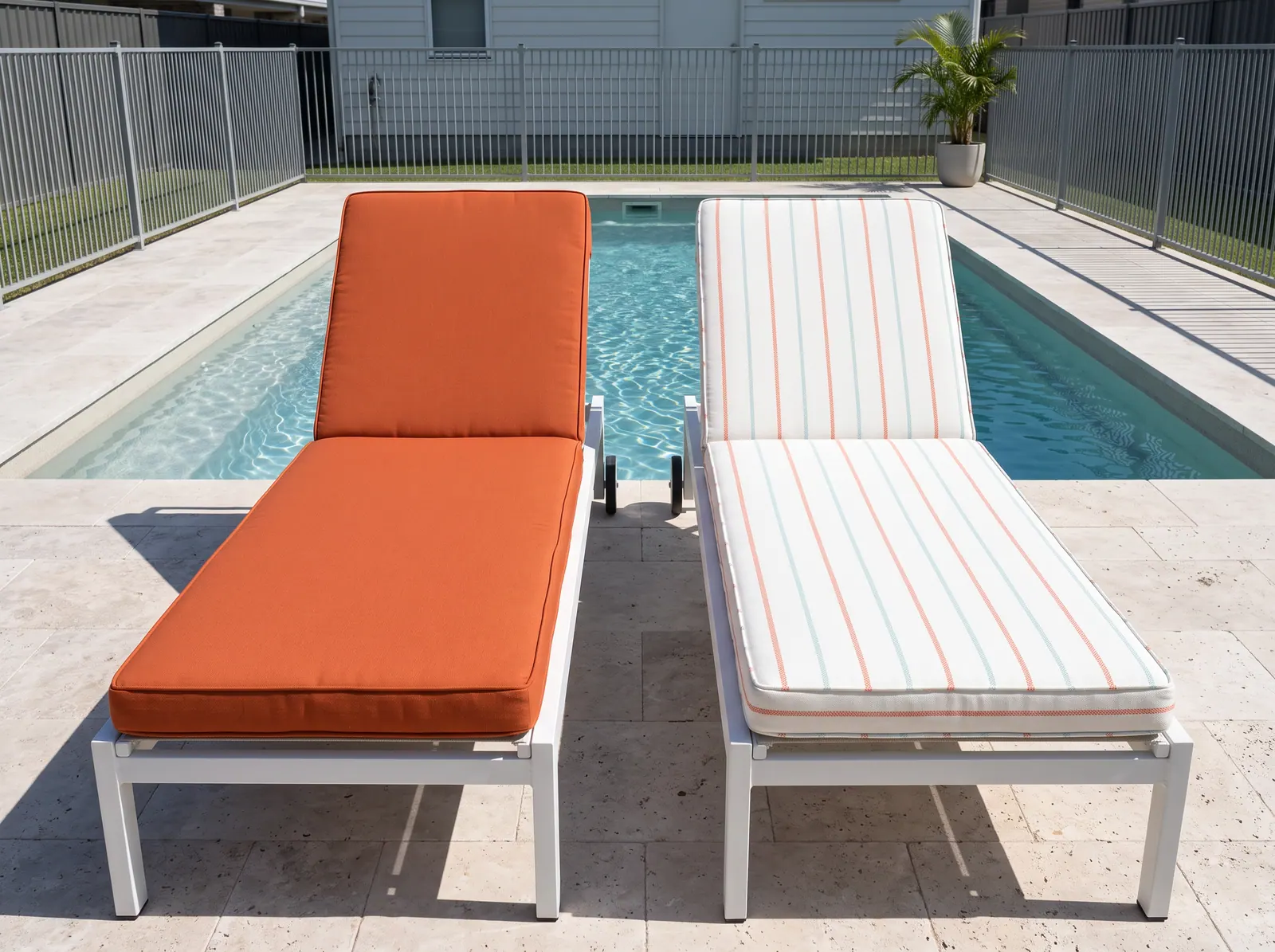
Two sunbed cushions can wear different fabrics and still read as a pair if one color runs through both. Here a solid orange lounger sits beside a white pinstripe that carries the same orange as a thin coral line. Both are box-edge cushions with self piping, and the stripes run lengthwise so the lighter lounger does not look shorter.
The cushion, cut open
Cover fabric. A removable, zippered cover. Machine wash at 86°F (30°C) on a gentle cycle and air dry.
Piping. A fabric-covered cord sewn into the seams. It sits on the seam line, so it does not change the size.
Fiber wrap. Polyester fiber (Dacron) batting around the foam: it fills the cover out and softens the edges.
Foam core. About 2.0 lb/ft³ (32 kg/m³) high-resilience foam, firm to medium-firm, cut to the ordered size.
Zipper. Along the back band, as hidden as possible. The zipper side faces down or toward the wall.
Base panel. The underside of the cover. A non-slip fabric backing can cover the whole of it instead.
Pinned by Callum: five marks from the palm to the pavers
Five pins run from the orange backrest down to the pinstripe seat and up to the lone palm, each one a decision about sun, stone and shape.
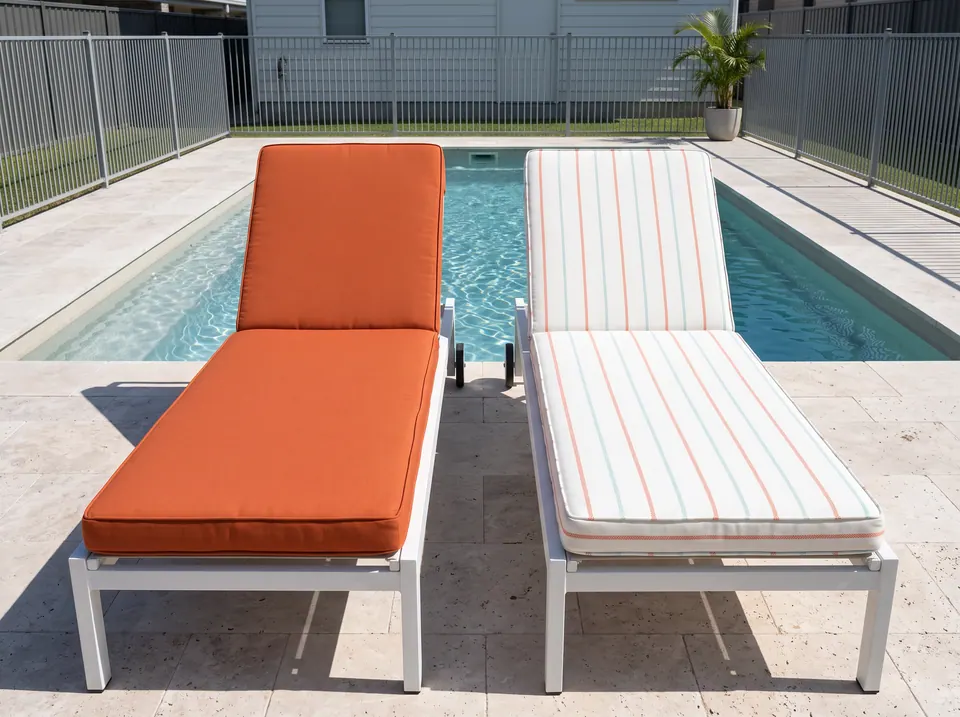
- Solid orange backrest
One bold solid anchors the pair.
- Orange box seat
Deep box seat with self piping gives a clean, upholstered edge.
- Pinstripe seat
The coral pinstripe repeats the orange as a thin line, tying the two loungers together.
- Pinstripe backrest
Stripes run lengthways so the lighter lounger doesn't look shorter.
- Potted palm
A single green plant is enough against the pale stone.
- Solid orange backrestOne bold solid anchors the pair.
- Orange box seatDeep box seat with self piping gives a clean, upholstered edge.
- Pinstripe seatThe coral pinstripe repeats the orange as a thin line, tying the two loungers together.
- Pinstripe backrestStripes run lengthways so the lighter lounger doesn't look shorter.
- Potted palmA single green plant is enough against the pale stone.
Anatomy of a matched pair that isn't identical
A sunbed cushion lives through the hardest weather of any cushion you own. Full sun bouncing off pale stone, chlorine splash, a wet towel left on it all afternoon. So the build has to be honest, and this pair is.
Start at the edge. Both are box cushions: a flat top, a flat bottom and a straight side wall between them, with self piping along both seams in the cushion's own fabric. That is parlor upholstery carried out to the pool. It gives the pair one silhouette, even though one is a loud solid and the other a quiet pinstripe.
Now the color. The orange on the left lounger comes back on the right as the thinnest line in the stripe, a coral thread between aqua and white. One color said twice, once loud and once soft. That is the whole trick, and it works just as well on two armchairs indoors.
The stripes run lengthwise, head to foot. Turned crosswise, the pale lounger would look stubby beside the solid. Our notes on stripe direction cover benches and seats too.
The props are few. White aluminum frames on wheels, a gray pool fence, travertine throwing light back up, and one potted palm. One green plant is enough against pale stone; a second would only crowd the glare. Both cushions are cut in outdoor acrylic, and the other sunbed cushions in the Atlas show more pairs. So which color would you let run through yours, friend?
What the pool borrows from the parlor, and what goes back indoors
| Idea | Where it comes from | Where else it works |
|---|---|---|
| Box edge with self piping | Indoor upholstery | Sunbeds and patio seats that should look tailored, not puffy |
| One color, said solid and then as a stripe | Poolside pairs | Two armchairs, a window seat and its pillows, twin beds |
| Stripes along the long side | Loungers | Any long bench, daybed or window seat cushion |
| Outdoor-grade fabric | The pool deck | Campers, sunrooms and mudrooms where sun and damp both visit |
| A template for every odd shape | Boats and campers | Bay seats, clipped corners, anything that is not square |
Six camper cushions and one honest template
A buyer messaged the workshop about a mini camper trailer with six bench cushions that needed new covers. Not new cushions, only covers, in a corduroy they had picked from the listing.
The workshop said yes, it does that work. Then the buyer did the smartest thing a camper owner can do: they sent a template showing all six shapes with every size marked, and asked for a quote from that.
A camper sits halfway between indoors and out. Damp mornings, hard sun through a small window, sandy feet. Its cushions are rarely square and no two quite match. A template of each one is the most reliable way to quote camper or boat covers, and our notes on RV dinette cushions show how to mark one up.
Rain doesn't negotiate, and neither does an odd corner. Draw it once and the cover fits the first time.
On the cutting table: the poolside pair
| Product | Sunbed cushions with seat and backrest, a pair |
|---|---|
| Edge | Box edge |
| Piping | Self piping on the top and bottom seams |
| Fabric | Outdoor acrylic: one solid orange, one white pinstripe with aqua and coral |
| Stripe direction | Lengthwise, head to foot |
| Frames | White aluminum loungers on wheels |
| Setting | Travertine pool deck in full overhead sun |
| Best for | Pool decks and patios where a pair should match without being identical |
Have it made
Have this made — ask Callum’s workshop
Short list: size, sun hours, how fast it has to dry. The workshop goes through it with you. — Callum
Leave your details and the workshop will call you to confirm measurements, fabric, foam and piping. No prices, dates or payment on this page: it is a request, not an order.
Buyer questions: cotton outdoors, a narrower back and two fabric families
- A common question
Can I use a ticking stripe for backyard cushions that stay out all year?
The workshop's answerNo. Ticking stripe is 100% cotton and is not made for outdoor use. For cushions that live outside, choose the outdoor linen-look fabrics instead: they are water-repellent, UV-resistant and come in natural tones.
- A common question
Can the back cushion on our RV couch be a couple of inches narrower than the seat?
The workshop's answerYes. For one converted bus seat, the back was made 46.5 in (118 cm) wide and the seat 48 in (122 cm) wide by 16.5 in (42 cm) deep. The backrest's thickness was subtracted from the back height so the two pieces sit together properly.
- A common question
I'm torn between two outdoor fabric families. Which one is better?
The workshop's answerNeither. Both come from the same mill with the same quality and very similar properties; only the pattern and the texture of the weave differ. If you want a white body with black piping, each family has a matching white and black pair.
Two sunbed cushions can wear different fabrics and still look like a pair, as long as one color runs through both: bold on one, a thin stripe on the other.
Callum
Questions buyers ask next
Can two sunbed cushions in different fabrics look like a set?
Yes, if they share one color and one silhouette. Pick a solid first, then a stripe that carries that color as its thinnest line, and order both with the same edge, thickness and piping so the pair reads as one design.
Which way should stripes run on a chaise lounge cushion?
Lengthwise, from head to foot. Stripes that follow the long side make the lounger look longer and calmer; crosswise stripes chop it into short bands and make a pale cushion look stubbier beside a solid one.
Is self piping a good choice on an outdoor sunbed cushion?
Self piping repeats the cushion's own fabric along the seams, so the edge looks crisp without a second color competing with the pattern. On a busy stripe it keeps the outline quiet; on a solid it adds a tailored line.
How do I measure a chaise lounge for new cushions?
Measure the seat section and the backrest section separately, each from the hinge line to its end, plus the width across the frame. Measure the frame itself rather than a worn cushion, and write down the thickness you want.
Fair winds — Callum
More photographs to read
 Save
 Save
 Save
 Save
 Save
 Save