The Pattern Room · a measuring pattern
Hanging egg chair cushions and hammock pads, measured from the old one
A hanging chair moves every time somebody laughs in it, so its cushion has to be cut to the seat and tied where the frame can hold it. Here is how we measure both, from the porch steps.
 Save
The quick answer
For an egg chair cushion replacement, lay the old cushion flat and measure it seam to seam, then trace it on paper and photograph the tracing beside a tape measure, plus the chair straight from the front. Seat and back are separate pieces. Hammock pads are long flat pieces measured between the spreader bars, with ties where the pad meets the bars.
A seat that swings needs a pattern, not a guess
The old cushion in your egg chair is the best tape measure you own. It has spent years pressed into the exact curve of that seat.
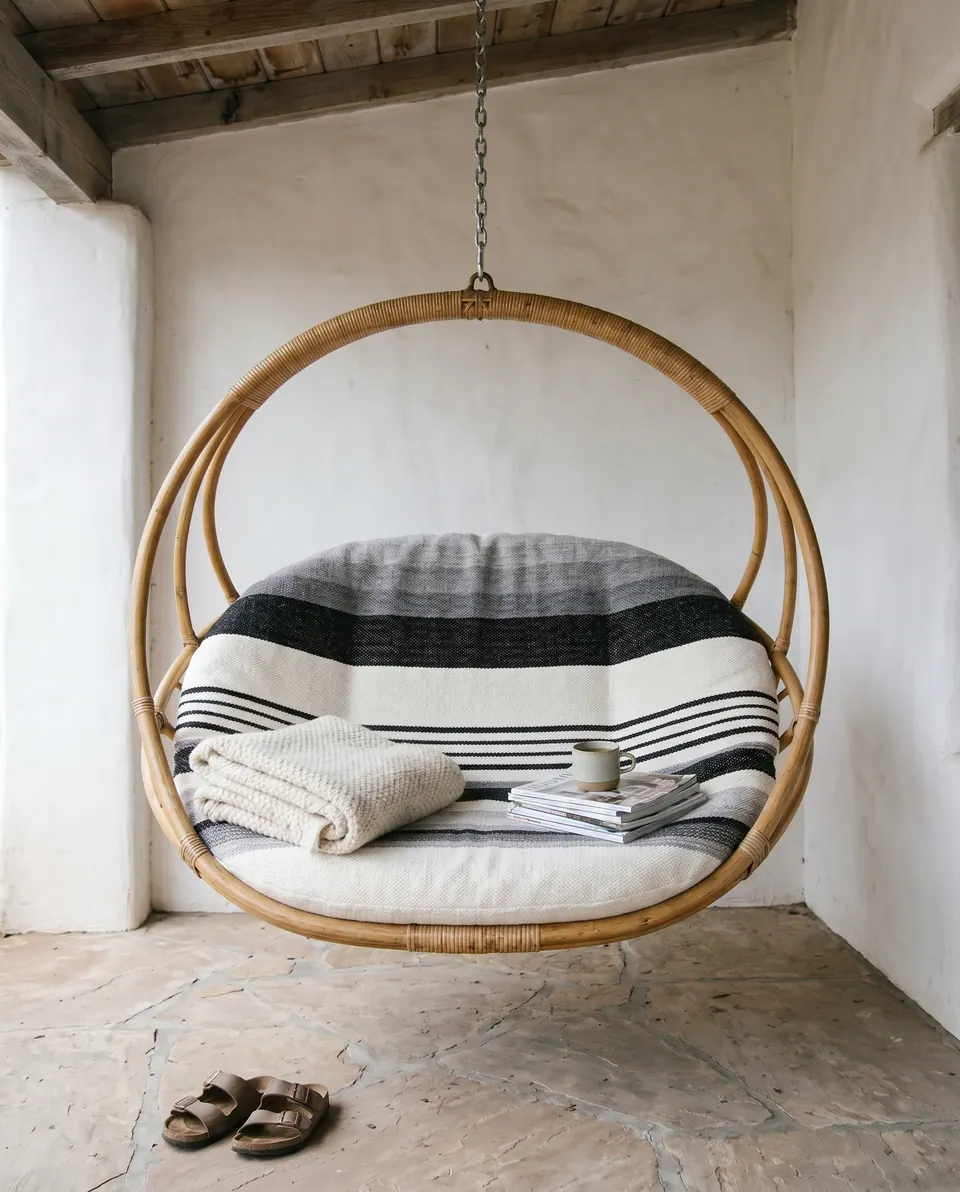
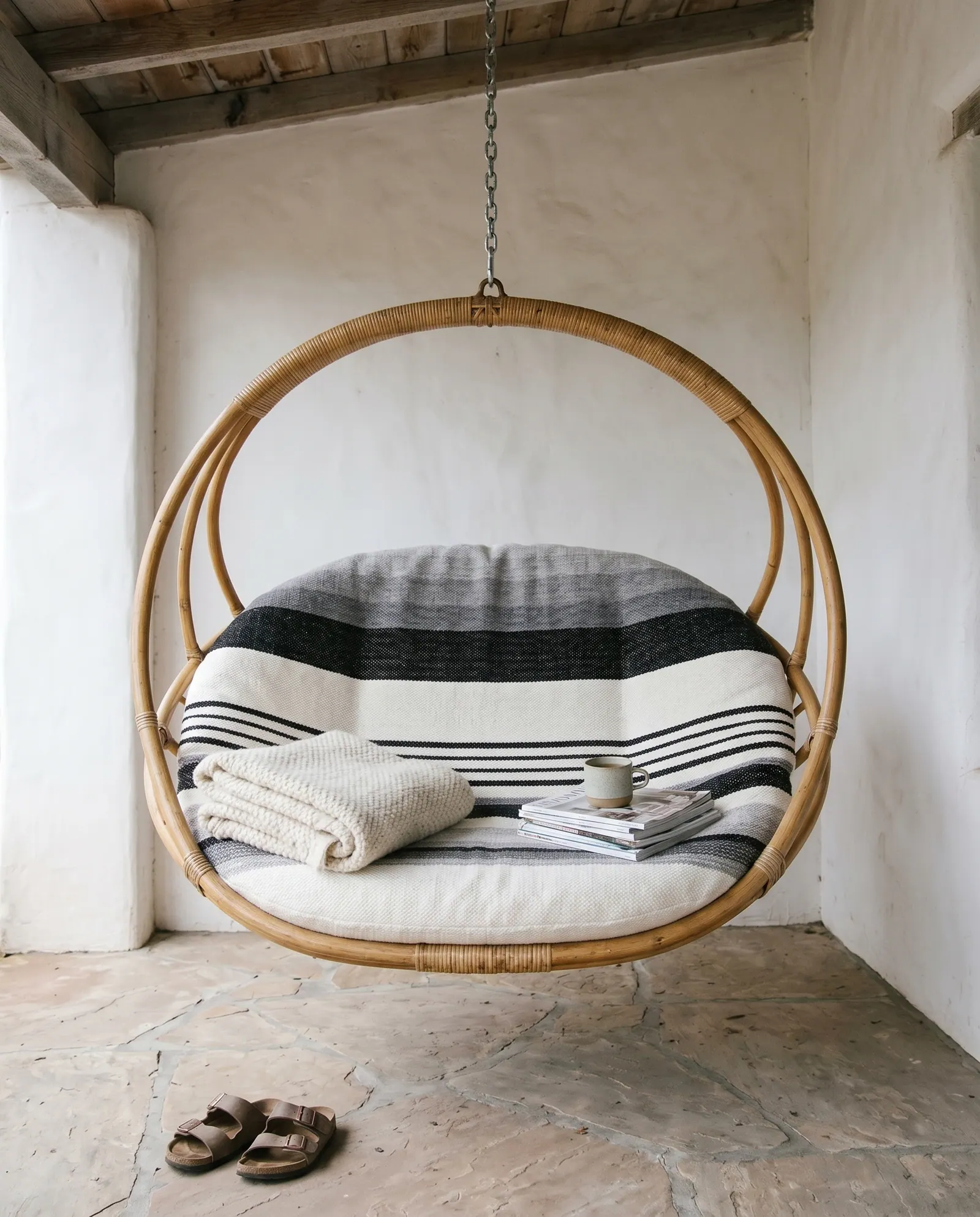
An egg chair cushion replacement is a shaped seat pad, rounded or teardrop, and often a separate back cushion that rests against the curve of the shell. A round hoop chair, like the striped one in the photo above, takes the same two pieces. A hammock is simpler: one long, flat pad, sometimes with a raised section at the head.
A papasan is a different animal, a bowl that takes a big round measured rim to rim; the papasan cushion size Pattern has that math. Everything else that hangs lives here and in the papasan and hanging chair atlas.
Pull up a chair. This Pattern is short, because the method is.
Egg chair, hoop chair, hammock: what each one takes
| Seat | Cushion shape | What to measure | How it stays put |
|---|---|---|---|
| Egg chair seat | Shaped pad, rounded or teardrop | The old pad laid flat, seam to seam, plus a paper tracing | Yes Ties at the back, where the frame can hold them |
| Egg chair back | Its own piece, leaning on the curved shell | Height from the top of the seat cushion, widest width, a straight-on photo of the curve | Partly Ties to the frame; a fit against a strong curve is reviewed first |
| Round hoop chair | Round or shaped seat, plus a back | Diameter and thickness if it is a true circle; otherwise a tracing | Yes Ties knotted around the rattan |
| Hammock | Long flat pad, one piece or seat plus raised head | Bed length between the spreader bars, and width where the pad will lie | Yes Corner ties knotted to the bars |
Simple rounds and rectangles are straightforward. Shaped pieces are reviewed from a measured drawing and photos before anything is promised.
Measuring an egg chair cushion in seven steps
Work from the old cushion if you still have it, and from the seat itself if you don't. Keep one unit, inches, for everything you send.
Lift the old cushion out and lay it flat
Set it on a table, top side up. A cushion measured while it sits bent in the chair lies about its size. Measure seam to seam across the widest point, then front to back through the middle, then the thickness at the center.
Trace it on paper
Lay the cushion on wrapping paper, butcher paper or the back of gift wrap and trace around it with a marker held straight up; stiff card and tissue won't do. Cut the shape out and write the widest width and the depth on it. No old cushion? Trace the seat itself.
Pattern sheet Lay paper on the seat and trace the edge, write the widest width and the front-to-back depth on the template, then photograph it flat from directly above with a tape measure in the picture. Mark where each curve starts and ends
If the pad has a straight stretch along the front or back, measure it and mark where the curve takes over. The workshop won't read a curve from numbers alone; it needs to see where the curve begins, ends and how deep it runs.
Photograph the tracing and the chair
Photograph the tracing flat from straight above with a tape measure in the picture, then the chair from the front, straight on, and the seat from above. No need to mail the paper; the photos do the traveling.
Measure the back as its own piece
A back cushion is a separate item with its own drawing. Measure its height from the top of the seat cushion and its width where it is widest, and send a straight-on photo of the curve it leans against. That curve is where the fit risk lives.
Decide where the ties go
Ties are never added unless you ask. Write how many, where (two at the back corners, one at each side, one at the top of the back) and how long, if they must wrap a thick rattan rim. Put it in the personalization box, not the size box, then find the ties in the pre-shipment photo. The tie placement Pattern shows knots that hold.
Pick fabric for where the chair hangs
On a porch or patio, choose the outdoor fabric, water-repellent and UV-resistant. The standard foam is not quick-dry and there is no mesh bottom as standard, so a chair on an open patio wants its cushion brought in before a storm. What water-repellent really means is worth five minutes.
Have it made
Measured it? Have Rosa’s workshop make it
Tell the workshop who sits there: grandkids, the dog, a cup of coffee at six. The right fabric and foam follow from the people. — Rosa
Leave your details and the workshop will call you to confirm measurements, fabric, foam and piping. No prices, dates or payment on this page: it is a request, not an order.
Hammock pads: long, flat and tied at the bars
A hammock pad is the easy cousin. Measure the bed between the spreader bars, the rods at each end, along the line where the pad will lie, then the width where it will rest. Decide between one piece and a seat plus a raised section at the head, like the rainbow-striped pad in the garden photo; two pieces follow the hammock's curve instead of bunching in the middle.
Ties keep it there. Ask for corner ties long enough to knot around the bars, and ties where the two pieces meet so they travel together. A sewn fabric hinge between the pieces is a different make, so ask the workshop before you plan around one.
A hammock with no spreader bars wraps around whoever lies in it, and a flat pad will fight that shape. Send a photo of it hanging and ask first.
The rattan armchair that was easy, and the back that wasn't
A buyer in the US wrote to the workshop about a classic rattan armchair with a U-shaped seat, a little wider at the front, with curved back edges. Not a hanging chair, but the same family of problem.
Measured properly, the seat came to 24 in (61 cm) deep and 21 1/4 in (54 cm) wide, under 3 in (7.5 cm) thick. The shop said that part was straightforward. A seat pad sits on a seat, and a seat is forgiving.
The back cushion had to press against a curved frame, so the shop flagged it as risky and asked for measurements and a straight-on photo of the curve before committing. That is the honest order of things: easy pieces get a yes, curved pieces get a look first.
What does the curve behind your seat look like, neighbor: gentle, or does it wrap right around you?
- What it taught
- Seat pads on curved chairs are easy; back cushions pressed against a curve carry the real fit risk.
What gets a yes, what gets a second look, and what got a no
Rounds and rectangles are simple: a round is ordered by diameter and thickness, a rectangle by length, depth and thickness, and several sizes can share one order.
Shaped seats get reviewed. The workshop never promises a curved piece until its craftsmen have seen a measured drawing and photos. It has declined a rocking-chair seat pad that had to fit a shaped chair exactly, and new covers for curved, angled outdoor loveseat cushions, because neither could be made accurately without the piece in the workshop. So re-covering an old curved egg chair pad is a harder job than cutting a new one from a tracing.
Shaped cushions take extra cutting and sewing on their own production line, so they're priced above a rectangle of the same size, and curved shapes go to the most experienced craftsman and take longer, so ask for the time in writing. On a tight budget, a plain round with a couple of throw pillows tucked into the curve costs much less. The limits on curved cushions spell out how a curve is judged.
Measure an old egg chair cushion flat, seam to seam, then trace it. A cushion measured while it sits bent in the chair lies about its size.
Rosa
What to send before anything is cut
- A photo of the chair from the front, straight on, and one of the seat from above.
- The paper tracing, photographed flat with a tape measure in the frame.
- Widest width, depth and thickness, written on the tracing and typed in your message.
- Where each curve starts and ends, with any straight stretch measured.
- The back cushion as its own drawing, with a photo of the curve it leans on.
- For a hammock: bed length between the spreader bars, the width, and one piece or two.
- Ties: how many, where, and how long.
- The fabric code, and whether the chair hangs under a roof or out in the weather.
Buyer questions: curves, rounds and ties
- A common question
How do I measure a curved seat, like a rocker, a barrel chair or a horseshoe back?
The workshop's answerMake a paper template: trace the seat, cut it out, write the widest width and the depth on it, and photograph it flat from directly above with a tape measure showing. You don't need to mail it. Without a template, send the width and depth, where each curve starts and ends and how deep it runs, and a top-down photo. The craftsmen check the shape and confirm before you order.
- A common question
Can you make any curved shape, or are some too hard?
The workshop's answerMild curves are possible, but nothing curved is promised until the craftsmen have reviewed a measured drawing and photos. A strongly curved round bay, a rocking-chair seat that had to fit exactly, and new covers for curved outdoor loveseat cushions have been declined. A full template turned one S-curve bench from a no into a yes, at a premium over a plain trapezoid.
- A common question
Do you make round cushions?
The workshop's answerYes, ordered by diameter and thickness, with a drawing or reference photo. The shop has made 16 in (40.5 cm) café bar-stool rounds 4 in (10 cm) thick and a 41 in (104 cm) round for inside a play tent. Round and rectangular sizes can share one cart; only the cushion is made, never a metal base.
- A common question
Can you sew ties onto a custom cushion so it stays where I put it?
The workshop's answerYes, on any made-to-measure cushion, odd shapes included. Write in the personalization box how many ties and where, such as the corners, two on the back edge or one side, with a length if they must wrap a frame. They're sewn into the seam, and never added unless you ask.
- A common question
Could you use hook-and-loop tape instead of ties?
The workshop's answerThe workshop usually suggests ties or a non-slip bottom instead. Hook-and-loop tabs and snap fasteners aren't made. A two-sided hook-and-loop strip has been added on request, one side sewn under the cushion and the other sent to you, at extra cost; ask in the personalization box and wait for confirmation.
Short answers for hanging seats
Is an egg chair cushion the same as a papasan cushion?
No. A papasan cushion is a big round sized from the bowl, rim to rim plus about 2 to 3 in. An egg chair takes a shaped seat pad cut from a tracing, often with a separate back cushion, so it is measured from the old pad or from the seat itself.
Can a hanging chair cushion stay outside all season?
Under a roof and in outdoor fabric it does well, since the fabric is water-repellent and UV-resistant. The standard foam isn't quick-dry and there's no mesh bottom as standard, so bring the cushion in before storms and store it indoors for winter.
Why does a shaped seat pad cost more than a rectangle?
A shaped cushion takes extra cutting and sewing and runs on a separate production line, so the custom-shape listing is priced above the rectangle listing. A shaped piece ordered on the rectangle listing is either refunded so you can reorder, or you pay the difference.
Can the seat and back of a hanging chair cushion be joined?
They can be tied: ties sewn where the two pieces meet keep them together, and more ties hold the pair to the frame. A permanently sewn hinge is a different make, so ask the workshop before you count on one.