A Reading by RosaWindow Seat Cushions
The oatmeal window seat cushion with a brown welt: box, knife, rounded or angled corners
Before the reading, three buyer questions: samples, squashed parcels and piping-free edges. Then Rosa studies an oatmeal seat that sits flush on white paneling and asks what shape its edge should take.

 Save
The quick answer
For a window seat on a built-in base, a box edge is usually the right choice: its straight sides finish flush with the front of the base and hold a crisp line. Knife edges suit thin pads and chair seats, rounded corners suit a seat end that opens onto a walkway, and angled corners belong in bay windows and angled nooks.
Questions first: samples, squashed parcels, no piping
- A common question
The size menu has an option called 'fabric sample'. What is that?
The workshop's answerIt is a fabric sample, so you can see and feel the color before you order the cushions themselves. Look at it in your own window light first.
- A common question
My parcel had the covers in it but no cushions. Are the inserts shipping separately?
The workshop's answerLook again before you worry. Foam inserts are often vacuum-compressed straight into their covers, so the package looks like covers only. If the foam really is missing, the workshop investigates.
- A common question
Can I have the cushion made with no piping at all?
The workshop's answerYes. Write in the order notes that you do not want piping, and the edges are sewn plain.
Now, the reading
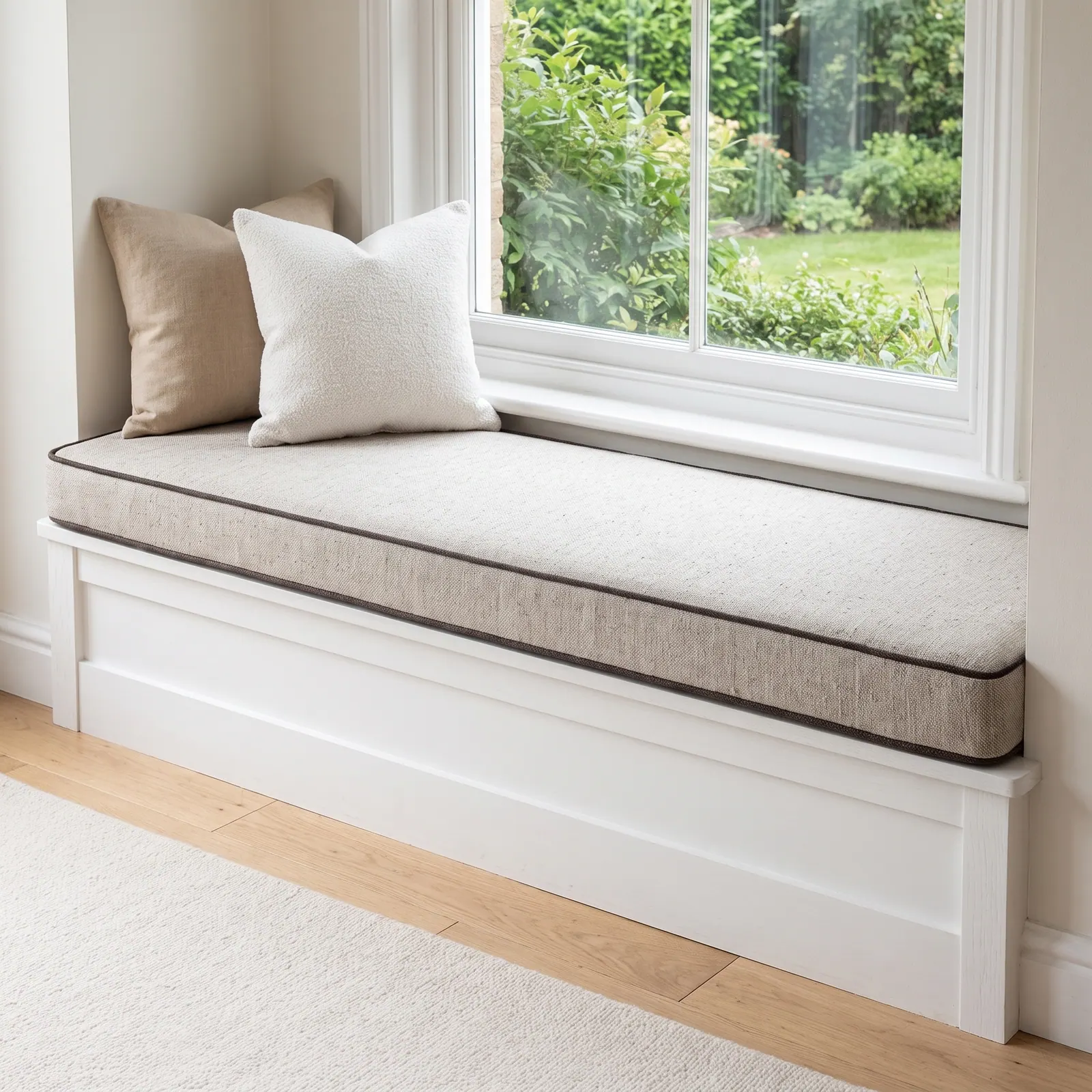
An oatmeal seat that stops exactly at the paint
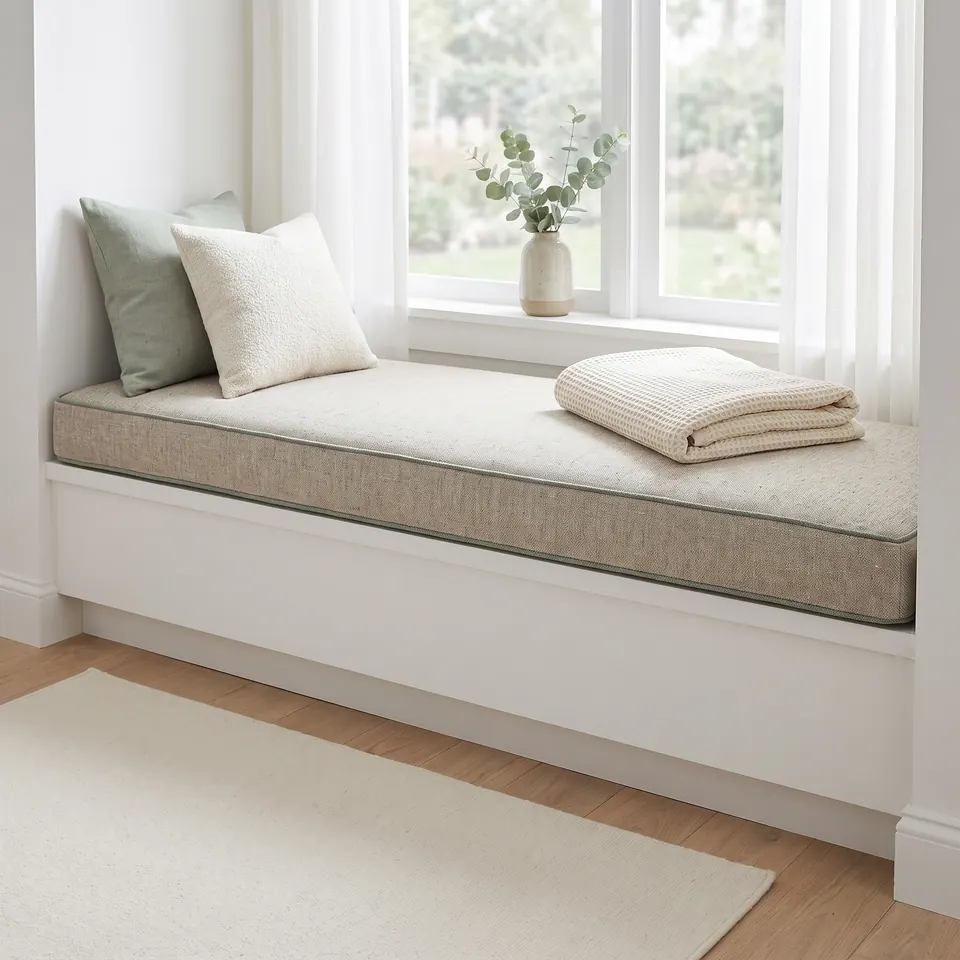
Here is a window seat cushion that knows where it ends. The front face lines up with the white paneled base below it, flush, not a finger's width of overhang, and that is the whole reason this built-in looks built in rather than furnished.
It is a box edge: straight sides joining a top and a bottom panel. On a paneled base that matters, because the side of the cushion becomes one more flat panel in the stack. The brown tweed welt along the top and bottom seams is the line that stops a pale oatmeal seat melting into white woodwork. Take the welt away and you would have a beige blur.
The fabric is an oatmeal greige linen-look weave, close to the wall color on purpose. With a green garden filling the wide casement window, the view is the only color the room needs. The two pillows sit at the wall end only: a taupe linen one a shade darker than the cushion for depth, and a white textured one in front that ties the seat to the painted base. The other end stays bare, so there is a full-length seat for anybody who wants to stretch out with a book. Below, a cream wool rug and a light oak floor keep the corner warm.
If your window seat faces a view, pick a cushion close to your wall color and let a darker welt define it. Box edges belong on built-ins; the box versus knife edge pattern lays out the rest, and the rounded corner measuring pattern covers open ends. More ideas wait among the window seat cushions. Which end of your seat do the pillows live at, neighbor?
Pinned by Rosa
Pins mark the two neutral pillows, the brown welt, the flush paneled base and the garden that supplies all the color.
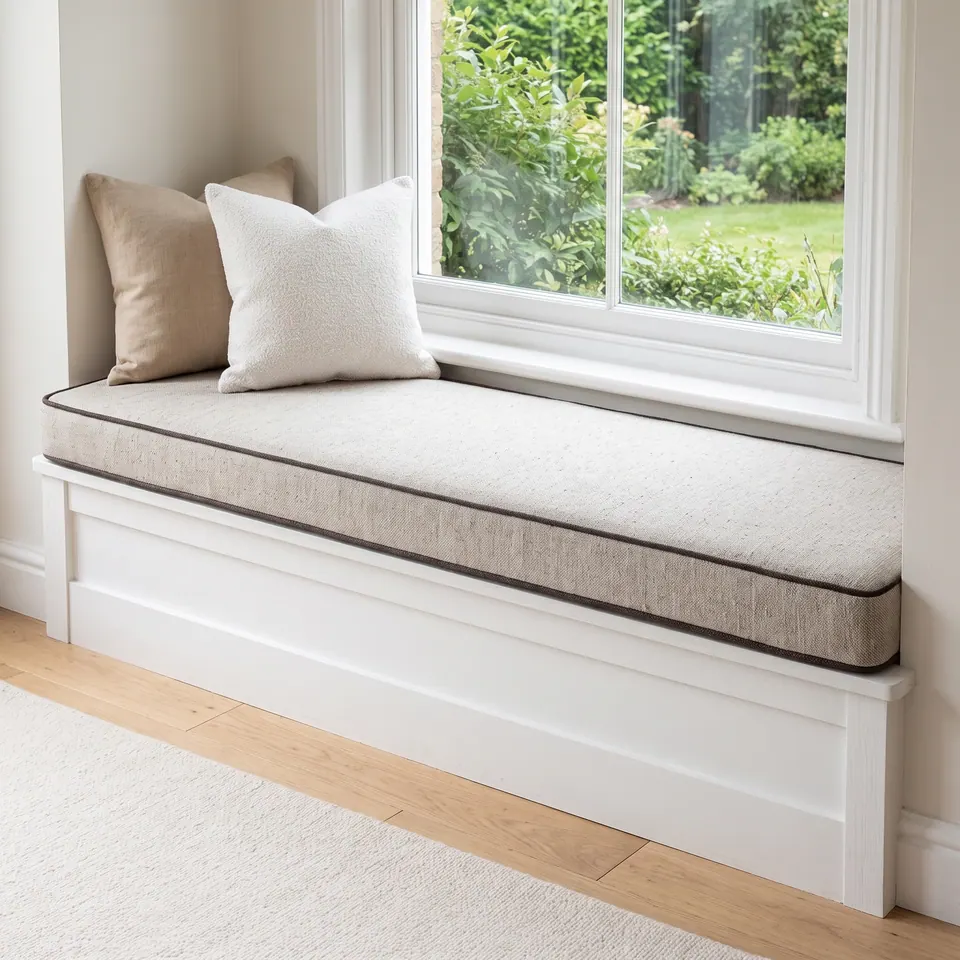
- Taupe linen pillow
The back pillow is a shade darker than the cushion so the pile of neutrals has depth.
- White textured pillow
A white pillow in front ties the seat to the painted base.
- Brown piping
Brown welt runs the full length and gives the pale seat a clear outline against white.
- Garden view
Green outside is the only color, so everything inside stays neutral.
- Paneled base
The cushion sits flush with the front of the painted base, with no overhang.
- Taupe linen pillowThe back pillow is a shade darker than the cushion so the pile of neutrals has depth.
- White textured pillowA white pillow in front ties the seat to the painted base.
- Brown pipingBrown welt runs the full length and gives the pale seat a clear outline against white.
- Garden viewGreen outside is the only color, so everything inside stays neutral.
- Paneled baseThe cushion sits flush with the front of the painted base, with no overhang.
Box, knife, rounded or angled: which edge goes where
| Edge | How it is built | Where it belongs |
|---|---|---|
| Box edge | Top and bottom panels joined by a straight side band | Built-in bases, window seats, deep benches |
| Knife edge | Top and bottom sewn straight together, thinning at the seam | Thin pads, chair seats, cushions that tie on |
| Rounded corners | Corners cut on a curve you measure | A seat end that opens onto a walkway or door |
| Angled corners | Corners cut to the wall's angle | Bay windows and angled nooks |
A kitchen bench order, written out line by line
A buyer abroad had a kitchen bench and wanted one seat cushion and two backrest cushions, all in a linen fabric, 3 in (7.5 cm) thick. The sizes were not on the menu. So the workshop suggested buying two of the stock 23⅝ x 47¼ in (60 x 120 cm) options to cover the price, and then making one 24¾ x 48¾ in (63 x 124 cm) seat and two 15¾ x 24⅜ in (40 x 62 cm) backrests, with every size written in the order notes.
The buyer paid for only one cushion at first, so a link for the balance went out before any foam was cut. That is simply how a custom order stays straight.
The lesson travels well: choose stock sizes that cover the price, then write every piece and every dimension in the note. The personalization note pattern shows how to lay it out.
On the cutting table: the oatmeal seat and its brown welt
| Piece | Window seat cushion on a paneled built-in |
|---|---|
| Fabric | Oatmeal greige linen-look weave |
| Edge | Box edge, square corners |
| Piping | Brown tweed contrast welt on top and bottom seams |
| Fit | Flush with the front of the base, no overhang |
| Pillows | Taupe linen and white textured, at the wall end only |
| No-piping option | Available; write it in the order note |
| Best for | Garden or view windows where the cushion should stay quiet |

Have it made
Have this made — ask Rosa’s workshop
Tell the workshop who sits there: grandkids, the dog, a cup of coffee at six. The right fabric and foam follow from the people. — Rosa
Leave your details and the workshop will call you to confirm measurements, fabric, foam and piping. No prices, dates or payment on this page: it is a request, not an order.
A box-edge window seat cushion should finish flush with the front of the base; even a little overhang makes a built-in look like a mattress.
Rosa
Questions buyers ask next
Does a box-edge window seat cushion always need piping?
No. Piping helps a box edge hold a crisp corner and outlines a pale cushion against pale paint, but a plain-seamed box edge works well on patterned fabric or in a spare, minimal room. Ask for no piping in the order note.
When is a rounded corner better than a square one on a window seat?
When one end of the seat is open to a walkway, door or table, so a square corner would catch knees and hips. Measure where the curve starts on each side and give that distance; for irregular curves, a paper template is the safer route.
Should a window seat cushion overhang the front of a paneled base?
On a paneled or painted built-in, no. Cut it to finish flush with the front face so base and cushion read as one piece of carpentry. A small overhang only makes sense on a plain ledge, where the cushion's edge is the only softness.
Porch light's on — Rosa