A Reading by MaggieDining Chair Cushions & Pads
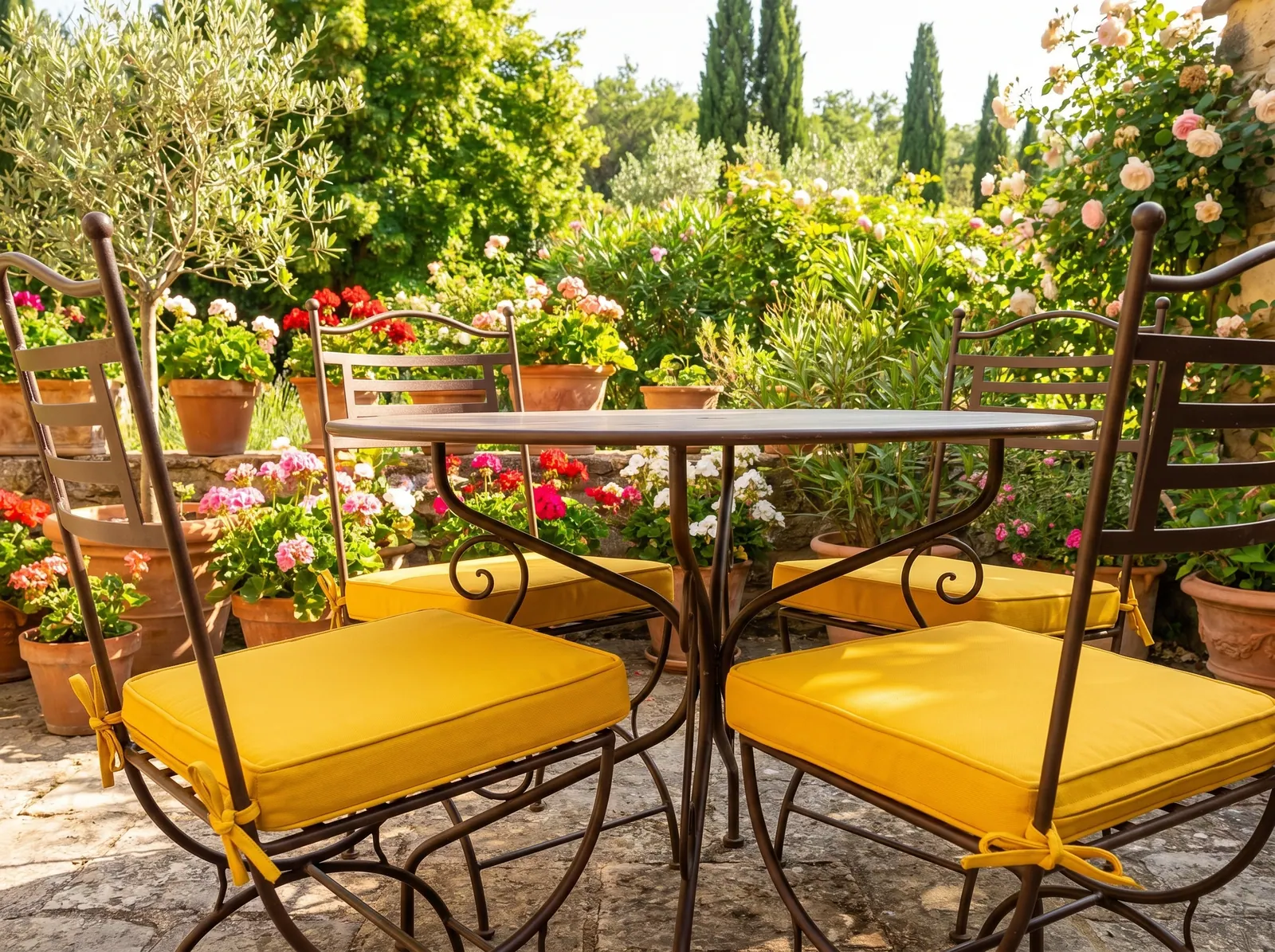
Anatomy of a mustard tie-on chair pad, from the bow at the back to the box at the front
Maggie takes a garden set of four wrought-iron chairs apart, pad by pad: what reads from the gate, what shows when you bend down, and how to measure for it.

 Save
The quick answer
A chair cushion with ties for a wrought-iron chair should be a firm box pad cut to the seat's exact shape, with ties at the back corners long enough to knot around the uprights. One strong solid, like mustard yellow, unifies a set of thin dark frames. Measure the bare seat or foam, never the old cover.
The cushion, cut open
Cover fabric. A removable, zippered cover. Machine wash at 86°F (30°C) on a gentle cycle and air dry.
Piping. A fabric-covered cord sewn into the seams. It sits on the seam line, so it does not change the size.
Fiber wrap. Polyester fiber (Dacron) batting around the foam: it fills the cover out and softens the edges.
Foam core. About 2.0 lb/ft³ (32 kg/m³) high-resilience foam, firm to medium-firm, cut to the ordered size.
Zipper. Along the back band, as hidden as possible. The zipper side faces down or toward the wall.
Base panel. The underside of the cover. A non-slip fabric backing can cover the whole of it instead.
Pinned by Maggie
Five pins, from the bow at the back upright to the climbing roses that let the yellow stay a solid.
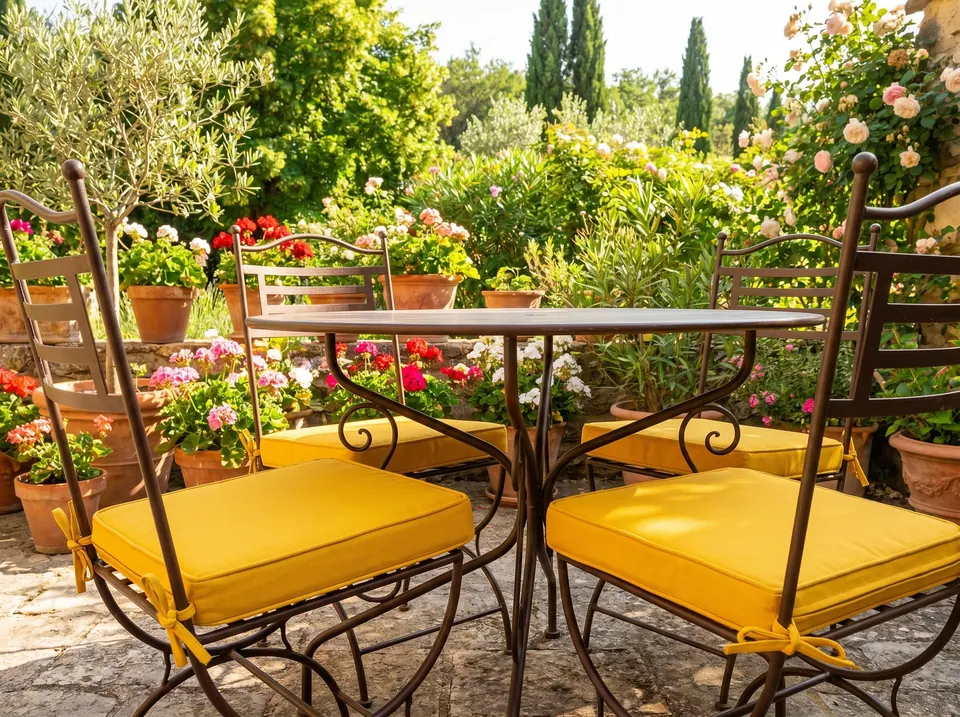
- Mustard box pad
A firm box cut to the chair's squared seat.
- Bow tie
Ties in the same yellow double as decoration.
- Matching pad
One strong solid unifies all four chairs.
- Bistro table
Thin dark iron lets the yellow do the visual work.
- Climbing roses
Pink roses sit happily beside the yellow.
- Mustard box padA firm box cut to the chair's squared seat.
- Bow tieTies in the same yellow double as decoration.
- Matching padOne strong solid unifies all four chairs.
- Bistro tableThin dark iron lets the yellow do the visual work.
- Climbing rosesPink roses sit happily beside the yellow.
Bow to box: the pad, layer by layer
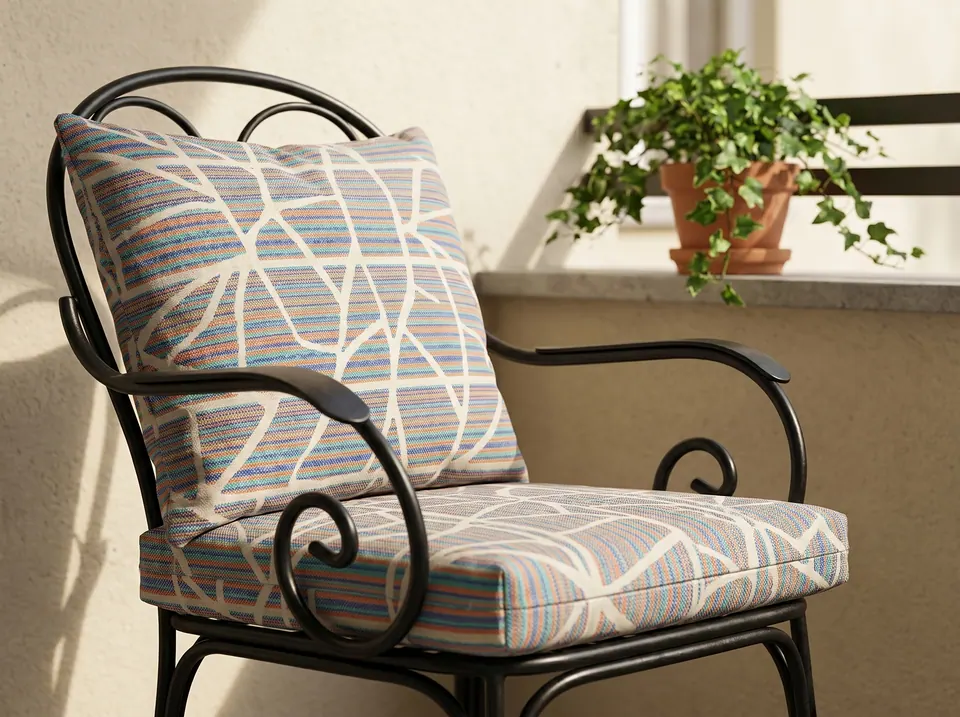
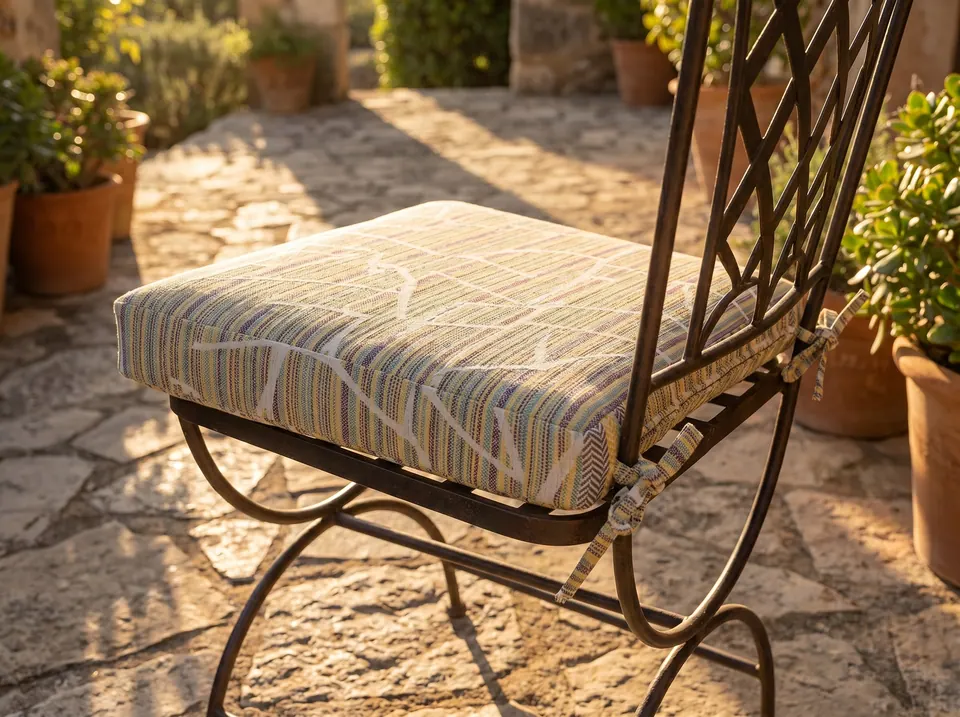
Start at the back, where the bow is. Each pad carries a pair of ties in the same mustard fabric, knotted in a bow around the chair's back upright. From the garden gate they read as trim. Up close they do the real work: keeping a pad on a smooth iron seat that gives it nothing to grip.
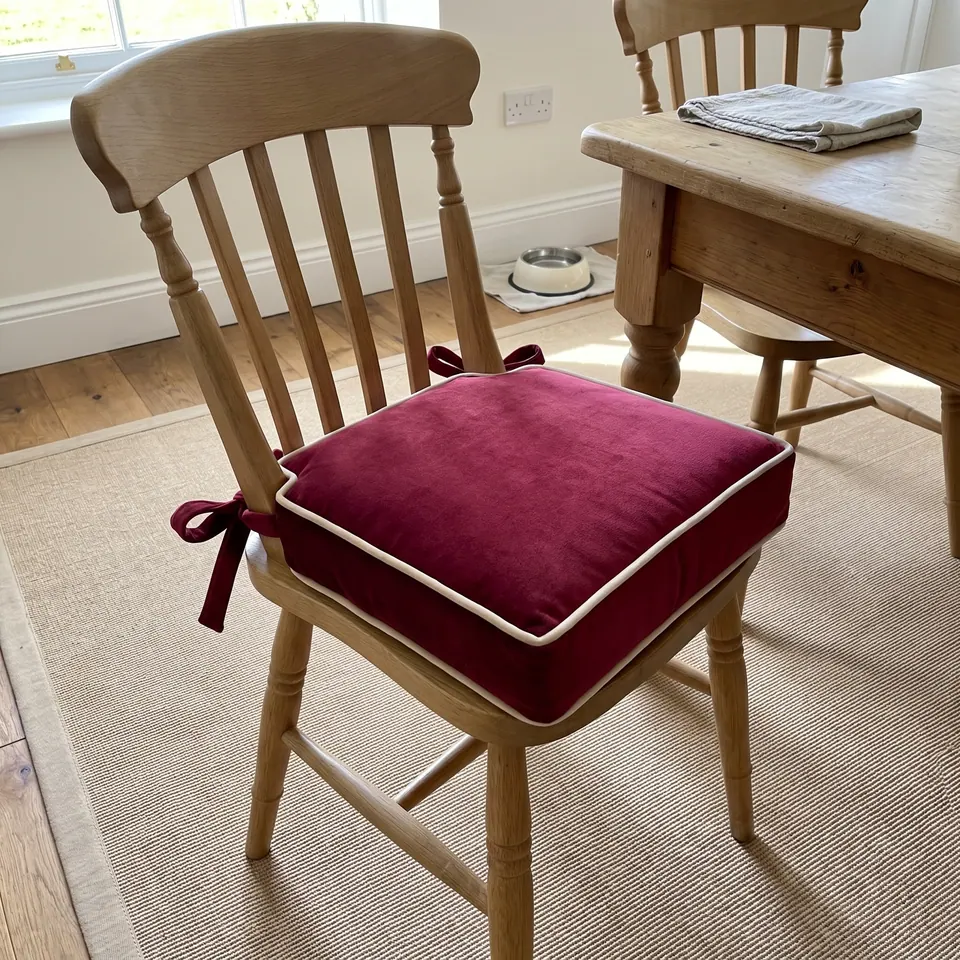
Move forward to the edge. The pad is a box, not a knife edge, so a band runs around its side with self piping along the top. The box keeps square corners and an even height across the chair's squared seat instead of doming in the middle. The piping is cut from the same yellow, which is why you don't notice it from ten feet. Bend down and you'll see whether the welt runs straight. I once unpicked a whole set because the corners wandered, dear, so I bend down every time.
Inside is a firm filling cut to the seat's shape; a thin iron seat has no padding underneath to share the load.
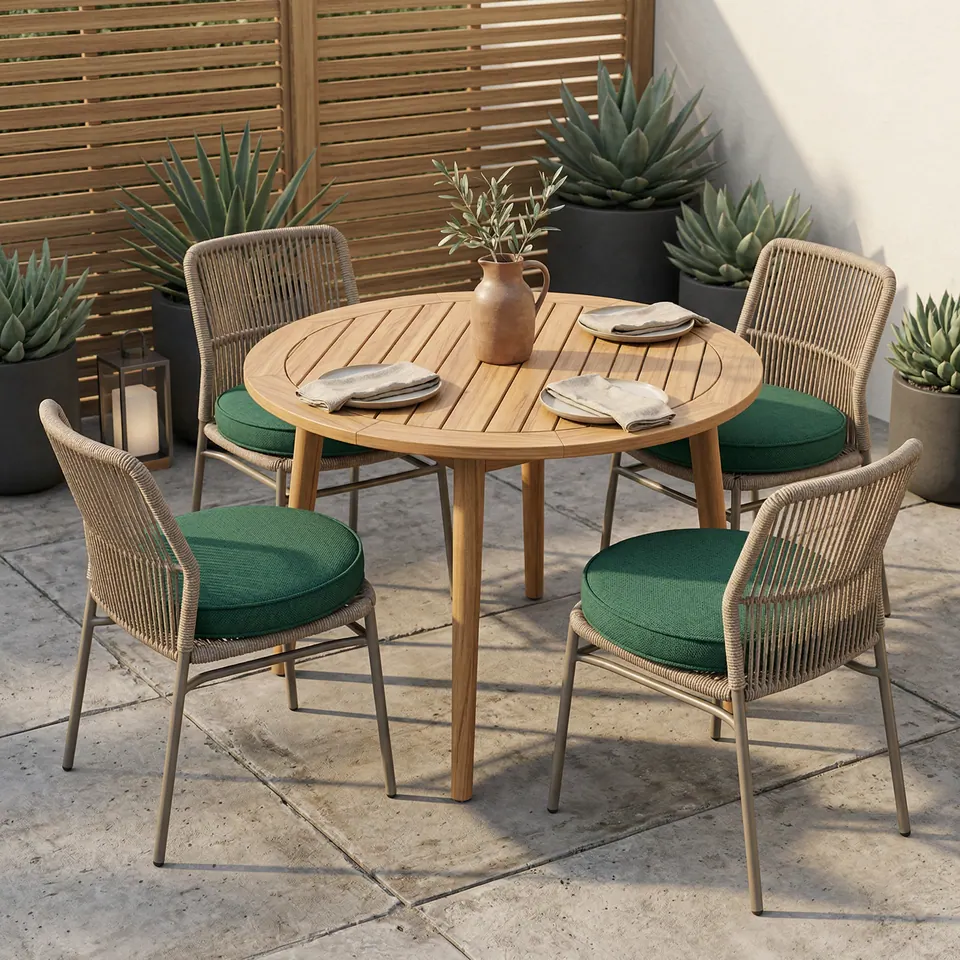
Now step back. Four brown wrought-iron chairs, a round bistro table, climbing roses, red and pink geraniums in terracotta pots, cypress and olive trees behind. The frames are thin and dark, so they can't carry color on their own. One saturated solid carries it for all four, and mustard sits beside pink roses and red geraniums without competing, because the flowers bring the pattern.
How many chairs are you dressing, and do they all share one seat shape? The Pattern on dining chair pad measurements covers the tape work, tapered dining chair pads handles seats that narrow toward the back, and more sets live under dining chair cushions and in outdoor acrylic.
From the gate and from the seat
| Detail | From ten feet | From ten inches |
|---|---|---|
| Color | One mustard solid ties four chairs together | The same shade on every pad, ordered as one set |
| Shape | A neat square on each seat | Box corners cut to the chair's squared seat |
| Ties | Yellow bows read as decoration | Knotted at the back uprights, long enough for a bow |
| Piping | Invisible | A straight welt along the top of the box band |
On the cutting table: the mustard tie-on pads
| Cushion | Box-edge tie-on seat pad, set of four |
|---|---|
| Fabric | Mustard yellow outdoor fabric |
| Piping | Self piping |
| Shape | Cut to the chair's squared seat |
| Ties | Same fabric, at the back corners, bowed at the uprights |
| Chairs | Brown wrought iron around a round bistro table |
| Measure | Bare seat or foam, every side labeled |
| Best for | Metal bistro sets and garden dining |

Have it made
Have this made — ask Maggie’s workshop
Numbers first, fabric second, piping last. Jot down what you have, and the workshop will go down the list with you, item by item. — Maggie
Leave your details and the workshop will call you to confirm measurements, fabric, foam and piping. No prices, dates or payment on this page: it is a request, not an order.
Buyer questions: shaped pads, small pairs and a round seat
- A common question
How do I measure for new covers on chair pads that aren't quite square?
The workshop's answerDraw the foam insert and label every side, for example a slight trapezoid with rounded front corners at 17 3/4 x 17 x 19 3/4 x 17 in (45 x 43 x 50 x 43 cm), 1 1/2 in (4 cm) high. Measure the bare foam, not the old cover. When one first set came out about 3/4 in (2 cm) short, the remake was cut 1/2 to 3/4 in (1 to 2 cm) larger, with longer ties.
- A common question
Is it worth ordering just two small seat cushions, 10 x 13 in and 2 in thick?
The workshop's answerYes. The workshop quoted the two 10 x 13 in (25 x 33 cm) cushions, 2 in (5 cm) thick, as a pair, eased the price when the buyer felt it was steep for such small pieces, and made them in a beige chosen from the color chart.
- A common question
Can you make a round chair cushion with a zip-off cover and ties for the chair back?
The workshop's answerYes. A 12 in (30 cm) round cushion, 4 in (10 cm) thick, with filling, a zippered cover and a loop or ties for the chair back has been quoted and made to order.
Eight pads, one week, and the calendar
A buyer in the US needed eight velvet seat cushions, 17 x 18 in (43 x 46 cm), piped in one color and fitted with ties, and hoped to have them within about a week.
The workshop told them to order the 18 x 18 in option with a note for 17 x 18, and offered a better price for the batch of eight. Ties were easy. The calendar was not: the earliest delivery the workshop could give was about two weeks out.
A bigger order did not buy a shortcut. If the chairs are for an event, order early and get the delivery date in writing.
- Sizes
- 8 pads, 17 x 18 in (43 x 46 cm)
The lesson: This batch of eight custom pads still took roughly two weeks, so plan events well ahead.
On thin dark wrought-iron chairs, one strong solid like mustard carries the whole set, and ties in the same fabric, tied in bows, become the trim.
Maggie
Questions buyers ask next
Do metal garden chairs need tie-on pads?
Usually, yes. A smooth iron seat gives a pad nothing to grip, so ties at the back corners, knotted around the uprights, keep it in place. Ask for ties when you order; they are not added automatically.
Box edge or knife edge for a bistro chair pad?
A box edge keeps square corners and an even height across a squared seat, which suits a firm pad. A knife edge tapers thin at the sides and domes in the middle, a softer, more casual look.
What color pads suit dark wrought-iron chairs?
A saturated solid. Thin dark frames can't carry color on their own, so one strong shade like mustard unifies the set, and it sits well beside pink and red garden flowers.
How far ahead should I order chair pads for an event?
Earlier than you think. One buyer hoping for eight custom pads within a week found the earliest delivery was roughly two weeks out. Give the event date in your first message, so the calendar is settled before anything is cut.
Stitch straight — Maggie
More photographs to read
 Save
 Save
 Save
 Save
 Save
 Save