A Reading by MaggieDining Chair Cushions & Pads
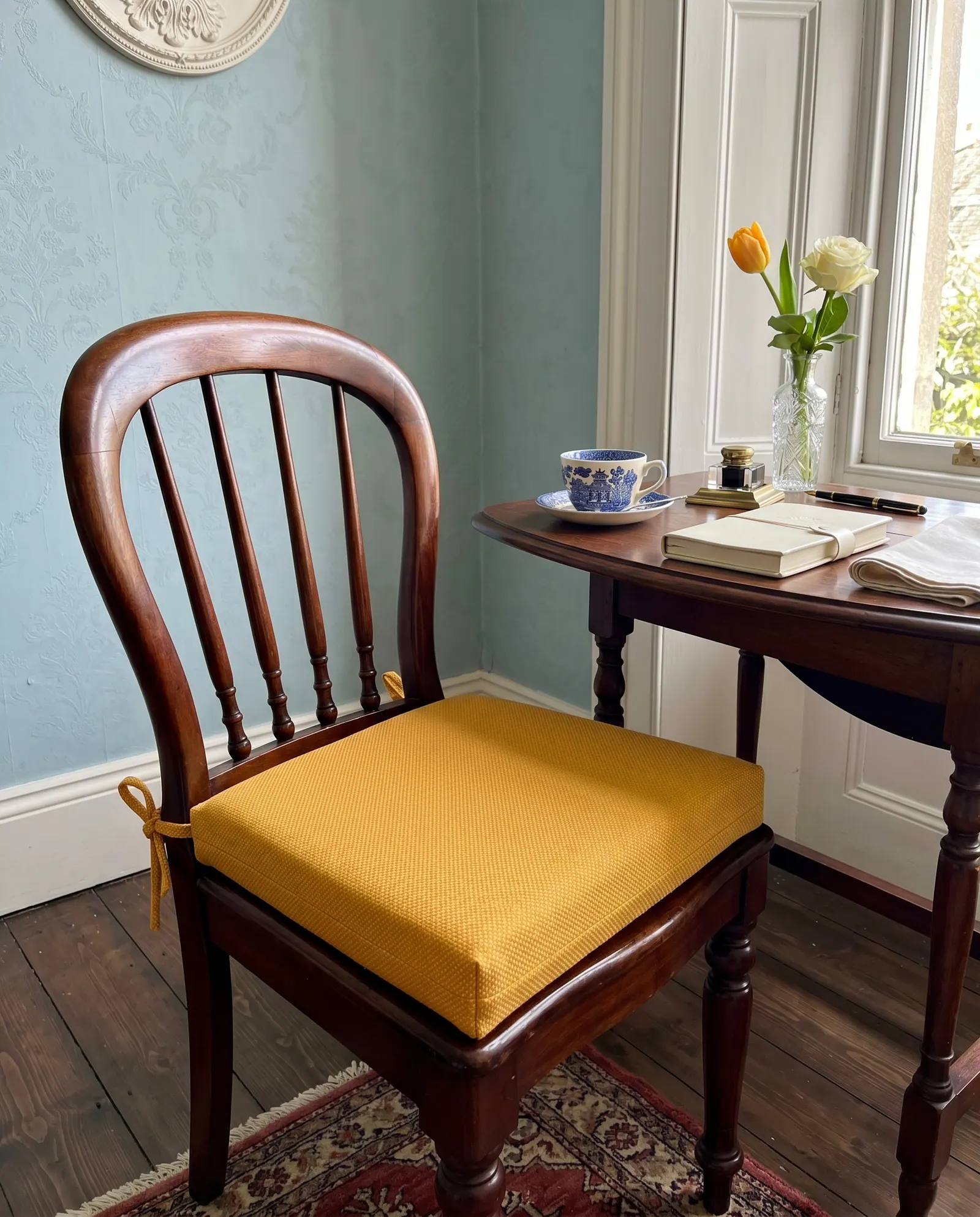
Measuring a tie-on mustard chair pad for a Victorian spindle-back chair
Maggie opens her notebook on a mahogany chair in a duck-egg morning room and writes down every number the pad needs, plus the one people forget.

 Save
The quick answer
A chair cushion with ties for a spindle-back chair needs three measurements, not two: the front width, the back width between the rear posts, and the depth at the center. Trace the seat on paper if it is shaped, mark where the posts meet it for the ties, and keep the pad 2 to 3 in (5 to 7.5 cm) thick.
Notebook, page one: what the photo already tells us
A chair pad is a small cushion with a long list of ways to go wrong. This one went right, and the photo shows why.
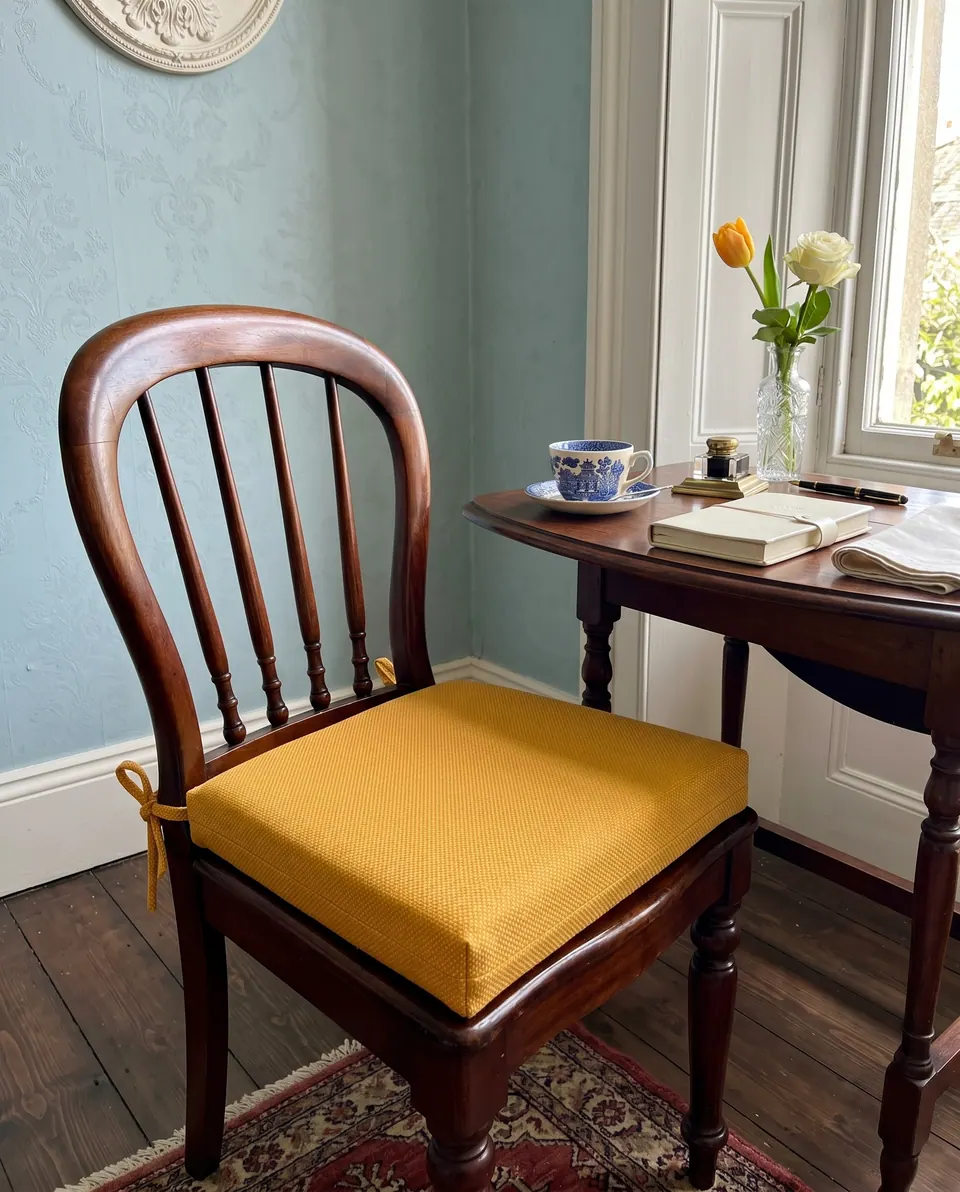
The pad follows the seat. It is wider at the front and narrower at the back, like the mahogany seat under it, so no wood peeks out at the corners and no fabric hangs over the sides. It is a box edge with no piping. The turned spindles already supply all the detail a Victorian chair can carry, and a welt would only add a fussy second outline.
Two ties in matching mustard fabric knot around the rear posts. On a polished seat that is not decoration; without them the pad would creep forward every time someone sat down to write.
Now the room. Duck-egg damask wallpaper, a mahogany writing table, a blue willow teacup, a cream notebook, an inkwell and a fountain pen. Mustard is the warm opposite of duck-egg blue, and the orange tulip in the glass vase repeats it beside a white rose. The red rug and dark wide floorboards hold the scene down. The pad is outdoor acrylic, which is water-repellent, so a splash of morning tea beads up for a moment instead of sinking straight in.
Where do people go wrong? At the back, dear. They measure the front, call it the width, and the pad gapes at the posts. I did it myself on my first set of six and have not forgotten it. The dining chair pad measuring pattern and the paper template pattern cover the method, and the chair cushion builder takes the numbers. Is your seat wider at the front than the back?
Pinned by Maggie: the morning room chair
Start at the mustard pad on the seat, then follow the pins to the tie on the rear post, the spindles, the willow teacup and the tulip.
- mustard box pad
The pad follows the chair's seat shape, wider at the front than the back.
- matching fabric tie
Ties at both rear posts stop the pad sliding on a polished seat.
- willow teacup
Blue china links the table to the duck-egg wallpaper.
- tulip and rose
The orange tulip repeats the warm mustard of the pad.
- spindle back
No piping here, because the turned mahogany already supplies the detail.
- mustard box padThe pad follows the chair's seat shape, wider at the front than the back.
- matching fabric tieTies at both rear posts stop the pad sliding on a polished seat.
- willow teacupBlue china links the table to the duck-egg wallpaper.
- tulip and roseThe orange tulip repeats the warm mustard of the pad.
- spindle backNo piping here, because the turned mahogany already supplies the detail.
Notebook, page two: measuring this exact seat
Trace the seat, not the old cushion
Lay paper on the seat, press it into the edges and trace. Mark which side is the front.
Write three numbers on the tracing
The front width, the back width measured between the rear posts, and the depth at the center, from front edge to back. Two numbers describe a rectangle, and this seat is not one.
Mark the posts
Put an X where each rear post meets the seat. That is where the ties go, and where the back corners of the pad must stop.
Choose the thickness
Chair pads usually run 2 to 3 in (5 to 7.5 cm). Go thicker and the seat rises against the table; dining seats feel right at around 18 in (46 cm) finished height.
Type it out to 1/8 in
Measure to the nearest 1/8 in and type the numbers into your note. A photo of the tape is not a measurement.
The 125-inch bench that had to be cut in two
Not every seat in my notebook is a chair. A family in the US wrote to the workshop about three outdoor benches by a pool and a fire pit. They wanted tufted, floor-style cushions: one bench at 125 x 20.5 x 3 in (318 x 52 x 7.5 cm) and two at 86.75 x 20.5 x 3 in (220 x 52 x 7.5 cm).
Two things came back from the cutting table. The 125 in cushion had to be made in two pieces. And tufting lets water in, even with outdoor fabric, so the workshop suggested plain foam-filled cushions instead.
A year later the family returned, and the order became four non-tufted pieces: two at 20.5 x 62 5/8 x 3 in (52 x 159 x 7.5 cm), the long bench split down the middle, and two at 20.5 x 86 3/4 x 3 in (52 x 220.5 x 7.5 cm), and that order took 3 to 5 days in production.
Measure the bench, not the cushion you used to have. Then let the maker tell you where a long run must split; the one piece or two pattern explains why.
On the cutting table: the morning room pad
| Piece | Tie-on chair pad for a Victorian spindle-back chair |
|---|---|
| Shape | Wider at the front, narrower at the back |
| Fabric | Outdoor acrylic in mustard gold, code 0821 |
| Edge | Box edge, no piping |
| Fastening | Matching fabric ties at both rear posts |
| Thickness | Chair pads usually 2 to 3 in (5 to 7.5 cm) |
| Measure | Front width, back width between posts, center depth |
| Accuracy | Nearest 1/8 in, typed out |
| Best for | Antique dining and desk chairs with polished seats |

Have it made
Have this made — ask Maggie’s workshop
I once cut a lovely cushion two inches short, and I have not forgotten it. That is why the workshop goes over your measurements with you on the phone. — Maggie
Leave your details and the workshop will call you to confirm measurements, fabric, foam and piping. No prices, dates or payment on this page: it is a request, not an order.
Buyer questions: seat pads, ottomans and bare covers
- A common question
Can you make one medium-firm seat pad, about 24 x 22 3/4 in (61 x 58 cm) and 2 3/4 in (7 cm) thick?
The workshop's answerYes. A single medium-firm pad at exactly that size, 24 x 22 3/4 x 2 3/4 in (61 x 58 x 7 cm), was quoted as a custom order.
- A common question
Can I buy just the round ottoman from the floor lounge chair set? And are the chairs heavy?
The workshop's answerYes, the small round ottoman can be bought on its own through a custom payment link. The corduroy floor lounge chairs are light and easy to pick up and carry.
- A common question
Could you make small square barstool covers, without any cushion inside?
The workshop's answerYes. Covers of roughly 14 x 14 in (36 x 36 cm) can be made on their own in the fabric you choose, such as T-318. Just say how many you need.
A tie-on chair pad for a spindle-back chair needs three numbers, not two: the front width, the back width between the posts and the depth at the center.
Maggie
Questions buyers ask next
What if an antique chair seat is wider at the front than at the back?
Then the pad should be too. Give the front width, the back width between the rear posts and the center depth, or send a paper tracing. A rectangle cut to the front width will gape at the posts.
Why use outdoor fabric on an indoor antique chair?
Outdoor acrylic is water-repellent, so a splash of tea beads up for a moment instead of soaking in, and its solution-dyed color holds up well by a sunny window. It suits a chair that is used every morning.
Should a Victorian chair pad have piping?
It is a matter of taste, and buyers split roughly half and half. On a chair with turned spindles or carving, a plain box edge usually looks calmer, because the wood already supplies the detail.
Stitch straight — Maggie