 Save
A Reading by MaggieDining Chair Cushions & Pads
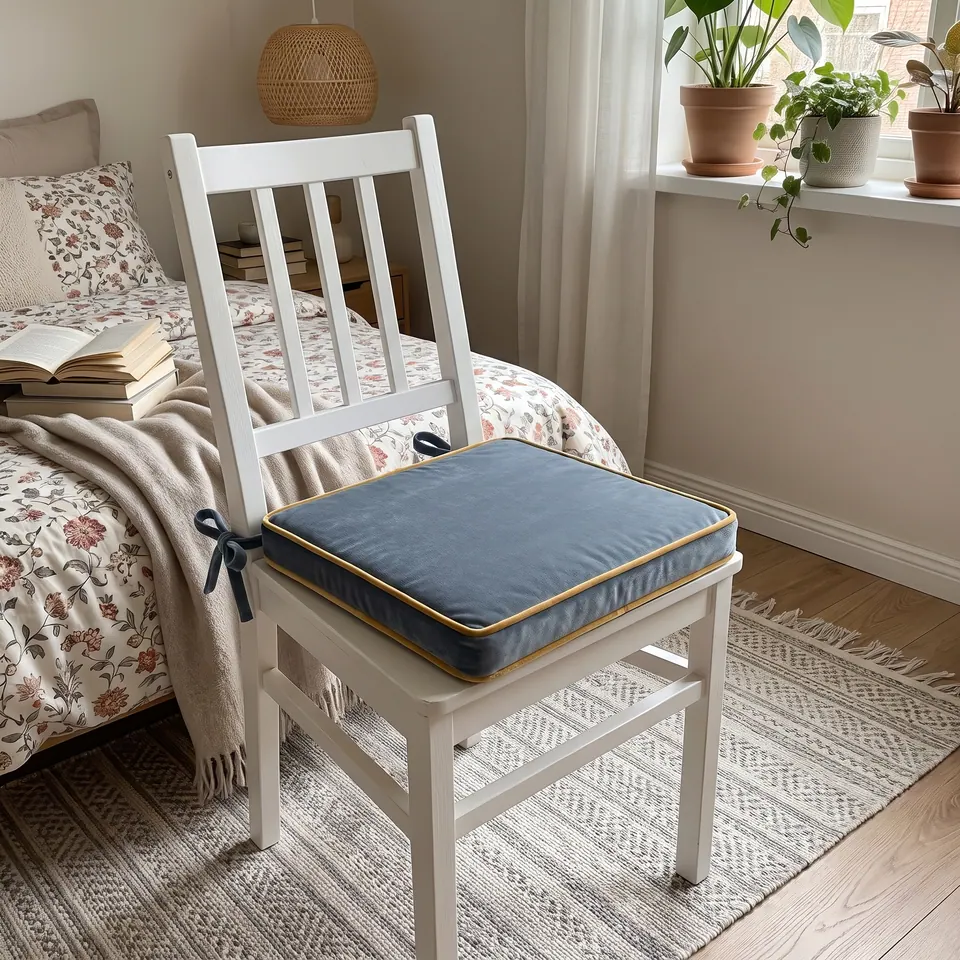
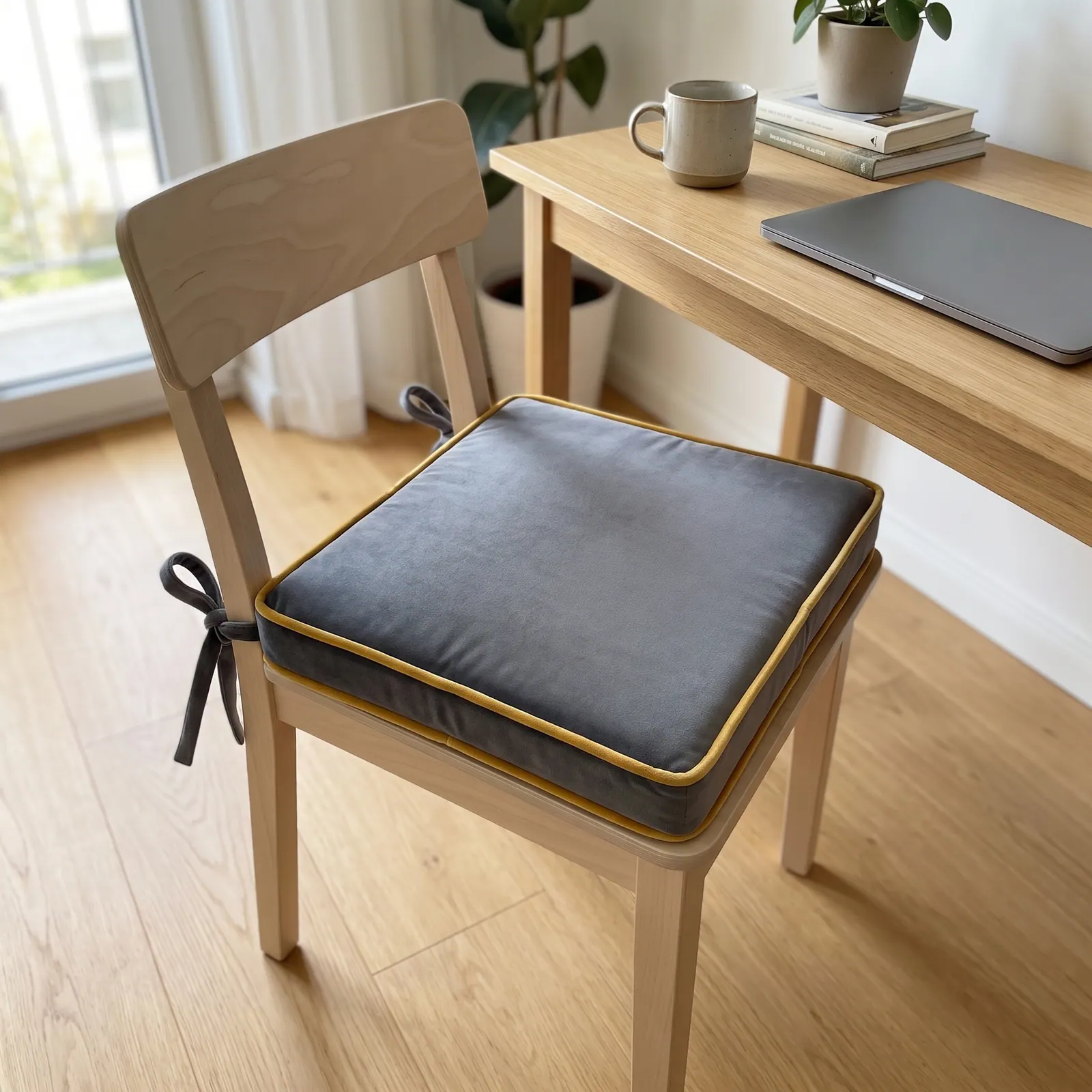
A graphite velvet chair cushion with ties, and the mustard line that warms it
A pale birch chair needed a darker seat, and a darker seat needed one warm line. Here is how graphite, mustard and morning light share a small work corner.
Graphite copes with daily desk use, and a mustard welt stops it looking corporate.

The quick answer
A graphite velvet chair cushion with mustard piping suits a pale wood chair because the dark seat anchors the frame while the warm welt ties it to oak and honey floors. Ties cut from the body fabric knot at the back legs, out of sight. For daily desk use, choose a mid-to-dark body color and put your one warm accent in the piping.
Why graphite, not black, on a pale birch chair
Put a pale seat on a pale birch chair beside a light oak desk and the whole corner floats off like a dandelion. This chair cushion pins it down. Graphite velvet is dark enough to anchor the frame and soft enough never to read as the harsh black of an office chair.
Velvet helps in a way a flat weave can't. Its pile catches the morning window along the front edge, so the seat shows a silver sheen where the light lands and a deeper charcoal where it doesn't. A dark color that shifts with the light never looks heavy.
Right, then, the practical point before the pretty one: graphite forgives. A desk chair takes jeans, coffee and a laptop bag every day, and a mid-to-dark body hides the traffic a cream seat would announce by Wednesday.
Pinned by Maggie: five marks around the desk
Five pins, from the gray tie bow at the back legs to the rubber plant that answers the graphite seat.
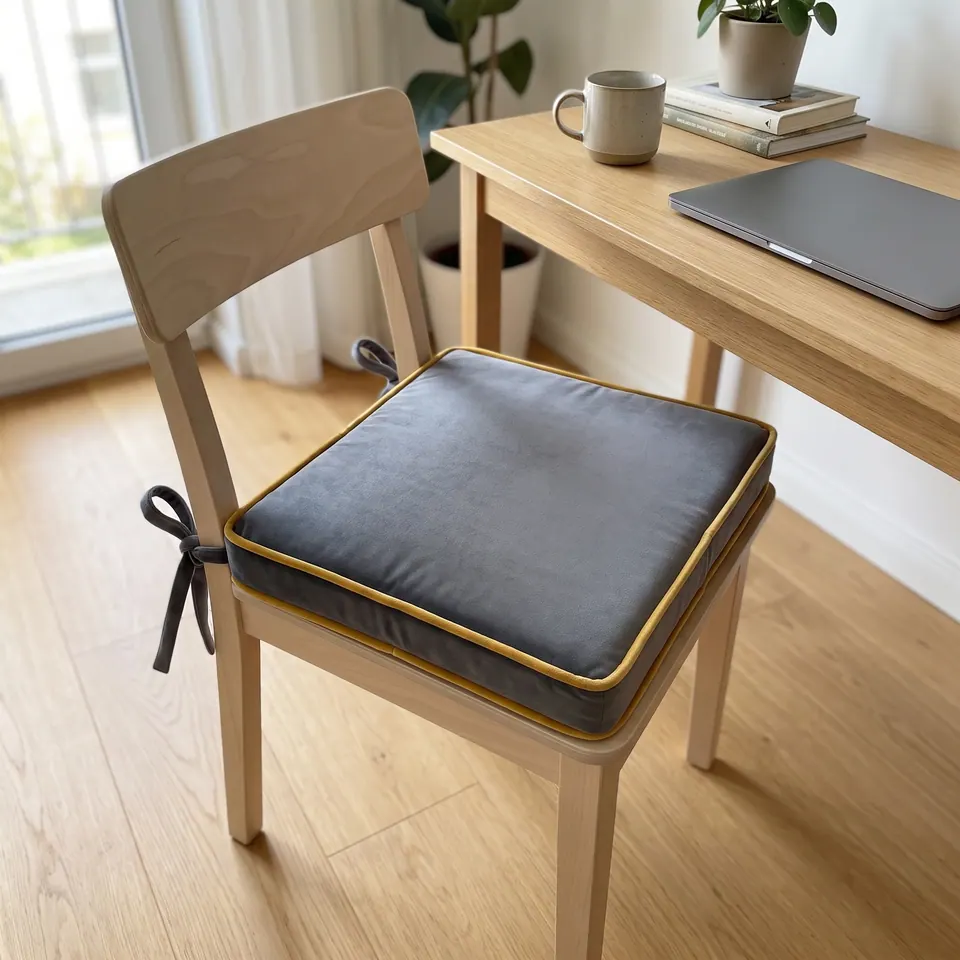
- Gray tie bow
Ties in the body fabric knot at the back legs, out of sight from the desk.
- Mustard piped corner
A warm welt connects the dark seat to the honey floor and birch frame.
- Laptop
A closed laptop sets the scene as a working corner.
- Stoneware mug
Neutral stoneware keeps the desktop calm.
- Rubber plant
Deep green foliage behind balances the graphite seat.
- Gray tie bowTies in the body fabric knot at the back legs, out of sight from the desk.
- Mustard piped cornerA warm welt connects the dark seat to the honey floor and birch frame.
- LaptopA closed laptop sets the scene as a working corner.
- Stoneware mugNeutral stoneware keeps the desktop calm.
- Rubber plantDeep green foliage behind balances the graphite seat.
The mustard line borrows its color from the floor
The mustard piping does the color work. Graphite on its own is sensible. Run a mustard welt around the box edge and it picks up the honey floorboards and the birch frame, so the dark seat belongs to the wood instead of sitting on top of it.
A confession, dear: for years I piped every dark cushion in black, to be safe. Safe turned out to mean invisible. Contrast piping works only when its color already lives somewhere in the room, and here it lives underfoot. Matching, contrast or no piping walks through the choice.
None of the props are accidents. The closed silver laptop makes this a working corner. The speckled stoneware mug stays neutral; a red one would argue with the mustard. The rubber plant behind the desk puts deep green against the graphite, and the little plant on the book stack repeats it at desk height. The sheer curtain softens the window so the velvet glows instead of glaring.
The ties are cut from the body fabric, not the mustard, and knot at the back legs where nobody at the desk sees them. Quiet ties, loud welt: one accent is plenty. Tie placement on chairs covers other frames.
What color is the floor under your desk chair? Start the piping there. More seats live in dining chair cushions, and the cloth sits on the velvet shelf of the Swatch Library.
Four cream chairs, copied from photographs
A buyer in the US wrote to the workshop wanting exact copies of the worn seat and back cushions on four dining chairs, in cream. No drawings, no templates: photos of each old cushion, with its dimensions. The shop confirmed it could replicate them, seat and back for every chair.
It is still the easiest replacement order I know. Lay the old cushion flat, run a tape measure along each side, and photograph every side with the numbers showing. The worn cushion is the template; the photos are the proof.
Cream suits a dining room with a tablecloth. Graphite suits a desk with a laptop bag. Choose the color for the traffic. Dining chair pad measurements lists what to capture, and the chair cushion builder drafts the shape.
Buyer questions: curves, returns and two inches of foam
- A common question
Can you make slightly curved trapezoid chair pads with ties so they match our bench cushion?
The workshop's answerYes, but the shop asked for a drawing first: each size on paper with the back width, the front width, the length of the curved side and where each tie goes. A shaped chair pad can't be priced from a list of numbers alone.
- A common question
If the color or the fit of our custom chair cushions doesn't work for us, can we send them back?
The workshop's answerYes, returns are accepted and the refund is issued once the cushions reach the workshop; return shipping is on the buyer. First the shop asks you to measure the cushion you received and the seat itself, because every cushion is cut to the exact measurements on the order and it wants to find where any difference came from.
- A common question
Will a 2 in (5 cm) seat cushion flatten when I sit on it, or should I go to 3 in (7.5 cm) for a chair?
The workshop's answerThe dense about 2 lb/ft³ (32 kg/m³) foam holds its shape and won't collapse, though 2 in is on the thin side and compresses a little under body weight. For a 15 3/8 in (39 cm) chair aiming at 16 1/2 to 17 in (42 to 43 cm), 2 in lands close to the target. The shop first asks whether it's for a bench, floor seating or a chair.
On the cutting table: the desk chair pad
| Product | Chair pad with ties for a desk or dining chair |
|---|---|
| Fabric | Graphite gray velvet |
| Piping | Contrast mustard welt |
| Edge | Box edge |
| Ties | Body-fabric ties knotted at the back legs |
| Thickness | 2 in (5 cm) keeps seat height close; weigh 3 in (7.5 cm) against your desk |
| Frame | Pale birch chair at a light oak desk |
| Ordering tip | Photos of the old pad with a tape measure on each side |
| Best for | Home-office corners with light wood and daylight |

Have it made
Have this made — ask Maggie’s workshop
Numbers first, fabric second, piping last. Jot down what you have, and the workshop will go down the list with you, item by item. — Maggie
Leave your details and the workshop will call you to confirm measurements, fabric, foam and piping. No prices, dates or payment on this page: it is a request, not an order.
Contrast piping only works when its color already lives in the room: mustard piping on a graphite velvet chair cushion borrows it from an oak floor.
Maggie
Questions buyers ask next
Is velvet a sensible choice for a desk chair cushion?
It can be, when the color is mid-to-dark. Graphite hides daily wear better than cream, and the velvet pile catches window light, so a dark seat reads soft rather than heavy. Keep one warm accent, such as a mustard welt, to stop it looking corporate.
Where do the ties go on a chair pad?
On most chairs the ties sit at the two back corners and knot around the back legs or spindles, where they stay out of sight from the front. Cutting them from the body fabric rather than the piping color keeps them quiet.
How do I pick a piping color for a dark cushion?
Take it from something already in the room: the floorboards, the chair frame or a wood desk. Mustard works on graphite in a birch-and-oak room because it echoes the warm wood. A piping color the room never repeats tends to look like a mistake.
Stitch straight — Maggie