 Save
A Reading by HarlanFloor Cushions & Floor Seating
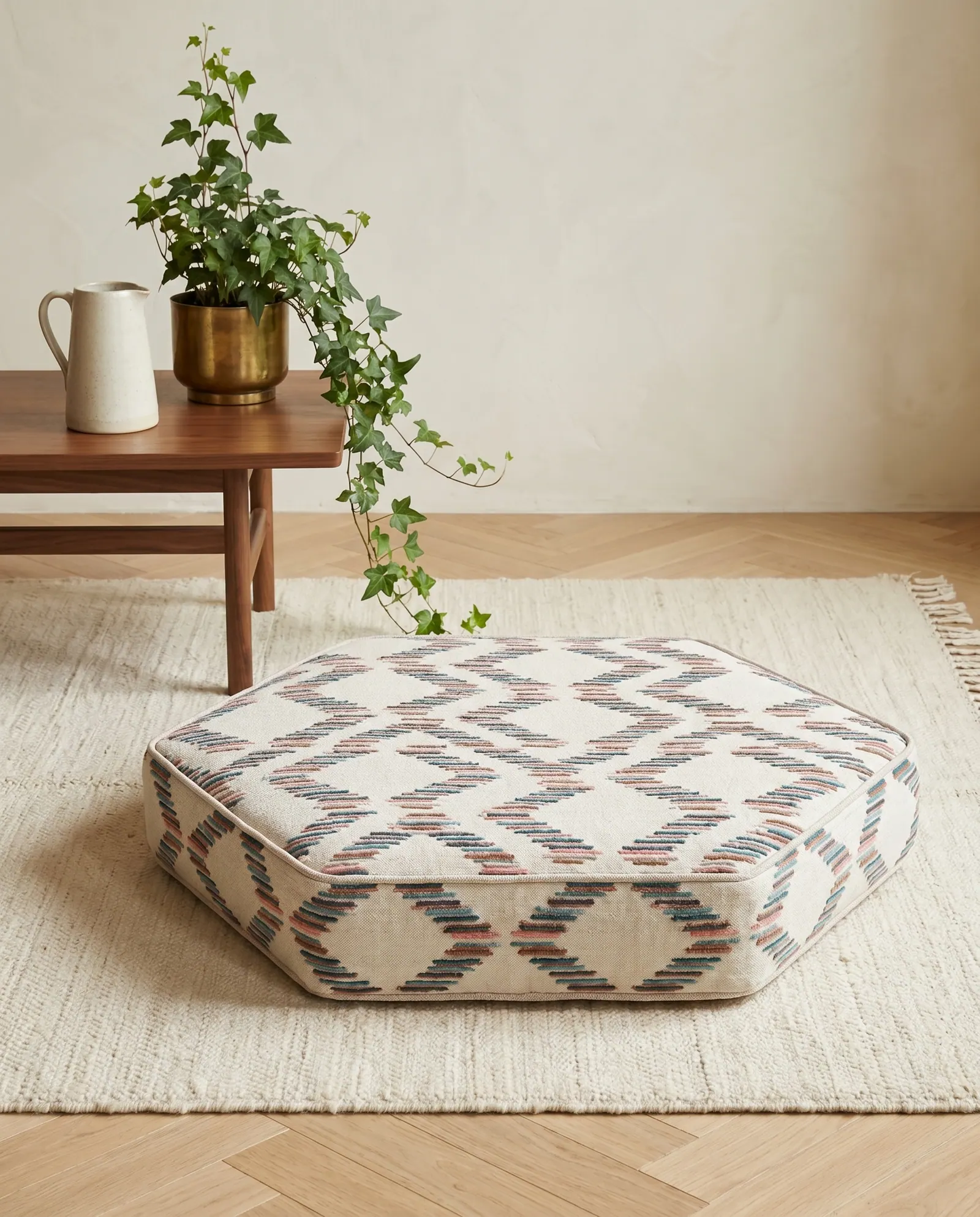
A six-sided floor cushion in cream jacquard, built for an afternoon on the floor
Harlan reads a hexagon on a pale rug and asks what it takes to sit on the floor for a whole chapter, not just a minute.
A six-sided floor cushion in a cream zigzag jacquard gives a living room flexible extra seating. The pattern wraps the sides too.

The quick answer
A floor cushion for long sitting needs a firm seat that keeps your hips off the hard floor and a shape you can turn on without meeting a corner. A hexagon with a box edge does both, and floor seating should run firm. If you add a backrest under a window, subtract the seat thickness from the sill height to find its limit.
Why six sides sit longer than four
Most floor cushions are bought for a minute's perch and kept for an hour's sitting. The hour is where a good one proves itself.
This one is a hexagon in cream jacquard, with a zigzag of teal, dusty pink and navy running over the top and down around the sides. Six sides mean no sharp corner waiting for your shin when you shift, and every side faces somebody. Set it by a low table and three or four people can lean in over cards or coffee with nobody getting the point.
When you read or work on the floor, you turn a little every so often. A shape that is nearly round turns with you.
Then the box edge. A straight side wall keeps the seat full right out to the rim, so you can sit near the edge with your knees down and not feel it give. Floor seating should run firm, and a tufted floor cushion usually sits about 4 to 5 in (10 to 13 cm) thick. Go softer and after an hour you are sitting on the floor with a pillow for company. The numbers are in floor cushion thickness and the foam firmness finder.
Pinned by Harlan: five marks around the hexagon
Five pins, from the six-sided top to the ivy that borrows the teal thread.
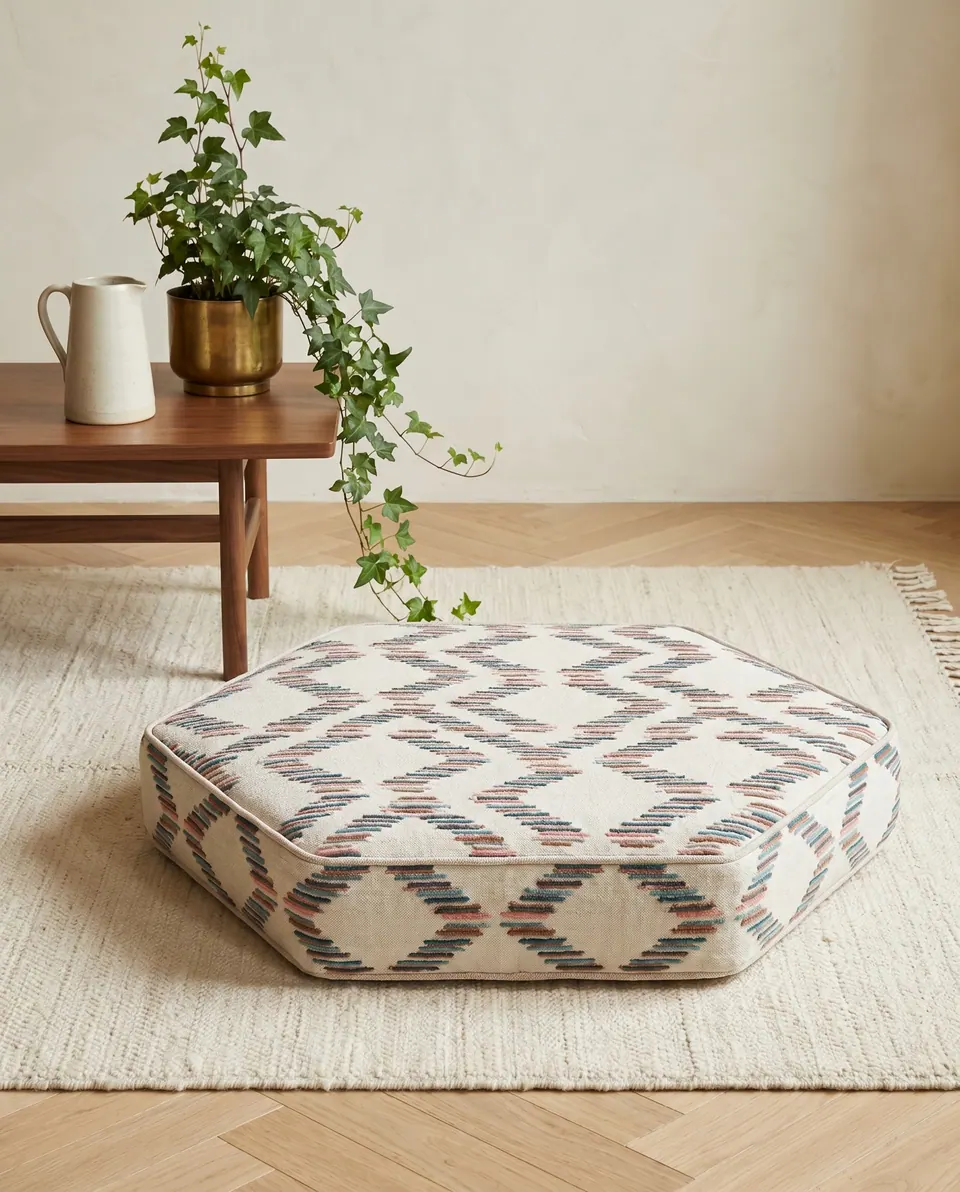
- Hexagon top
Six sides let several people sit around one floor cushion with no sharp corner.
- Piped top seam
Self piping sharpens each of the six angles so the hexagon keeps its shape.
- Patterned gusset
The zigzag continues on the side wall, so the cushion looks finished from every angle.
- Ivy in brass pot
Trailing ivy softens the geometry and adds a vertical line.
- Fringed rug
A cream rug keeps the multicolour pattern from fighting the herringbone floor.
- Hexagon topSix sides let several people sit around one floor cushion with no sharp corner.
- Piped top seamSelf piping sharpens each of the six angles so the hexagon keeps its shape.
- Patterned gussetThe zigzag continues on the side wall, so the cushion looks finished from every angle.
- Ivy in brass potTrailing ivy softens the geometry and adds a vertical line.
- Fringed rugA cream rug keeps the multicolour pattern from fighting the herringbone floor.
The pale rug, the ivy and the white jug
Four colors in one weave could shout. They don't, because the ground is cream and the cushion sits on a cream flatweave rug with a fringe. Cushion and rug read as one soft island on the herringbone oak, and the zigzag stays cheerful instead of loud. Warm, soft daylight helps; the pink stays dusty and the navy stays ink, not black.
Self piping runs along the top seam in the same cloth. It sharpens each of the six angles so the hexagon holds its shape through a long afternoon, and it doesn't add a fifth color. The zigzag carries on around the gusset, so the cushion looks finished from every side. A seam is a promise, and on a floor cushion people walk all the way around to check it.
Behind it, a low walnut bench holds trailing ivy in a brass pot and a white ceramic jug. The ivy gives the one tall line in a low room, and its green is picked up by the teal thread. The jug is white for the same reason the rug is cream: it rests the eye. Copy the idea, not the objects. One plant whose color already lives in the cushion. More patterns like this are in jacquard and damask, and more shapes in floor cushions and living room cushions.
Seven inches under the windowsill
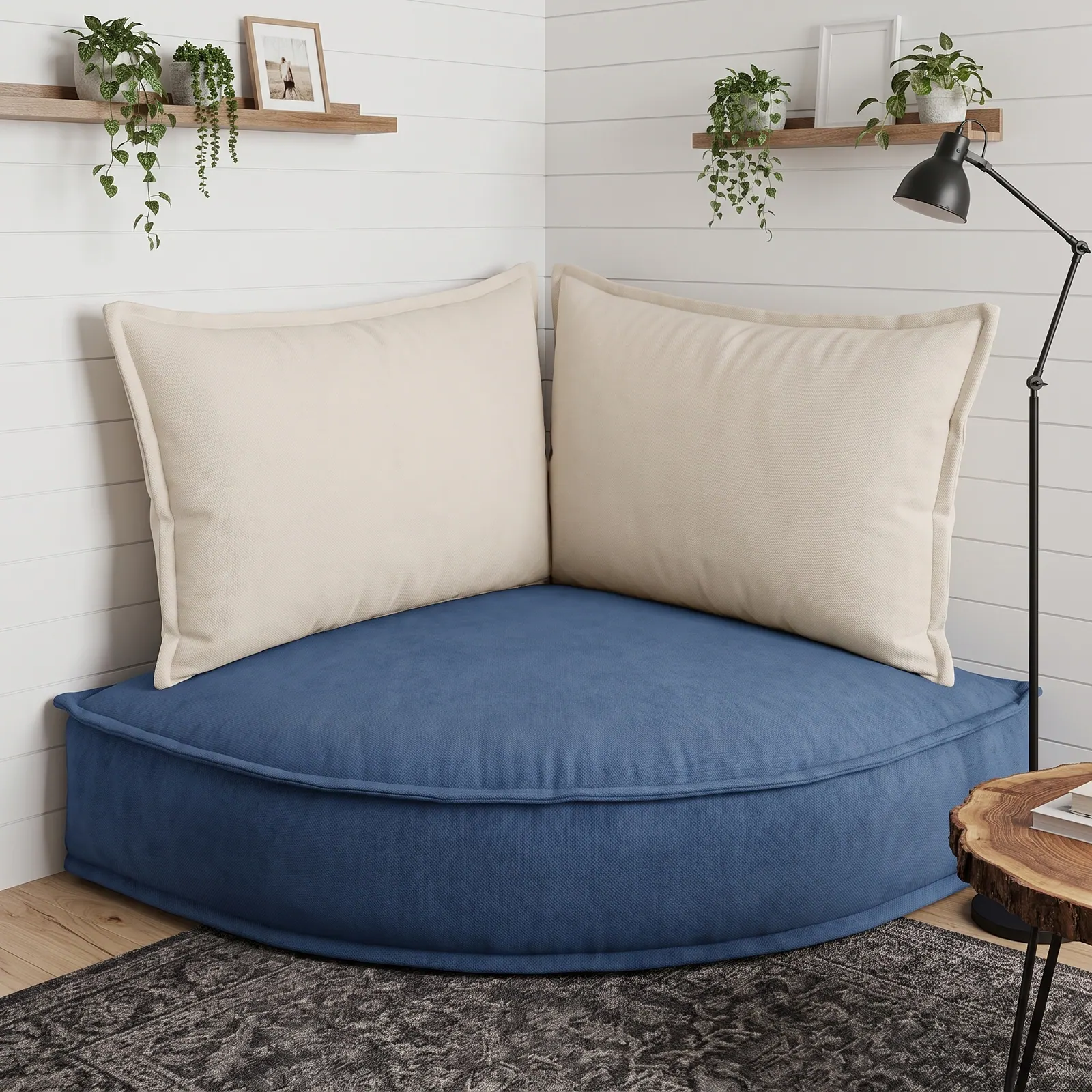
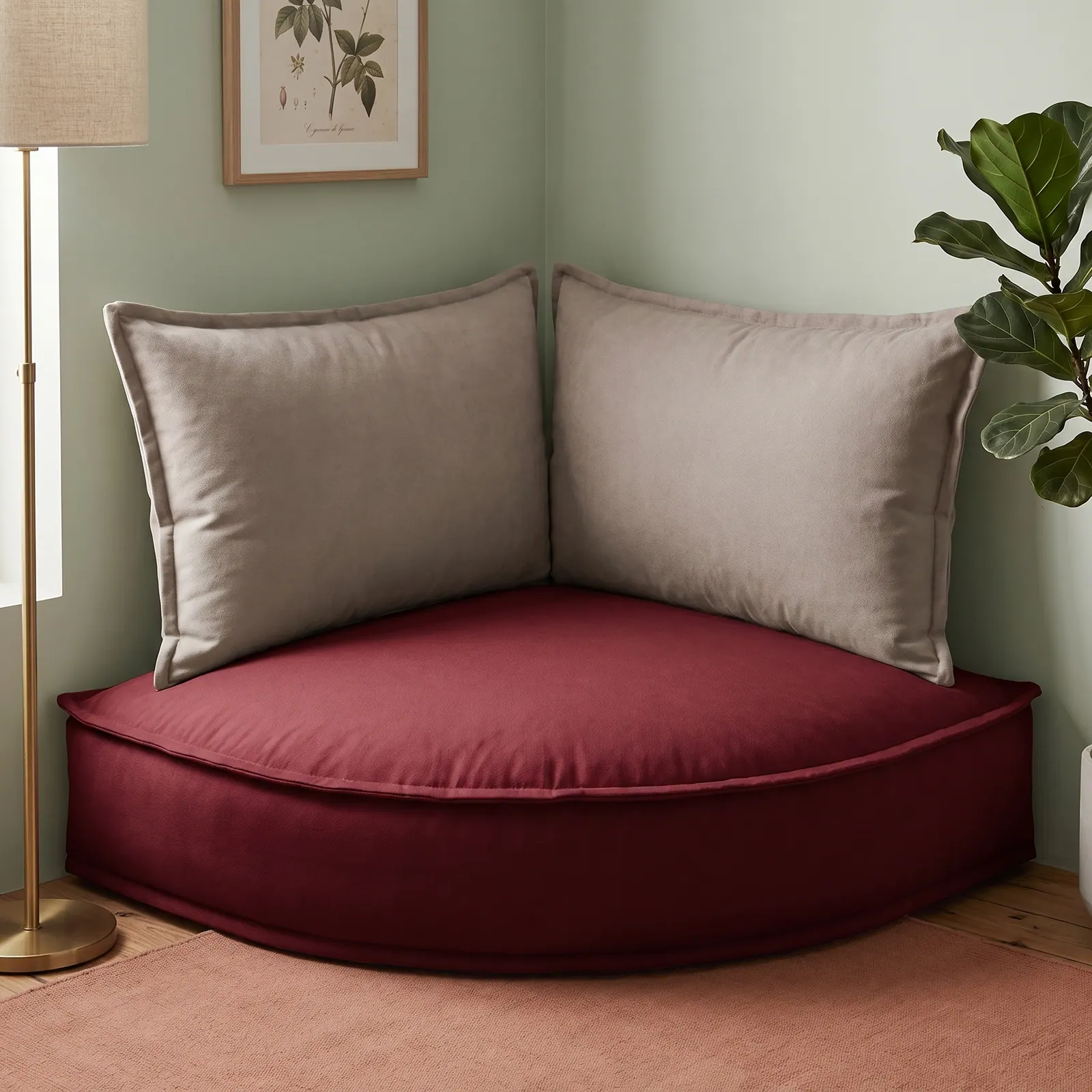
A buyer in the US wrote to the workshop about a window nook where the sill sat only 11 in (28 cm) above the floor. She wanted a brick velvet tufted floor cushion, 45 in (114 cm) long, with side cushions and a back, and nothing rising above the glass.
The shop did the arithmetic with her. A 4 in (10 cm) seat left 7 in (18 cm) under the sill. A round bolster would have poked above the line, so the back became a low, flat piece instead. She got her whole set, and her window stayed clear.
Here is the rule to keep: measure from the floor to the sill, subtract the seat thickness, and that is the tallest your backrest can be. What does your sill measure, my friend?
A floor cushion backrest under a window can only be as tall as the sill height minus the seat: an 11 in sill and a 4 in seat leave 7 in.
Harlan
Buyer questions: fabric, floors and footprints
- A common question
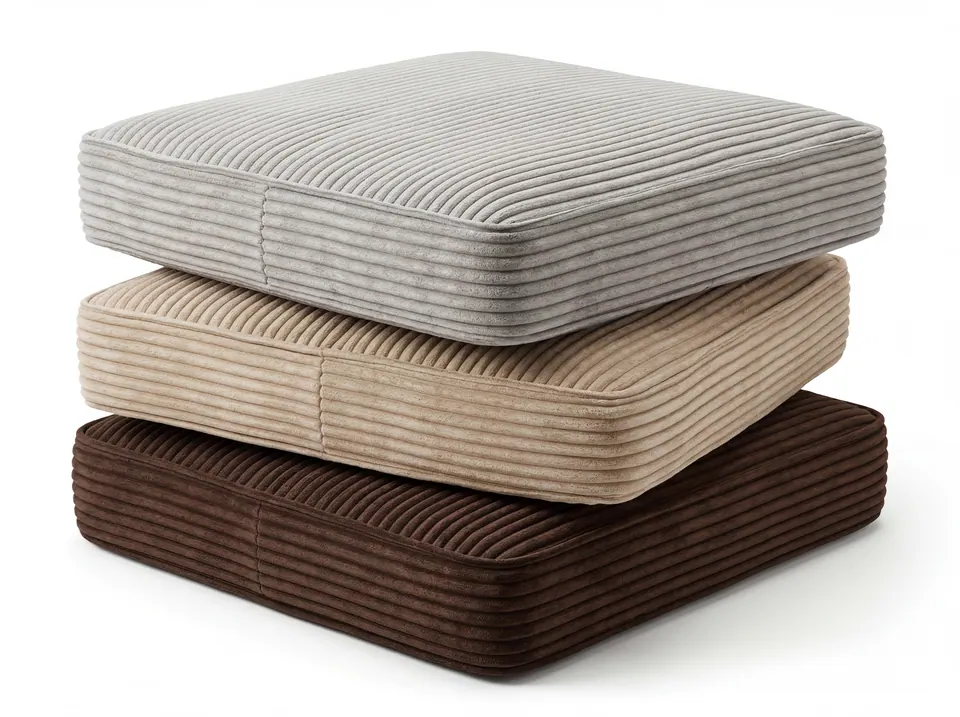
What is the corduroy on your floor pouf made of? Cotton or polyester?
The workshop's answerBoth. The pouf is made in the same corduroy as the teddy sofas, which is a cotton-polyester blend.
- A common question
Will the metal support bars under a floor sofa scratch my wood floors, and do they come in polished metal?
The workshop's answerThe bars have stoppers underneath to protect the floor. They come only in the matte black coated finish shown in the photos, not polished metal. On a two-seater, two small bars do the same job as one wide bar.
- A common question
Are the listed sizes for the seat cushion alone, or for the seat and backrest together?
The workshop's answerFor sets with a backrest, the listed measurements are the total footprint of the seat cushion and the backrest together.
On the cutting table: the hexagon
| Product | Hexagonal floor cushion, box edge |
|---|---|
| Fabric | Cream jacquard with a teal, dusty pink and navy zigzag |
| Piping | Self piping along the top seam, sharpening all six angles |
| Gusset | Patterned; the zigzag wraps the side wall |
| Floor | Fringed cream flatweave rug on herringbone oak |
| Props | Low walnut bench, ivy in a brass pot, white ceramic jug |
| Light | Warm, soft daylight |
| Best for | Living rooms where several people gather around a low table |

Have it made
Have this made — ask Harlan’s workshop
Old upholsterers will tell you the real cutting happens in the conversation, long before the shears come out. Tell the workshop what you sit on, and they will talk it through with you. — Harlan
Leave your details and the workshop will call you to confirm measurements, fabric, foam and piping. No prices, dates or payment on this page: it is a request, not an order.
Questions buyers ask next
Is a hexagonal floor cushion better than a square one for a living room?
For shared floor seating, usually yes. Six sides leave no sharp corner to catch a shin, and each side faces a person, so several people can sit around one cushion or a low table. A square suits a single seat pushed against a wall.
Why does the pattern continue down the sides of the cushion?
People walk all the way around a floor cushion, so the side wall is seen as often as the top. Carrying the zigzag onto the gusset makes the cushion look finished from every angle instead of showing a plain band.
What does self piping do on a six-sided cushion?
Piping cut from the same fabric firms up the top seam at each of the six angles, so the shape stays crisp after long use. It does this without adding another color to a pattern that already carries four.
How thick should a floor cushion be for sitting an hour or more?
Thick and firm enough that you don't feel the floor. Tufted floor cushions usually run about 4 to 5 in (10 to 13 cm), and floor seating is best kept firm. A thin, soft cushion flattens under your hips within the hour.
Sit well. — Harlan
More photographs to read
 Save
 Save
 Save
 Save
 Save
 Save