A Reading by HarlanBolster Pillows
Four striped bolster pillows on a daybed, and the hand-finishing that holds them true
Harlan lays four rolls side by side and reads them the way he learned in a High Point shop: seam first, stripe second, color last.
 Save
The quick answer
Choose a bolster pillow stripe by viewing distance: a pinstripe reads as plain texture from across a room, a narrow or medium stripe adds rhythm at arm's length, and a wide stripe becomes the pattern you notice from the doorway. Whatever the width, the stripes should meet at the long seam and the piping should be cut to match.
The cushion, cut open
Cover fabric. A removable, zippered cover. Machine wash at 86°F (30°C) on a gentle cycle and air dry.
Piping. A fabric-covered cord sewn into the seams. It sits on the seam line, so it does not change the size.
Fiber wrap. Polyester fiber (Dacron) batting around the foam: it fills the cover out and softens the edges.
Foam core. About 2.0 lb/ft³ (32 kg/m³) high-resilience foam, firm to medium-firm, cut to the ordered size.
Zipper. Along the back band, as hidden as possible. The zipper side faces down or toward the wall.
Base panel. The underside of the cover. A non-slip fabric backing can cover the whole of it instead.
The anatomy of a rolled bolster, part by part
A bolster is the plainest shape in the shop and the least forgiving. A square pillow can hide a wandering seam in its corners. A roll has nowhere to hide it.
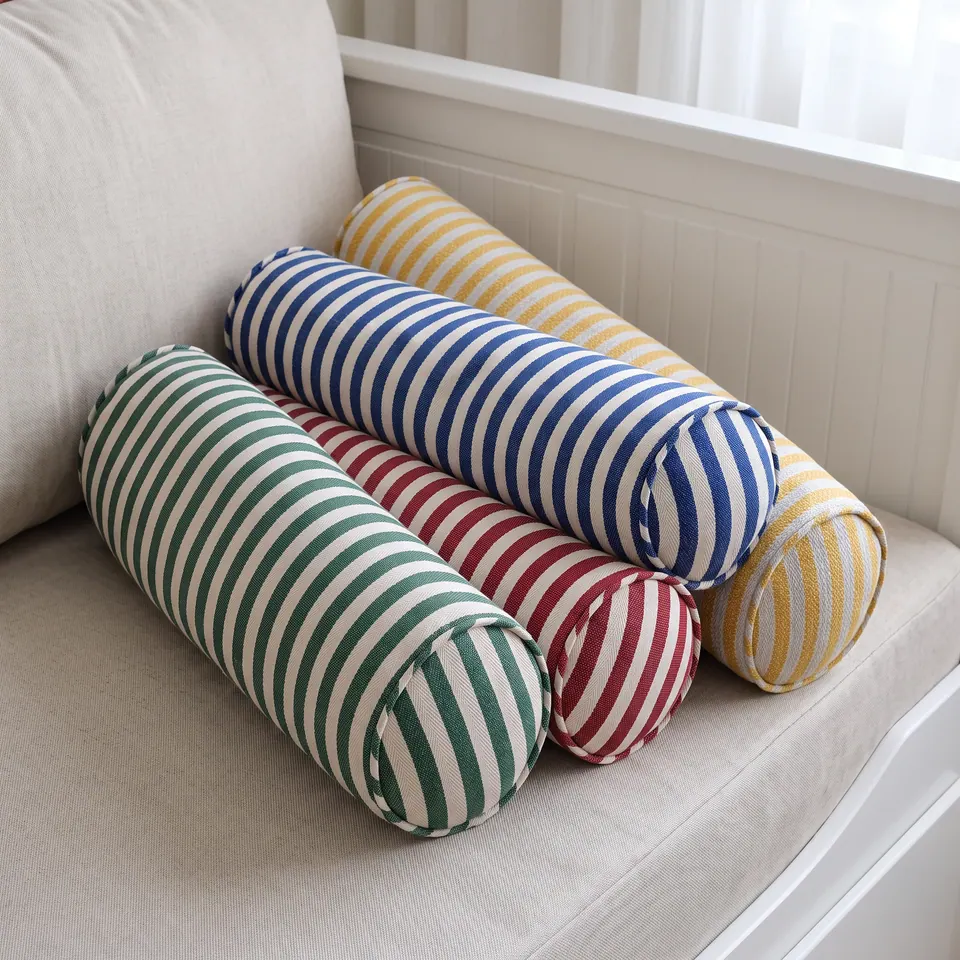
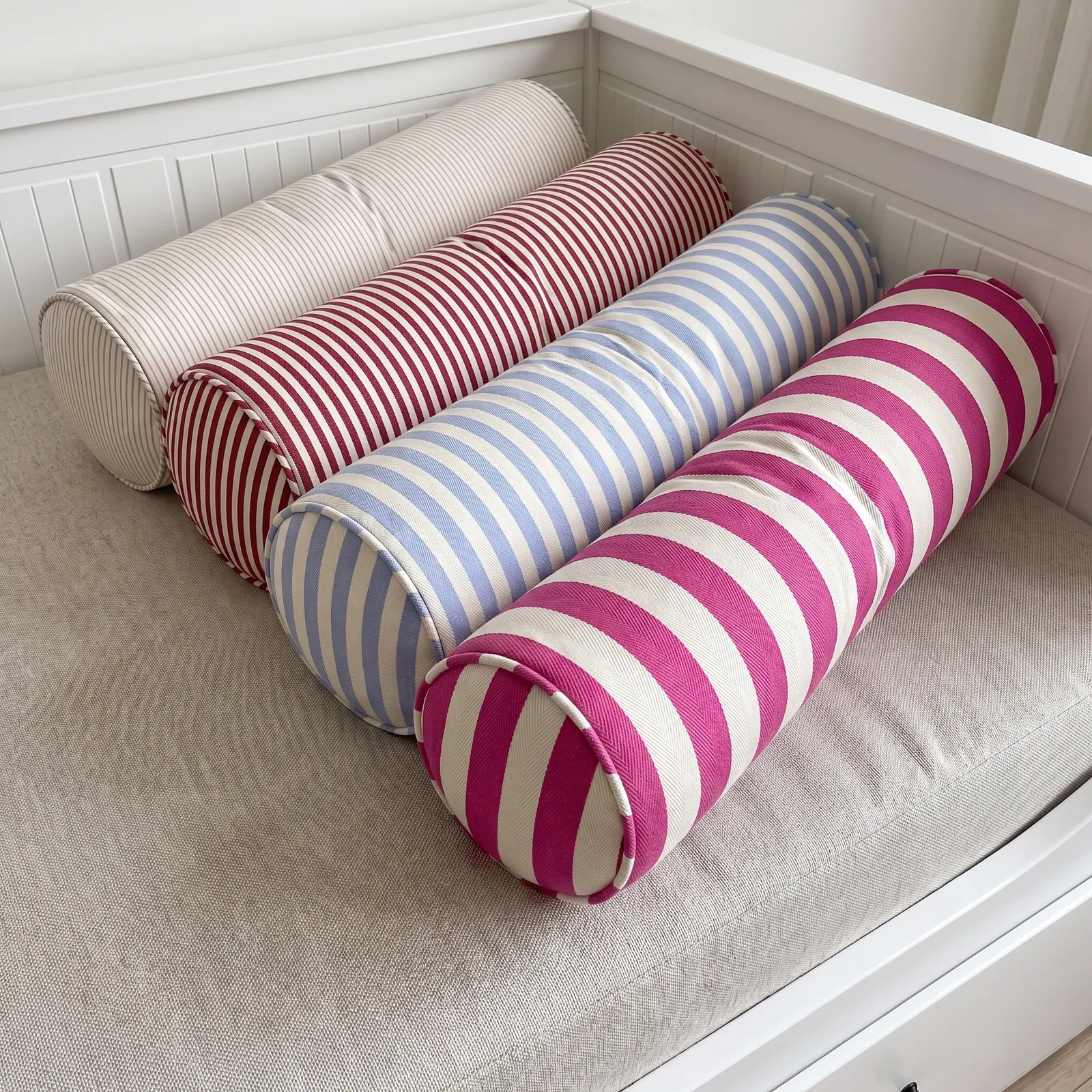
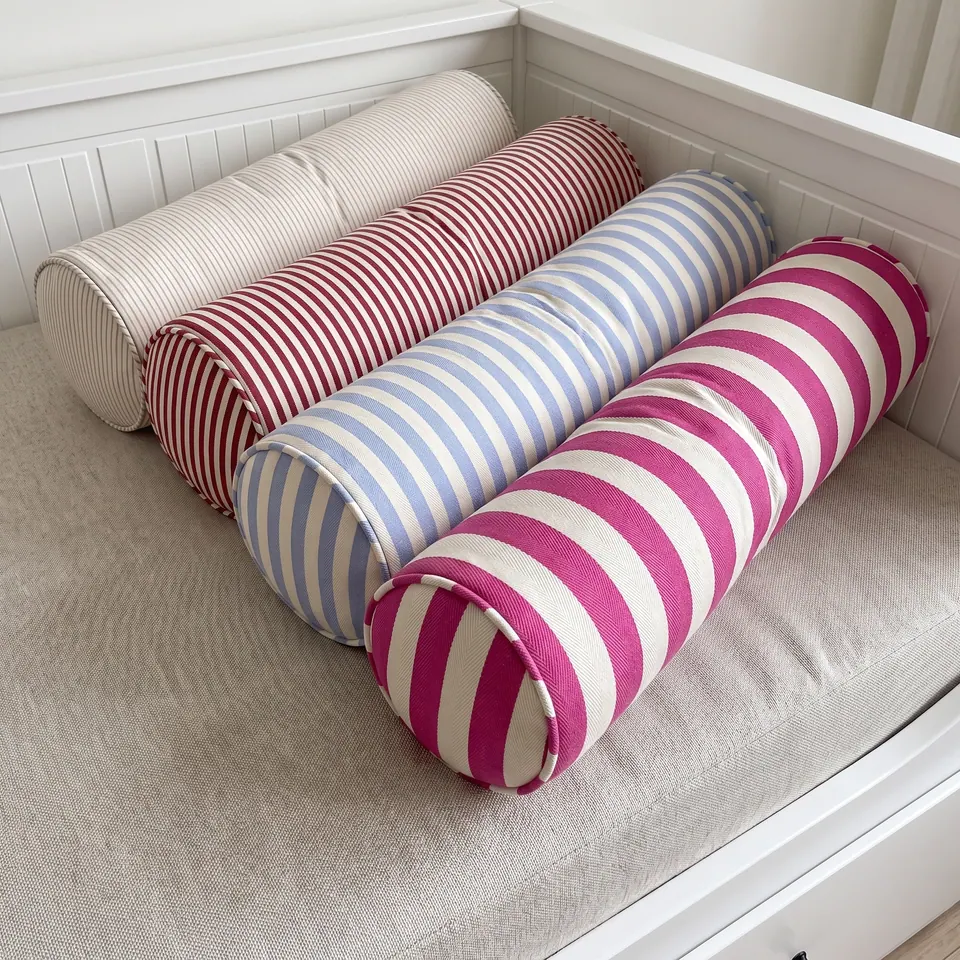
Here are four of them on a white beadboard daybed with a linen mattress cushion, lined up back to front by stripe width: an ecru pinstripe, a narrow red stripe, a periwinkle medium stripe and a wide magenta stripe. Same diameter, same length, all cut to fit between the frame ends. Only the scale changes, so the photograph works as a chart.
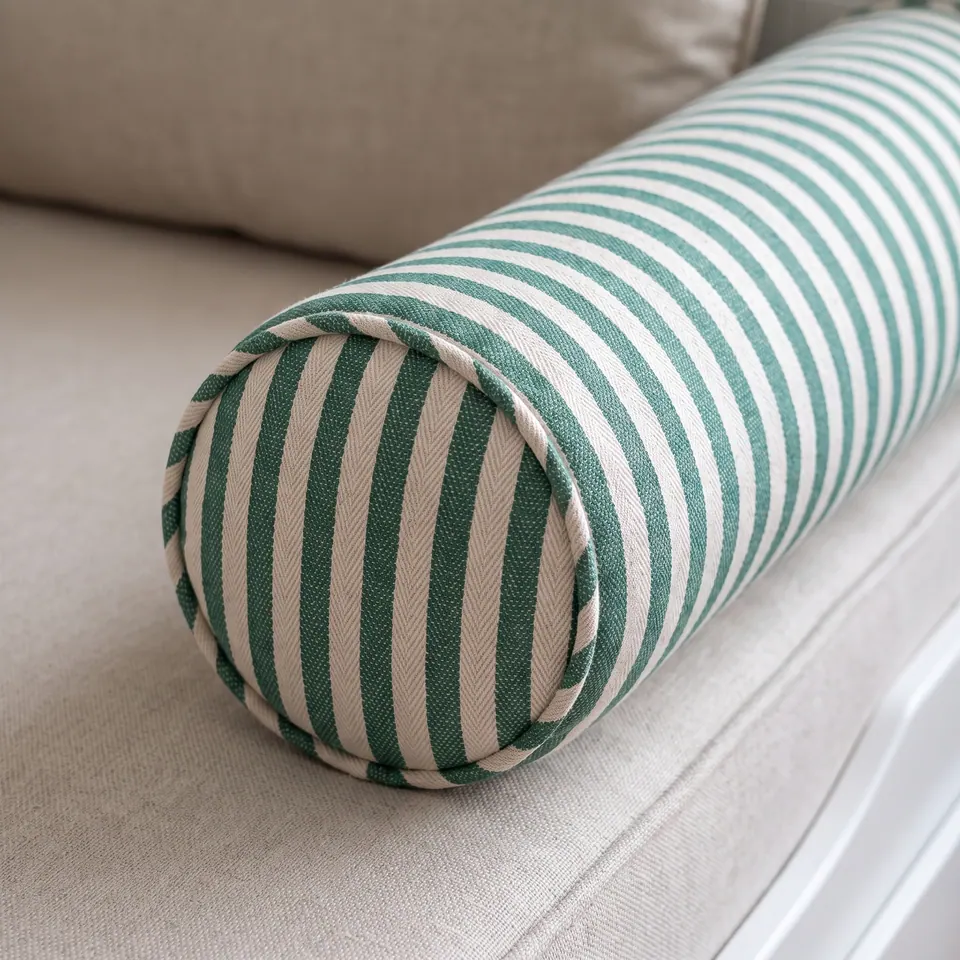
Read one the way I do, my friend: - The body. One rectangle of cloth rolled into a tube. The stripe should run straight around it, never spiral. - The long seam. Where the two edges meet, the stripes have to line up, stripe to stripe. A seam is a promise, and this is where it gets kept or broken. - The piping ring. Self piping at each end frames the round end panel. Here it's cut from the same striped cloth, so the stripe carries into the bead. - The end panel. A flat disc that sets the diameter. When the ends of four rolls match, the row looks like one family. - The length. All four stop at the same point against the back rail. That's measuring, not luck.
A sewing machine will run a straight seam all day. What takes a hand is the matching: laying the stripe so it meets itself, easing piping around a circle without a pucker, setting the end so the roll lies true. A pinstripe forgives a small miss. A wide magenta stripe shows it from across the room.
Which width would you want to see from your doorway? Sizes are laid out in bolster pillow size and diameter, and more rolls live in the bolster pillows atlas.
Pinned by Harlan: four stripes and a back rail
Five pins, running from the finest ecru pinstripe at the back to the wide magenta roll in front and the rail they all fit against.
- Ecru pinstripe
A pinstripe reads almost as a plain texture from across the room.
- Narrow red stripe
A narrow stripe adds rhythm without dominating a small space.
- Periwinkle medium stripe
The middle width is the safest choice when the bolster is seen both close and far.
- Wide magenta stripe
Wide stripes become pattern you notice from the doorway; use them where the daybed is a focal point.
- Daybed back rail
All four rolls are cut to the same length to fit between the frame ends.
- Ecru pinstripeA pinstripe reads almost as a plain texture from across the room.
- Narrow red stripeA narrow stripe adds rhythm without dominating a small space.
- Periwinkle medium stripeThe middle width is the safest choice when the bolster is seen both close and far.
- Wide magenta stripeWide stripes become pattern you notice from the doorway; use them where the daybed is a focal point.
- Daybed back railAll four rolls are cut to the same length to fit between the frame ends.
Stripe width against viewing distance
| Stripe | Reads as | Put it where |
|---|---|---|
| Ecru pinstripe | Plain texture from across the room | Anywhere the room should stay calm |
| Narrow red stripe | Rhythm without taking over | Small rooms and reading corners |
| Periwinkle medium stripe | Pattern both up close and far away | The safe pick when seen both ways |
| Wide magenta stripe | The pattern noticed from the doorway | A daybed that is the focal point |
Covers cut a few inches bigger than standard
A buyer got in touch who already owned a teddy-style floor sofa and wanted only new covers, a little larger than the standard 78.5 x 39 x 7 in (199 x 99 x 18 cm). The workshop made two mattress covers at 80 x 39 x 8 in (203 x 99 x 20 cm) and two backrest covers at 40 x 39 x 15 in (102 x 99 x 38 cm), ordered through the covers-only listing.
They offered to send a drawing. The numbers were enough. Length, depth and thickness for every piece: give those three and a cover can be cut to fit the foam already in the house. The Pattern on cushion covers for existing foam walks through it, and the cloth in this photo belongs to striped cotton and ticking. For a daybed with rolls like these, see daybed cushions.
Buyer questions: spare covers, flat foam, and a bolster added later
- A common question
Can I buy a second set of covers in another color so I can change the look later?
The workshop's answerYes. Extra cover sets are sold separately in any color on the listing, so you can switch colors or keep a spare. A second set has been made for a custom 96 in (244 cm) sofa as well, and covers from the matching teddy-style listing fit this sofa too.
- A common question
My vacuum-packed cushion still looks flat. How long should it take, and what if it never comes back?
The workshop's answerGive it a couple of days and work the filling with your hands to help it along. If it's still flat after about a week, send the workshop photos from a few different angles so it can judge whether the filling needs replacing.
- A common question
Could I get a round bolster to match my window seat cushion, even if I order it later?
The workshop's answerYes. Send the diameter, length, quantity and fabric code, and the bolster goes on your quote or on a separate link later. One was 6 in (15 cm) across and 67.5 in (171 cm) long in matching linen. Slim seats pair well with them: a 2 in x 70 in (5 x 178 cm) cushion went out with an 8 in and a 6 in (20 and 15 cm) bolster, both 70 in long.
On the cutting table: the four rolls
| Product | Round bolster pillows, set of four |
|---|---|
| Fabric | Striped cotton: ecru pinstripe, narrow red, medium periwinkle, wide magenta |
| Piping | Self piping cut from the same stripe |
| Diameter | One diameter for all four |
| Length | Cut to fit between the daybed frame ends |
| Seam | Stripes matched across the long seam |
| To order | Send diameter, length, quantity and fabric code |
| Best for | Daybeds and slim seats that need a back or an arm |
Have it made
Have this made — ask Harlan’s workshop
The best cushions I have known began with somebody asking one more question. Ask yours here. — Harlan
Leave your details and the workshop will call you to confirm measurements, fabric, foam and piping. No prices, dates or payment on this page: it is a request, not an order.
A striped bolster pillow is judged at the long seam: if the stripes don't meet there, the whole roll looks crooked from across the room.
Harlan
Questions buyers ask next
Which bolster stripe width suits a daybed in a small bedroom?
A pinstripe or a narrow stripe. Seen at arm's length in a small room, they add rhythm without taking over. Save the wide stripes for a daybed that faces the door of a large room, where the pattern has distance to settle.
Should every bolster pillow along one daybed rail share a diameter?
When they line up along one back rail, yes. A shared diameter and length let the stripes do the talking. Mixed diameters suit slim seats better, where a larger roll behind a smaller one builds a backrest in layers.
What makes a striped bolster look well made up close?
Three things: stripes that meet at the long seam, piping cut from the same stripe so the end ring continues the pattern, and end panels set square so the roll lies straight instead of leaning off true.
Sit well. — Harlan