A Reading by ÉlodieBench Cushions
An emerald velvet bench cushion with ivory piping, read from the corner out
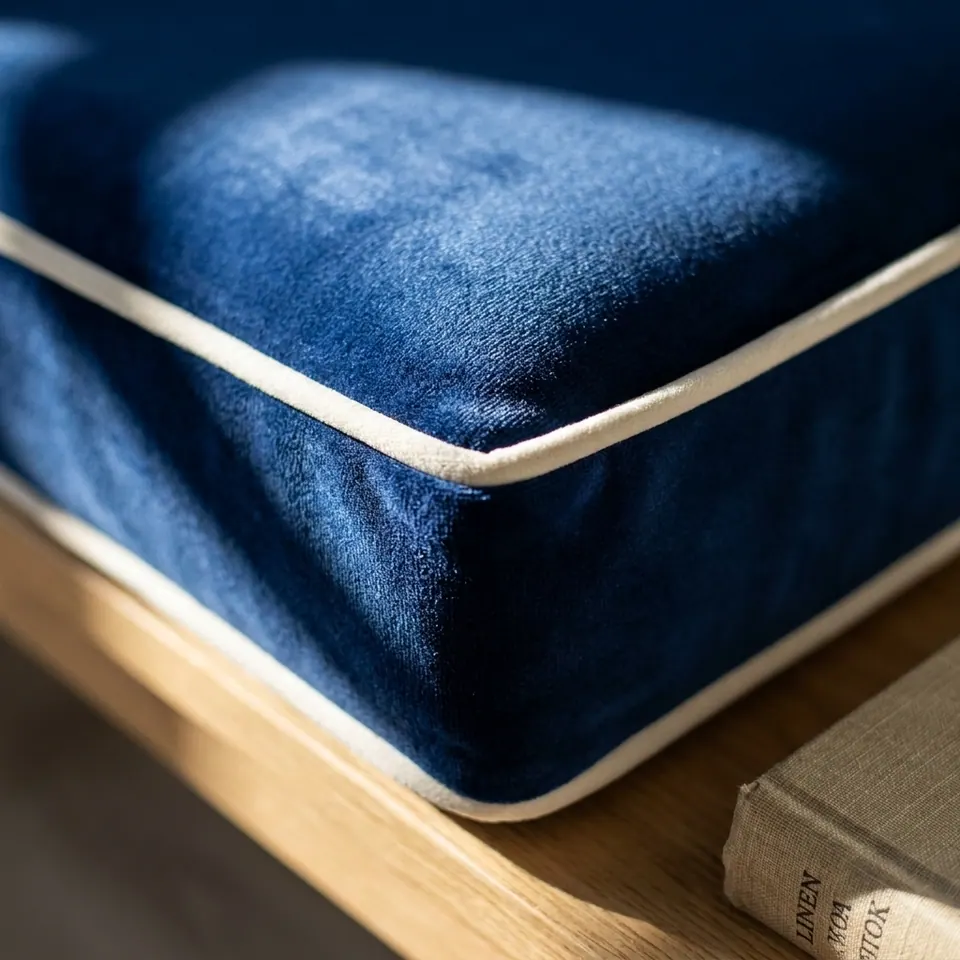
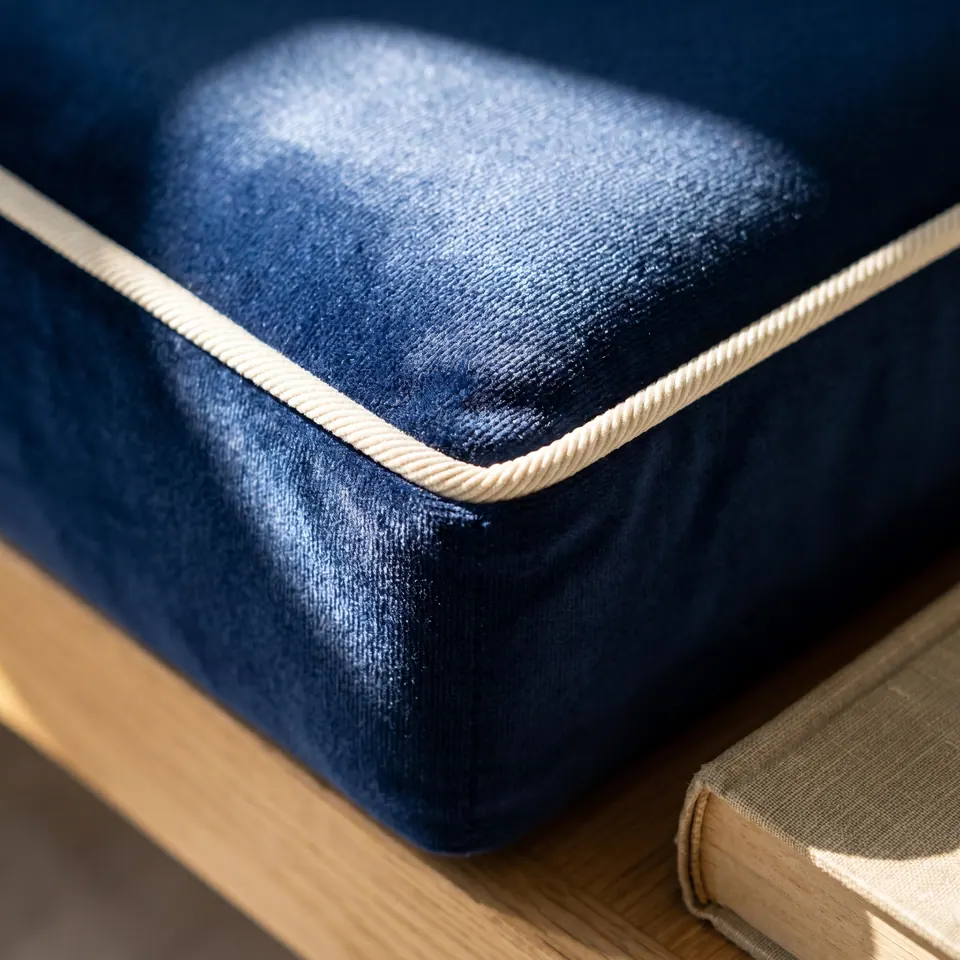
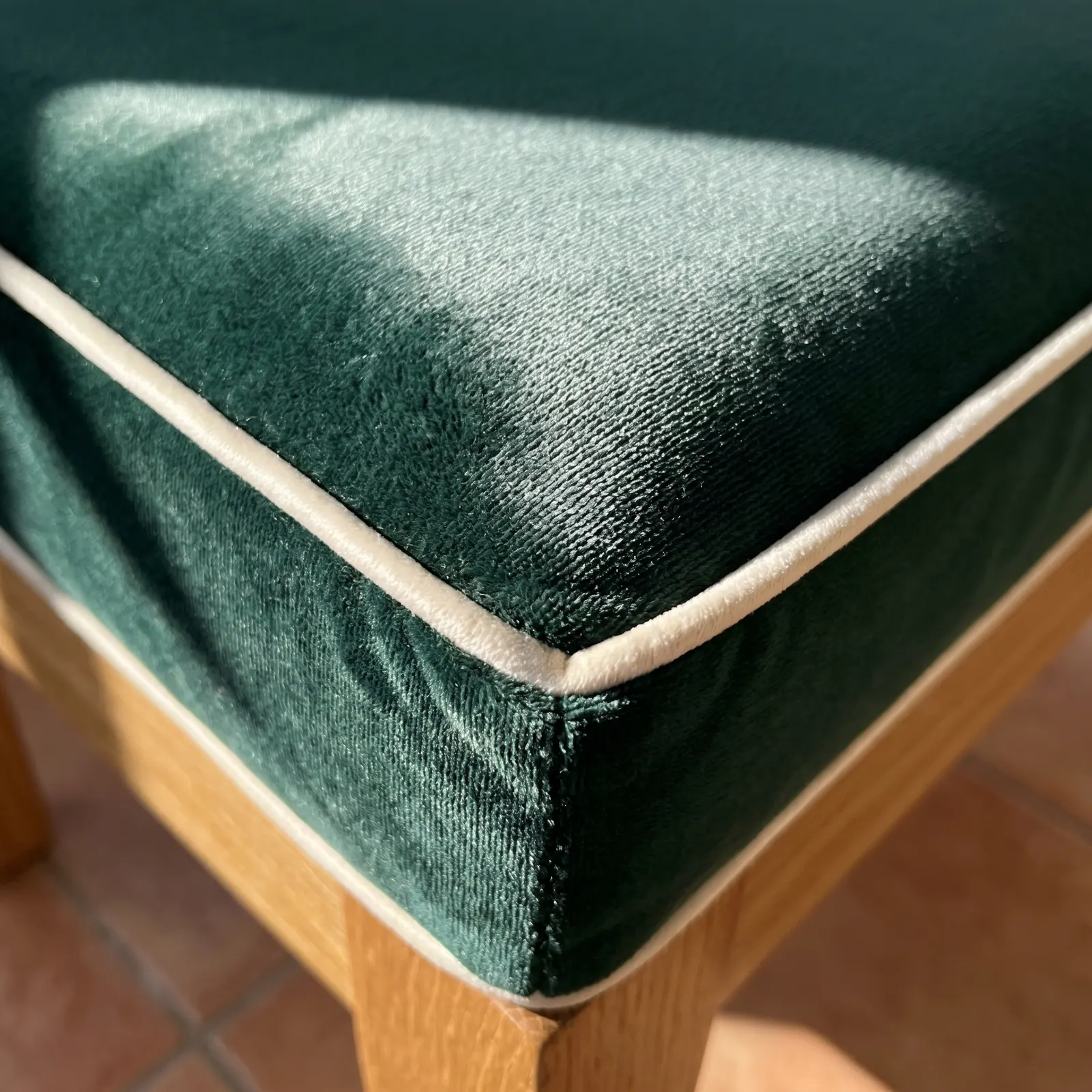
One corner, one strip of sun, one pale cord. It is a small photograph, and it holds a whole lesson about how a dark green behaves next to warm wood and clay.

 Save
The quick answer
Emerald velvet on a bench cushion shifts with the light: brighter where the pile brushes away from you, deeper toward bottle green in shade, and richer still beside warm terracotta and oak. Ivory contrast piping draws a clean outline around that dark block. At the corner, the cord should turn in one line with the side seam directly below.
Bottle green in a raking light
Daylight never lies; your screen sometimes does. This close-up proves it. Late sun rakes across the corner of an oak bench, and the velvet on top is three greens at once: a bright, almost jade shine where the pile brushes away from the eye, a true emerald in the middle, and a deep bottle green where the side band turns into shadow.
Below, terracotta floor tiles glow a warm red-orange. Green and red-orange sit across the color wheel from each other, so the clay pushes the velvet deeper and richer. The honey oak frame does the same more gently, warming the edge of the seat.
Then the ivory. Pale piping around a dark velvet draws the cushion in outline, like ink around a watercolor. It helps a deep green hold its shape above a patterned tile floor, where a self-piped edge would melt into the shadow. Choose it when you want a tailored, almost upholstered look; skip it when you want the velvet to read as one soft mass. The contrast piping entry explains the cord itself.
What color is the floor under your bench, my friends? Start there, then choose the green. More shapes live under bench cushions.
Pinned by Élodie: corner, seam, pile, band and tile
Five pins, all within a hand's width of one corner, because that is where a velvet cushion tells the truth.
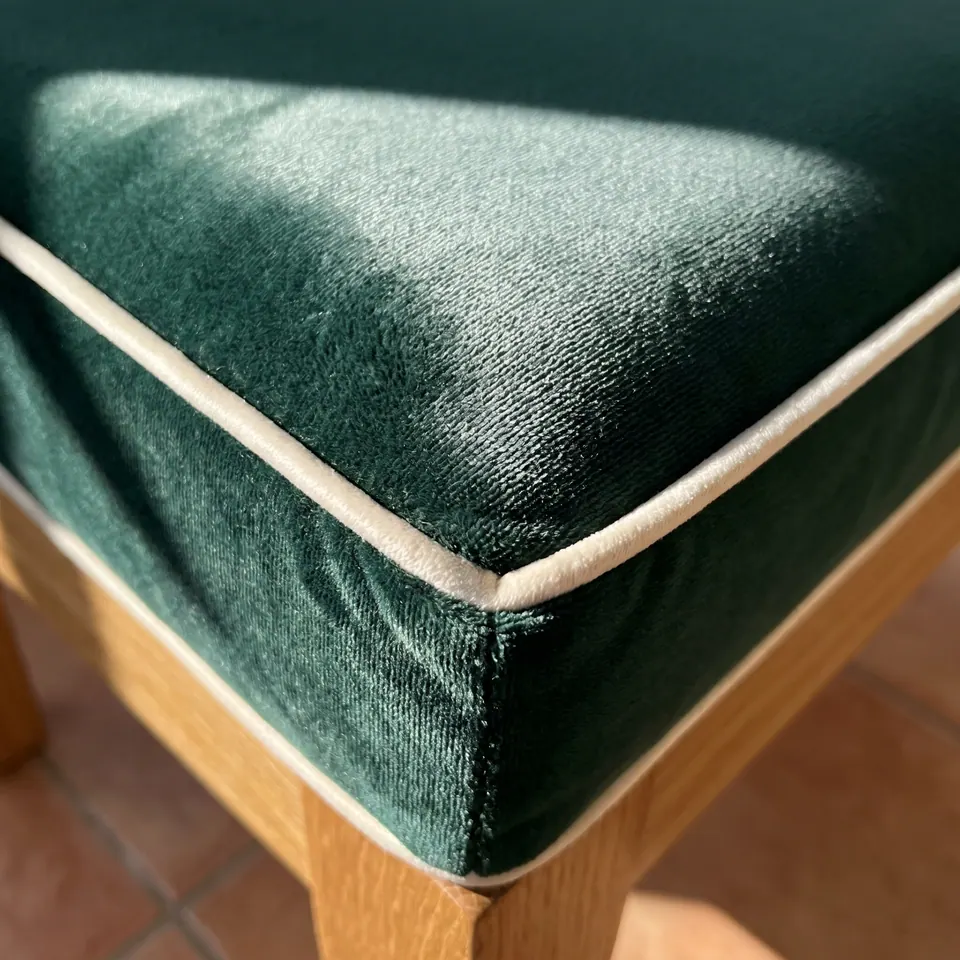
- piped corner turn
The ivory cord turns the corner in one clean line with no puckering.
- vertical side seam
The side-band seam lands directly under the piped corner, a sign of careful cutting.
- velvet pile in sun
Sunlight shows the pile direction, so every panel should be cut with the nap the same way.
- side band
A straight, taut side band shows the foam fills the cover right to the corners.
- terracotta tiles
Warm tiles below push the green toward a deeper bottle shade.
- piped corner turnThe ivory cord turns the corner in one clean line with no puckering.
- vertical side seamThe side-band seam lands directly under the piped corner, a sign of careful cutting.
- velvet pile in sunSunlight shows the pile direction, so every panel should be cut with the nap the same way.
- side bandA straight, taut side band shows the foam fills the cover right to the corners.
- terracotta tilesWarm tiles below push the green toward a deeper bottle shade.
Notebook page: the same emerald beside five neighbors
| Beside | What the emerald does | Note in the margin |
|---|---|---|
| Raking sun | Turns bright, almost jade, where the pile brushes away from the eye | Cut every panel with the nap running one way |
| Shade | Sinks toward bottle green | Judge the color in daylight at the bench, not on a phone |
| Terracotta tiles | Deepens, as red-orange and green enrich each other | Warm clay floors suit jewel greens |
| Oak frame | Warms at the edge of the seat | Honey wood softens a cool green |
| Ivory piping | Gains a drawn outline | Pale cord for a tailored look; self piping for a softer one |
Pale pink to graphite, and two backs that met in a corner
A buyer in the US ordered a velvet banquette: two scalloped back cushions, 24 in (61 cm) high and 80 in (203 cm) and 53 in (135 cm) long, and two seat cushions of 16 x 80 in (41 x 203 cm) and 16 x 37 in (41 x 94 cm). The workshop confirmed a 4 in (10 cm) seat and shredded-foam backs.
After paying, she changed her mind about color: from pale pink 115 to graphite gray 134, with off-white 194 piping. That is the same move as the emerald here. A dark velvet with a pale cord reads as tailored, and the outline follows every scallop.
The clever catch came from the measurements. Both backs had been measured wall to wall, so where they met in the corner, one would have run into the other. The workshop shortened one by 4 in (10 cm), its own depth, and the two backs sat side by side. Our notes on velvet bench cushion care and on matching or contrast piping pick up from here.
On the cutting table: the emerald corner
| Product | Bench cushion, box edge |
|---|---|
| Fabric | Velvet in emerald, deepening to bottle green in shade |
| Piping | Ivory contrast piping |
| Corner | Cord turns in one line; side seam falls directly below |
| Nap | All panels cut with the pile running the same way |
| Side band | Taut, with the foam filling right to the corners |
| Frame and floor | Oak bench over terracotta tiles |
| Best for | Sunny halls, sunrooms and dining benches |

Have it made
Have this made — ask Élodie’s workshop
Describe the room at four in the afternoon: the floor, the wall, the one color you love. That is where a good fabric choice begins. — Élodie
Leave your details and the workshop will call you to confirm measurements, fabric, foam and piping. No prices, dates or payment on this page: it is a request, not an order.
Buyer questions: a joining bolster, a low back and an 8 in dinette
- A common question
Can you make a straight cylinder backrest to join two sofas into one sectional?
The workshop's answerYes. A straight backrest 39 in (100 cm) long was made in a matching off-white for exactly that job.
- A common question
I'm afraid the back cushions will sit too low. What happens if I end up returning the sofa?
The workshop's answerThe workshop couldn't estimate return costs, but suggested adding extra cushion pieces if the back feels too low, which raises or extends the seating without starting over.
- A common question
Could you make cushions for a U-shaped dinette at least 8 inches thick?
The workshop's answerYes. One U-shaped dinette set was made in velvet: a long seat 65 in (165 cm) wide, 17.5 in (44.5 cm) deep and 8 in (20 cm) thick, a 65 in back cushion 4 in (10 cm) deep, and two side seats of 17.5 x 24.5 in (44.5 x 62 cm), also 8 in thick.
On a dark velvet bench cushion, ivory piping draws the outline; the cord should turn each corner in one clean line with the side seam right below it.
Élodie
Questions buyers ask next
Why does velvet look lighter from one side?
The pile leans one way. Where it brushes away from your eye it reflects more light and looks paler; where it faces you it looks deeper. That is why every panel of a velvet cushion should be cut with the nap running the same way.
Should a dark velvet cushion have pale piping?
Choose pale piping when you want a tailored, almost upholstered look: it draws the cushion in outline and holds its shape visually over a busy floor. Self piping in the same velvet reads softer and quieter.
What should a well-made box cushion corner look like?
The piping turns the corner in one clean line with no puckering, the vertical side seam falls directly beneath it, and the side band is taut, showing that the foam fills the cover right to the corners.
With color and care — Élodie