A Reading by MaggieBench Cushions
One navy velvet corner, a twisted ivory cord, and how to order it right the first time
Maggie reads a close-up the way she reads an order form: edge first, then everything the photo is quietly asking you to specify.

 Save
The quick answer
To order a custom velvet bench cushion right the first time, send one message listing the exact size, body fabric code, piping style and code, tufting, foam and wrap, zipper and fastening. Then ask for a close-up of your chosen velvet with its piping, because a corner like this navy one shows the pile and cord better than a room photo.
The cushion, cut open
Cover fabric. A removable, zippered cover. Machine wash at 86°F (30°C) on a gentle cycle and air dry.
Piping. A fabric-covered cord sewn into the seams. It sits on the seam line, so it does not change the size.
Fiber wrap. Polyester fiber (Dacron) batting around the foam: it fills the cover out and softens the edges.
Foam core. About 2.0 lb/ft³ (32 kg/m³) high-resilience foam, firm to medium-firm, cut to the ordered size.
Zipper. Along the back band, as hidden as possible. The zipper side faces down or toward the wall.
Base panel. The underside of the cover. A non-slip fabric backing can cover the whole of it instead.
Pinned by Maggie: one corner, five checks
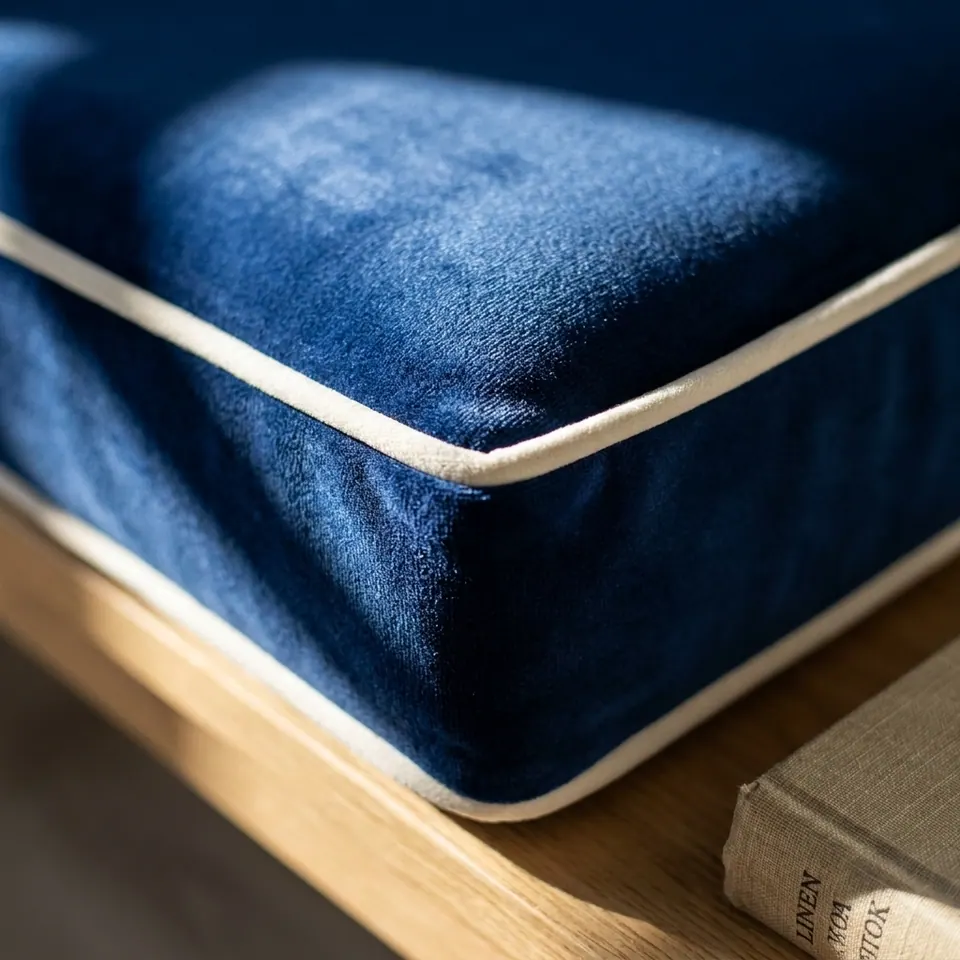
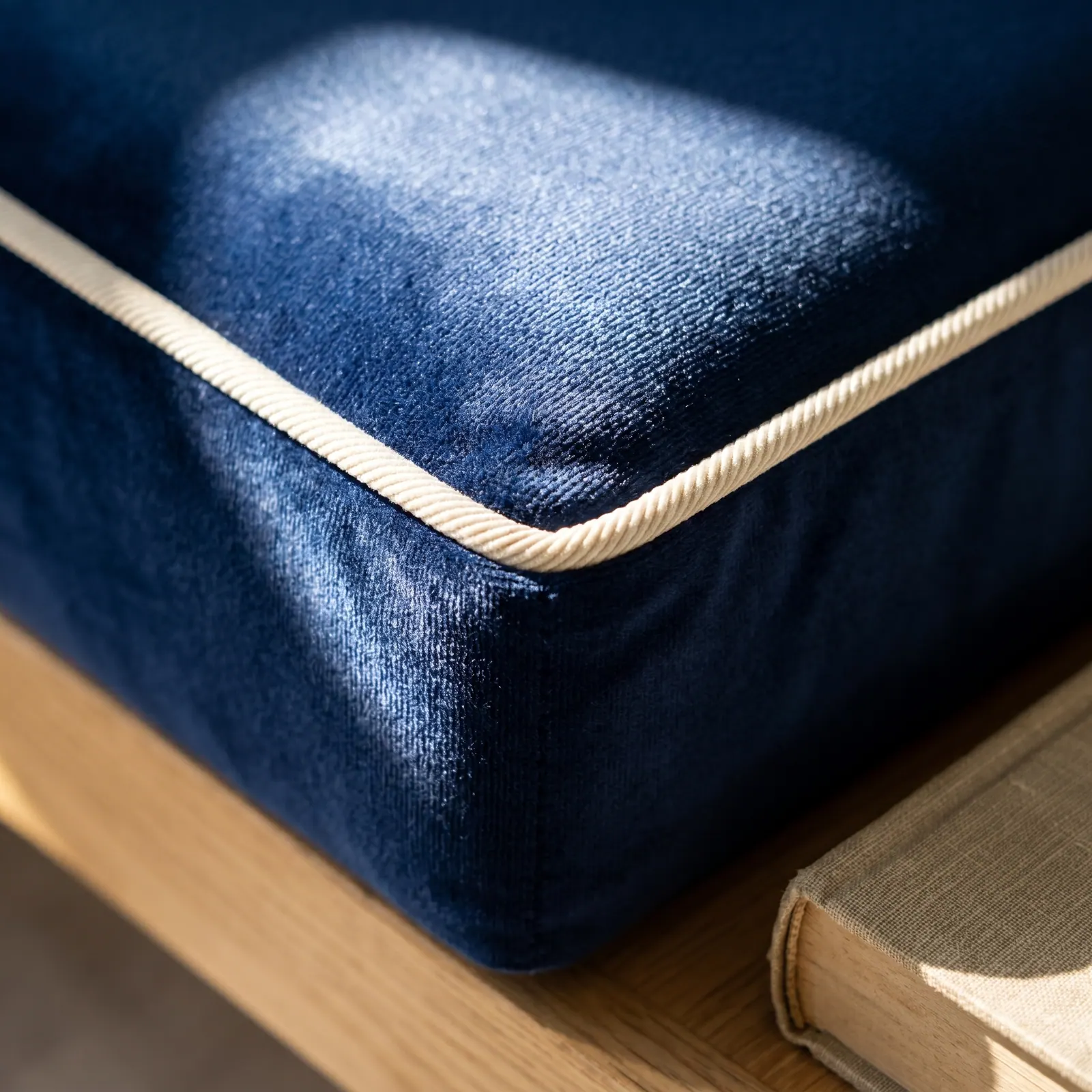
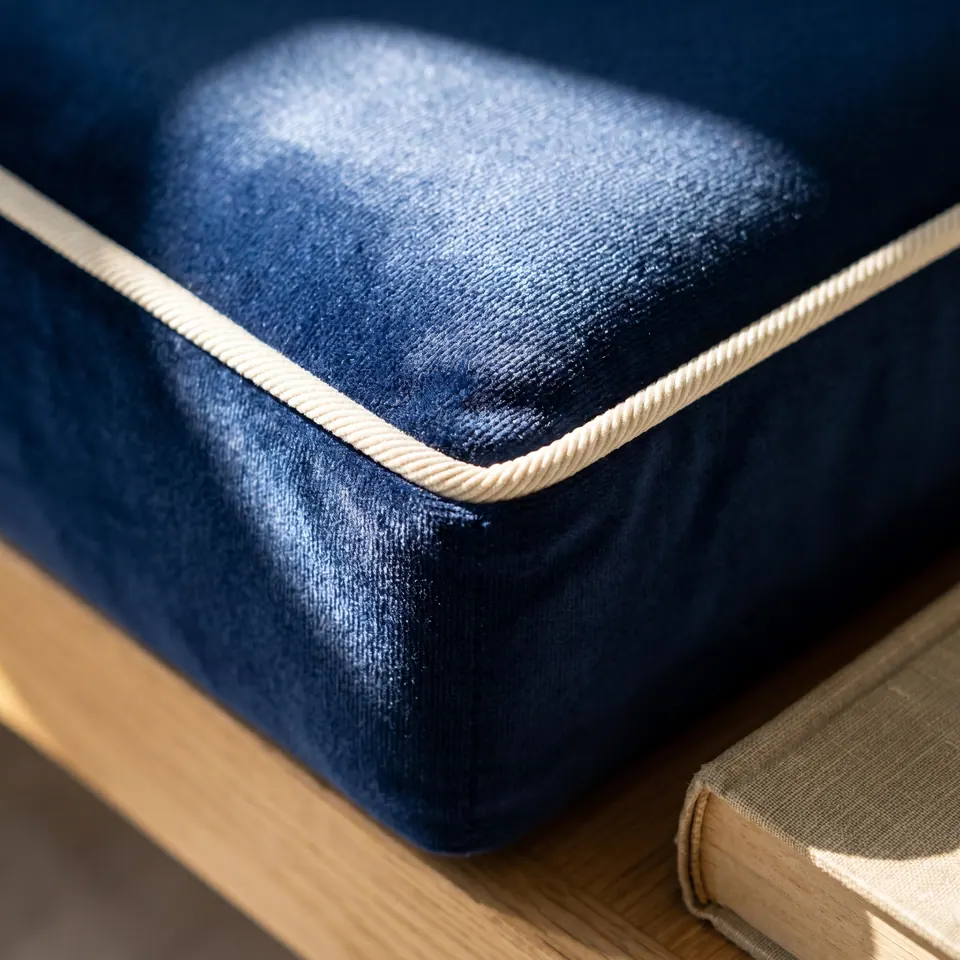
Five pins on a single corner, from the twisted cord to the book that gives you the scale.
- Twisted cord piping
A twisted cord gives a rope-like edge that looks a little more formal than flat welt.
- Gusset corner
The side panel turns the corner without puckering, which is the mark of a well-cut box cushion.
- Velvet pile
Sun across the top shows the pile lying one way; brush it smooth after sitting.
- Oak bench
Warm oak makes navy look deeper and richer.
- Cloth-bound book
A linen book cover shows the cushion's size against something familiar.
- Twisted cord pipingA twisted cord gives a rope-like edge that looks a little more formal than flat welt.
- Gusset cornerThe side panel turns the corner without puckering, which is the mark of a well-cut box cushion.
- Velvet pileSun across the top shows the pile lying one way; brush it smooth after sitting.
- Oak benchWarm oak makes navy look deeper and richer.
- Cloth-bound bookA linen book cover shows the cushion's size against something familiar.
Reading the corner before you read the price
Right, then. A close-up is where a cushion stops flattering you and starts telling the truth, and this one tells it well.
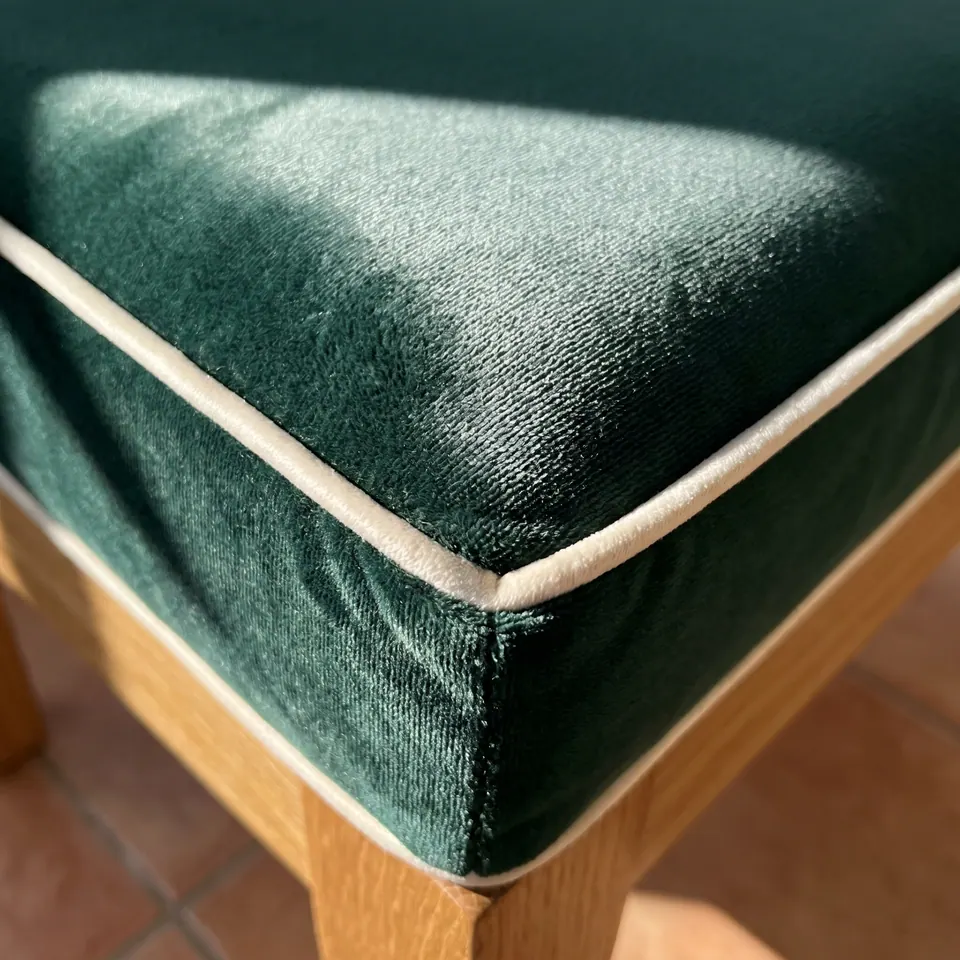
Start at the edge. A twisted ivory cord is laid into the top seam, and in raking sunlight it catches like a thin rope. It looks a touch more formal than a flat welt, and against navy velvet it reads nautical and tailored at once. Good for a study, good for a coastal room, good for anyone who likes a line that behaves.
Now drop your eye to the corner. The side panel turns without a pucker. That is the mark of a well-cut box cushion, and it is the first place I look, because a gusset that fights its corner will fight it forever.
Then the top. Sun across the velvet shows the pile lying one way, lighter where it runs with the light and deeper where it runs against it. That is velvet being velvet, not a flaw. Brush it smooth after sitting and it settles.
The props are there to work. Warm oak makes the navy look deeper and richer. The cloth-bound book gives you the size of the cushion against something familiar. That is the whole styling.
I once approved a velvet from a wide room shot and spent a week explaining its shading to myself. Ask for a close-up of your fabric and piping together. For pile habits, read velvet bench cushion care; browse the velvet family and more bench cushions.
Seven requests in one message
A buyer wrote in with a bench cushion order I would frame and hang in the workroom. Size: 61 x 22 3/4 x 2 3/8 in (155 x 58 x 6 cm). Fabric: a black, given by its code. Then the list: blind tufting, stitched with no buttons; piped edges; firm high-density foam wrapped in batting; a hidden zipper; hook-and-loop strips underneath.
They also asked for a Martindale rating. The shop had no lab figure to give and said so plainly, describing the cloth as heavy-duty upholstery instead. When the courier lost the fabric samples, the shop handled the claim and sent a second set.
Because every detail sat in one list, the quote covered all of it, with no surprises at the cutting table. Tufting, edge, wrap, zipper, fastening: one message, dear, not five. What would your list leave out?
The one-message order list
- Exact size as length x width x thickness, with units written out
- Body fabric code, plus a request for a close-up photo before production
- Piping: none, self or contrast, with its code
- Tufting: blind (stitched, no buttons), buttoned, or plain
- Foam firmness, and whether it is wrapped in batting
- Zipper and fastening: hidden zipper, ties, or hook-and-loop strips underneath
- If your size isn't listed, ask for it to be added as a new option
Buyer questions: color regrets, odd sizes, fiber content
- A common question
My cushion arrived and the color isn't what I pictured. Can I return or exchange it?
The workshop's answerIf the cushion was made exactly in the fabric and size you ordered, a color preference isn't treated as a fault, and return shipping is at your cost. Instead, the shop offered a new cover in the same measurements, so you keep the foam and simply swap covers through the zipper. In another case it made two replacement covers at production cost.
- A common question
None of your size options come close to my bench. How do I order?
The workshop's answerMessage the shop with your exact size and it will be added as a new size option on the listing, so you can check out as normal. Sizes added this way include 18.5 x 11.5 in, 20 x 50 in, 40 x 138 in and 29 1/2 x 29 1/2 in (75 x 75 cm).
- A common question
What are your fabrics made of? Is the linen 100% linen?
The workshop's answerThe performance, or soft, fabric is a poly-cotton blend: thick, soft, durable and easy to clean. The natural linen chart is 50% linen and 50% polyester, and some linen-look codes are 100% polyester. None of the linens are 100% linen.
On the cutting table: the navy corner
| Product | Bench cushion, box edge |
|---|---|
| Fabric | Navy velvet |
| Piping | Twisted ivory cord laid into the top seam |
| Gusset | Side panel turns the corner without puckering |
| Pile | Lies one way; brush smooth after sitting |
| Bench | Light oak |
| Light | Raking side sunlight |
| Best for | Studies, hall benches and coastal rooms that want a tailored edge |

Have it made
Have this made — ask Maggie’s workshop
Numbers first, fabric second, piping last. Jot down what you have, and the workshop will go down the list with you, item by item. — Maggie
Leave your details and the workshop will call you to confirm measurements, fabric, foam and piping. No prices, dates or payment on this page: it is a request, not an order.
Ask for a close-up of your velvet and its piping before ordering: a bench cushion corner shows the pile direction and the cord better than any room photo.
Maggie
Questions buyers ask next
What is twisted cord piping on a cushion?
A rope-like cord sewn into the seam in place of a flat fabric welt. It catches light along its twists and looks a little more formal, which suits velvet and tailored rooms. On this cushion an ivory cord outlines navy velvet.
Why does velvet look lighter in patches after someone sits on it?
Velvet pile lies in one direction, and sitting pushes patches of it the other way, so they catch light differently. It is the nature of pile, not damage. Brushing the top smooth after sitting lays the pile back down.
What should I check first in a box cushion photo?
The corners. A well-cut side panel turns the corner without puckering or pulling. If the gusset gathers or twists at the corner in the product photo, it will look that way on your bench too.
Can a custom bench cushion be tufted without buttons?
Yes. Blind tufting is stitched through the cushion with no buttons on the surface. Name it in your order alongside the edge, foam wrap, zipper and fastening, as one buyer did for a 61 in (155 cm) bench, so the quote covers every detail.
Stitch straight — Maggie
More photographs to read
 Save
 Save
 Save
 Save
 Save
 Save