A Reading by NateBench Cushions
An Eggplant Velvet Bench Cushion, and Why Its Piping Is Off-White
A dark library corner, a notched velvet seat and one bright line around it. Here is how I choose between self piping, contrast piping and no piping at all.

 Save
The quick answer
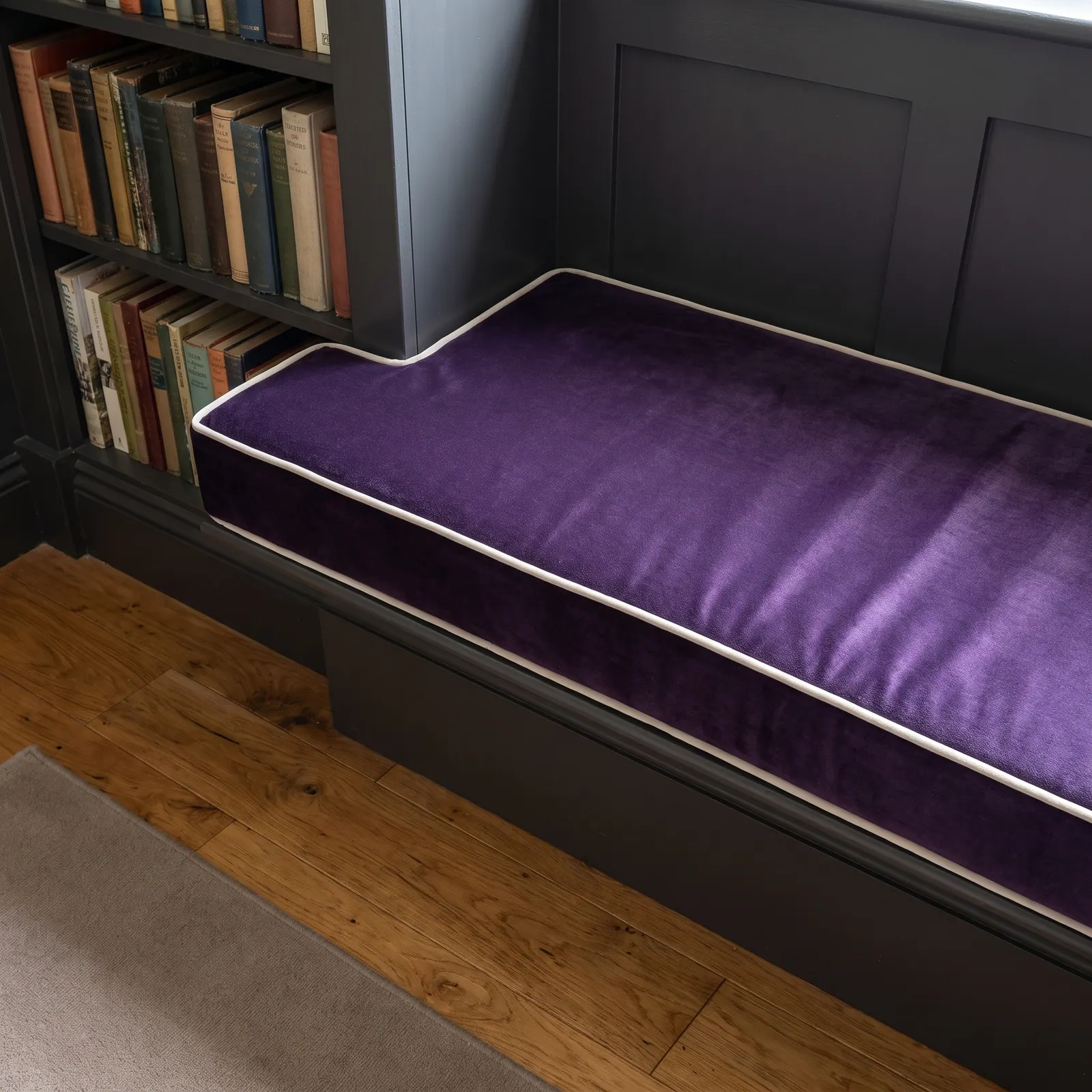
Choose contrast piping when the room around a custom bench cushion is darker than the fabric, because the welt becomes the only line that shows the shape. This eggplant velvet seat uses off-white piping to trace its step around a bookcase. Self piping suits calm rooms; no piping suits soft, casual cushions. Order a hair under the ledge size to absorb handmade tolerance.
The cushion, cut open
Cover fabric. A removable, zippered cover. Machine wash at 86°F (30°C) on a gentle cycle and air dry.
Piping. A fabric-covered cord sewn into the seams. It sits on the seam line, so it does not change the size.
Fiber wrap. Polyester fiber (Dacron) batting around the foam: it fills the cover out and softens the edges.
Foam core. About 2.0 lb/ft³ (32 kg/m³) high-resilience foam, firm to medium-firm, cut to the ordered size.
Zipper. Along the back band, as hidden as possible. The zipper side faces down or toward the wall.
Base panel. The underside of the cover. A non-slip fabric backing can cover the whole of it instead.
Cross-section first: two welts and a step
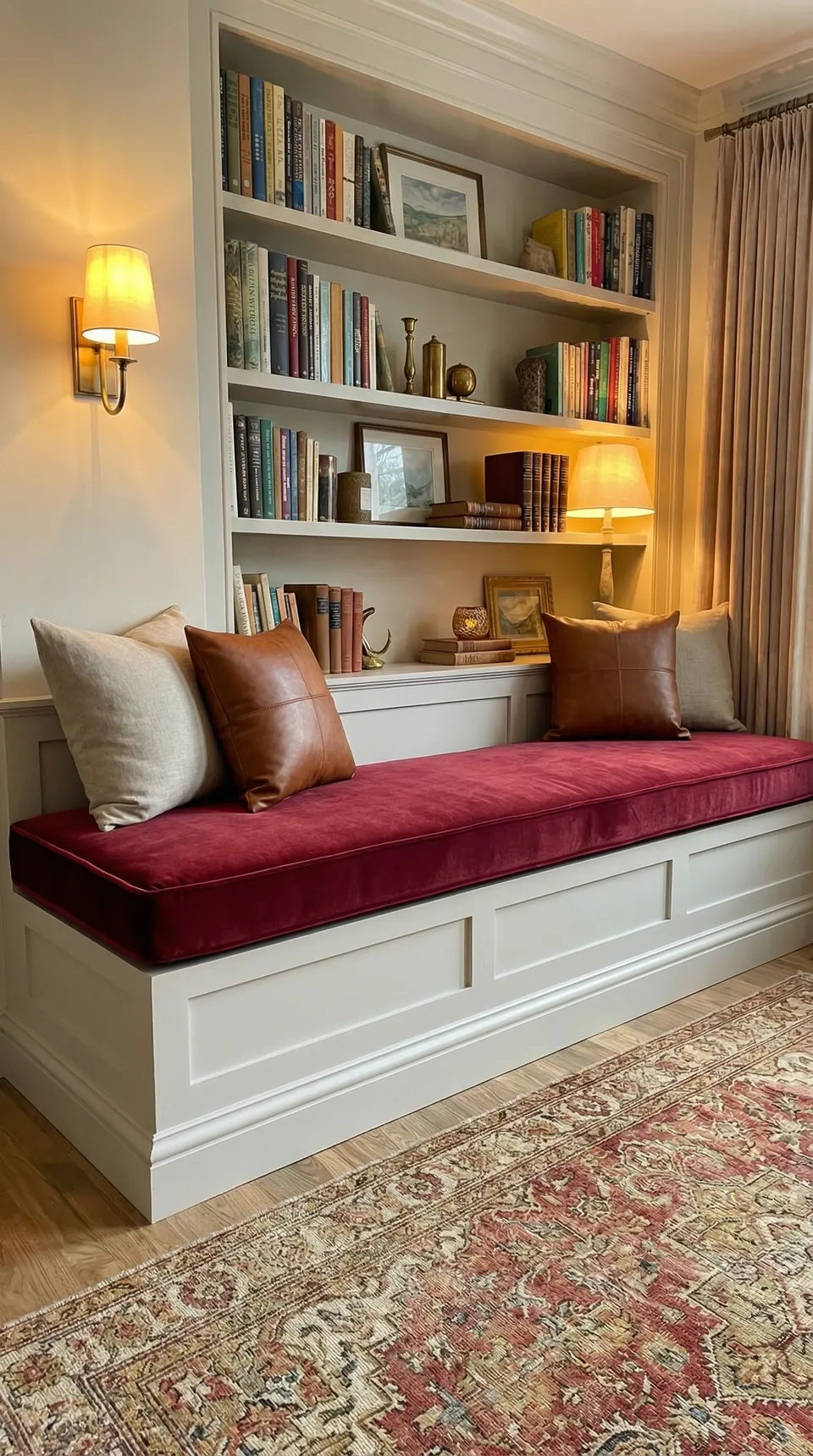
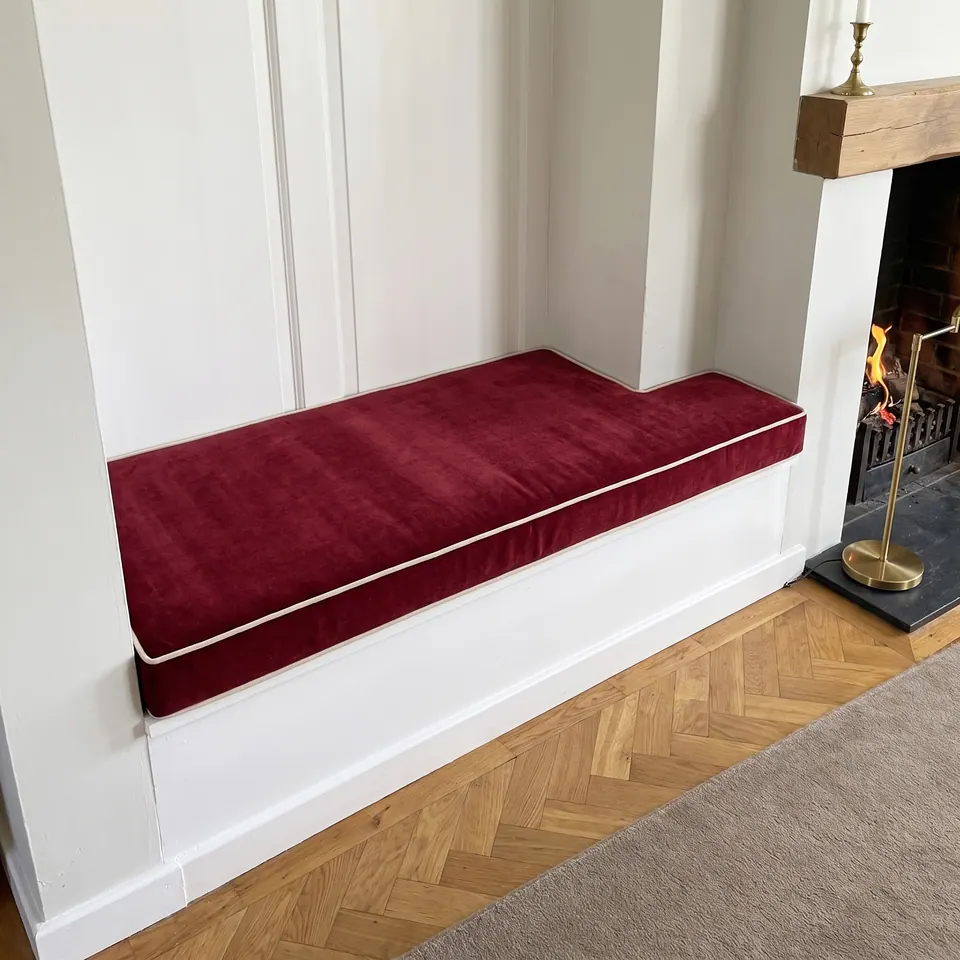
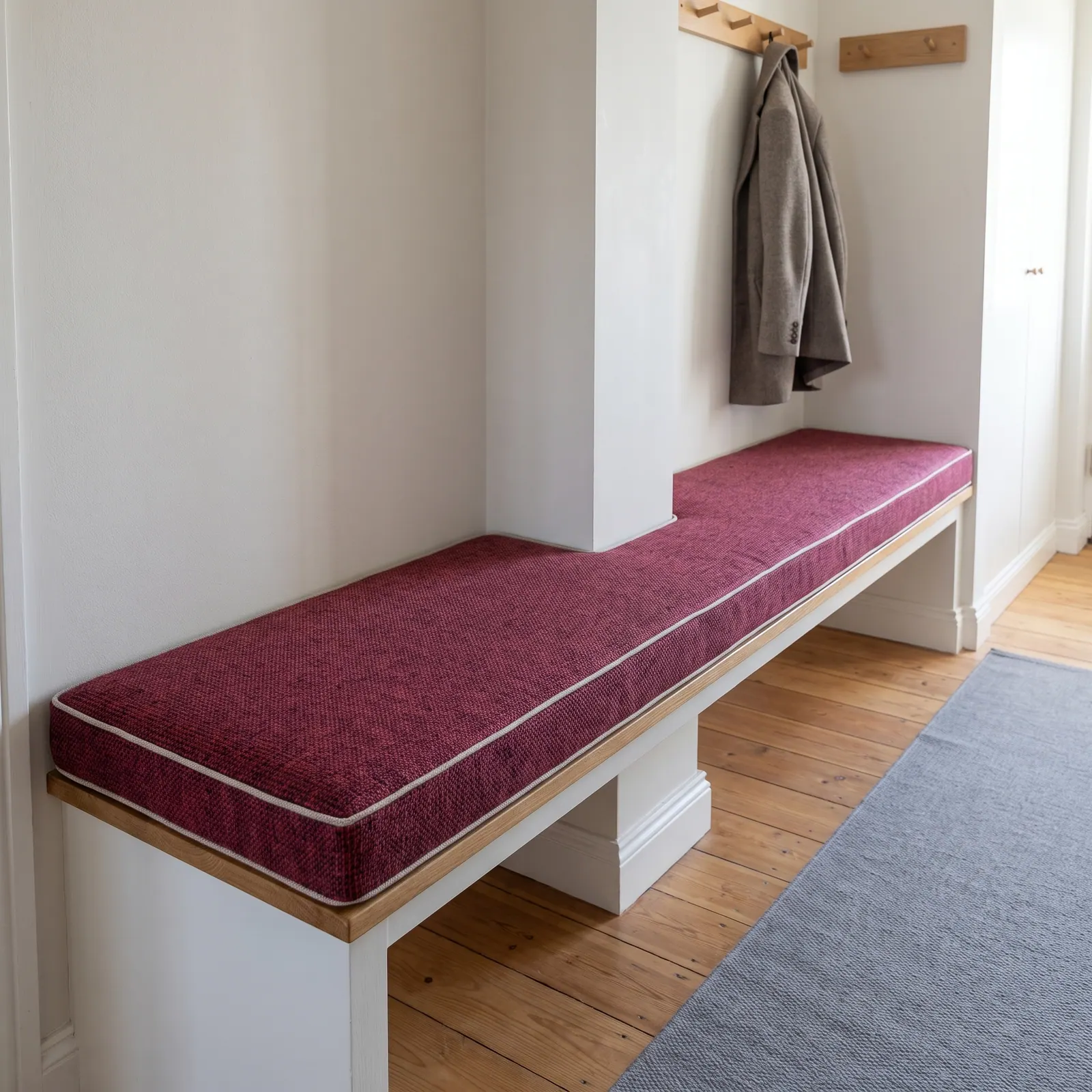
Start with the section, not the color. This seat is a box-edge cushion: a top panel, a bottom panel and a boxing strip between them, with a welt sewn into the seams. On a custom bench cushion in a corner this dark, those welts are the only light lines in the frame.
The plan view matters more. The front edge steps back where the bookcase projects into the seat, so the cushion is a rectangle with one notch taken out of a front corner. Without piping, that step dissolves into shadow. With an off-white welt you can read the whole outline from the doorway: long run, step, short run.
Now the light. One raking beam crosses the seat. Eggplant velvet reads nearly black where the pile lies away from it and violet where the pile catches it. Navy would have gone flat here, and black would have vanished into the paneling.
The props are doing structural work. Clothbound books on the built-in shelves bring faded rust, green and tan, warm neighbors that keep the purple from turning cold. Charcoal shaker-style paneling makes the cushion look like part of the joinery rather than something laid on top. Wide oak floorboards and a gray wool rug put the only mid-tones at the bottom of the picture, so the eye climbs to the seat and stops at the white line.
Five pins on a stepped velvet seat
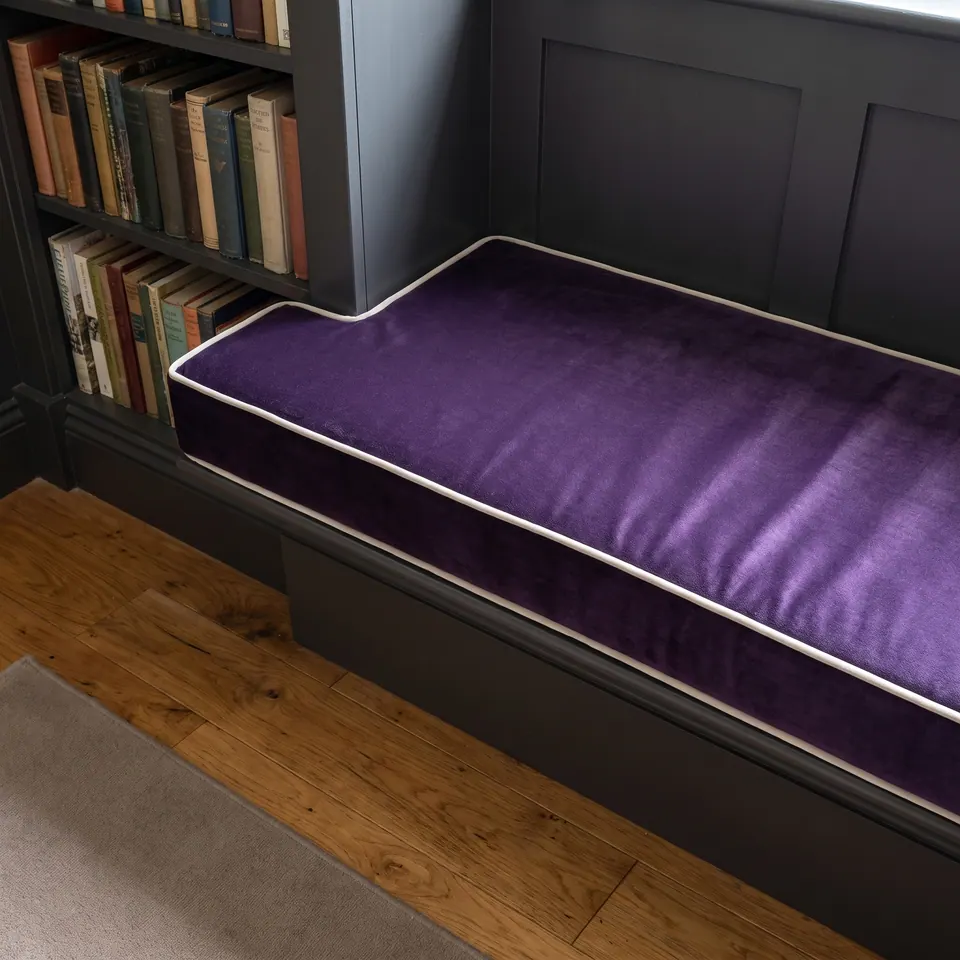
Five pins, from the notch at the bookcase to the charcoal paneling, trace how one bright welt holds a dark corner together.
- Notch at the bookcase
The front corner steps back where the bookcase juts out, so the cushion fills the seat right up to the shelf.
- Off-white piping
A bright welt is the only light line in a dark corner and shows off the stepped outline.
- Velvet sheen
Eggplant velvet reads almost black in shade and violet where the light hits the pile.
- Clothbound books
Faded spines in rust, green and tan give the purple warm neighbors without competing.
- Charcoal paneling
Dark woodwork makes the cushion look part of the joinery rather than laid on top.
- Notch at the bookcaseThe front corner steps back where the bookcase juts out, so the cushion fills the seat right up to the shelf.
- Off-white pipingA bright welt is the only light line in a dark corner and shows off the stepped outline.
- Velvet sheenEggplant velvet reads almost black in shade and violet where the light hits the pile.
- Clothbound booksFaded spines in rust, green and tan give the purple warm neighbors without competing.
- Charcoal panelingDark woodwork makes the cushion look part of the joinery rather than laid on top.
Self, contrast or no piping on eggplant velvet
| Piping | What it does to the outline | Choose it when |
|---|---|---|
| Contrast (off-white here) | Draws the outline in one bright stroke; every step and corner shows | The room is darker than the fabric, or the shape has a notch worth showing |
| Self piping | Firms the edge without adding a color; the seat reads as one block | The fabric already carries the room, or the shape is a plain rectangle |
| No piping | A softer seam; the outline blurs a little at a distance | You want a relaxed cushion and nobody will study the edge from across the room |
111 1/4 inches long and a quarter inch too wide
A buyer in the US ordered a cushion for a long ledge bench: 29.5 x 111.25 in. The workshop works in whole centimeters, so it was cut at 29 1/2 x 111 3/8 in (75 x 283 cm). The length landed perfectly. The width measured 30 in and crept a little past the front of the ledge.
Here is the arithmetic. A handmade cushion carries about ± 3/8 in (1 cm) of tolerance, more of it over a long span, and a box edge relaxes outward with use. On a free-standing bench nobody notices. Inside a ledge, the tolerance has nowhere to go but over the edge.
The rule I write on the drawing: where a cushion must sit inside a ledge, order it a few millimeters under the maximum. The size tolerance Pattern explains why, and the bench cushion builder lets you try the numbers. What does your ledge measure between its stops, partner?
Buyer questions: piping picks, a lone backrest and straps
- A common question
I can't decide on a piping color. Would you pick one for me?
The workshop's answerThe workshop prefers that you choose, since color is personal, but will suggest one when asked. For a pattern with a light tone that might be L-02, a light cream that blends in, with L-01 as a lighter, whiter option. A suggestion may not be an identical match and the final choice stays yours, so switch codes before production if you prefer another.
- A common question
Can I buy just one straight back pillow for a sofa I already own?
The workshop's answerYes. The straight backrest measures 39 x 15 x 15 in (100 x 39 x 39 cm) and is sold on its own as an option on the modular sofa listing.
- A common question
Will outdoor back cushions slide off my chairs if they have no straps?
The workshop's answerOften they stay put: back cushions made with double piping have enough structure to sit in place without sliding. Straps can still be added for a small extra cost, and for the seats the workshop may suggest a non-slip base instead.
On the cutting table: the library step seat
| Piece | Stepped library seat cushion, one piece |
|---|---|
| Fabric | Eggplant velvet |
| Piping | Off-white contrast welt |
| Edge | Box edge with boxing strip |
| Shape | Rectangle with a front notch where the bookcase projects |
| Setting | Charcoal-painted paneled window seat in a home library |
| Tolerance | About ± 3/8 in (1 cm), more over a long run |
| Order size | A few millimeters under the ledge maximum |
| Best for | Dark reading nooks with built-in shelving |

Have it made
Have this made — ask Nate’s workshop
Send the numbers in inches: length × depth × thickness, plus any angle. The workshop checks them with you, because foam has no undo button. — Nate
Leave your details and the workshop will call you to confirm measurements, fabric, foam and piping. No prices, dates or payment on this page: it is a request, not an order.
Contrast piping earns its place when the room is darker than the cushion: on eggplant velvet, one off-white welt draws the whole stepped outline.
Nate
Questions buyers ask next
Why does off-white piping suit an eggplant velvet cushion in a dark room?
In a room of charcoal paint and old books, a light welt is the only line that shows the cushion's shape. Eggplant velvet reads almost black in shade, so without contrast the outline disappears into the joinery.
Does a notched bench cushion look better with contrast piping?
Usually. A notch or step is a detail worth seeing, and a contrast welt draws it in one stroke. On a plain rectangle in a busy room, self piping keeps the seat calmer and lets the fabric lead.
How much smaller than the ledge should I order a velvet bench cushion?
A few millimeters under the maximum. Handmade cushions carry about 3/8 in (1 cm) of tolerance, more over long spans, and a box edge relaxes outward with use. Inside a ledge, that extra has nowhere to go.
± 1/4 in — Nate
More photographs to read
 Save
 Save
 Save
 Save
 Save
 Save