A Reading by HanaDaybed Cushions & Covers
A denim blue daybed cushion and bolster, and what keeps them still
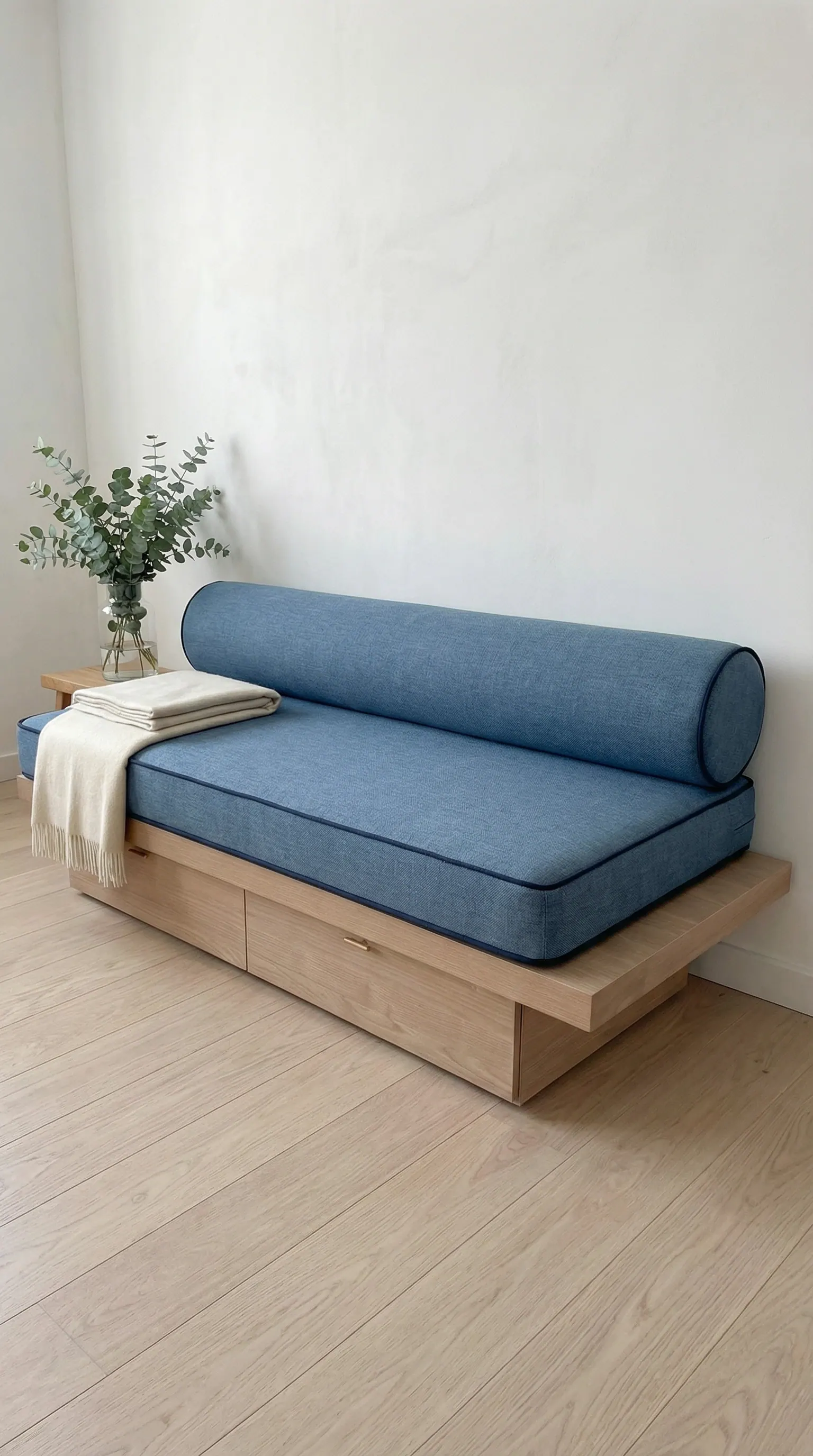
Hana reads a blue daybed in an almost empty white room. Nothing on it moves. She explains why.

 Save
The quick answer
A daybed cushion on a solid platform stays put best with a non-slip base, because ties need a rail or spindle to knot around. Put the zipper along the back edge, against the wall, where it can wrap the corners to let firm foam in. For a daybed slept on every night, a skirted cover that tucks under the mattress is easier than a zippered one.
Seattle ·
To the one looking at a daybed and wondering how it stays neat,
A letter from the white room
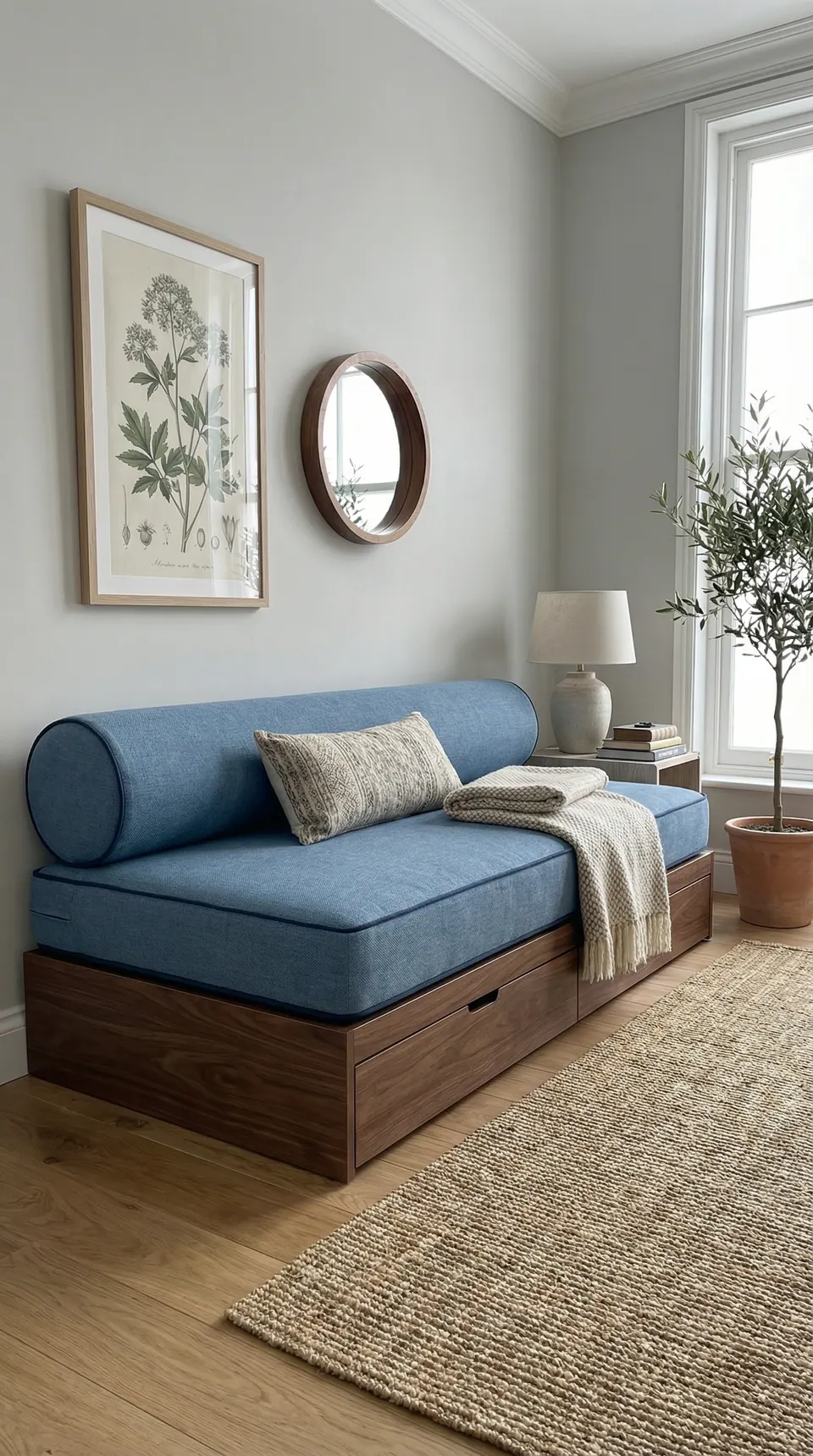
This room is almost empty. White walls. A pale oak floor. An oak platform with drawers, and on it a denim blue daybed.
The cushion carries all the color, so the tailoring shows. Navy piping runs along every edge of the seat and the backrest. It is a darker welt in the same color family, and in a plain room it is the quickest way to add definition. The round bolster at the end is outlined the same way, a neat navy circle.
The fabric is a linen-look weave. It has linen's matte slub but wrinkles and shrinks less, which matters on a piece that is sat on every day.
A cream fringed blanket is folded at one end. It breaks the long run of blue. Eucalyptus stands in a glass vase on a small oak side table beside the daybed, not on it. The seat stays clear.
Pale oak keeps the blue from feeling cold. The drawers underneath keep the floor free. Leave a hand's width of floor, and the room breathes.
Nothing here is tied. Nothing slides. That is the part worth copying.
Pinned by Hana: the blue daybed
Start at the piped end of the bolster, then follow the pins along the navy welt to the blanket, the eucalyptus and the oak drawers.
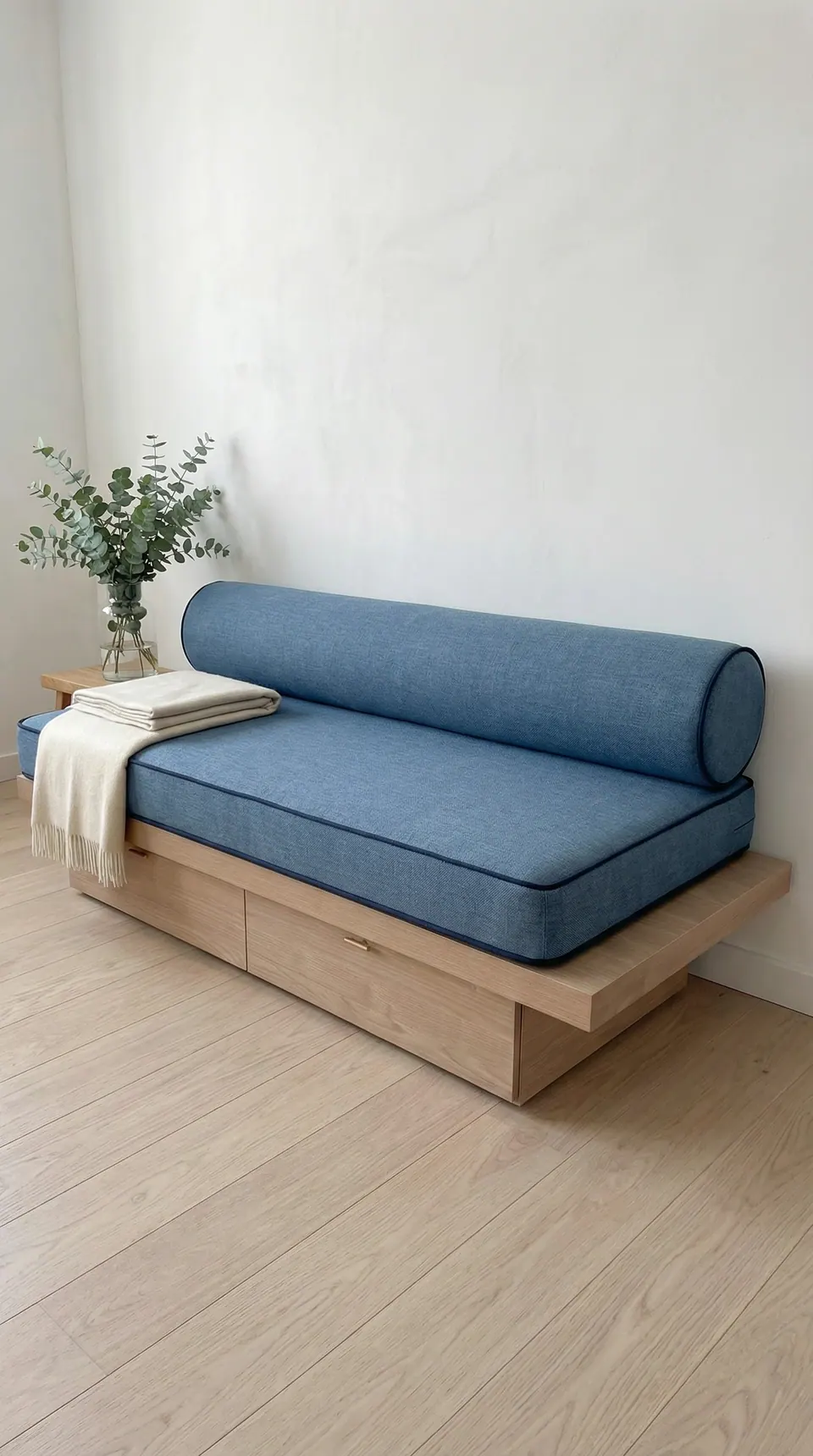
- Piped bolster end
Navy piping outlines the circular end, so the bolster reads as tailored.
- Navy seat welt
A darker welt in the same color family defines the box edge in a plain room.
- Eucalyptus vase
Gray-green leaves add life and sit beside the daybed, not on it.
- Folded blanket
A cream blanket at one end breaks the solid blue.
- Oak drawers
Storage below keeps the room clear, which lets the cushion carry the color.
- Piped bolster endNavy piping outlines the circular end, so the bolster reads as tailored.
- Navy seat weltA darker welt in the same color family defines the box edge in a plain room.
- Eucalyptus vaseGray-green leaves add life and sit beside the daybed, not on it.
- Folded blanketA cream blanket at one end breaks the solid blue.
- Oak drawersStorage below keeps the room clear, which lets the cushion carry the color.
The fastening question, answered by what is underneath
Look under the cushion before you choose how to hold it.
- Ties need something to tie to: a rail, a spindle, a slatted back. On a daybed with a railed frame they work well, one at each back corner.
- A non-slip base is a grippy fabric sewn to the underside. On a solid platform like this oak one, or a Kallax laid on its side, it holds better than any knot. It makes the cushion one-sided, so draw an odd shape as seen from above, and ask whether the grip fabric washes with the cover.
- The zipper goes along the back edge, against the wall, where nobody sees it. On a box cushion it often wraps around the corners, which lets thick, firm foam slide in without crushing them.
- A skirted cover has no zipper at all. It covers the top and front and tucks between mattress and base. For a bed used every night, it is the easiest.
The daybed cushion atlas shows seats and covers, the pattern on stopping cushions sliding compares ties and grip, and the zipper placement pattern covers the rest. The cloth lives on the linen-look shelf, and the bolster in the bolster pillow atlas.
What is under your cushion: a rail, slats, or a solid top?
A cushion that slides is noise. A zipper you can see is noise. Take both away, and the room is quiet.
The off-white that looked beige, and the cover that tucks
A buyer came back to the workshop after an off-white velvet order for a daybed looked beige at home. The workshop explained that velvet's pile leans one way and changes with the light, and showed the photo it took before dispatch, which matched the chart.
Then the bigger question came. The daybed was used every day, and a fitted zippered cover felt like a chore. What the buyer wanted was an open-bottom cover over the top and front, tucked between the mattress and the base.
The workshop agreed and made skirted covers for the 78 3/4 x 35 1/2 x 7 in (200 x 90 x 18 cm) mattress.
For a bed used daily, a skirted throw-over cover is easier than a fitted zippered one. The daybed mattress cover pattern explains how to measure for either.
On the cutting table: the white room daybed
| Pieces | Daybed seat, backrest and one round bolster |
|---|---|
| Fabric | Linen-look weave in denim blue, code 906 |
| Piping | Navy contrast piping on every edge |
| Edge | Box edge; bolster with flat round ends |
| Base | Solid oak platform with drawers |
| Best hold | Non-slip base; ties only where there is a rail |
| Zipper | Along the back edge, wrapping the corners |
| Daily beds | Skirted cover tucked between mattress and base |
| Best for | Minimal living rooms, studios and guest daybeds |

Have it made
Have this made — ask Hana’s workshop
Measure once, slowly. Write the numbers here. The workshop will go over them with you. — Hana
Leave your details and the workshop will call you to confirm measurements, fabric, foam and piping. No prices, dates or payment on this page: it is a request, not an order.
Buyer questions: a Kallax, a code and a smoother fabric
- A common question
What size cushion do I need for an IKEA Kallax used as a bench?
The workshop's answerThe 16 3/8 x 57 5/8 in in the product title is width by height. Laid on its side, the top surface is usually 57 5/8 in long by 15 3/8 in deep (146.5 x 39 cm), and the 16 3/8 in becomes the bench height. Measure your own unit, since IKEA dimensions vary by country.
- A common question
A discount code from your email removed the sale price when I used it. What should I do?
The workshop's answerThe emailed codes are generally meant for larger orders. When a code replaced the standing sale price and pushed the total up, the workshop asked the buyer to order at the sale price and then refunded the code's value to the original payment method.
- A common question
I don't want the fluffy fabric. What other fabric types are there?
The workshop's answerThe fluffy one is velvet. For a smoother surface, choose the soft-fabric chart; it appears in two charts only to show a wider color range, and it is the same material. Corduroy is available too.
Ties need something to tie to: on a daybed with a solid platform, a non-slip base holds the cushion better than any knot.
Hana
Questions buyers ask next
Do ties work on a daybed with a solid platform?
Not well. Ties need a rail, spindle or slatted back to knot around. On a solid platform, a non-slip base sewn to the underside of the cushion grips the surface and holds the cushion in place.
Which edge of a daybed cushion should carry the zipper?
The back edge, against the wall, where it stays out of sight. On a box cushion it often wraps around the corners so thick foam can go in without crushing them. A hidden zipper under a fold of fabric keeps it tidier still.
How big should a daybed bolster be?
Bolsters are sized by length and diameter. An 8 in (20 cm) diameter is common and looks in proportion on most seats, and arm bolsters are often made to match the depth of the seat they sit on.
Does a non-slip base change how I order an odd-shaped cushion?
Yes. The grip fabric makes the cushion one-sided, so draw the shape as seen from above. Otherwise an asymmetric cushion may arrive mirror-imaged, with the grip on the wrong face.
— Hana