A Reading by NateBench Cushions
One cream boucle bench pad, three colored seat pads, and the budget math behind the set
A long pad for every day, three small squares for company. It is the cheapest way I know to change a room's color next year without buying the whole cushion again.

 Save
The quick answer
Spend on the long bench cushion you sit on every day and save on the small loose pads that carry the color. Choose the main pad's thickness once, because a cover is sewn for one foam thickness and thinner foam leaves it baggy. Send true measurements, not trimmed ones, so the order is cut right the first time.
Pinned by Nate: five points from pampas to painted frame
Five pins, one per decision: two about color, two about scale and one about the frame the cushion is cut to.
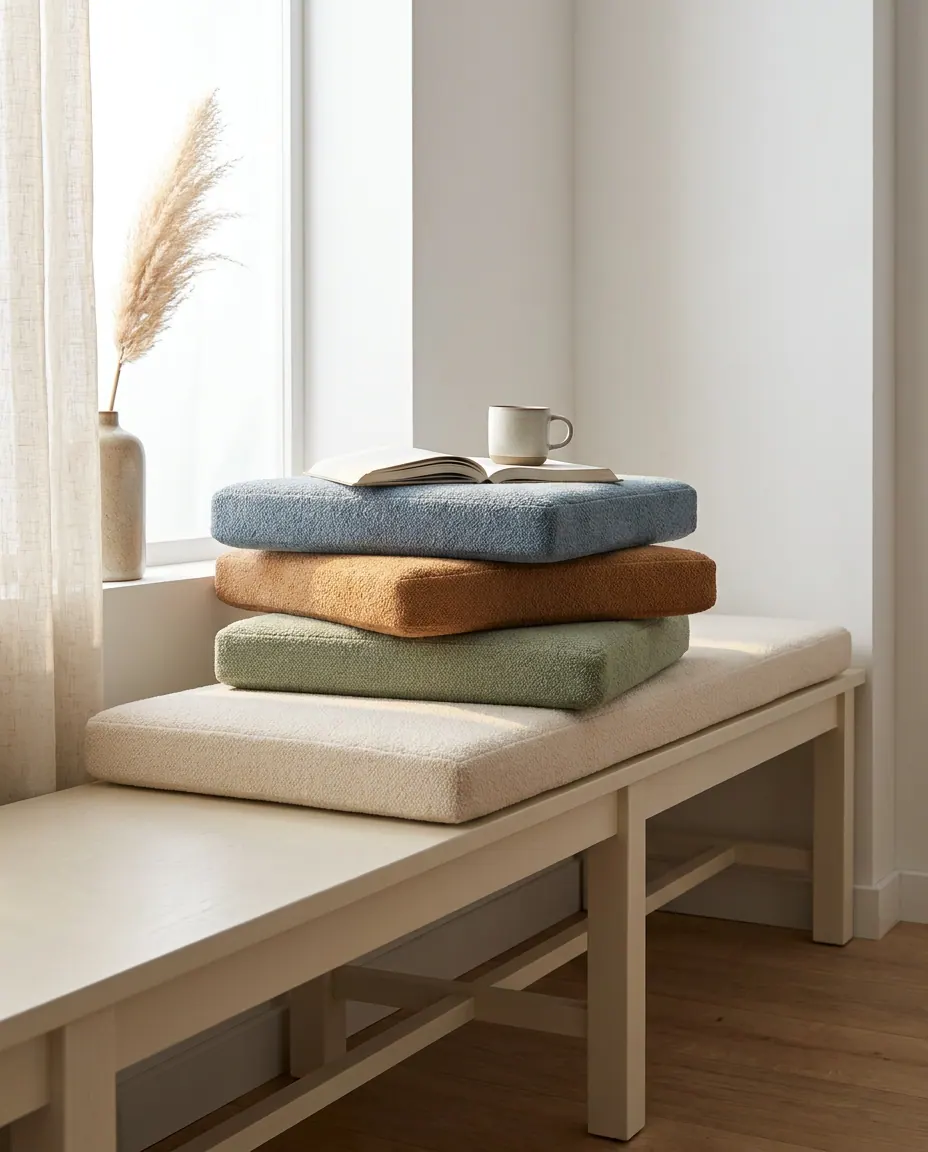
- Pampas in stoneware
Dry pampas repeats the caramel and cream without adding a new color.
- Book and white mug
The book and mug on the top pad give the scale: each square is roughly a chair-seat size.
- Caramel middle pad
Warm caramel between two cool colors keeps the stack from reading cold in north light.
- Long cream bench pad
The full-length cream pad is the everyday seat; the colored squares are loose extras for chairs or the floor.
- Painted bench frame
A frame painted close to the cushion color makes the bench look built in.
- Pampas in stonewareDry pampas repeats the caramel and cream without adding a new color.
- Book and white mugThe book and mug on the top pad give the scale: each square is roughly a chair-seat size.
- Caramel middle padWarm caramel between two cool colors keeps the stack from reading cold in north light.
- Long cream bench padThe full-length cream pad is the everyday seat; the colored squares are loose extras for chairs or the floor.
- Painted bench frameA frame painted close to the cushion color makes the bench look built in.
Reading the set: one constant, three variables
Here is a custom bench cushion split into a constant and three variables. The constant is the long cream boucle pad, cut to the painted window bench so closely that frame and cushion read as one soft block. The variables are three square seat pads, sage, caramel and dusty blue, stacked on top.
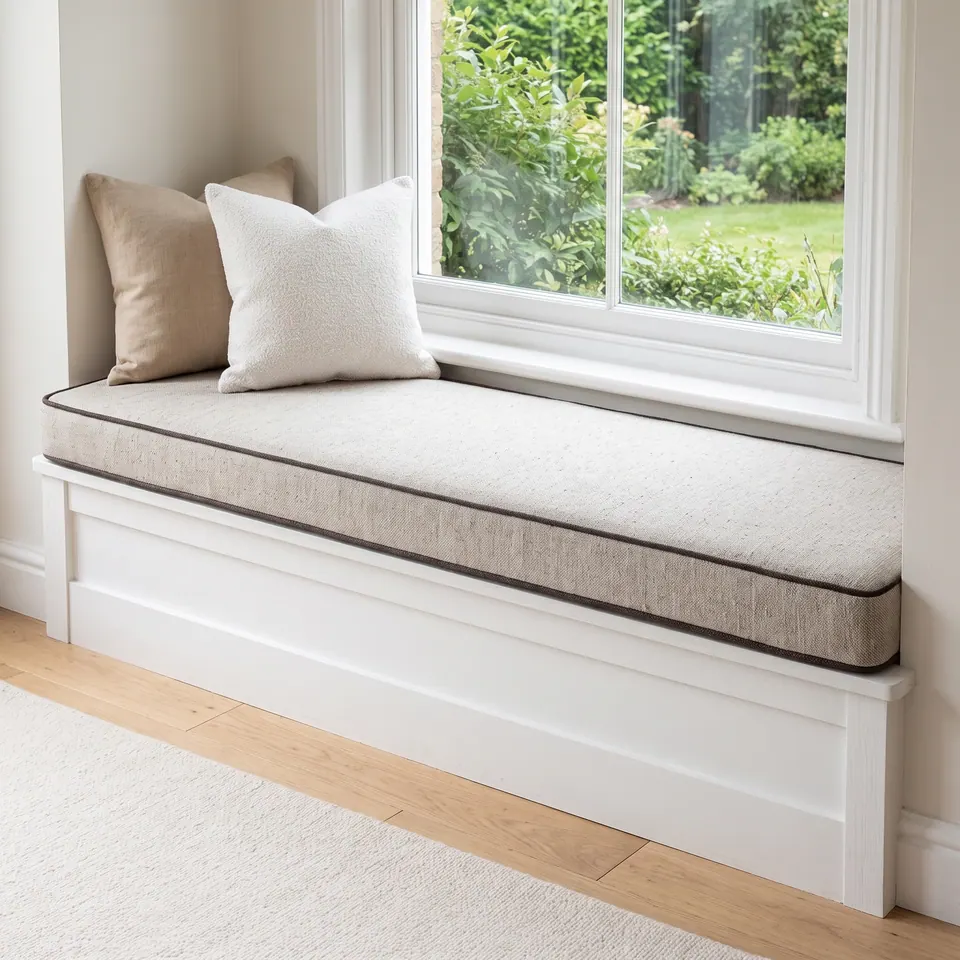
The long pad has a box edge and no piping. On boucle that is the right call: the looped surface softens a seam line anyway, and a cord would draw an outline on a bench that is meant to melt into the wall. The frame is painted close to the cushion color, which is why the whole thing looks built in.
The stack runs cool, warm, cool. Caramel sits between sage and dusty blue, and that warm middle keeps the stack from reading cold in white morning light. The pampas grass in the beige stoneware vase repeats caramel and cream without adding a new color. The open book and white mug on the top pad are the scale bar: each square is roughly a chair seat.
That last point is the budget one. The squares are loose extras. They move to chairs or the floor when guests come, and if you tire of dusty blue in two years, you replace one small pad, not the long one. The bench cushions hub has more long-pad shapes, the boucle and teddy shelf shows the loops up close, and the living room collection shows where loose pads end up.
Which of your colors would you want to be able to swap out next spring?
The cost sheet, line by line
| Line item | Spend or save | Engineering reason |
|---|---|---|
| Long seat pad | Spend | Takes the daily load; cut to the true bench size with a box edge |
| Square seat pads | Save | Small and loose; swap one color without touching the main pad |
| Thickness | Decide once | A cover is sewn around one foam thickness; 2 in (5 cm) foam in a 4 in (10 cm) cover sits baggy |
| Piping on boucle | Skip | The loops soften the seam; no cord keeps the block reading as one piece |
| Measurements | Free, if true | Trimmed numbers break the geometry and cost a round of messages |
Five edges, one slant that didn't close
A buyer in the US sent the workshop a trapezoid bench that sat between wall moldings. The numbers: long side C 68 in (173 cm), short side D 40 in (102 cm), depth 17.25 in (44 cm), and one slant of 21 in (53 cm).
The workshop ran the check. With C at 68 in and D at 40 in, each side steps in 14 in (36 cm). Over 17.25 in of depth, the slant comes out at about 22 1/4 in (57 cm), not 21 in. A miss of 1 1/4 in is not a rounding error.
It turned out the buyer had shrunk some sizes to clear the moldings. Kind instinct, wrong place for it. The shop asked for all five edges again, measured true. The corrected set: both slants 24 in (61 cm), C 72.5 in (184 cm), D 40 in (102 cm), depth 17.5 in (44.5 cm). Step-in is 16.25 in per side, the slant computes to 23.9 in, and that checks. It went to production.
Give true measurements, partner, and let the maker allow for clearances. Tolerance is kindness to your future self. The trapezoid cushion calculator runs the same check before you hit send.
On the cutting table: cream pad plus three
| Product | Long window bench pad plus three square seat pads |
|---|---|
| Fabric | Boucle in cream, sage, caramel and dusty blue |
| Edge | Box edge on every piece |
| Piping | None; the loops soften the seam |
| Fit | Long pad cut to the painted bench top |
| Square pads | Loose, roughly chair-seat size |
| Thickness | Chosen once; a new thickness needs a new cover |
| Best for | Window benches that lend seats to the room |

Have it made
Have this made — ask Nate’s workshop
Send the numbers in inches: length × depth × thickness, plus any angle. The workshop checks them with you, because foam has no undo button. — Nate
Leave your details and the workshop will call you to confirm measurements, fabric, foam and piping. No prices, dates or payment on this page: it is a request, not an order.
Buyer questions: thinner foam, one back pillow and a trapezoid quote
- A common question
My bench cushion is too thick to sit on comfortably. Could I just put thinner foam in the cover I already have?
The workshop's answerA 2 in (5 cm) thickness is available, but your cover was sewn around 4 in (10 cm) foam, so thinner foam inside it would sit loose and baggy. For a proper fit, order a 2 in cushion with its own cover in the same size and fabric.
- A common question
Can I buy one straight back pillow for a sofa I already own?
The workshop's answerYes. The straight backrest measures 39 x 15 x 15 in (100 x 39 x 39 cm) and is sold on its own as an option on the modular sofa listing.
- A common question
How do you work out a quote for a trapezoid window seat cushion?
The workshop's answerFrom its edges. One quote was built on a back of 68.25 in (173 cm), a front of 113.75 in (289 cm) and sides of 33.75 in (86 cm) and 33 in (84 cm). Send every edge and the quote comes back on those exact numbers.
A cushion cover is sewn for one foam thickness: put 2 in foam in a 4 in cover and it sits loose and baggy, so order the new thickness with its own cover.
Nate
Questions buyers ask next
Does a boucle bench cushion need piping?
No. The looped surface already softens the seam line, so an unpiped box edge looks clean and lets the pad read as one soft block with the bench. Add a cord only if you want the outline to show.
Can loose square seat pads double as chair cushions?
Yes, that is their job here. Each square is roughly chair-seat size, so the three can move from the window bench to chairs or the floor when guests arrive, and go back when they leave.
What goes wrong if I shorten a measurement to clear a wall molding?
The shape stops adding up. On one trapezoid bench, trimmed numbers implied slants near 22 1/4 in against a measured 21 in, and every edge had to be sent again. Give the true size and let the maker allow the clearance.
± 1/4 in — Nate