A Reading by NateBench Cushions
A cream custom bench cushion under a sunny window, read part by part
Nate treats a sunny oak bench like a drawing: every part has a number, and every number belongs in the order note.

 Save
The quick answer
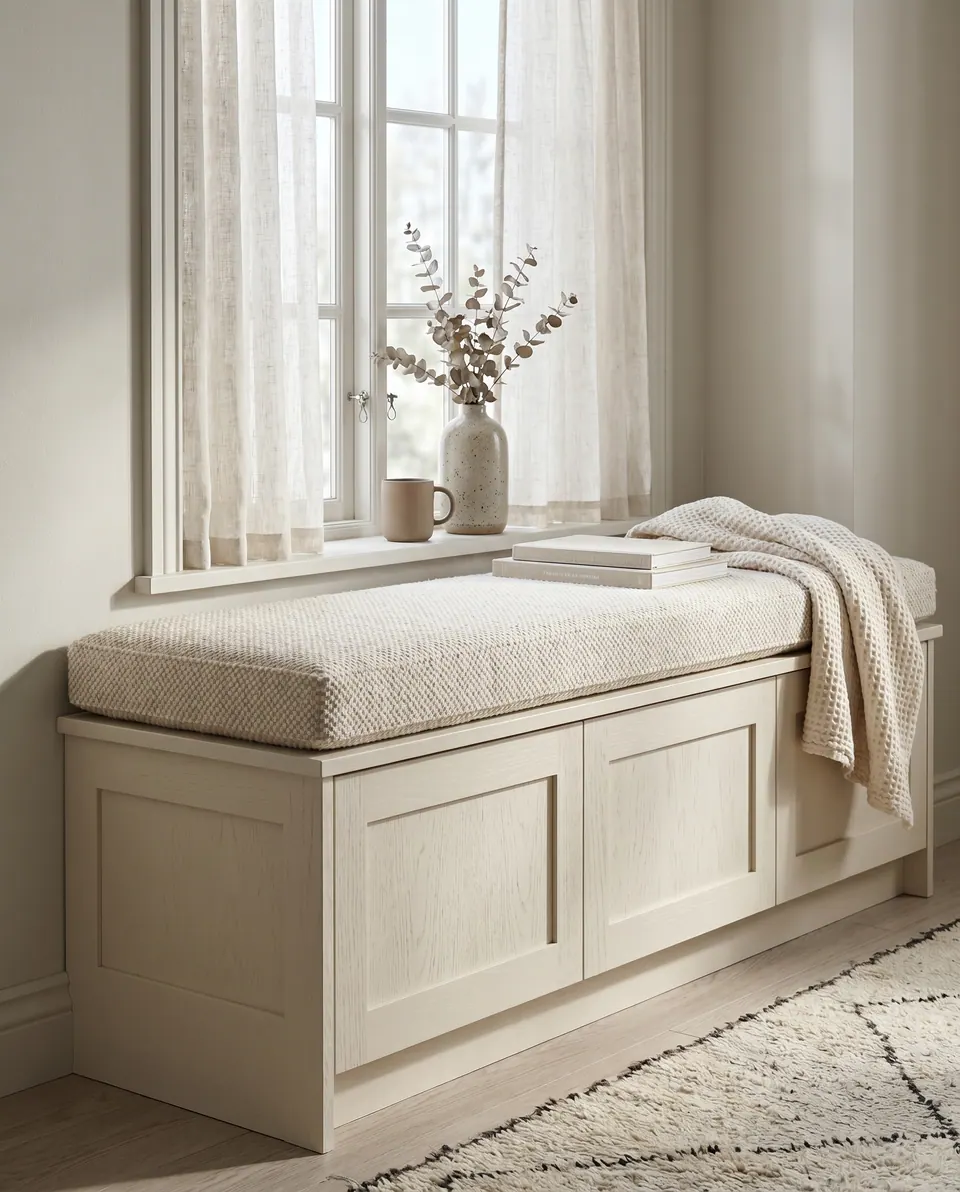
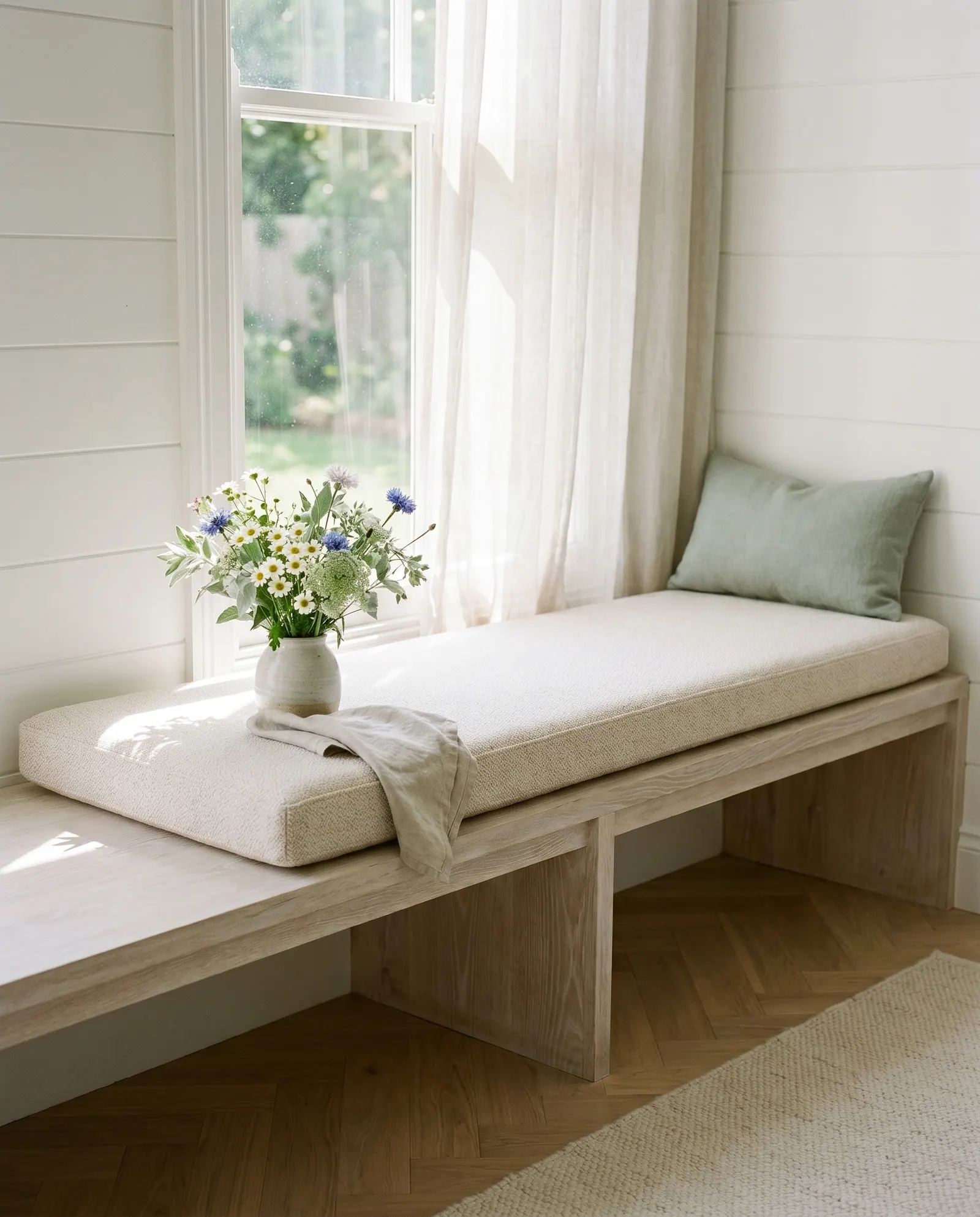
A custom bench cushion comes out right the first time when the order carries four things: the exact fabric code, a piping note, every edge measured to ± 1/4 in, and a swatch or close-up checked in daylight. This cream box cushion shows the result: self piping, a medium profile below the sill, and one sage lumbar.
The cushion, cut open
Cover fabric. A removable, zippered cover. Machine wash at 86°F (30°C) on a gentle cycle and air dry.
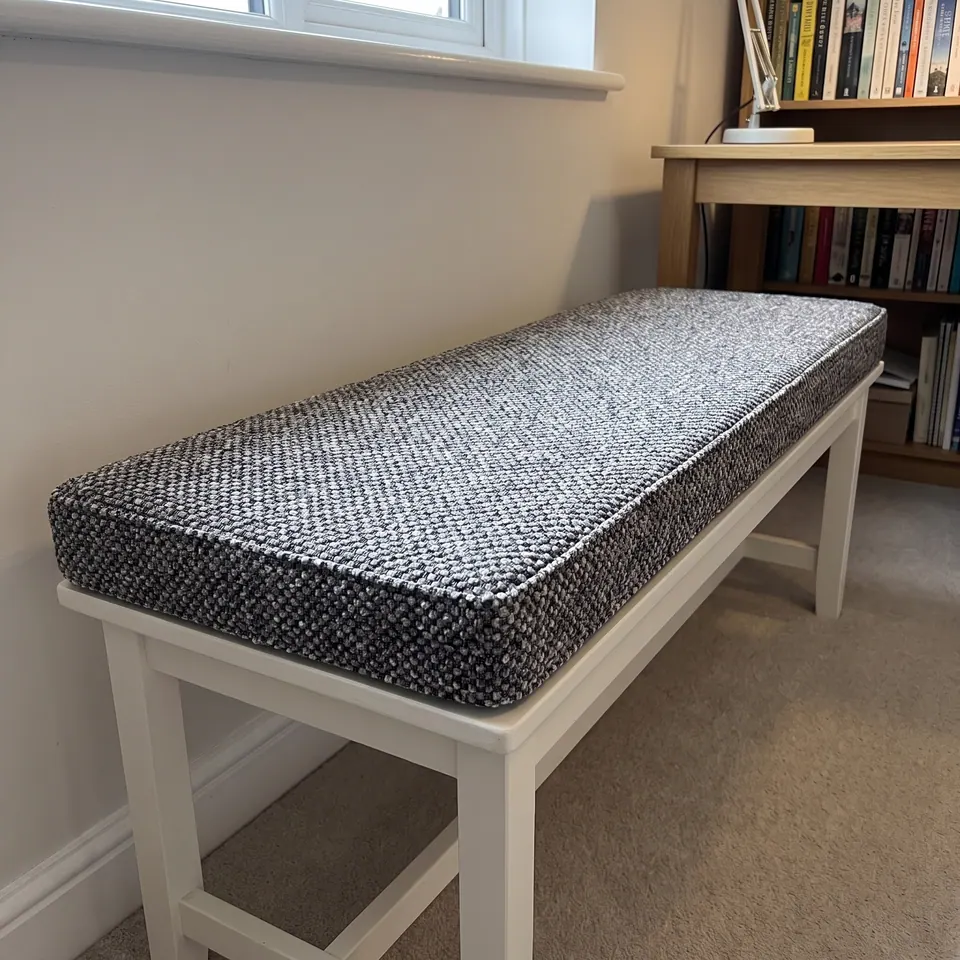
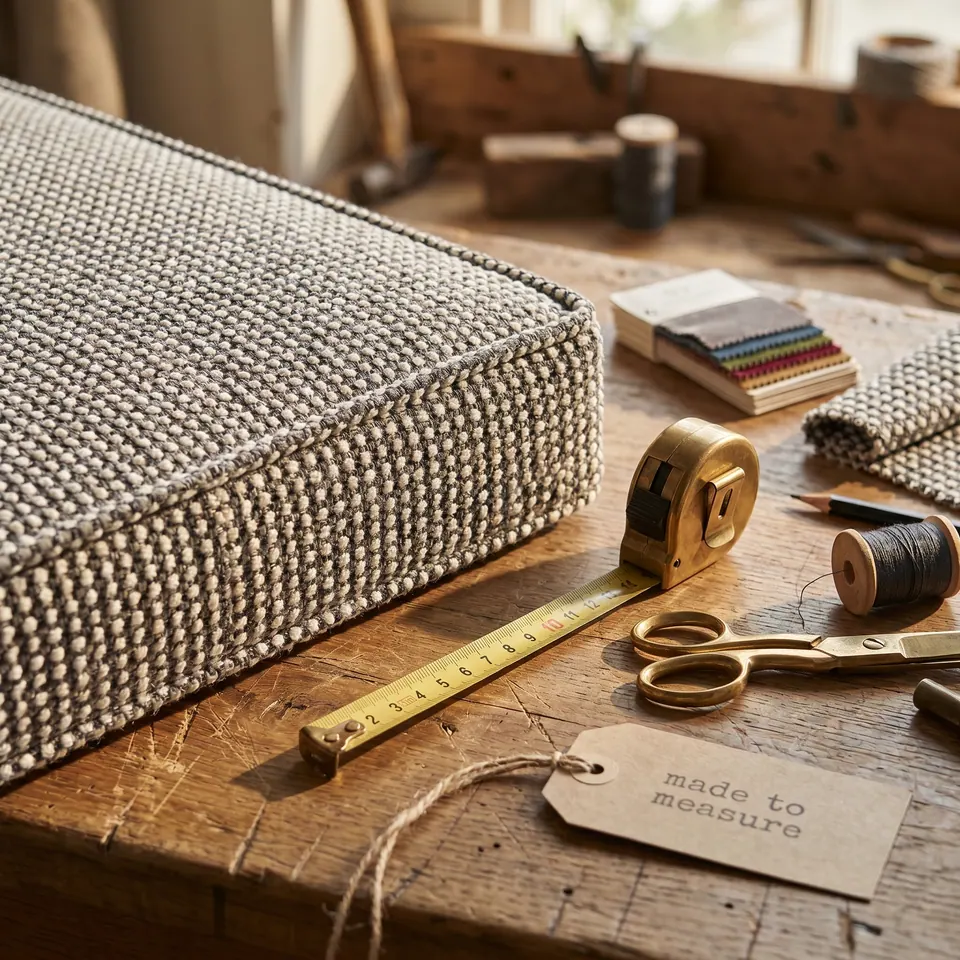
Piping. A fabric-covered cord sewn into the seams. It sits on the seam line, so it does not change the size.
Fiber wrap. Polyester fiber (Dacron) batting around the foam: it fills the cover out and softens the edges.
Foam core. About 2.0 lb/ft³ (32 kg/m³) high-resilience foam, firm to medium-firm, cut to the ordered size.
Zipper. Along the back band, as hidden as possible. The zipper side faces down or toward the wall.
Base panel. The underside of the cover. A non-slip fabric backing can cover the whole of it instead.
The cushion as a parts list
Five parts make this cushion, and each one was a decision somebody wrote down.
Top and border. A nubby cream weave, code 22, wrapped into a box edge. The profile is medium, which keeps the seat well below the sill, so the window still reads as open. The cushion stops where the pale oak top stops. The slab legs stay visible, and the bench still reads as furniture, not a mattress.
The seam line. Self piping in the same cream. In a room of white shiplap, sheer linen and pale oak, a second color on the edge would have been the loudest thing present. Same-color cord sharpens the front line and adds nothing else.
Light. Bright morning sun makes cream look cleaner and paler than it will at dusk. Listing photos fall into the same trap, which is why a good order starts with a swatch, not a screenshot.
Props. One sage lumbar pushed to the wall end leaves most of the seat free, and its gray-green picks up the garden past the glass. The flax throw over the front softens the crisp box corner. The stoneware vase of daisies and cornflowers stands on the cushion end, which only works on a firm, flat top; in real life, partner, use a small tray. The jute rug and herringbone floor stay neutral so the weave carries the interest.
What does your order note say right now? Our bench cushions start from the same parts list, and woven textures like this one sit with jacquard and damask.
Pinned by Nate: five parts, five decisions
Each pin marks one decision that belonged in the order note, from box profile to the vase that really wants a tray.
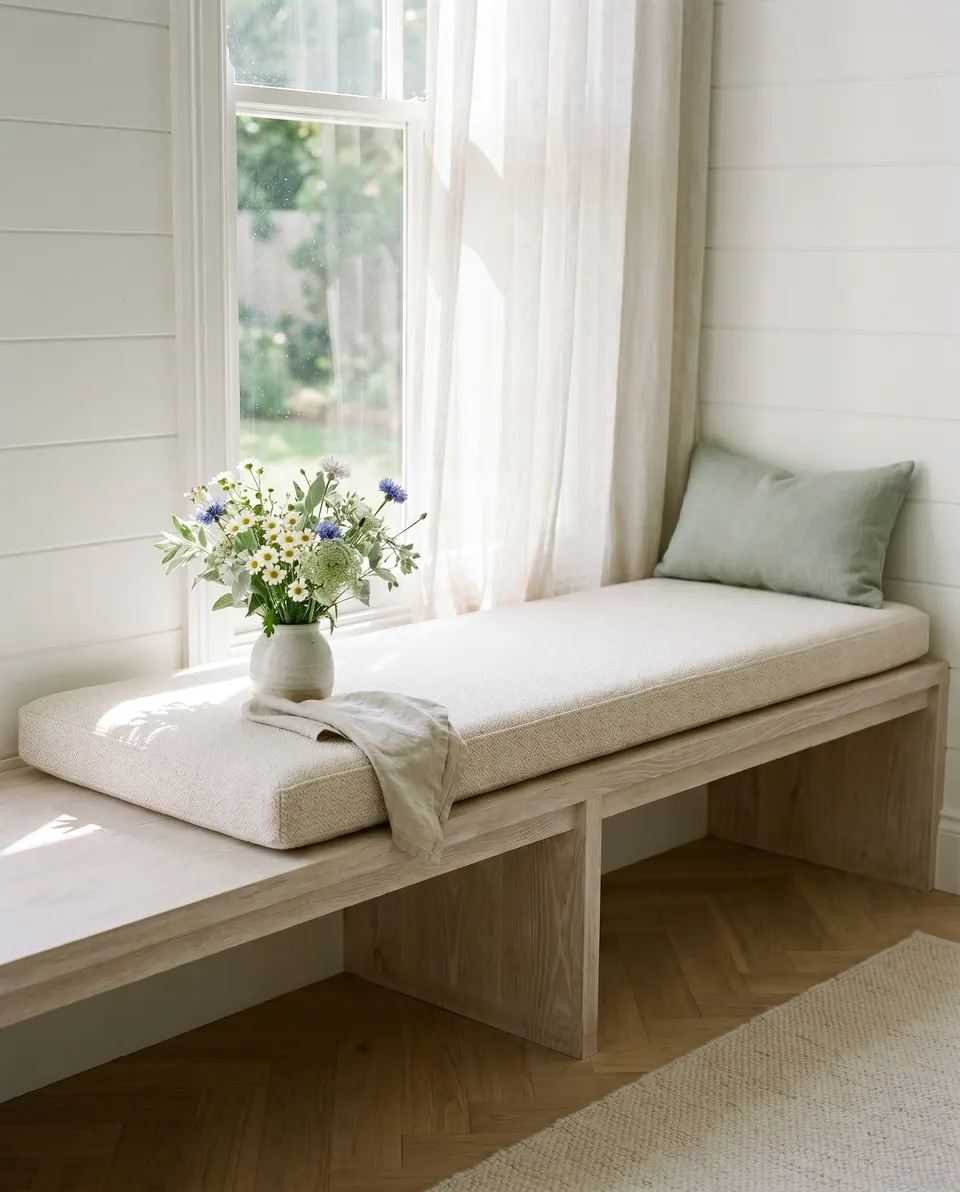
- Cream box cushion
A medium box profile keeps the seat well below the sill, so the window still reads as open.
- Self piping edge
Piping in the same cream sharpens the front line without adding a second color to a pale room.
- Sage lumbar pillow
One long lumbar pushed to the wall end leaves most of the seat free for sitting.
- Wildflower vase
The vase stands on the cushion end, which only works on a firm, flat top; a small tray is safer in real life.
- Draped linen throw
A throw hanging over the front softens the crisp box corner and hints that the seat is used.
- Cream box cushionA medium box profile keeps the seat well below the sill, so the window still reads as open.
- Self piping edgePiping in the same cream sharpens the front line without adding a second color to a pale room.
- Sage lumbar pillowOne long lumbar pushed to the wall end leaves most of the seat free for sitting.
- Wildflower vaseThe vase stands on the cushion end, which only works on a firm, flat top; a small tray is safer in real life.
- Draped linen throwA throw hanging over the front softens the crisp box corner and hints that the seat is used.
The order note, line by line
Name the fabric by its code
Write the chart code, not a color word. 'Cream' covers a dozen shades; code 22 covers one. Repeat the code in personalization next to the size.
Check the color in daylight
Order swatches or ask for close-ups of finished cushions. Listing photos are shot in bright light, so some fabrics look paler online than on the bench. See swatches before ordering.
Write the piping in words
Self piping is 'piping same color' plus the code; a contrast cord gets its own code. Leave it out and someone else decides.
Measure every edge, then draw it
Length, depth and thickness for a rectangle, to ± 1/4 in (6 mm). A rounded end or an arch needs a dimensioned drawing. A trapezoid needs all four sides.
Say where the hardware is
If a back cushion will sit under a window lever or latch, give its height above the seat so the back can be sized to clear it.
Three trapezoids and the side nobody measured
One buyer wrote in with the construction plan of a large corner bench and asked for three trapezoid cushions, about 26 3/4 in (68 cm) deep and 3 1/8 in (8 cm) thick, in white-to-cream linen. Good start. A plan beats a photo every time.
Before quoting, the workshop asked for every side length, including the short end side at each corner. Those angled ends are the ones people forget, and a trapezoid without them is two numbers short of a shape. The buyer took another offer in the end, but the lesson stays on the bench: a trapezoid cushion needs all four sides. Angles are just lengths in disguise. The custom shape drawing guide walks through it.
- Sizes
- 3 trapezoids, about 26 3/4 in (68 cm) deep, 3 1/8 in (8 cm) thick
The lesson: A trapezoid cushion needs all four sides; the angled end sides at the corners are the ones people forget.
Buyer questions: a darker blue, a rounded end, a window lever
- A common question
The linen I received looks darker blue than the listing photo. Did I get the wrong fabric?
The workshop's answerProbably not. Listing photos are taken in bright light, so some fabrics look paler online. L-41 is the palest blue in the linen range, and lighter blues are in other charts. Even when the correct fabric was used, the shop still asks what solution you would like. Close-ups, finished-cushion photos or swatches are the safest way to judge.
- A common question
Can you make a cushion for a bench with one rounded end, or a half-round window seat?
The workshop's answerYes, from exact dimensions and a drawing. A 33 x 20 in (84 x 51 cm) bench rounded at one end was quoted from the owner's shop drawings. An arched window seat 67 in (170 cm) wide and 47 1/4 in (120 cm) deep was drawn as a 64 5/8 x 20 7/8 in (164 x 53 cm) rectangle plus an arc from a 64 5/8 in (164 cm) circle.
- A common question
Do you make back cushions to match a bench cushion, and how tall should they be under a window?
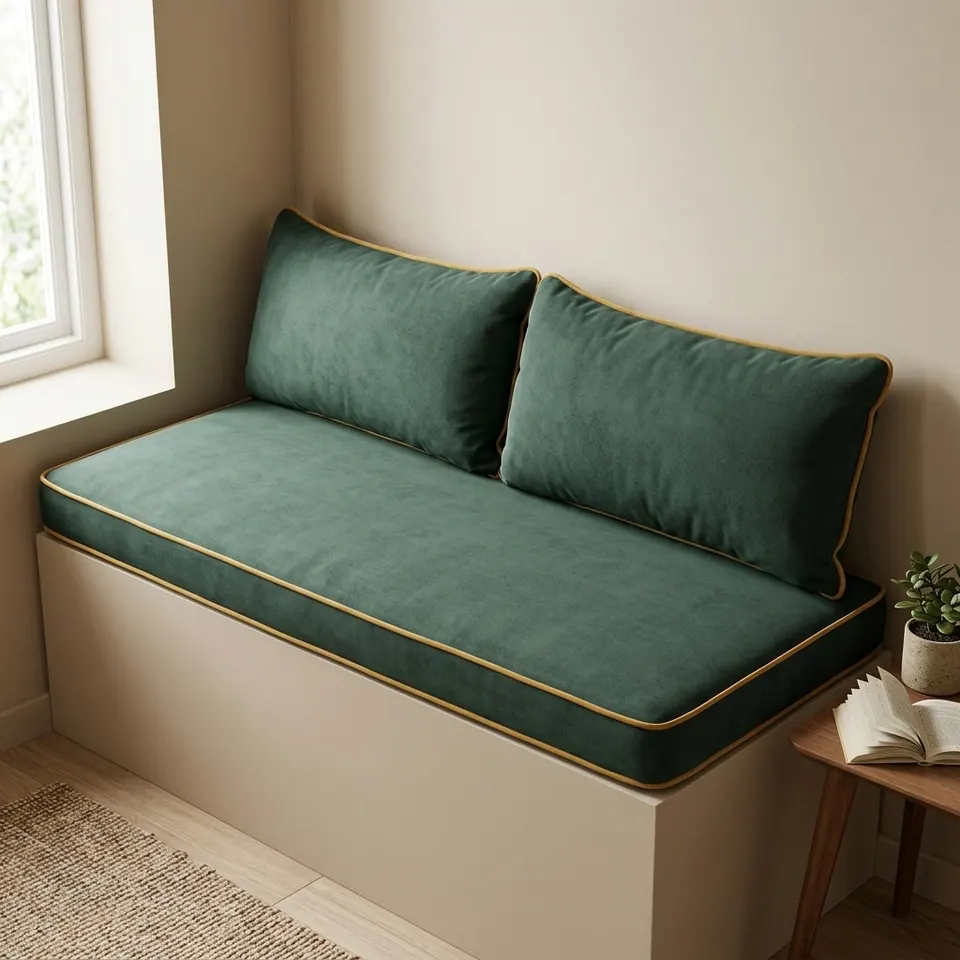
The workshop's answerYes, in the same fabric so the set coordinates. For a bench against a sill with a window lever about 11 in (28 cm) above the seat cushion, the shop advised backs 14 to 16 in (36 to 41 cm) tall, so the lever sits safely behind them, and 3 to 4 in (7.5 to 10 cm) thick. The backs stay loose so the window still opens.
On the cutting table: the sunny oak bench
| Cushion | Box-edge bench cushion, cut to the oak top |
|---|---|
| Fabric | Nubby cream weave, code 22 |
| Piping | Self piping in the same cream |
| Profile | Medium box, seat well below the sill |
| Bench | Pale oak with slab legs |
| Pillow | One sage linen lumbar at the wall end |
| Order note | Code, piping in words, every edge measured |
| Measure to | ± 1/4 in (6 mm) on every edge |
| Best for | Window benches, reading nooks, sunny living rooms |

Have it made
Have this made — ask Nate’s workshop
Precision starts on the phone. Give the workshop your measurements and they will read them back to you, edge by edge. — Nate
Leave your details and the workshop will call you to confirm measurements, fabric, foam and piping. No prices, dates or payment on this page: it is a request, not an order.
A trapezoid cushion needs all four sides measured; the short angled ends at the corners are the ones people forget.
Nate
Questions buyers ask next
What should an order note for a custom bench cushion include?
The fabric code, the size as length x depth x thickness, the piping in plain words, and any extras such as a zipper position or matching backs. Codes and notes in personalization leave nothing to guesswork.
Why does cream fabric look different in person than online?
Light. Bright photo lighting can make a fabric look paler than it will on your bench, and morning sun flatters cream more than evening lamps do. A swatch held in your own room is the fair test.
Can a vase or tray stand on a bench cushion?
Only on a firm, flat top, and even then a small tray is safer than a bare vase. A medium box cushion like this one stays level enough, but a sitter's weight nearby can tip anything tall.
± 1/4 in — Nate