A Reading by ÉlodieLumbar Pillows
Cornflower blue lumbar and black ticking: an attic bed read from the door, then from the pillow
Élodie reads the same bed twice, from the doorway and from arm's length, and finds a stripe chosen to rhyme with the wall.

 Save
The quick answer
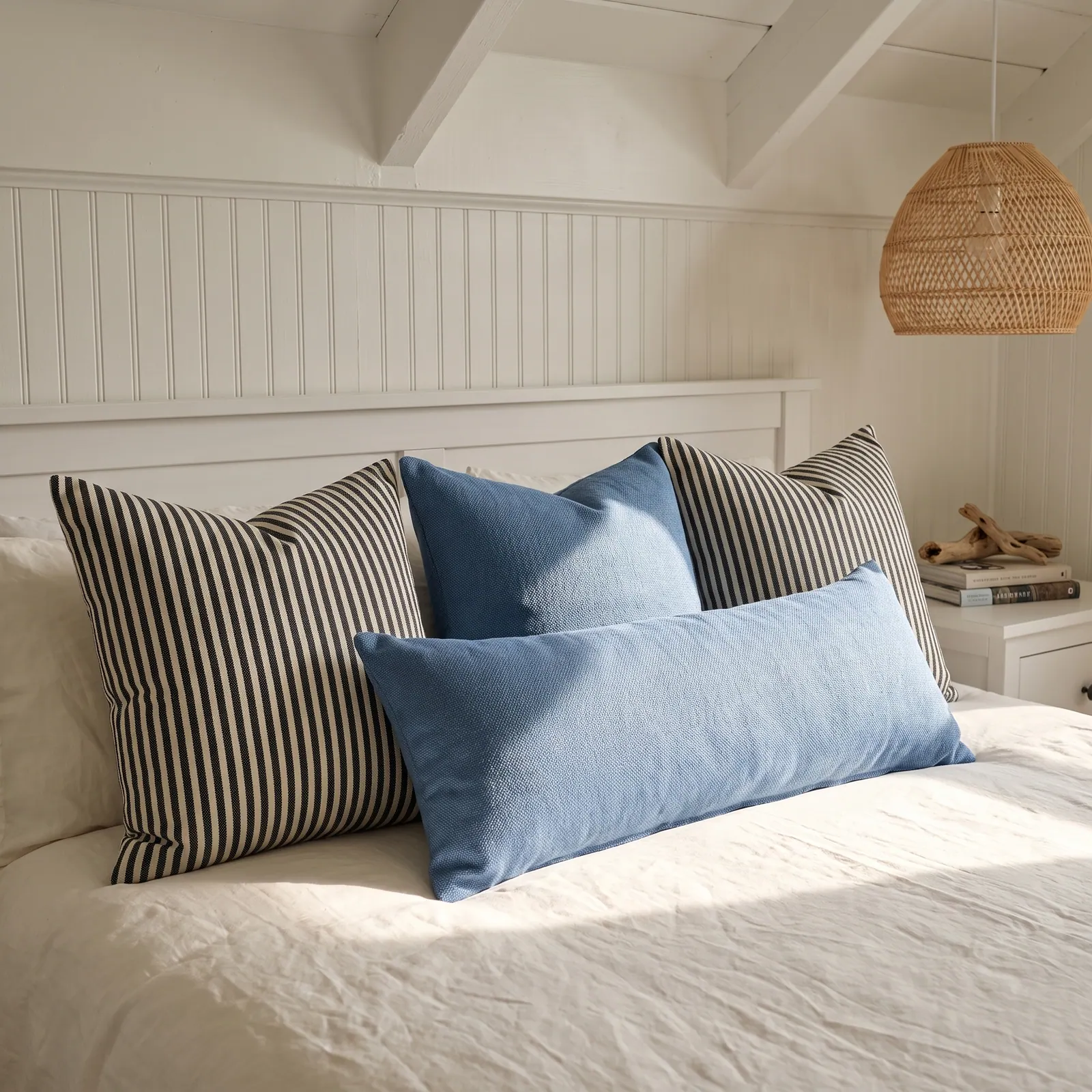
A cornflower blue lumbar pillow reads from across a room as one calm block of color, while black-and-cream ticking only shows its fine stripe up close. Pair them so the far view stays simple and the near view rewards you: here the narrow ticking repeats the vertical grooves of the beadboard wall behind the bed.
The cushion, cut open
Cover fabric. A removable, zippered cover. Machine wash at 86°F (30°C) on a gentle cycle and air dry.
Piping. A fabric-covered cord sewn into the seams. It sits on the seam line, so it does not change the size.
Fiber wrap. Polyester fiber (Dacron) batting around the foam: it fills the cover out and softens the edges.
Foam core. About 2.0 lb/ft³ (32 kg/m³) high-resilience foam, firm to medium-firm, cut to the ordered size.
Zipper. Along the back band, as hidden as possible. The zipper side faces down or toward the wall.
Base panel. The underside of the cover. A non-slip fabric backing can cover the whole of it instead.
From ten feet, then from ten inches
Stand in the attic doorway, my friends, and the bed resolves into three things: a white field, two dark squares at the edges, and a band of cornflower blue in the middle. That is all the eye takes in at ten feet, and it is enough. The eye sits down first, and here it sits on blue.
The blue does the heavy lifting from afar. The woven lumbar and the square behind it are the same cornflower, so they read as one block rather than two pillows. Nothing else in the room is that color, so it stays calm against white rafters and a white linen duvet.
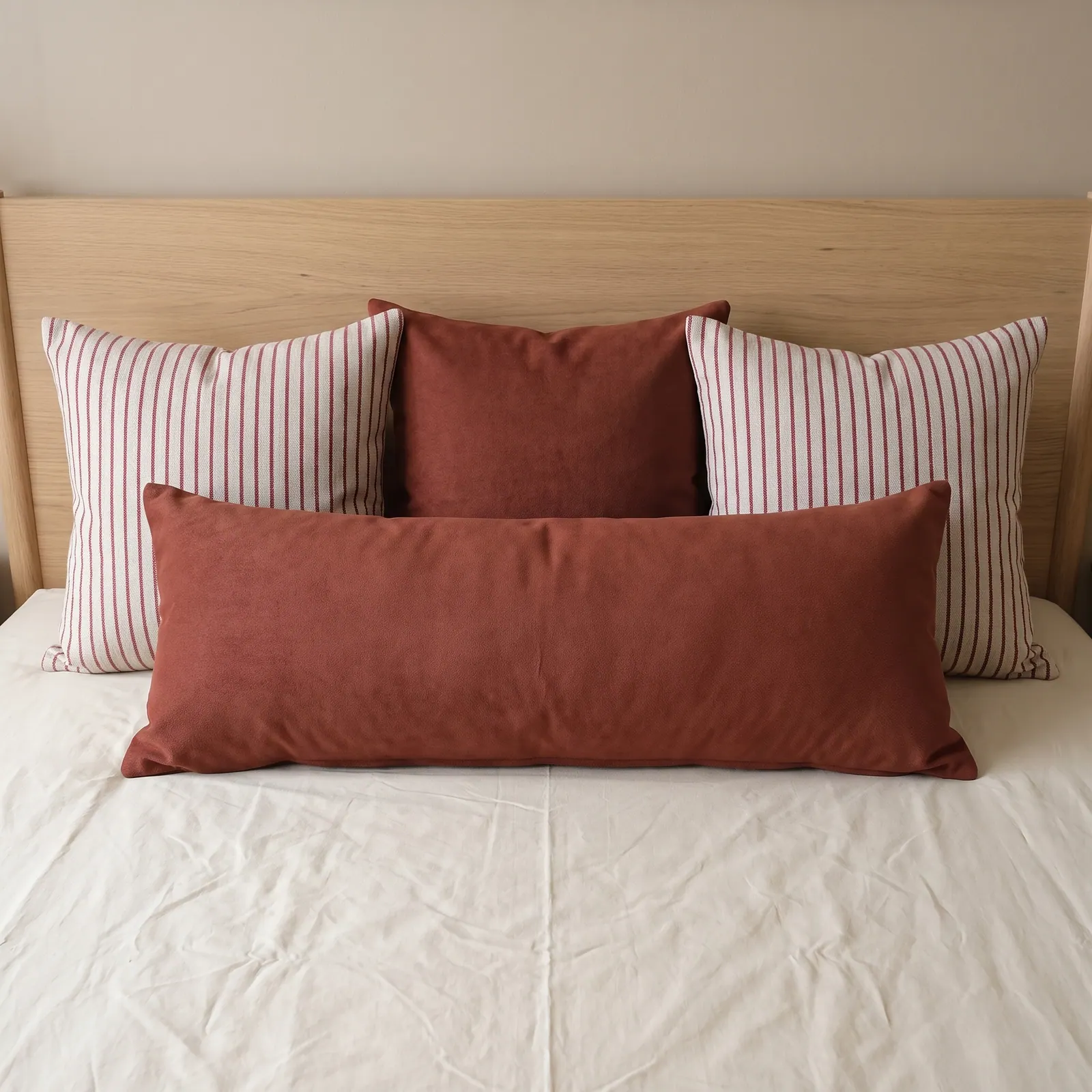
Walk to the bed and the dark squares change character. They are not black at all but narrow black-and-cream ticking, and the stripe spacing repeats the vertical grooves of the beadboard behind the paneled headboard. From the door the ticking is a dark frame; up close it is a conversation with the carpenter. Knife edges and no piping keep that stripe the only line on the pillows.
The warm notes are rationed. A rattan dome pendant, and a piece of driftwood on a stack of books on the white nightstand: the only natural tones in a white room, and the only hint of the sea, with no anchor or shell in sight. Bright attic daylight keeps the cornflower clear rather than dusky.
To copy it, find a line already in your room, paneling or floorboards, and choose a stripe whose spacing matches. More pairings live in lumbar pillows and throw and lumbar pillows to match a seat; the calm solids come from the linen-look fabrics, and more attic beds from bedroom cushions.
Pinned by Élodie: what shows up close
Five pins across the bed and the room, from the cornflower lumbar to the driftwood on the books.
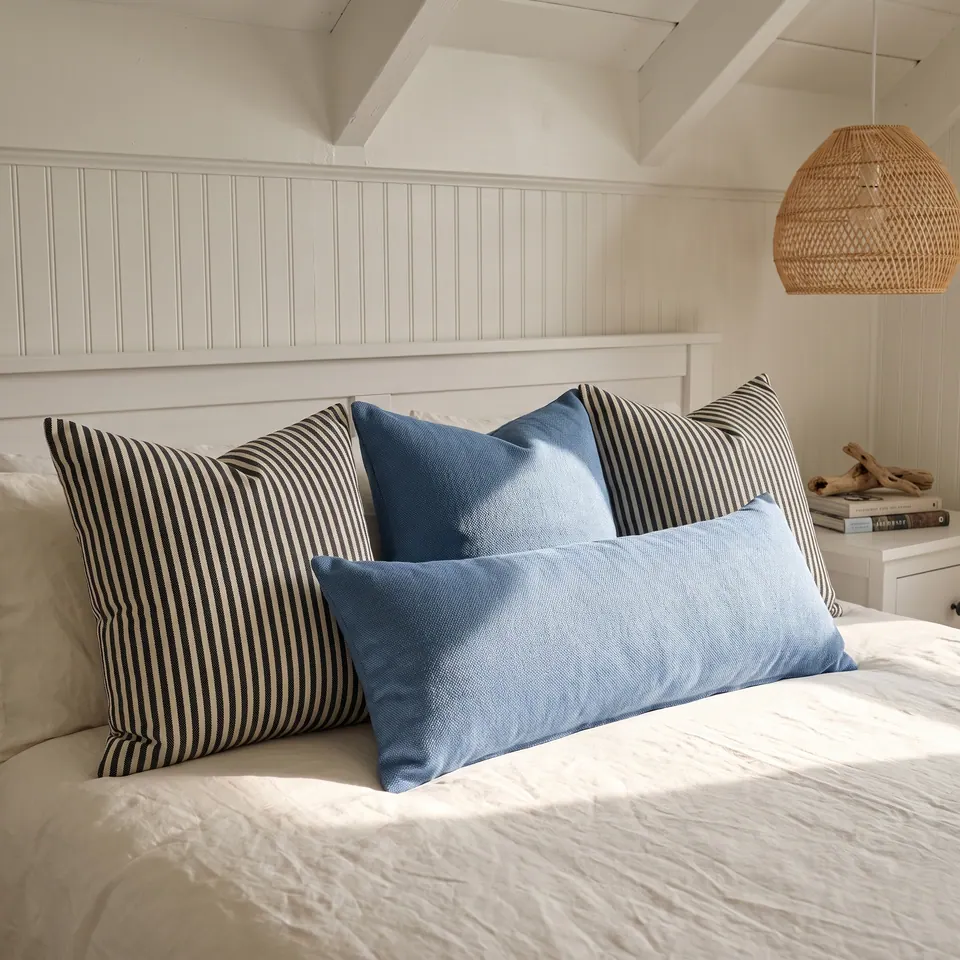
- Cornflower blue lumbar
Blue in the center adds color without breaking the white-and-black base.
- Blue woven square
The square repeats the lumbar so blue reads as one calm block.
- Black ticking square
Narrow ticking repeats the vertical grooves of the beadboard behind.
- Rattan pendant
Rattan brings one warm natural texture into a white room.
- Driftwood on books
A piece of driftwood makes the seaside theme explicit without a single anchor or shell.
- Cornflower blue lumbarBlue in the center adds color without breaking the white-and-black base.
- Blue woven squareThe square repeats the lumbar so blue reads as one calm block.
- Black ticking squareNarrow ticking repeats the vertical grooves of the beadboard behind.
- Rattan pendantRattan brings one warm natural texture into a white room.
- Driftwood on booksA piece of driftwood makes the seaside theme explicit without a single anchor or shell.
Swatch strip: the attic seen from the doorway
- Cornflower blue#6F8FD8The one saturated color; reads as a single block from the door.
- Ink black ticking#1E1E1FA narrow stripe that repeats the beadboard grooves.
- Ticking cream#EEE7D6The ground between the stripes, softer than the walls.
- Beadboard white#F6F5F1Walls, rafters, headboard and duvet: the quiet field.
- Rattan honey#C29A5BThe pendant's warm weave, one of two natural tones.
- Driftwood gray#9E968AThe seaside in one object.
A twin XL mattress, ten inches deep
A buyer in the US wrote to the workshop about a twin XL mattress she used as a daybed, 38 x 80 x 10 in (97 x 203 x 25 cm). She wanted a thick linen cover with a hidden zipper. Could a cover go that deep? It could, at no extra charge, ordered through the zippered cover listing.
I love this story because it is the close-up principle again. From across a room a daybed is a rectangle; from arm's length it is a depth, and the depth is where a cover fits or fails. Deep mattress covers are ordered like cushion covers. Give the full depth, and the cover will hold the corners.
Buyer questions: covers only, piping quotes, and green
- A common question
Can I buy just the covers, without foam, for cushions or a mattress I already have?
The workshop's answerYes. Covers only come with a zipper and are ordered through the zippered cover listing: pick the size range, then write the exact length, width and thickness plus the fabric code. The thickness is what makes it fit snugly, even on a 55 x 27 1/2 in (140 x 70 cm) mattress. No foam or filling is included.
- A common question
How do I get a price for new sofa cushion covers with contrasting piping?
The workshop's answerUse the cover-only listing and select the size range for each piece, for example two seat covers at 23 1/2 x 20 1/2 x 4 in (60 x 52 x 10 cm) and two back covers at 15 3/4 x 20 1/2 x 3 1/4 in (40 x 52 x 8 cm). The price appears directly. Write the exact sizes, the body fabric code and the piping code in Add Personalization.
- A common question
Can you make covers in a custom color, like sage or moss green?
The workshop's answerNo. Only the colors shown on the listings are made, and custom color matching isn't offered. Water green is the only green. A few listed colors that were never photographed on a model can still be requested in the order note.
On the cutting table: the attic pillows
| Product | Lumbar pillow with a matching square and two contrast squares |
|---|---|
| Lumbar | Cornflower blue woven, knife edge |
| Squares | One cornflower blue, two black and cream ticking stripe |
| Piping | None; knife edges keep the stripe the only line |
| Fabric family | Linen-look |
| Bed | White paneled headboard, white linen duvet |
| Room | White beadboard walls, exposed rafters, rattan dome pendant |
| Best for | Coastal bedrooms and attic rooms with paneling |

Have it made
Have this made — ask Élodie’s workshop
A fabric reads one way at noon and another at dusk. Mention your light, and the workshop will weigh it with you. — Élodie
Leave your details and the workshop will call you to confirm measurements, fabric, foam and piping. No prices, dates or payment on this page: it is a request, not an order.
Choose a ticking stripe whose spacing matches a line already in the room, like beadboard grooves, and the throw pillows and wall look designed together.
Élodie
Questions buyers ask next
Why pair a solid lumbar with striped square pillows?
The solid carries color across the room and the stripe adds detail up close. With the solid in the center and the stripes at the edges, the bed reads as calm from the door and still has something to discover at arm's length.
How do I pick a ticking stripe width for a room?
Match it to a line that already exists: beadboard grooves, paneling, floorboard widths. When the stripe spacing repeats that line, the pillow and the wall look designed together instead of competing for attention.
Do lumbar pillows need piping?
Not always. These pillows have knife edges and no piping, which keeps them soft and leaves the ticking stripe as the only line. Piping suits box cushions and tailored looks; on a relaxed coastal bed it adds a line you may not need.
How do I keep a white coastal bedroom from feeling cold?
Keep the saturated color to one family, like cornflower blue, and let warmth come from natural materials: a rattan pendant, a piece of driftwood, a stack of books. They bring the only warm tones into a white room without adding pattern.
With color and care — Élodie
More photographs to read
 Save
 Save
 Save
 Save
 Save
 Save