The Cutting Table · compared on the table
What size insert does my pillow cover need?
Also asked as:18 x 18 pillow covers3 custom lumbar pillow covers
A pillow is judged from across the room before anyone touches it. The insert decides whether it reads crisp or tired.

 Save
The quick answer
For a full, plump pillow, choose an insert about 2 in (5 cm) larger than the cover: an 18 x 18 in cover takes a 20 x 20 in insert. Big squares can go up to 4 in larger; for a slouchy pillow, use the same size. On lumbars, which guides debate, 1 to 2 in larger each way fills them.
Get a quote for a throw pillows
The insert chart, cover by cover
Measure the empty cover, then read across.
| Cover | Insert for a full, plump look |
|---|---|
| 14 x 14 in (36 x 36 cm) | 15 or 16 in square (38 or 41 cm) |
| 18 x 18 in (46 x 46 cm) | 20 in square (51 cm) |
| 20 x 20 in (51 x 51 cm) | 22 in square (56 cm) |
| 22 x 22 in (56 x 56 cm) | 24 in square (61 cm) |
| 26 x 26 in euro sham (66 x 66 cm) | 28 in square (71 cm) |
| 30 x 30 in (76 x 76 cm) | 32 to 34 in square (81 to 86 cm) |
| 24 x 12 in lumbar (61 x 30 cm) | 25 x 13 in (64 x 33 cm) |
| 14 x 36 in lumbar (36 x 91 cm) | 16 x 38 in (41 x 97 cm) |
For a soft, slouchy pillow, use an insert the same size as the cover. Charts differ by an inch here and there; the 24 x 12 in row is a real workshop order.
Key facts
- For a full look, published charts size a square insert about 1 to 2 in larger than its cover; 2 in is the common rule (18 in cover, 20 in insert).
- Large squares can go further: one chart pairs a 30 in cover with a 34 in insert.
- A same-size insert gives a softer, slouchier pillow.
- Lumbar advice is split; a 14 x 36 in cover with a same-size insert tends to look flat, and a 16 x 38 in insert fills it.
- Feather and down compress more than polyester, which is why those fills are usually sized up.
- The workshop fills pillows with shredded foam in a separate inner cover; polyester fiber or solid foam can be requested.
- Covers alone are made to any size for inserts you already own, always with a zipper.

Have it made
Have Élodie’s workshop cut this for you
Describe the room at four in the afternoon: the floor, the wall, the one color you love. That is where a good fabric choice begins. — Élodie
Leave your details and the workshop will call you to confirm measurements, fabric, foam and piping. No prices, dates or payment on this page: it is a request, not an order.
Why two extra inches read as generous
An 18 in (46 cm) insert in an 18 in cover lets the fabric relax, and the corners go soft. A 20 in insert pulls the cloth taut to every corner, so a linen weave or a velvet pile catches the light evenly. The eye sits down first, and it prefers a full pillow.
Fill changes the arithmetic. Feather and down compress more than polyester, so charts built around them size up by 2 in or more. The workshop fills its own pillows with shredded foam in a separate inner cover, or polyester fiber or solid foam on request. Covers are cut to your own feather or down inserts; to have the workshop supply one, ask the workshop first. See throw pillows and covers for inserts you already own.
Lumbars: where the charts part ways
On long pillows the guides disagree. Some say match the insert to the cover; others size up, and one chart that says match still pairs a 12 x 20 in cover with a 12 x 22 in insert. Another says a 14 x 36 in lumbar looks flat with a same-size insert and full with 16 x 38 in.
My rule: about 1 in larger each way on a small lumbar, 2 in on a long one. Match only for a flat, tailored lumbar against a bench back. Sizes are on lumbar pillows.
Which look does your sofa ask for, my friends: crisp and upright, or soft enough to sink into?
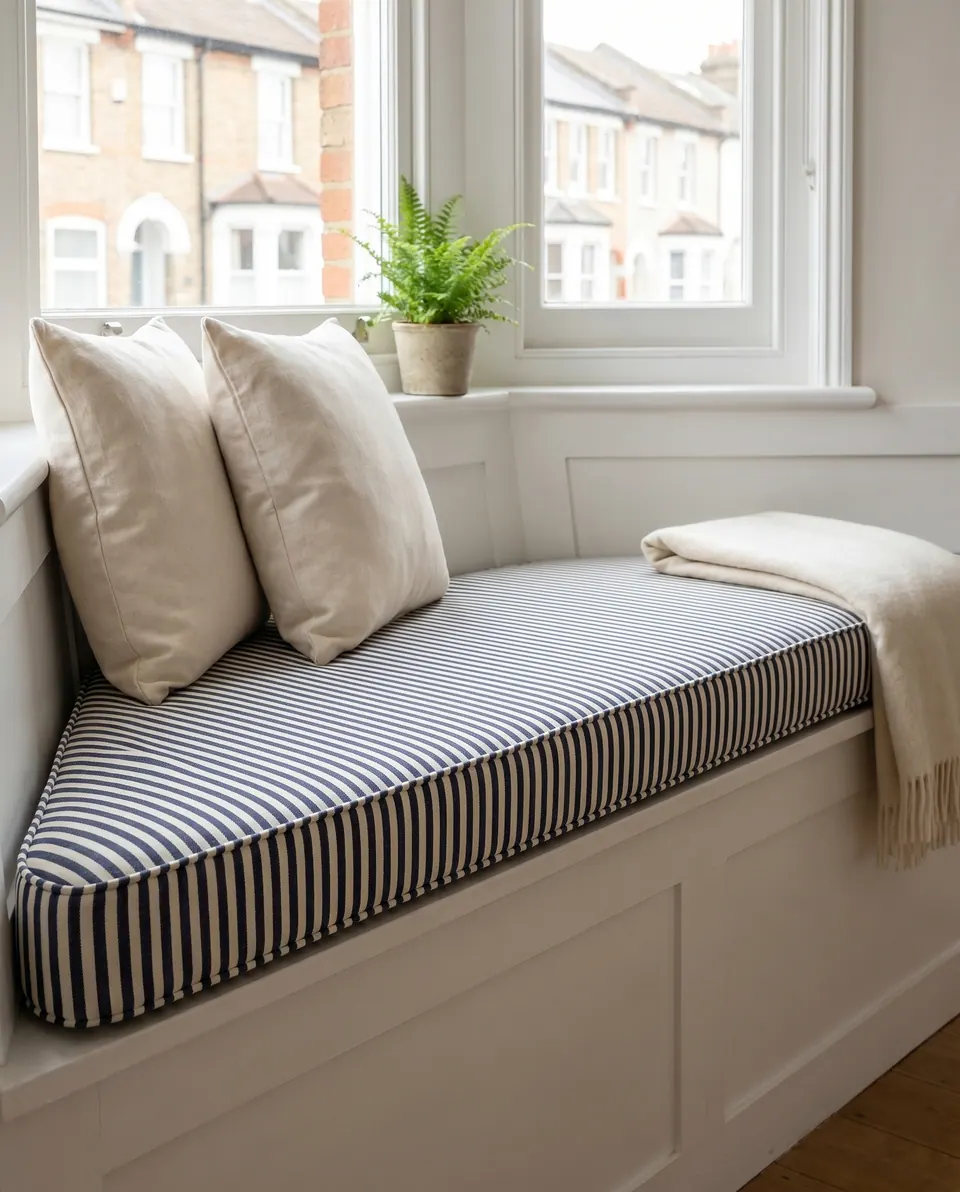
Three ticking-stripe lumbars to match a bench
A buyer in the US asked for three lumbar pillows in the same ticking stripe as their bench cushion. The covers measured 24 x 12 in (61 x 30 cm); the inserts, 25 x 13 in (64 x 33 cm), one inch larger each way, for a full look.
A stripe is honest about fit. Underfilled, its lines wander; filled well, each one runs straight.
- Measured
- Covers 24 x 12 in (61 x 30 cm); inserts 25 x 13 in (64 x 33 cm)
- What it taught
- On a small lumbar, one inch larger each way was enough for a full look.
A same-size insert whispers. An insert two inches larger speaks up. Decide which voice the sofa needs.
Élodie
Buyer questions
- A common question
Can you make zippered covers for the throw pillow inserts I already have?
The workshop's answerYes. Order on the zippered cover listing, put the sizes in the Exact Size field, note that they are pillow covers with your color and piping codes, then message the shop. Pillow covers are flat, with no side depth.
- A common question
Could you make lumbar pillows to match my bench cushion, and make them look full?
The workshop's answerYes, in the same fabric, filled or as covers only, with zippered covers that come off to wash. One order put 25 x 13 in (64 x 33 cm) inserts in 24 x 12 in (61 x 30 cm) covers for a full look.
- A common question
My new throw pillows arrived flat and underfilled. What happened?
The workshop's answerThe fill shifts toward the middle during vacuum-packed shipping. Pat and shake each pillow back into its corners and allow 1-2 days. The corners stay a touch less full than the body, but there shouldn't be gaps.
Questions buyers ask next
Does a feather or down insert need more oversize than a polyester one?
Usually. Feather and down compress more than polyester, which is why charts written for those fills size up by 2 in or more. With polyester, try the insert in the cover before committing to the full step.
How do I measure a pillow cover before buying the insert?
Lay the empty cover flat and zipped and measure seam to seam across each side. Add about 2 in (5 cm) for a full insert, nothing for a soft one.
What lumbar size suits a queen bed or a three-seat sofa?
One published guide suggests 14 x 24 in for a queen bed, 14 x 36 in or 12 x 46 in for a king, and 14 x 36 in for a three-cushion sofa. Treat those as starting points.