A Reading by ÉlodieBench Cushions
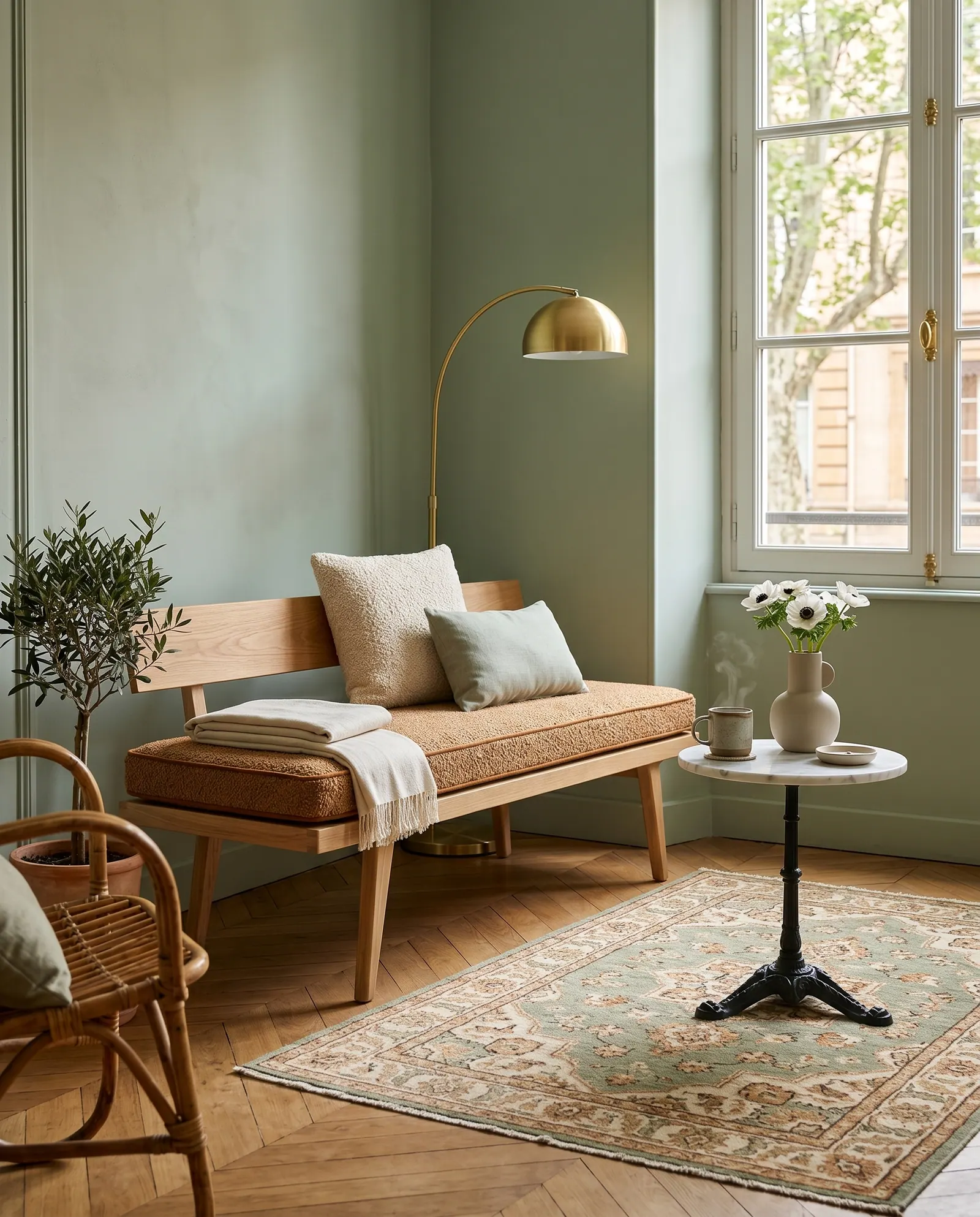
A caramel bouclé custom bench cushion in a sage-green room, and the mistakes it quietly avoids
Élodie's notebook page on one café corner: a warm seat against cool walls, tonal piping that follows the rails, and five small errors this photograph steps around.

 Save
The quick answer
The most common mistake with a bench cushion in a green room is choosing more green. Against muted sage walls, a warm caramel or cognac bouclé keeps the corner inviting, while one sage pillow repeats the wall so the seat feels built in. Judge colors in daylight, pipe in the cushion's own tone, and choose foam firm or thick enough for the job.
Notes on a café corner in north light
My friends, look at the wall before the cushion. It is a soft sage with gray in it, lit by a tall window that faces north. That light is cool and even. It makes greens greener and whites faintly blue.
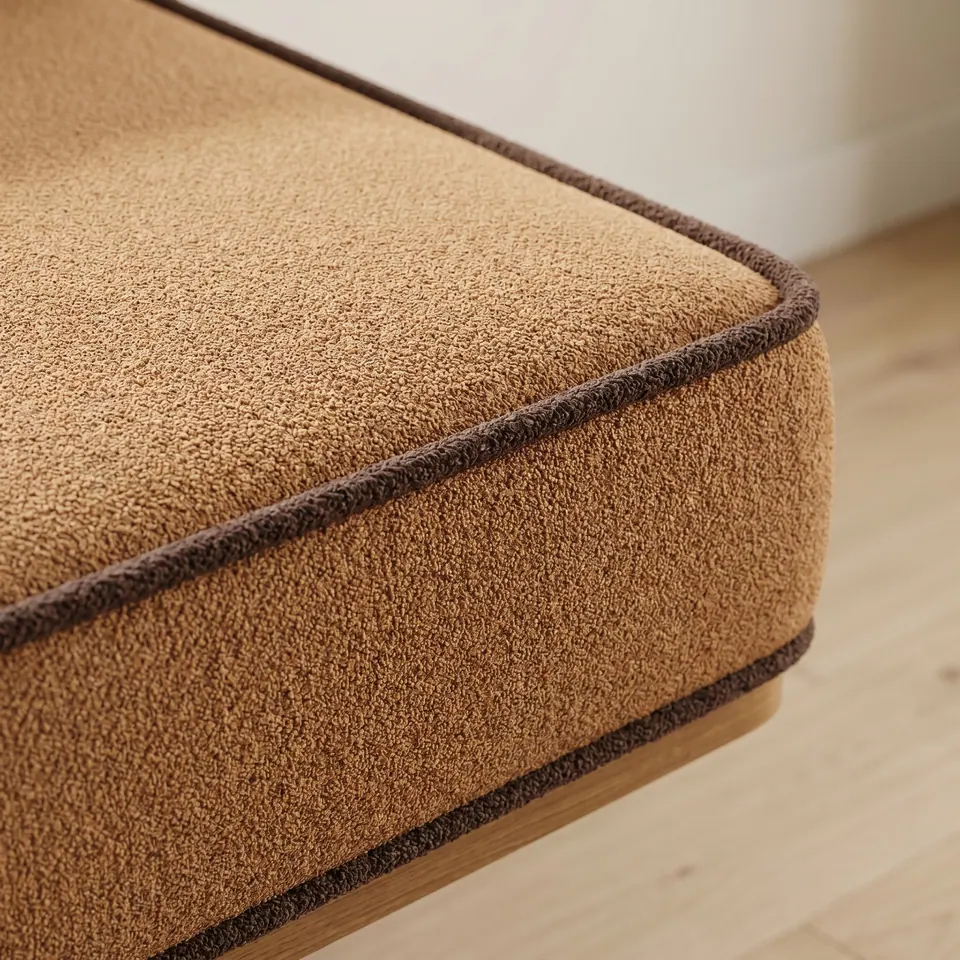
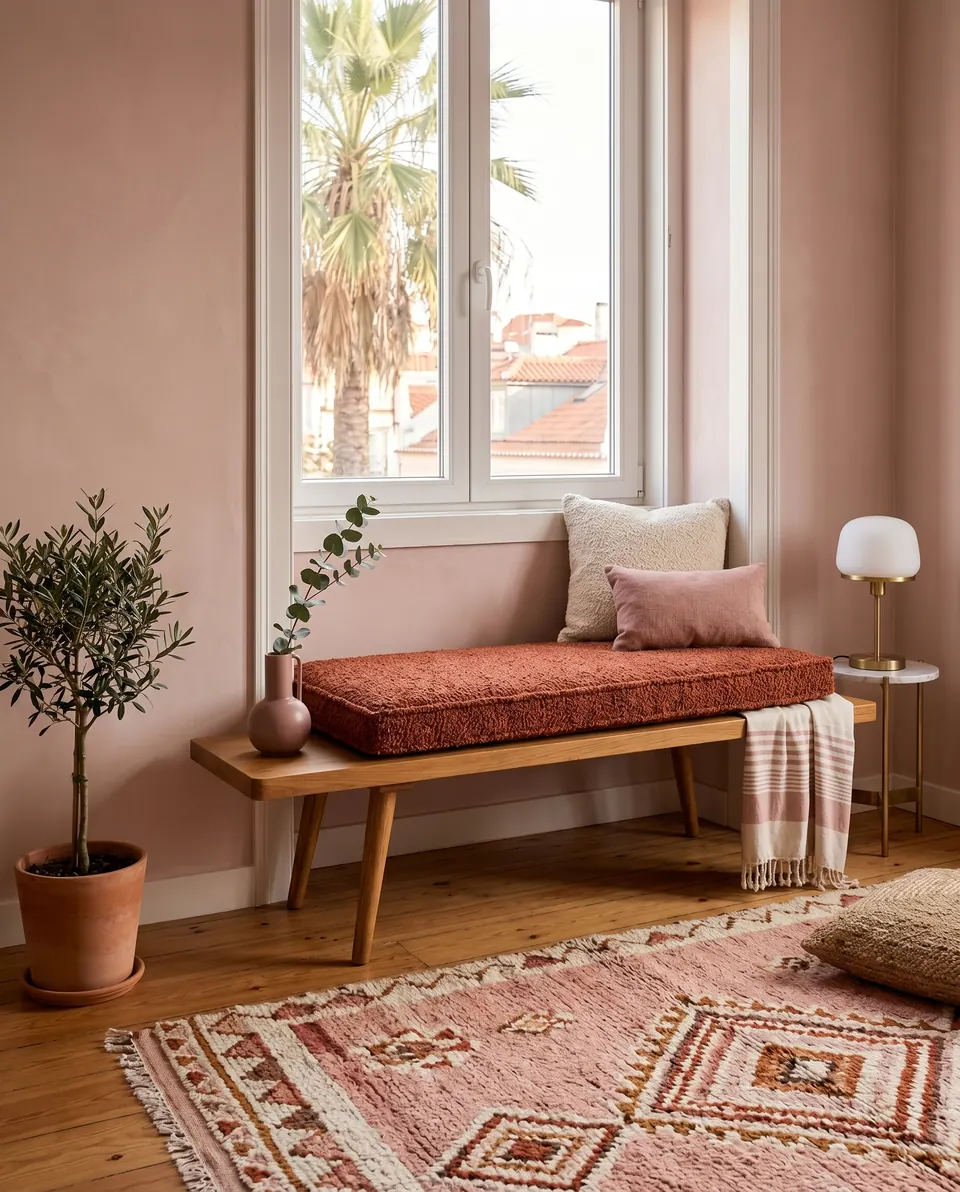
Into the coolness goes one warm thing: a caramel bouclé box cushion on a pale oak bench with a backrest. Caramel with cinnamon in the shadows between the loops. Of everything in the room, it is the spot the eye rests on first.
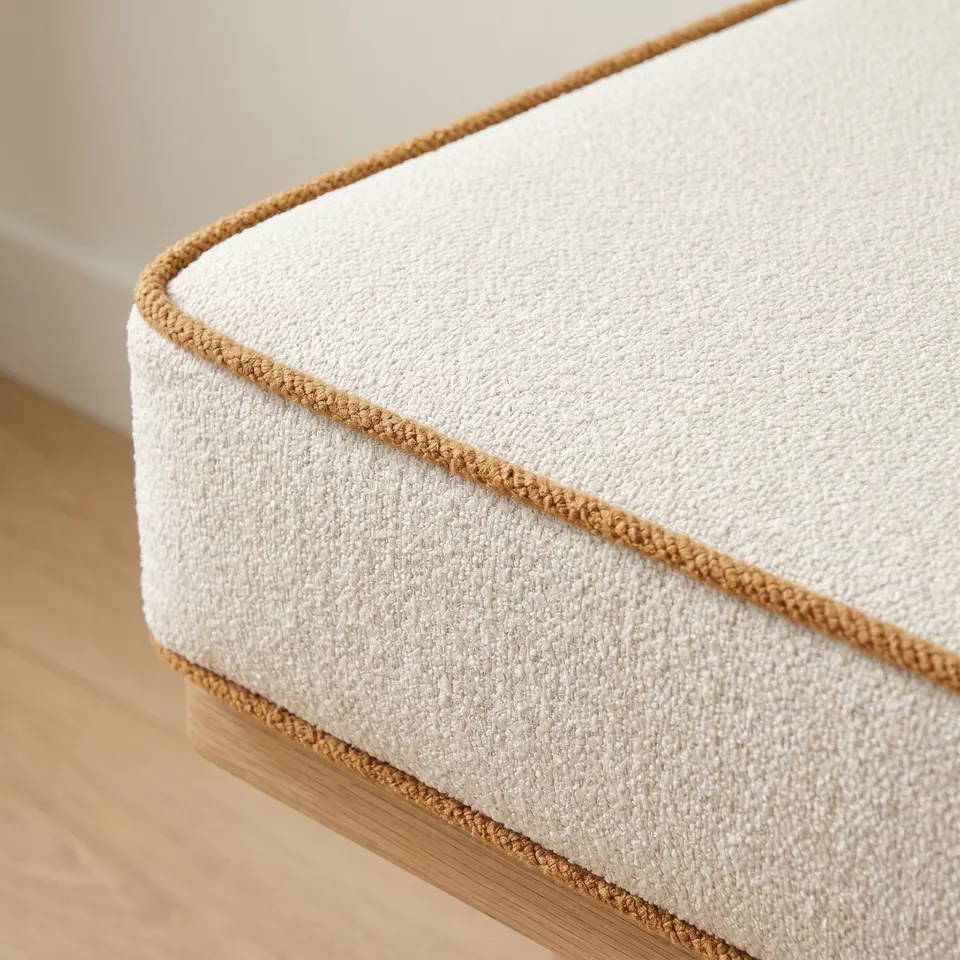
The piping is tonal, the same caramel, and it runs along the bench rails in one clean line instead of drawing a second outline around them. A pale sage velvet pillow repeats the wall color on the seat. That is the small trick that makes a freestanding bench look built in. Beside it sits a cream bouclé pillow, and at the left end a folded cream throw with fringe lightens the caramel where the window light lands.
The props finish the sentence. A brass arc lamp curves over the backrest, so the seat still works for reading after dark. A marble bistro table on an iron base holds a steaming mug and white anemones in a cream vase. A rattan armchair with its own sage cushion faces the bench and turns the corner into a café for two. Underfoot, a sage and cream rug on herringbone oak ties floor to wall, and an olive in terracotta stands by the window.
What color is the wall behind your bench at four in the afternoon? More warm-and-cool pairings live under living room cushions and bench cushions.
Five pins on the oak settle
Five pins follow the warm seat, the sage echo and the brass lamp that keep a cool room from feeling cold.
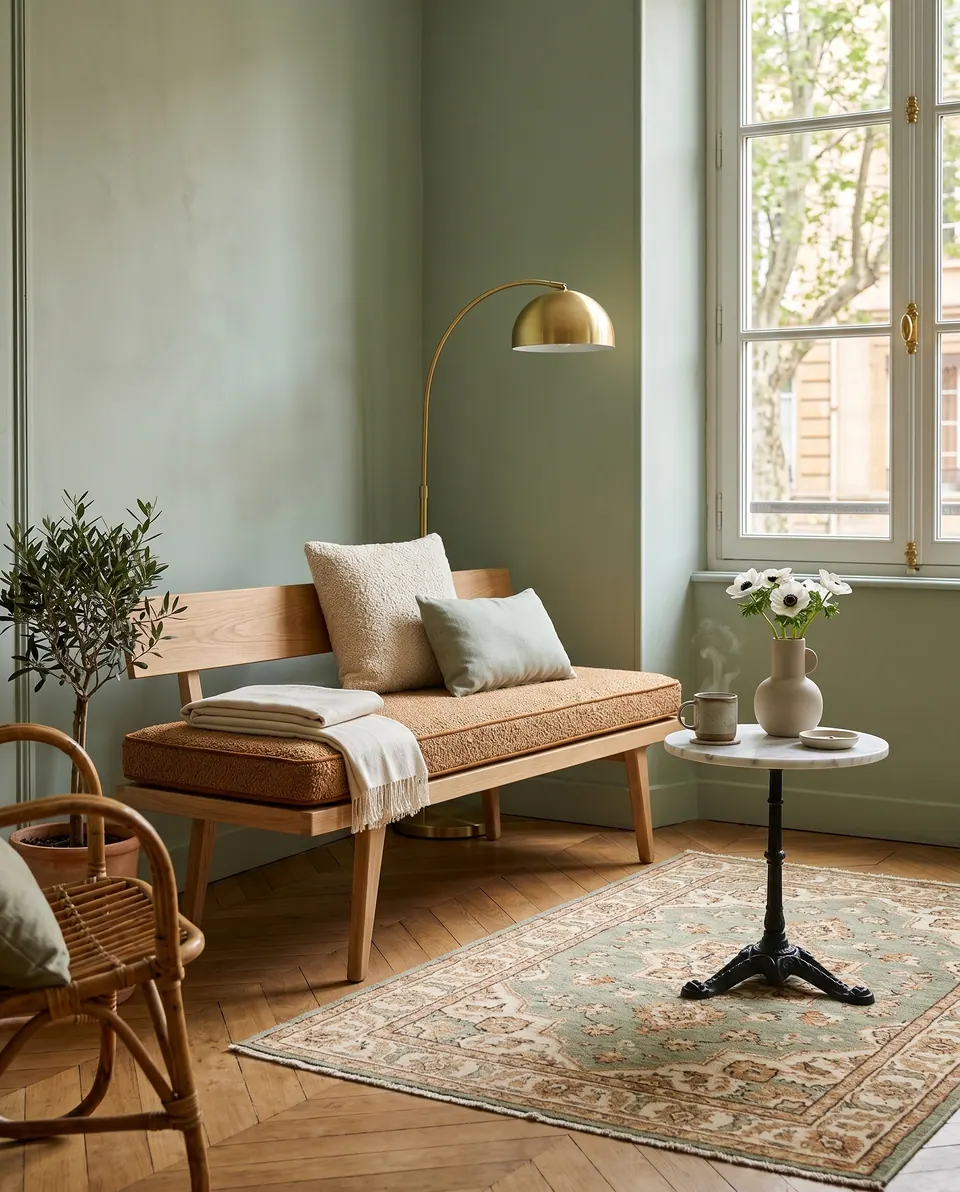
- Caramel bouclé cushion
Warmth against cool sage walls keeps the corner inviting.
- Sage velvet pillow
Wall color on the seat makes the bench feel built in.
- Folded fringed throw
Cream on the left end lightens the caramel seat.
- Brass arc lamp
Curves over the backrest to light the seat for reading.
- Rattan armchair
A second seat turns the bench into a conversation corner.
- Caramel bouclé cushionWarmth against cool sage walls keeps the corner inviting.
- Sage velvet pillowWall color on the seat makes the bench feel built in.
- Folded fringed throwCream on the left end lightens the caramel seat.
- Brass arc lampCurves over the backrest to light the seat for reading.
- Rattan armchairA second seat turns the bench into a conversation corner.
Five mistakes this photograph steps around
- Green on green. Another sage on a sage wall simply disappears; caramel or cognac gives a cool room its warm center.
- Piping that shouts. A dark welt here would redraw a bench that already has rails. Tonal caramel piping lets the oak do the outlining.
- Choosing on a screen. North light cools every color it touches. Daylight never lies; your screen sometimes does, so hold real swatches against the wall.
- A seat with no echo. Without the pale sage velvet pillow, the bench would float in front of the wall instead of belonging to it.
- Foam chosen for looks. A slim cushion looks neat, but think about who sits there, and for how long, before you pick the thickness.
Beautiful colors, wrong foam
A customer ordered a long cushion as a birthday gift: about 76⅜ x 11¾ x 2 in (194 x 30 x 5 cm), in burnt terracotta velvet, color 112, with forest green piping, color 125. A lovely pairing. It was meant to support an elderly parent's back in bed.
It arrived vacuum-packed and flat, with a cut in the cover and a torn plastic bag. The workshop explained that vacuum-packed cushions recover in 24 to 48 hours, sometimes a few days, and offered a thicker replacement cover.
But once the foam had recovered, the real problem showed. At 2 in (5 cm), the cushion was simply too soft to hold an older person upright. The workshop refunded it without asking for a return.
The colors were right; the foam was wrong for the job. For back support, go firmer or thicker, and try the foam firmness finder before choosing.
Buyer questions: chocolate linens, an 8 in dinette and a fringed edge
- A common question
Which of your linens is the deepest chocolate brown?
The workshop's answerThe workshop sent real photos of three browns side by side: L38, L77 and L19. The buyer was leaning toward L38 as piping on L-62.
- A common question
Can you make U-shaped dinette cushions at least 8 inches thick?
The workshop's answerYes. One velvet dinette set had a long seat 65 in (165 cm) wide, 17½ in (44 cm) deep and 8 in (20 cm) thick, a 65 in (165 cm) back cushion 4 in (10 cm) deep, and two side seats of 17½ x 24½ in (44 x 62 cm), also 8 in (20 cm) thick.
- A common question
Can you add fringe or a scalloped edge to a bench cushion?
The workshop's answerYes, if you send a picture of the edge you want. For special details like this, the workshop sends a photo of the finished cushion before it ships.
On the cutting table: the caramel settle cushion
| Bench | Pale oak bench with a backrest |
|---|---|
| Cushion | Box-edged seat cushion |
| Fabric | Caramel bouclé with cinnamon depth |
| Piping | Tonal, the same caramel as the body |
| Pillows | Cream bouclé and pale sage velvet |
| Wall | Muted sage green |
| Light | Soft north light from a tall window |
| Best for | Living-room reading corners and dining benches with a back |

Have it made
Have this made — ask Élodie’s workshop
Describe the room at four in the afternoon: the floor, the wall, the one color you love. That is where a good fabric choice begins. — Élodie
Leave your details and the workshop will call you to confirm measurements, fabric, foam and piping. No prices, dates or payment on this page: it is a request, not an order.
On a sage-green wall, a caramel bouclé bench cushion warms the room more than another shade of green; one sage pillow ties the seat back to the wall.
Élodie
Questions buyers ask next
What cushion color works on a bench in a sage-green room?
A warm one. Caramel, cognac or cinnamon bouclé balances cool sage walls. Keep the green for one pillow, so the bench still connects to the wall without disappearing into it.
Is tonal piping better than contrast on a bench with a wooden backrest?
Often, yes. When the bench rails already draw a strong outline, tonal piping keeps one clean line. Contrast piping earns its place when the cushion needs its own edge, for example on a plain box with no frame around it.
How long should I wait before judging a vacuum-packed bouclé bench cushion?
Give it 24 to 48 hours, and sometimes a few days. Unwrap it, lay it flat and let the foam recover fully before you decide on thickness or firmness.
Is a 2 inch cushion enough for back support in bed?
Not for an older person who leans on it. A 2 in (5 cm) cushion proved too soft for that job. Choose firmer foam or a thicker cushion when the piece has to hold someone upright.
With color and care — Élodie
More warm seats in cool rooms
 Save
 Save
 Save
 Save
 Save
 Save