A Reading by MaggieBench Cushions
A blue madras bench cushion, and how a nook holds it in place
Right, then. Every fastening question starts with one look at what surrounds the bench, and this nook answers half of it before the tape measure comes out.

 Save
The quick answer
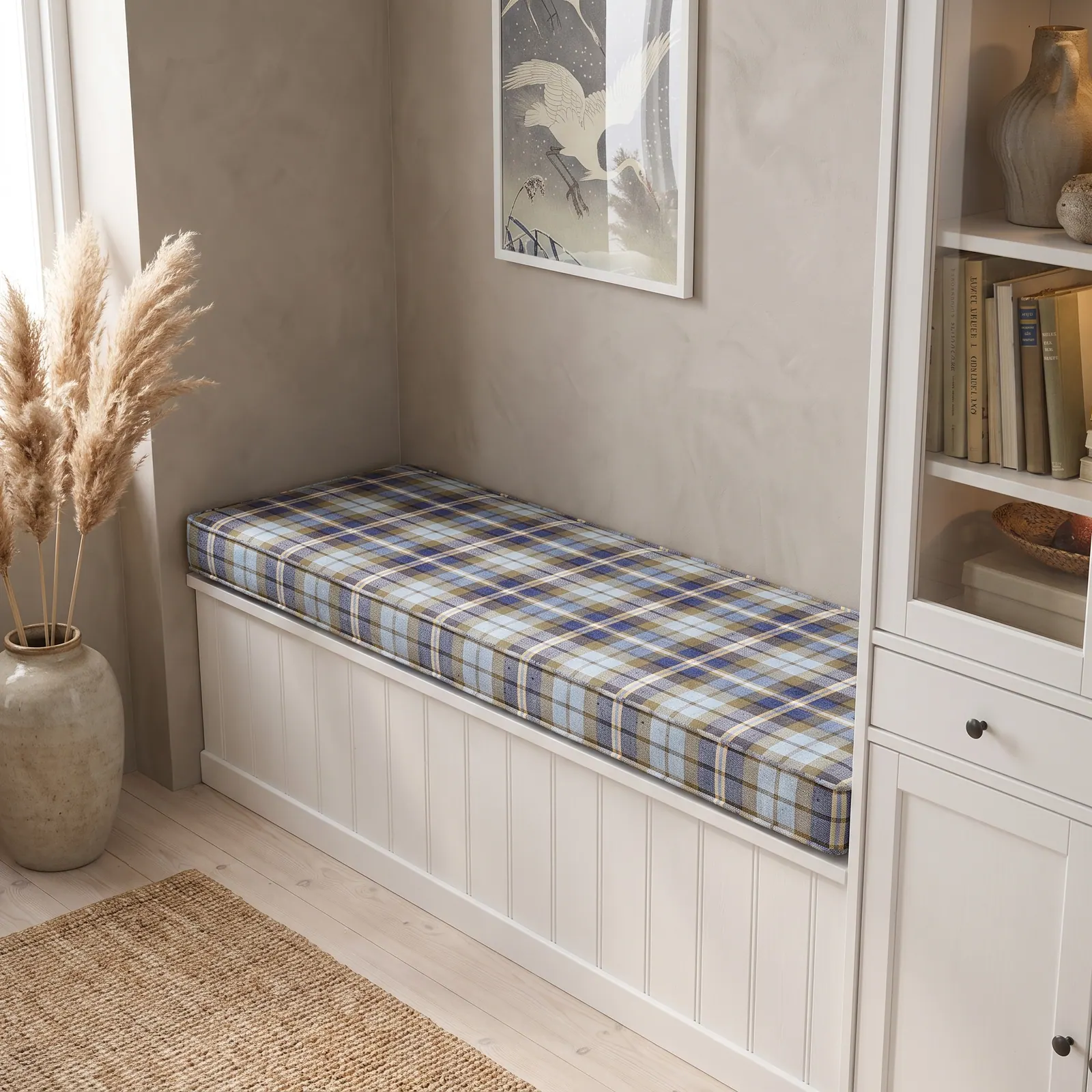
A bench cushion that fits a nook wall to wall rarely needs ties, because the walls stop it sliding sideways. If it creeps forward, choose the optional non-slip base; save ties for open benches with slats or legs. Ask for the zipper on the back edge, facing the wall, so it never shows. Here self piping finishes the madras front edge.
Three questions about shape, piping and liners
Common questions and the workshop's answers.
- A common question
My bench wraps around a bay window instead of running straight across. Can one cushion follow it?
The workshop's answerYes. Send a photo of the bench and a simple sketch with exact measurements. One continuous piece takes more work and material, so it costs a little more; the alternative is three separate cushions, one for each run.
- A common question
Can I skip the piping, and does that make the cushion cheaper?
The workshop's answerIt can be made without piping, but the price stays the same. Piping (welting) is standard, so write 'no piping' next to your fabric code in the personalization note. Light, plain fabrics look clean without it.
- A common question
Is the backrest filling stuffed straight into the cover, or does it have its own liner so the cover still washes?
The workshop's answerThe filling comes in its own inner cover. Slip the filled insert into the outer cover, and the outer cover can come off for washing whenever you need.
Now, the reading
What the nook does before any tie is sewn
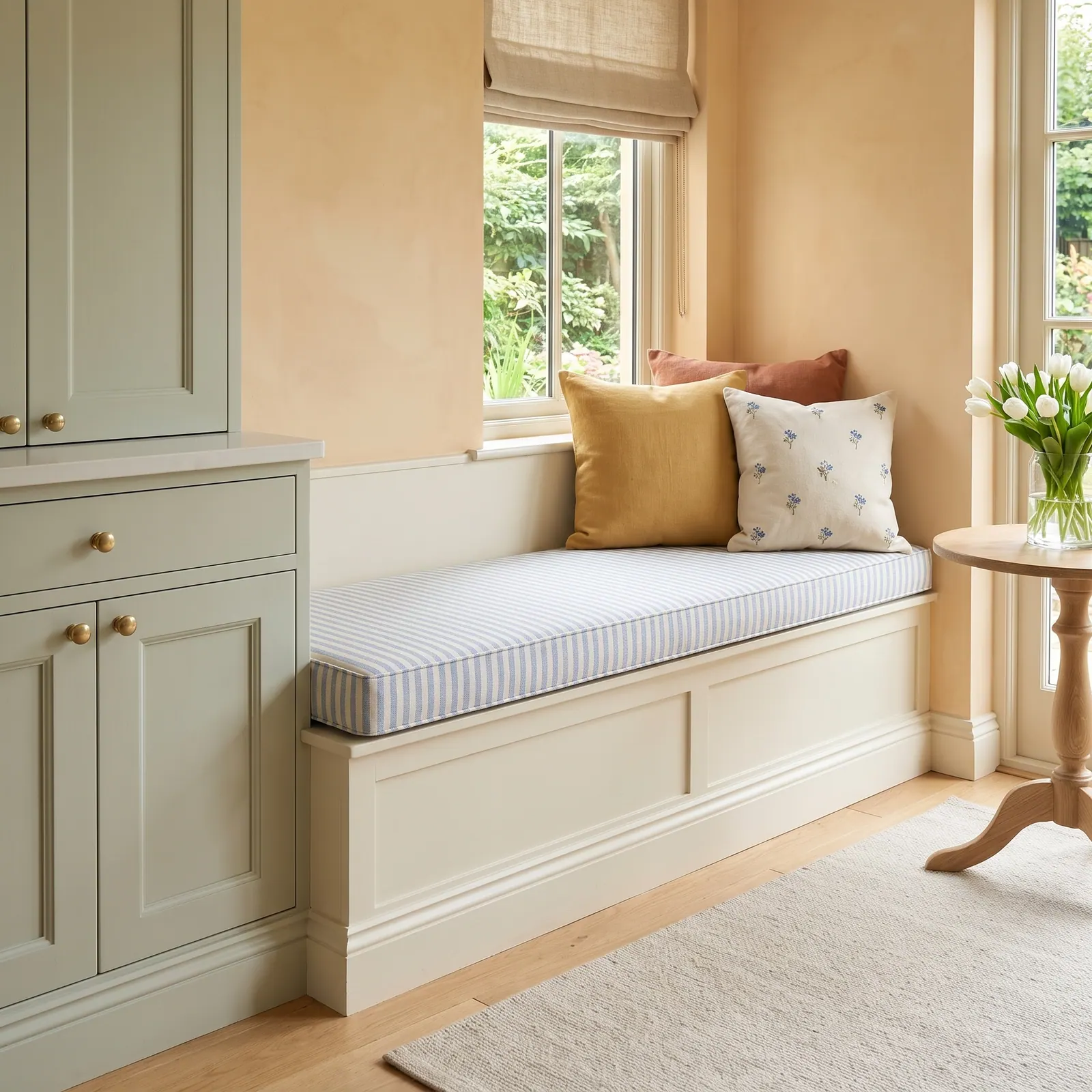
The best fastening in this photograph is carpentry. The bench cushion sits between a greige limewash wall and a white bookcase, so it cannot drift left or right. That leaves one direction to worry about: forward, toward your knees.
Look at the proportion. The seat is long and shallow, the box edge stands upright, and the check runs square to the front. A plaid is honest that way: if the cushion sat crooked by half an inch, the lines would tell on it.
The piping is self piping, cut from the same madras, so the check carries over the front edge without a hard outline. On a pale bench I usually argue for contrast. Here the plaid draws its own lines, and a navy cord would have been one too many.
The light is soft and bookish. Sky blue and navy give the pale reading nook structure; a thin mustard thread keeps it from going cold. The heron print, centered over the bench, shares the blues. Mustard and cream book spines repeat the yellow. Pampas in a stoneware vase fills the corner by the window, and a jute rug keeps the floor quiet.
More checks live in checked linen and gingham. What's under your nook bench: a closed box, or open slats?
Pinned by Maggie
Five places where the plaid, the piping and the props agree with each other.
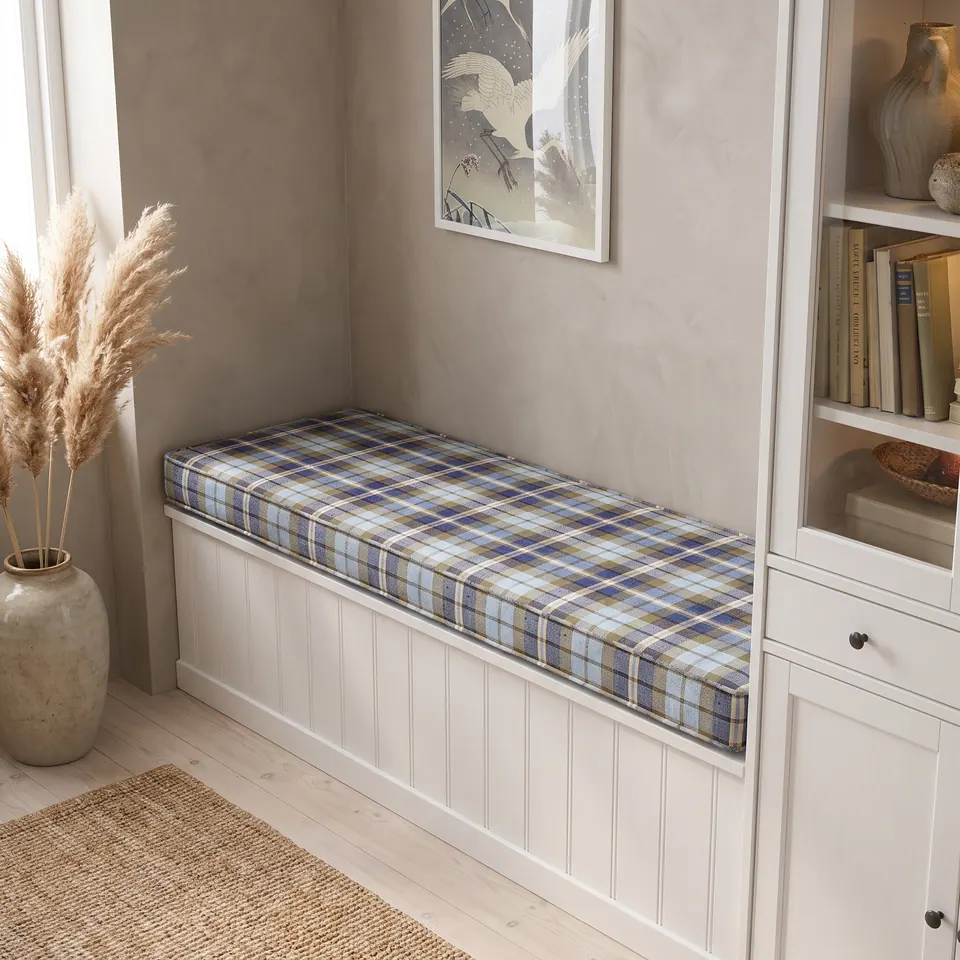
- Blue madras check
Blue and navy squares add structure to a pale room without bright color.
- Self-piped border
Matching piping keeps the check continuous around the front edge.
- Heron print
Centered over the bench, the print shares the cushion's muted blues.
- Pampas in stoneware
Tall dried grass fills the corner by the window.
- Book spines
Mustard and cream spines repeat the thin yellow thread in the plaid.
- Blue madras checkBlue and navy squares add structure to a pale room without bright color.
- Self-piped borderMatching piping keeps the check continuous around the front edge.
- Heron printCentered over the bench, the print shares the cushion's muted blues.
- Pampas in stonewareTall dried grass fills the corner by the window.
- Book spinesMustard and cream spines repeat the thin yellow thread in the plaid.
My fastening checklist for a nook bench
- A wall at each end: skip the ties. The nook does the holding.
- Creeping forward on a painted top: add the optional non-slip base, at extra cost.
- An open bench with slats or legs: ask for ties sewn into the back corners.
- The zipper: on the back edge facing the wall, or underneath if the back shows.
A 6-inch-deep cushion that waited in its bag
A buyer ordered a cushion for a small ledge on a staircase: 34 x 6 x 4 in (86 x 15 x 10 cm), black linen with matching piping. Proportions like that make a tailor stop. The workshop wrote back to check whether the length was 34 or 36 in (91 cm), and where it would live.
It went out during a busy stretch, with more than 200 orders in production. The buyer then forwarded the parcel on without opening it. The workshop's advice was plain: open the vacuum pack as soon as possible so the foam can regain its shape.
I once assumed an odd size was a typo and said nothing. Never again.
- Sizes
- 34 x 6 x 4 in (86 x 15 x 10 cm)
- Fabric
- Black linen, matching piping
The lesson: Don't leave a vacuum-packed cushion sealed; the longer the foam waits, the longer it takes to recover.
If a vacuum-packed cushion stays sealed for weeks, the foam takes longer to recover its shape, so open the bag the day the cushion arrives.
Maggie
On the cutting table
| Cushion | Bench cushion, box edge, fitted wall to wall |
|---|---|
| Fabric | Blue, navy and mustard madras check |
| Piping | Self piping, cut from the same check |
| Zipper | Hidden, on the back edge facing the wall, or underneath |
| Grip | Optional non-slip base at extra cost; ties sewn in on request |
| Thickness | 4 in (10 cm) standard; 2, 3 and 5 in offered |
| Care | Cover off, 86°F (30°C) gentle wash, air dry |
| Best for | Built-in reading nooks with a wall at each end |

Have it made
Have this made — ask Maggie’s workshop
Have the tape measure handy when they call. Old cushions shrink and sag; the seat underneath does not. — Maggie
Leave your details and the workshop will call you to confirm measurements, fabric, foam and piping. No prices, dates or payment on this page: it is a request, not an order.
Questions buyers ask next
Does a nook bench cushion need ties to stay put?
Usually not. When the cushion fits wall to wall, the walls stop sideways movement. If it still creeps toward the front, the optional non-slip base grips by friction. Ties help most on open benches, where there is something to tie around.
Which edge should the zipper sit on for a bench against a wall?
The back edge, facing the wall, so it disappears. If the back of the bench shows, ask for it underneath. On bench covers the zipper often wraps around two corners so the foam slides out easily.
How long do creases take to drop out of a new bench cushion?
Vacuum creases in the cover usually settle within about a week as the foam expands. Open the pack promptly and judge the cushion's size and shape after that week, not on the day it arrives.
Stitch straight — Maggie
More striped and checked benches, read the same way
 Save
 Save
 Save
 Save
 Save
 Save