 Save
- Monochrome photo prints
Black-and-white photographs repeat the check colors on the wall.
- Black check seat
A strong black gingham makes the floor seat the focal point of the room.
- Rubber plant
Glossy dark leaves carry the black note and soften the white bookcase.
- Tripod floor lamp
Wooden legs lift warm wood above floor level to match the boards.
- Rag runner
A multicolored rag rug breaks up the black and white with casual color.
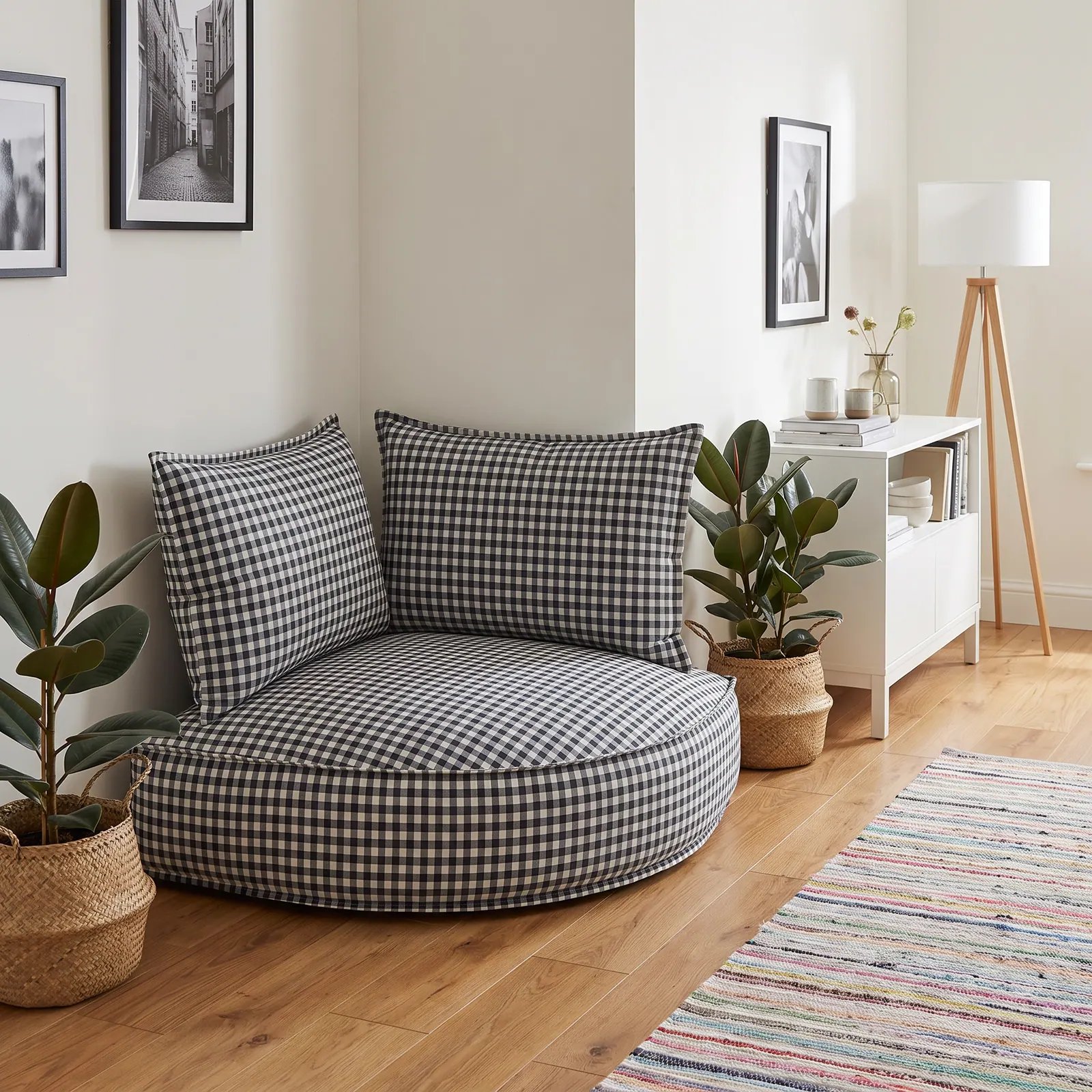
Plate Black Gingham Corner Floor Cushion in a Bright Oak-Floored Room
A bold black check sits between two rubber plants, echoed by monochrome photographs and warmed by honey oak boards.
A Reading by HarlanCorner Floor Cushions & Poufs
A black gingham corner floor cushion, warmed by honey oak and white walls
The boldest check in the book, and somehow the friendliest thing in the room. The wood did that, and the morning light helped.
The quick answer
Black gingham works on a corner floor cushion when the room around it is mostly white walls and warm honey wood, which keeps the strong contrast friendly. Repeat the black once or twice at eye level, with monochrome prints or dark glossy leaves, and use self piping so the check runs cleanly around the box edge.
Why black gingham needs honey oak
Black gingham is the loudest of the checks. Put it in a gray room and it turns stern. Put it on honey oak, against white walls, in morning light, and it turns friendly. That is the whole trick of this corner, and it is worth borrowing.
Watch where the black goes after it leaves the cushion. Up to the framed street photographs, which carry the same black and white at eye level. Out to the two rubber plants, whose dark, glossy leaves hold the black note and soften the white bookcase. So this corner floor cushion is not the only dark thing in the room, only the boldest.
Then find the warm things. The floorboards. The seagrass belly baskets. The wooden legs of the tripod lamp, which lift that honey color off the floor and set it beside the seat. Warm wood takes the chill off a hard contrast, the way a hand on the shoulder takes the edge off hard news.
The rag runner has the last word. Its mixed colors say people live here, and they keep the check from reading like a chessboard.
The seat is a box, and its self piping carries the check right around the edge. A contrast cord on a pattern this strong would be one voice too many in the choir. Gingham from the checked linen and gingham family is an even check, so the box shows it squarely on every side, and the two backrest pillows repeat it at shoulder height.
What color is the floor under your corner, my friend?
Pinned by Harlan: where the black goes next
Five pins, each one showing where the black travels after the cushion and what warms it up along the way.
The numbers match the pins on the plate.
- Monochrome photo printsBlack-and-white photographs repeat the check colors on the wall.
- Black check seatA strong black gingham makes the floor seat the focal point of the room.
- Rubber plantGlossy dark leaves carry the black note and soften the white bookcase.
- Tripod floor lampWooden legs lift warm wood above floor level to match the boards.
- Rag runnerA multicolored rag rug breaks up the black and white with casual color.
Swatch strip: black, chalk and honey
- Gingham black#1E1D1BThe check's dark square, repeated by the prints and the rubber leaves.
- Chalk white#F1EEE7The check's light square and the walls it borrows from.
- Honey oak#C38E52Floorboards and lamp legs: the warmth that keeps black friendly.
- Rubber-leaf green#2E3A2BDark enough to stand in for black at eye level.
- Seagrass#B7A07ABelly baskets that bracket the seat like bookends.
- Rag-rug brick#B0614AThe runner's casual color, so black and white are never alone.
The second corner that turned out to be standard
A buyer in the US already owned one of the workshop's curved corner floor cushions in brick corduroy. They came back to give it company: a 22 x 22 in (56 x 56 cm) square pillow in brick and two 20 in (51 cm) flat round pillows in off-white, all piped. Brick with off-white strikes the same bargain as this gingham: one bold color, one quiet one.
Then they wanted a second corner cushion in a custom size. The workshop asked for a drawing with every edge measured. Somewhere between the pencil and the tape, they saw it themselves: the shape was close to the workshop's standard corner. They ordered the standard 32 x 32 in (81 x 81 cm) and one more off-white square.
That drawing spared them a custom order they did not need. Buy the cushion once, cry once. Our Pattern on labeling a custom cushion drawing shows how to mark every edge, and the one on quarter-circle corner sizes lays out the standard shapes.
Buyer questions: wood floors, a museum order and an ottoman added later
- A common question
Will the metal bars under a floor sofa scratch my hardwood floor?
The workshop's answerBare bars can slide and mark wood, so put a rug or a small piece of fabric under them. The workshop sent updated bars to customers whose bars slid, and a fitted protective bar grip was being made. Grips from other brands may not fit, because bar thickness differs.
- A common question
Could you make 15 custom floor cushions for a museum project?
The workshop's answerYes. Custom sizes and colors in quantity are fine. That order was 15 cushions at 26 x 26 x 5 in (66 x 66 x 13 cm) in eight linen colors, with the handle kept and reinforced and the leather label left off. Five more were added later from the same listing.
- A common question
Can I buy the ottoman on its own, or add one later to lengthen my floor sofa?
The workshop's answerYes. The ottoman is sold separately, by itself or with a straight or L-shaped backrest, and customers do add one a year or more after buying the sofa.
On the cutting table: the black check corner
| Cushion | Corner floor cushion with a box-edge seat |
|---|---|
| Backrests | Two black gingham backrest pillows |
| Fabric | Black-and-white gingham check (D23) |
| Piping | Self piping in the same check |
| Edge | Box edge |
| Floor | Honey oak boards with a multicolor rag runner |
| Walls | Off-white, with framed black-and-white street prints |
| Styling | Two rubber plants in seagrass baskets, low white bookcase, tripod lamp |
| Best for | A white living-room corner that needs one confident focal point |
Have it made
Have this made — ask Harlan’s workshop
Fabric has a temper and foam has a memory. Better to settle both in a conversation than to guess at them alone. — Harlan
Leave your details and the workshop will call you to confirm measurements, fabric, foam and piping. No prices, dates or payment on this page: it is a request, not an order.
Black gingham on a floor cushion looks friendly, not stern, when honey oak and white walls surround it and one monochrome print repeats the check.
Harlan
Questions buyers ask next
What wall color suits a black gingham floor cushion?
White or off-white walls give black gingham the most room to breathe, while a gray wall pulls the corner cold. Here plain white walls and a white bookcase let the check lead, and honey oak supplies the warmth.
What piping works on a gingham corner cushion?
Self piping, cut from the same check, keeps the pattern running around the box edge without adding a new color. On a strong black-and-white check, a contrast welt tends to compete with the squares rather than finish them.
Is a standard corner floor cushion size enough, or do I need custom?
Draw your corner and write every edge on the drawing before deciding. One buyer planned a custom size, then saw from the drawing that the standard 32 x 32 in (81 x 81 cm) corner already suited the space.
Which plants suit a black and white seating corner?
Plants with dark, glossy leaves, like the two rubber plants here, carry the black note up from the cushion and soften white furniture. Seagrass baskets add a warm, woven texture that answers the oak floor.
Sit well. — Harlan
More photographs to read
 Save
 Save
 Save
 Save
 Save
 Save