 Save
A Reading by MaggieBench Cushions
A custom bench cushion in a banded print, and why its piping matches the bands
Maggie reads a storage bench in a paneled living room and settles the question every order form asks: self piping, contrast piping, or none at all.

Swatch strip measured from the photograph
- sand#bcb1a526%
- camel#9b8b7a24%
- chestnut#68513e22%
- oatmeal#cec6bc16%
- linen#dad6d012%
The quick answer
For a bench cushion in a bold banded print, choose self piping: the welt is cut from the same cloth, so the edge continues the pattern instead of framing it. Save contrast piping for solid fabrics, where one colored line sharpens the box. Whatever you choose, write it and both fabric codes in the order note; the shop confirms them before production.
Self, contrast or none: reading the welt
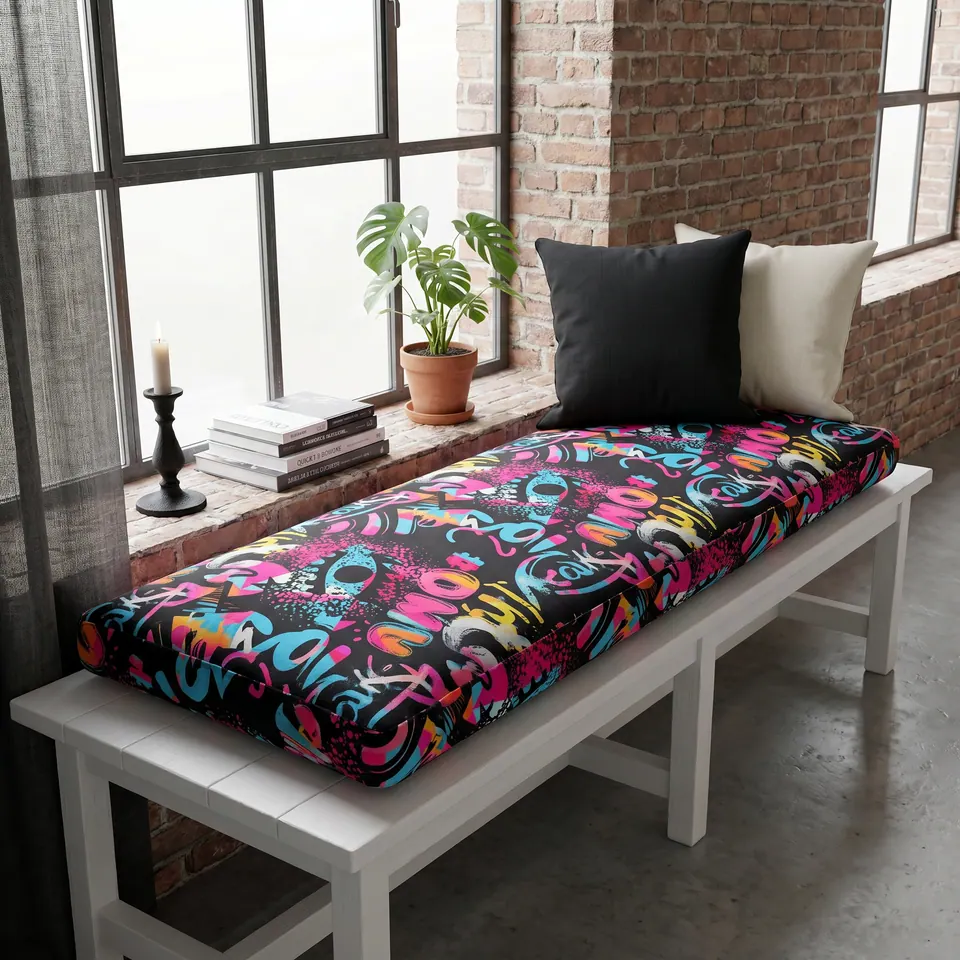
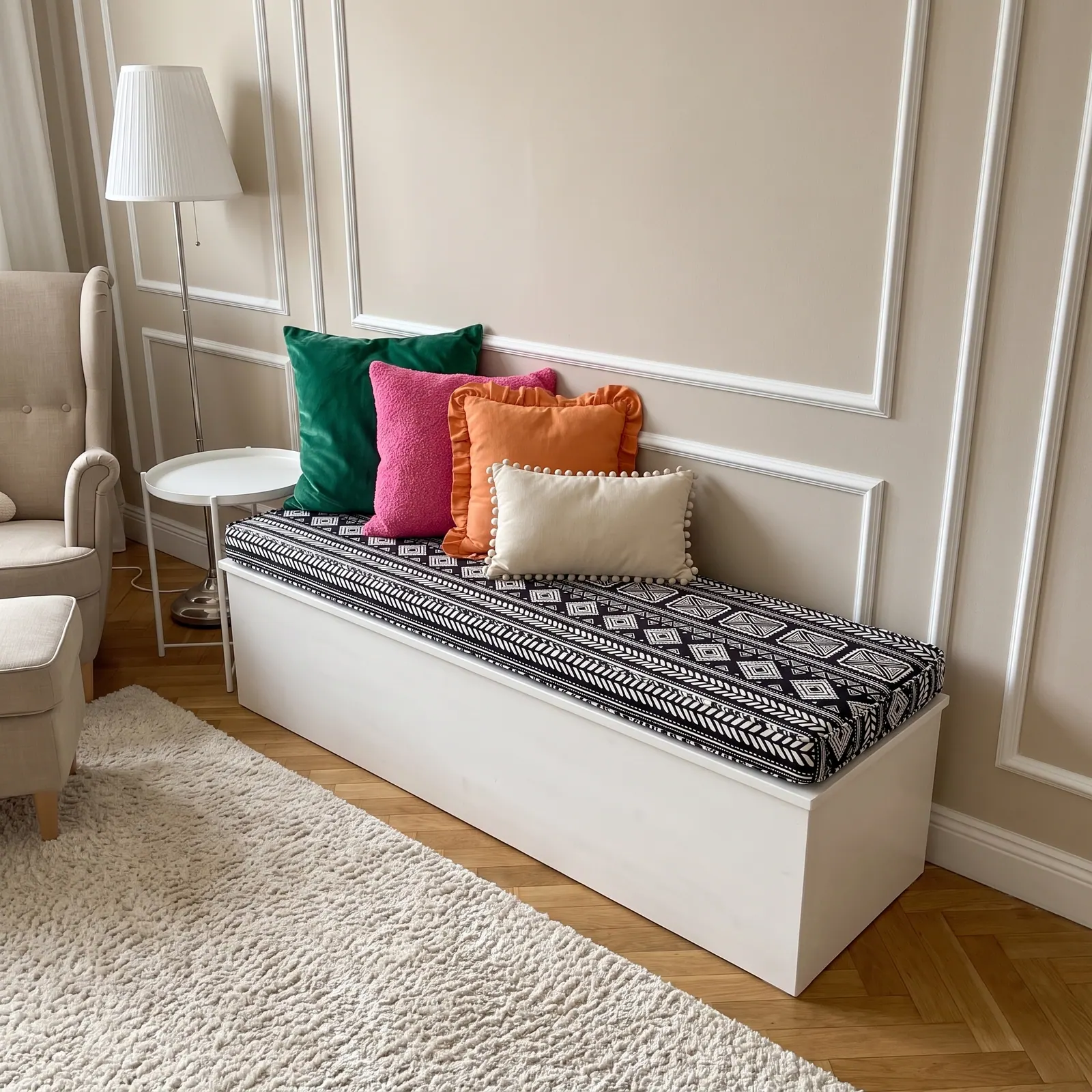
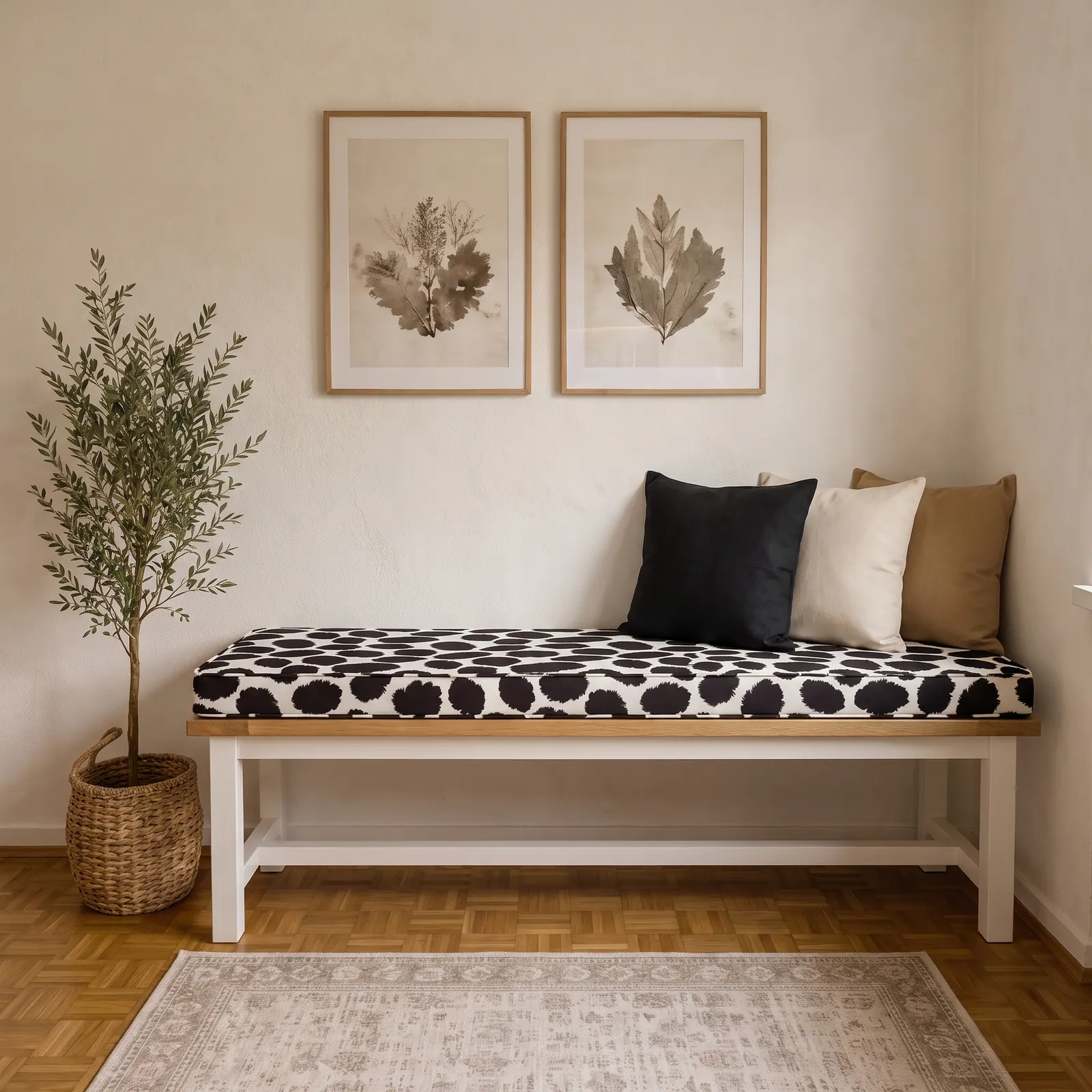
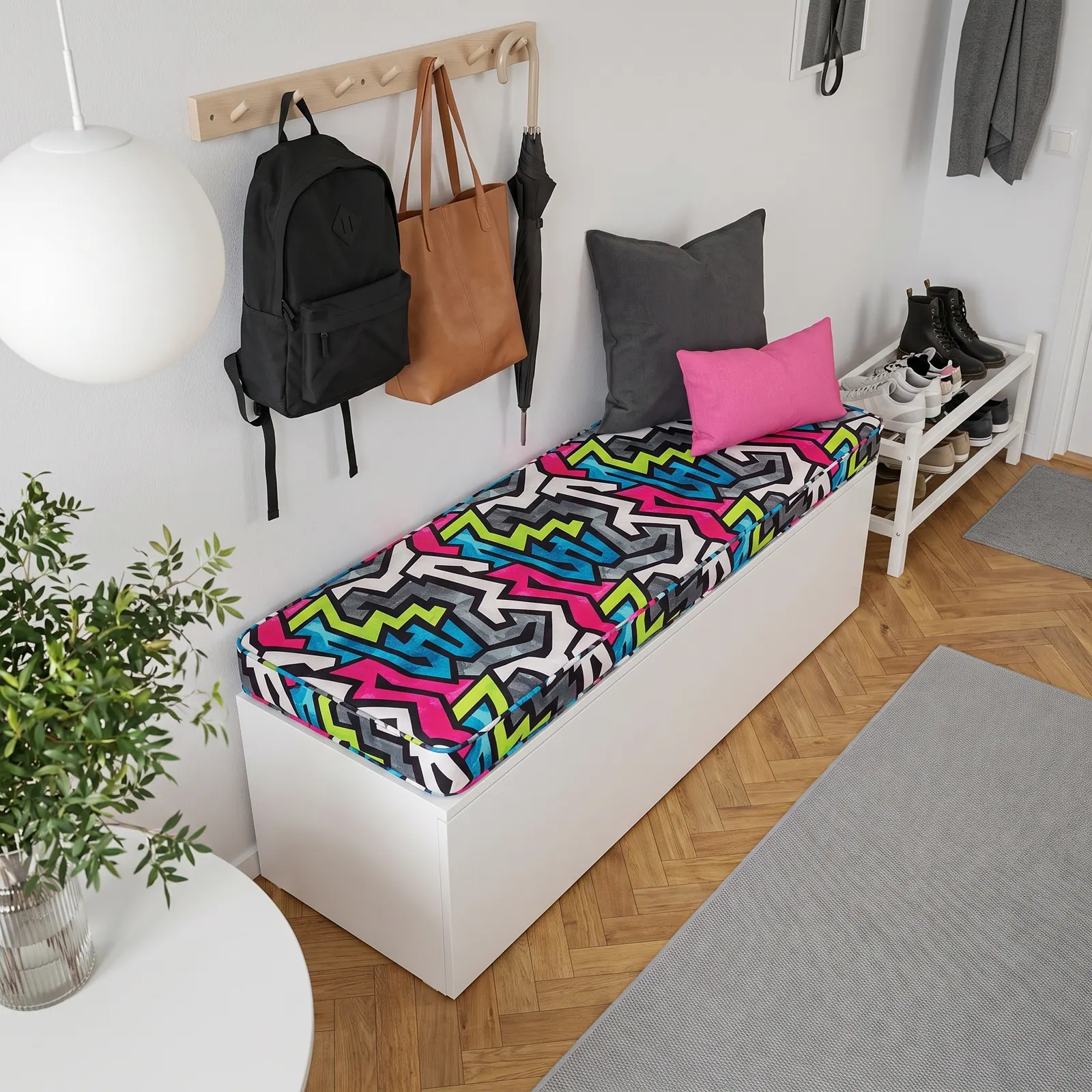
The bands on this custom bench cushion run the full length of the box, and that is the whole trick. A short white storage bench suddenly reads long, because your eye rides the black and white lines from the wall to the wingback chair.
The piping is self piping, cut from the same banded cloth, and on a print this graphic it is the right call. A solid black welt would have drawn a frame around every edge, and the cushion would look like a picture of a pattern rather than the pattern itself. No piping at all is the quietest choice; I keep it for relaxed fabrics where a crisp line isn't the point.
Contrast piping has its place. On a solid emerald or oatmeal cushion, one darker line sharpens the box and makes a plain seat look tailored. A straight welt is a kind of honesty: it shows exactly where the edge is. On a print, the print already does that job. The Pattern on matching, contrast or no piping lays out all three.
Everything else keeps its voice down: cream wall paneling, herringbone oak parquet, a cream wingback and footstool, a white pleated floor lamp, a round white side table, a shaggy cream rug. Quiet furniture lets one graphic element lead.
The pillows are cleverly done. Emerald velvet, tallest and darkest, starts the row at the wall. Fuchsia bouclé sits a step lower, a ruffled orange lower again, and a small cream lumbar with pompoms ends it softly, so the eye travels along the seat the way the bands do.
One warning. With bands and stripes, the roll width decides which way the pattern can run, so ask before you order if direction matters; see stripe direction and roll width. Which line do you want your eye to follow across the room, dear?
Swatch strip: black, white and four jewel notes
- Ink black band#1E1D1BThe strongest line in the print; self piping carries it around the edge.
- Chalk white band#EEEBE3Keeps the black from feeling heavy against cream paneling.
- Emerald velvet#0E5A45Tallest, darkest pillow, placed at the wall end to start the row.
- Fuchsia bouclé#C2266EOne step lower, and loopy where the velvet is smooth.
- Ruffled orange#E0772FThe warmest note, halfway down the step.
- Pompom cream#EFE6D4Smallest and palest lumbar; the row ends softly.
- Herringbone oak#B58A5AThe floor warms the whole black and white story.
Pinned by Maggie
Five pins along the bench, from the banded print to the quiet wingback that lets it lead.
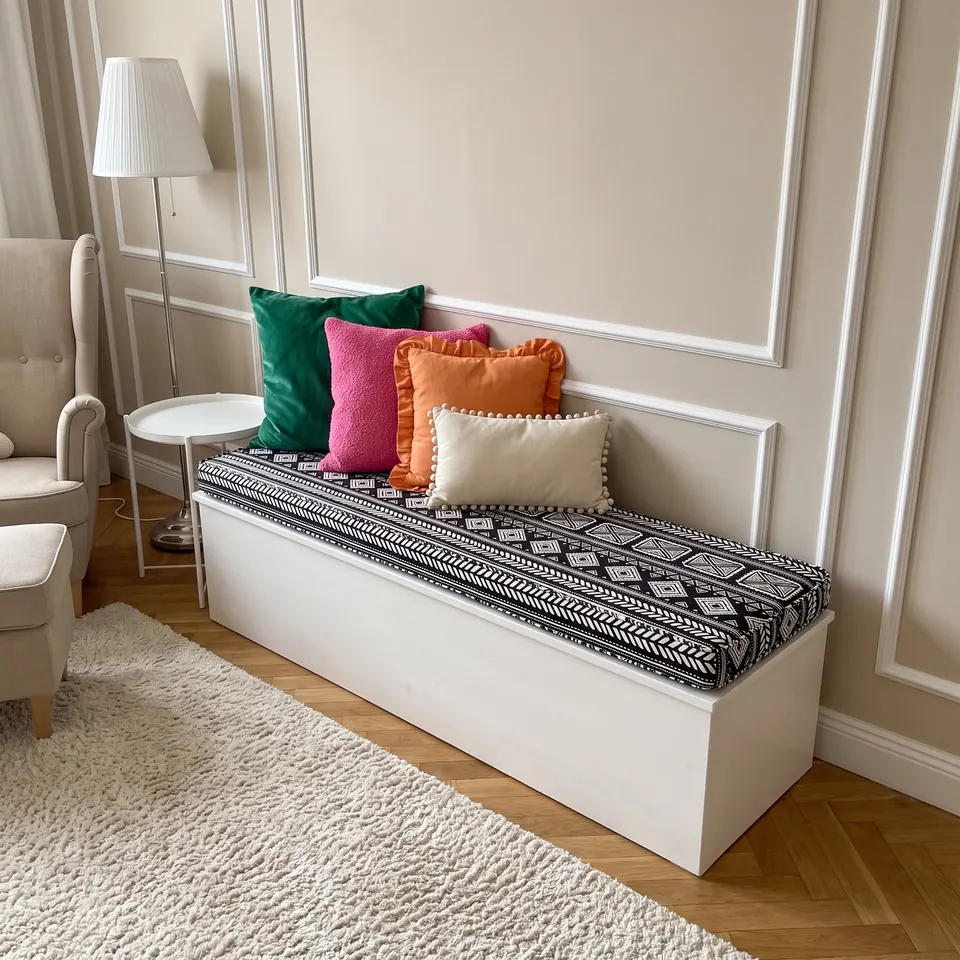
- Banded tribal-style print
The bands run the full length and make a short box look longer.
- Emerald velvet pillow
The tallest, darkest pillow starts the row at the wall end.
- Fuchsia bouclé pillow
Each pillow is a step lower than the one behind it.
- Cream pompom lumbar
Ending on the palest, smallest pillow finishes the row softly.
- Wingback armchair
Quiet cream furniture leaves the black and white print as the one graphic element.
- Banded tribal-style printThe bands run the full length and make a short box look longer.
- Emerald velvet pillowThe tallest, darkest pillow starts the row at the wall end.
- Fuchsia bouclé pillowEach pillow is a step lower than the one behind it.
- Cream pompom lumbarEnding on the palest, smallest pillow finishes the row softly.
- Wingback armchairQuiet cream furniture leaves the black and white print as the one graphic element.
A 113-inch bench and a backrest that shrank
A buyer messaged the workshop about a long built-in bench: 113 in (287 cm) of seat, 23 5/8 in (60 cm) deep, with 22 1/2 in (57 cm) of wall above it for a backrest. They liked a back that differs from the seat and asked whether the back could be softer.
Then came the sensible question. Once they learned the seat cushion would be 4 to 5 in thick, they cut the backrest to 17 3/4 in (45 cm), because the seat cushion sits on the bench and eats into the wall. They ordered velvet in color 36, a softer back, and one-piece cushions wherever the length allowed.
I once measured a backrest from the bench instead of the cushion top. It stood up like a headboard, and I never did it again. Our Pattern on back cushion height does the subtraction with you.
- Sizes
- seat 113 x 23 5/8 in (287 x 60 cm); backrest cut from 22 1/2 in (57 cm) to 17 3/4 in (45 cm) high
The lesson: Subtract the seat cushion's thickness from the wall height before sizing a backrest.
Buyer questions: piping colors, thickness, exact sizes
- A common question
Can the piping be a different color, or even a different fabric, from the cushion?
The workshop's answerYes. Contrast piping can be any color on the fabric charts. Buyers have paired an olive velvet 123 body with lilac 116 piping, and an L07 body with L14 piping. Write both codes in the order note, and the shop confirms them before production.
- A common question
How thick are your cushions as standard, and can I go thinner or thicker?
The workshop's answerThe standard is 4 in (10 cm). The shop also makes 3.5 in, 3 in, 2 in and even 1 in (2.5 cm) cushions, and thicker ones at 6 in (15 cm) or 8 in (20 cm). Write the thickness you want in the personalization box.
- A common question
My bench doesn't match any listed size. Will you make one to my exact length and depth?
The workshop's answerYes, every cushion can be made to exact measurements. Send the length and depth, plus the thickness if you know it, and the shop checks the details and sends a quote. Inches, centimeters and millimeters are all fine.
Cut sheet for the banded bench
| Cushion | Box-edge bench cushion on a white storage box |
|---|---|
| Black and white banded geometric, code P-35 | |
| Pattern direction | Bands along the full length |
| Piping | Self piping from the same print |
| Contrast option | Any chart color, both codes in the order note |
| Thickness | Standard 4 in (10 cm); from 1 in (2.5 cm) up to 8 in (20 cm) on request |
| Pillows | Four, stepping down from emerald to cream |
| Best for | Living rooms, entry benches, window boxes |

Have it made
Have this made — ask Maggie’s workshop
Have the tape measure handy when they call. Old cushions shrink and sag; the seat underneath does not. — Maggie
Leave your details and the workshop will call you to confirm measurements, fabric, foam and piping. No prices, dates or payment on this page: it is a request, not an order.
On a bold banded print, choose self piping: a black welt would frame every edge, and the cushion would look like a picture of the pattern.
Maggie
Questions buyers ask next
Does piping make a bench cushion look more tailored?
On a solid fabric, yes: a welt marks the edge and keeps the box line crisp. On a busy print, self piping does the same work quietly, because the welt is cut from the print itself and adds no new outline.
Which way should the bands on a printed bench cushion run?
Along the length usually flatters a short bench, because the eye travels end to end. The roll width of the fabric decides which directions are possible, so if the direction matters, ask before you order.
How do I arrange several throw pillows on one bench?
Step them. Start with the tallest, darkest pillow at the wall end and finish with the smallest, palest one toward the open end. Mixing textures, such as velvet, bouclé and a ruffle, keeps four pillows from looking like a matched set.
How tall should a backrest cushion be above a bench?
Measure the wall from the bench top, then subtract the thickness of the seat cushion. One buyer with a 4 to 5 in seat cut the backrest from 22 1/2 in (57 cm) to 17 3/4 in (45 cm).
Stitch straight — Maggie
More photographs to read
 Save
 Save
 Save
 Save
 Save
 Save