 Save
- Thick mustard cushion
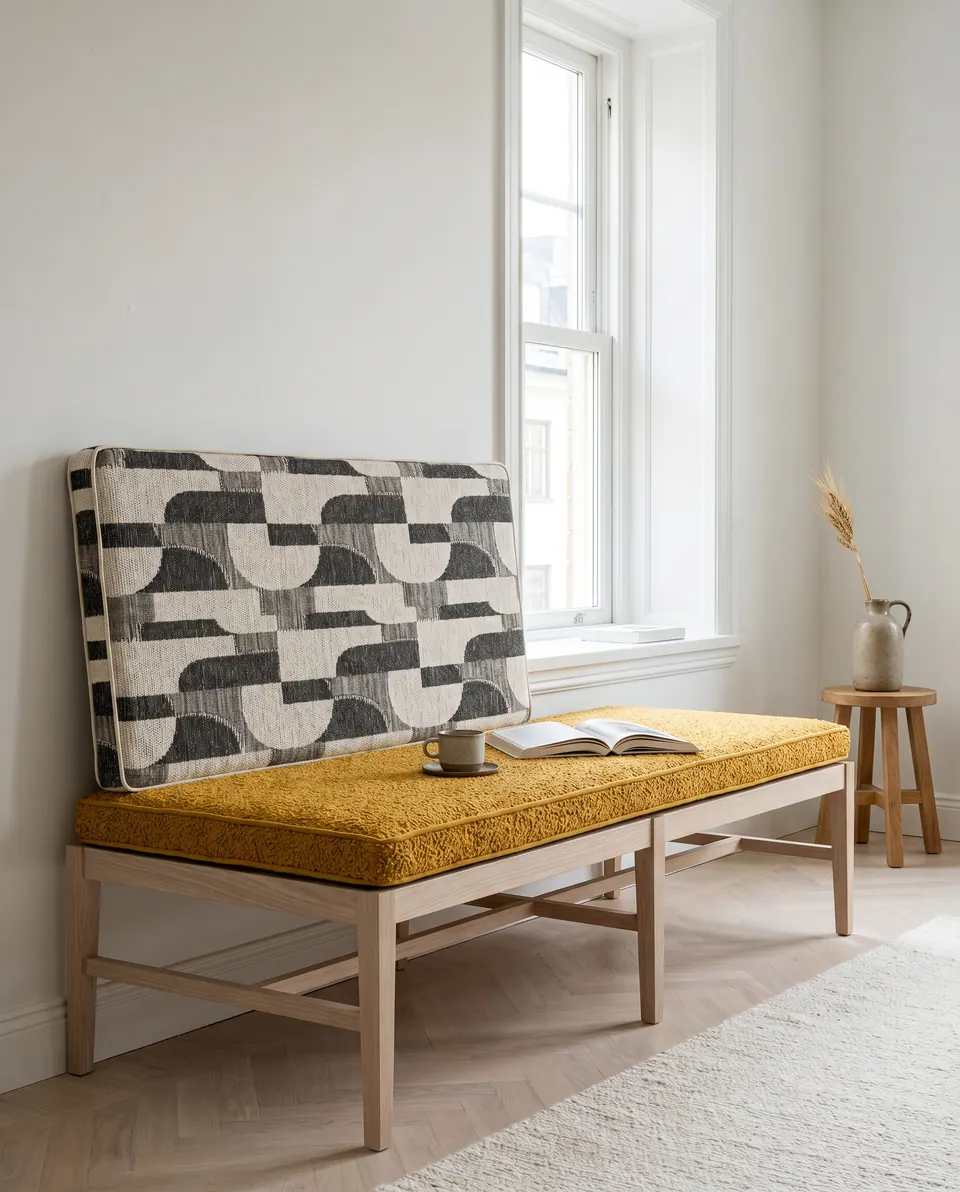
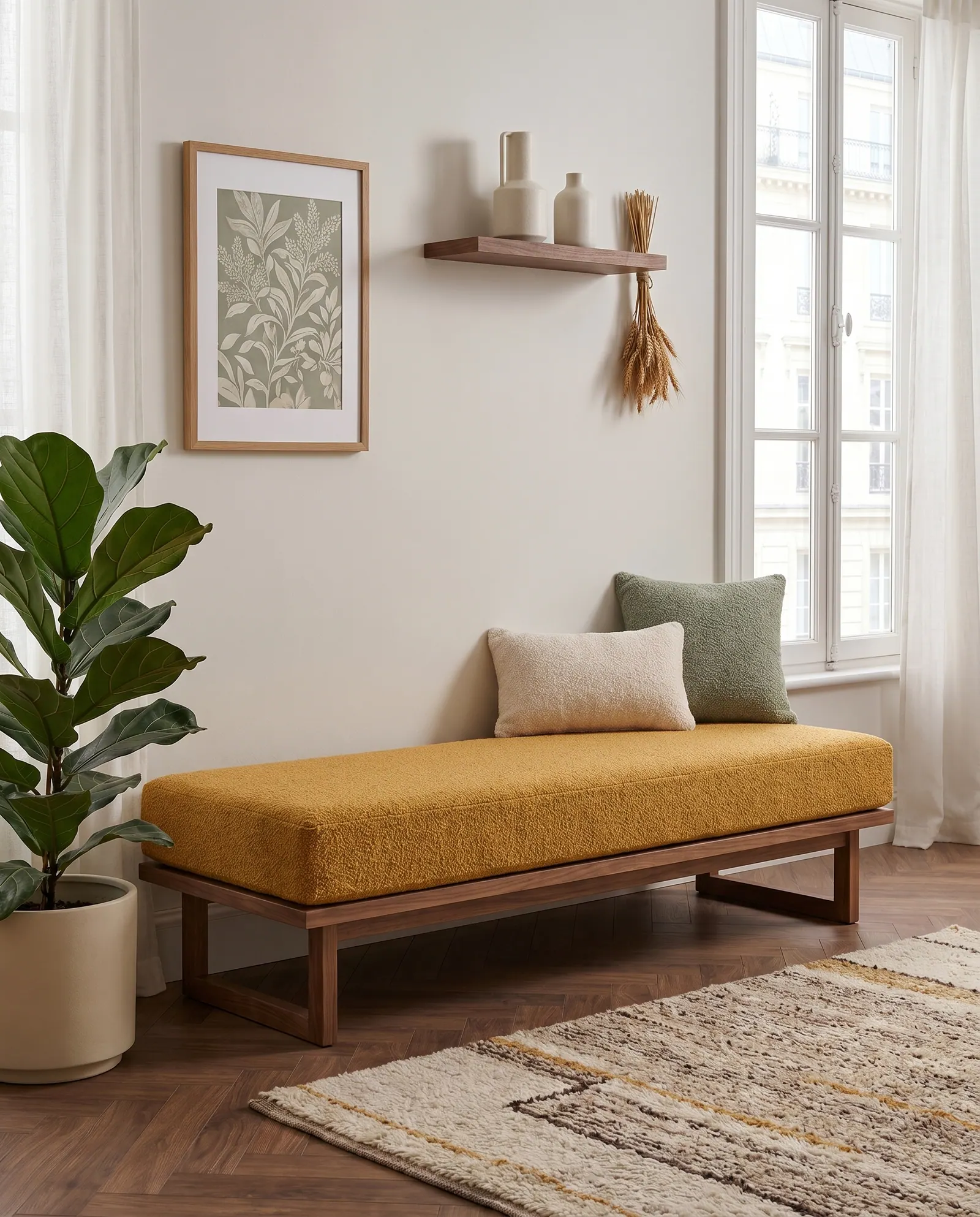
A deeper cushion on a low sled frame brings the seat up to a comfortable daybed height.
- Cream bouclé lumbar
The lumbar sits in front of the sage, so the pair steps down in size.
- Sage square pillow
Sage and mustard are a classic mid-century pairing.
- Walnut sled legs
Open sled legs keep the thick cushion from looking heavy.
- Dried wheat bundle
Hung beside the shelf, the wheat repeats mustard at eye level.
Plate Thick Mustard Bouclé Cushion on a Walnut Sled-Leg Bench
A thick mustard bouclé cushion gives a low walnut sled bench real comfort, styled with sage and cream pillows.
A Reading by MaggieBench Cushions
A Thick Mustard Bouclé Bench Cushion on a Walnut Sled Bench, Read at the Welt
Self piping, contrast or none? Maggie reads the edge of a deep bouclé box cushion and explains why a same-color welt wins on a fabric this nubbly.

The quick answer
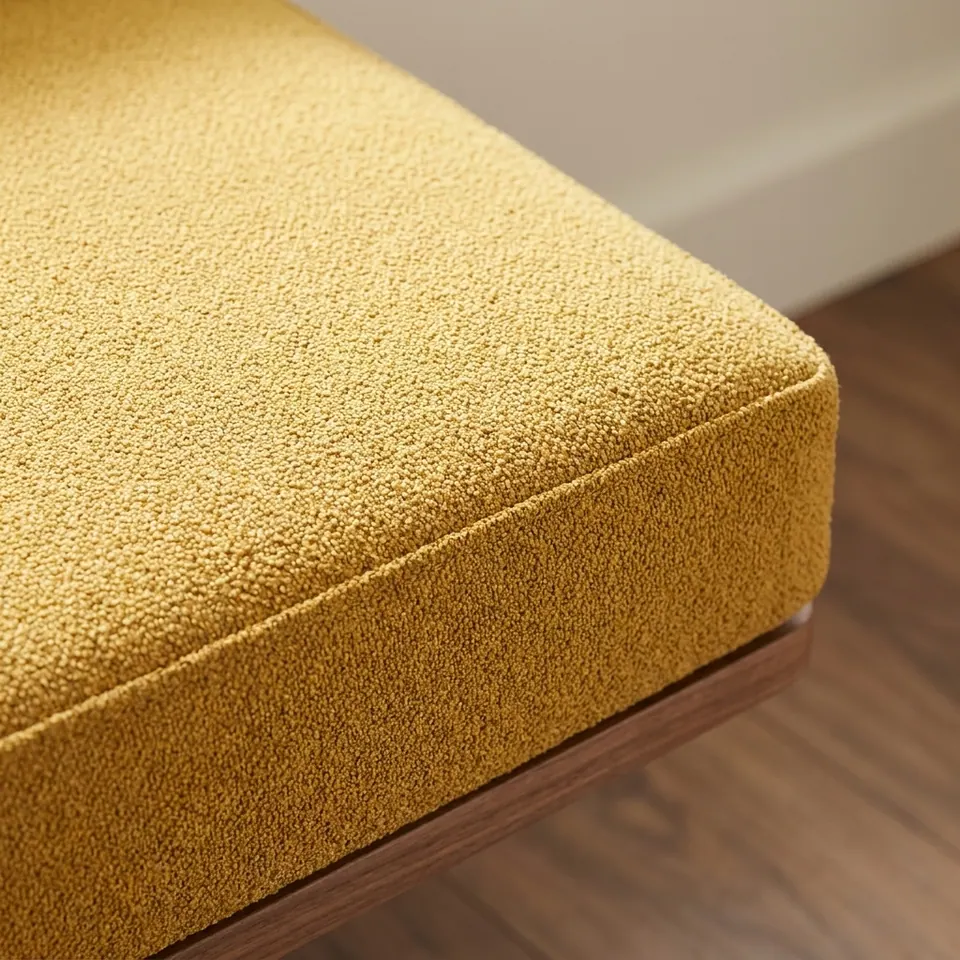
On a bouclé bench cushion, self piping is usually the right call: a welt in the same fabric gives a firm, soft edge, while a contrast cord would outline every loop. This thick mustard box cushion shows it on a walnut sled-leg bench, where open legs let a deep cushion look light instead of heavy.
Pinned by Maggie: five checks on a sled-leg bench
Five pins, from the mustard welt to the dried wheat by the shelf, showing how the edge, the depth and the pillows were decided.
The numbers match the pins on the plate.
- Thick mustard cushionA deeper cushion on a low sled frame brings the seat up to a comfortable daybed height.
- Cream bouclé lumbarThe lumbar sits in front of the sage, so the pair steps down in size.
- Sage square pillowSage and mustard are a classic mid-century pairing.
- Walnut sled legsOpen sled legs keep the thick cushion from looking heavy.
- Dried wheat bundleHung beside the shelf, the wheat repeats mustard at eye level.
Why the welt on this bouclé cushion is mustard, too
Right, then. A thick mustard bouclé box cushion on a walnut sled-leg bench, and the first thing I checked was the edge. Old habit.
The piping is self piping: a welt cut from the same mustard bouclé, so the top edge reads as one soft, firm fold rather than a drawn line. On a nubbly fabric that is the kind choice. Bouclé already has plenty to say, and a contrast cord would outline every loop. A straight welt is a kind of honesty, and a same-color one doesn't need to shout about it.
The cushion is deep, close to the height of the frame itself. On a wall bench that would look like a mattress. Here the sled legs leave the frame open underneath, light passes below the seat, and the thick block still looks light. A slim frame can carry a thicker cushion; a chunky base wants a thinner one. I once ordered it the other way around and lived with a very heavy bench for a very long year.
The pillows follow the rule I give for any bench cushion: lighter and smaller in front, darker and larger behind. Cream lumbar before sage square. Sage and mustard is the old mid-century pairing, and the dried wheat hung by the shelf carries mustard up to eye level, so the seat isn't the only warm note against white walls. The piping Pattern has the long version.
Self, contrast or no piping: what each does to the line
| Piping | What it does to the edge | Choose it when |
|---|---|---|
| Self piping | A welt in the body fabric; the edge reads as one soft, firm fold | The fabric is textured, like bouclé, or the color should carry the room alone |
| Contrast piping | A cord in a second color draws the outline like ink | The shape should read from across the room and the edges are dead straight |
| No piping | Top and border meet in a plain seam; the softest look | The cushion is casual, or a looped or pile fabric already blurs the edge |
Two angled seats and a sketch with every side labeled
One buyer wrote in needing two tufted cushions for two spaces with different angles, and sent the sizes in centimeters. Sensible. The shapes were the catch: the workshop confirmed they were trapezoids, not rectangles, and asked for a hand drawing with every side labeled.
Once the drawing arrived, the pair was quoted in white and blue velvet with center buttons, and a custom option was set up on the velvet listing so the order could go through.
Here's the piping connection, dear. A welt follows every edge you draw. If a side is missing from your sketch, it is missing from the cushion. A labeled sketch of every side is worth more than a paragraph of description, and the trapezoid cushion calculator will check your angles before you send it. So which of your bench edges would you leave to a guess?
Buyer questions: long runs, end backrests, a bay window L
- A common question
Can you make a really long or L-shaped cushion, something like 80 by 300?
The workshop's answerYes. The workshop first checks whether the size is in inches and whether the layout is L-shaped, and it can make the cushion flat, without buttons, in a linen-like fabric.
- A common question
My bench sits between two walls. Could I have two short backrest pillows at the ends instead of one full-length backrest?
The workshop's answerYes. Write in the personalization box that you'd like two backrest pillows, each 25 in (64 cm) wide or your own width, to sit against the walls at both ends. Standard backrest pillows are about 15 3/4 in (40 cm) tall.
- A common question
What would an L-shaped bay window seat cushion cost at 44 1/2 in (113 cm) on one side, 74 3/4 in (190 cm) on the other and 22 3/4 in (58 cm) deep?
The workshop's answerThe workshop quoted it as a single L-shaped bay window cushion straight from those three numbers. For a quote of your own, send both side lengths and the depth in one unit.
On the cutting table: the mustard sled bench
| Piece | Bench cushion, box edge |
|---|---|
| Fabric | Mustard yellow bouclé |
| Piping | Self piping in the same bouclé; matching piping is a common choice and has come at no extra charge |
| Thickness | Deep, close to the height of the sled frame |
| Frame | Freestanding walnut sled-leg bench, open underneath |
| Pillows | Cream bouclé lumbar in front, sage bouclé square behind |
| Rule of thumb | Slim frame, thicker cushion; chunky base, thinner cushion |
| Best for | Living rooms where a bench doubles as a lounging seat |

Have it made
Have this made — ask Maggie’s workshop
I once cut a lovely cushion two inches short, and I have not forgotten it. That is why the workshop goes over your measurements with you on the phone. — Maggie
Leave your details and the workshop will call you to confirm measurements, fabric, foam and piping. No prices, dates or payment on this page: it is a request, not an order.
Self piping suits a bouclé bench cushion: a contrast cord outlines every loop, while a same-color welt reads as one soft, firm fold.
Maggie
Questions buyers ask next
Does bouclé look better with self piping or contrast piping?
Self piping usually suits bouclé. The looped surface already carries texture, so a same-color welt gives a soft, firm edge, while a contrast cord outlines every bump. Save contrast for smooth fabrics and crisp, straight edges.
How thick should a cushion be on a low sled-leg bench?
A low, open frame can carry a thicker cushion, close to the frame's own height, which brings the seat up toward daybed comfort. A chunky solid base looks better with a thinner cushion, so the whole piece doesn't read as heavy.
How should throw pillows be arranged on a bench cushion?
Put the lighter, smaller pillow in front and the darker, larger one behind. Here a cream lumbar sits before a sage square, so the pair steps down in size and the mustard seat stays the main color.
Can piping follow a trapezoid or angled cushion?
Yes. The welt runs along every edge of the shape, which is why the workshop asks for a hand drawing with each side labeled. A side missing from the sketch becomes a guess on the cutting table.
Stitch straight — Maggie