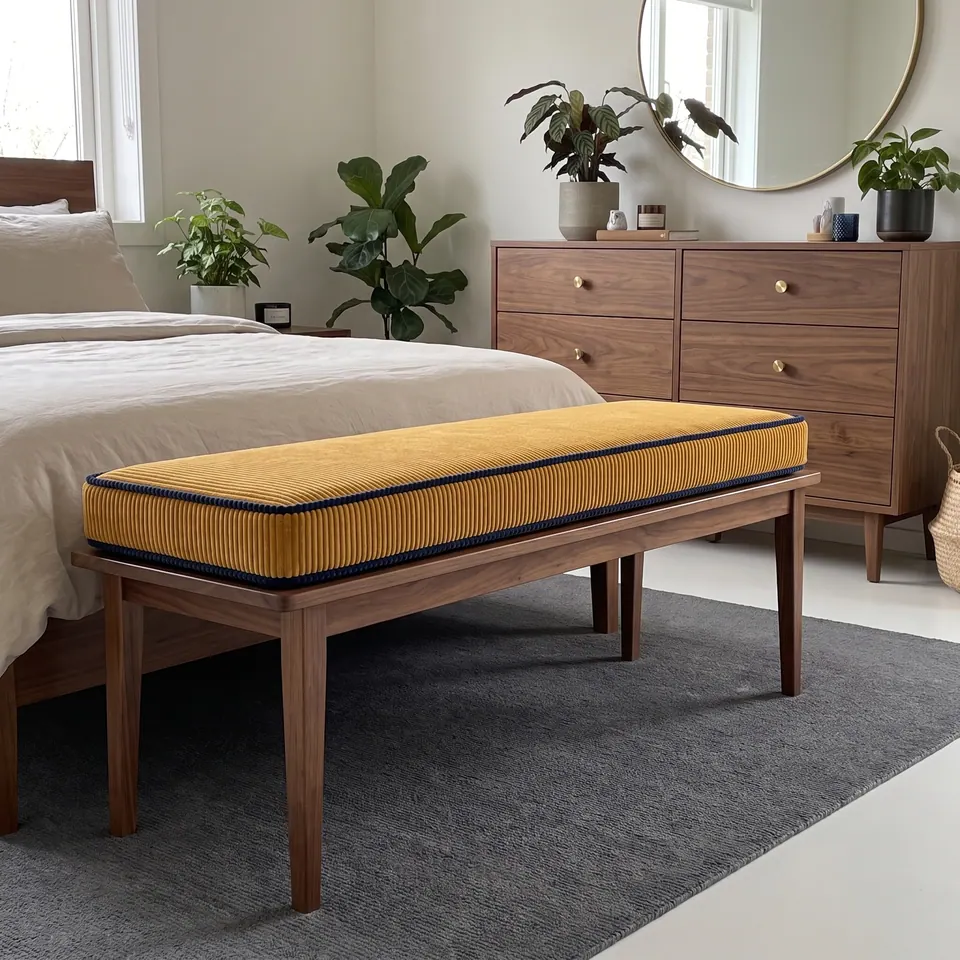
 Save
A Reading by MaggieBench Cushions
A mustard bouclé bench cushion up close, and the measuring behind that corner
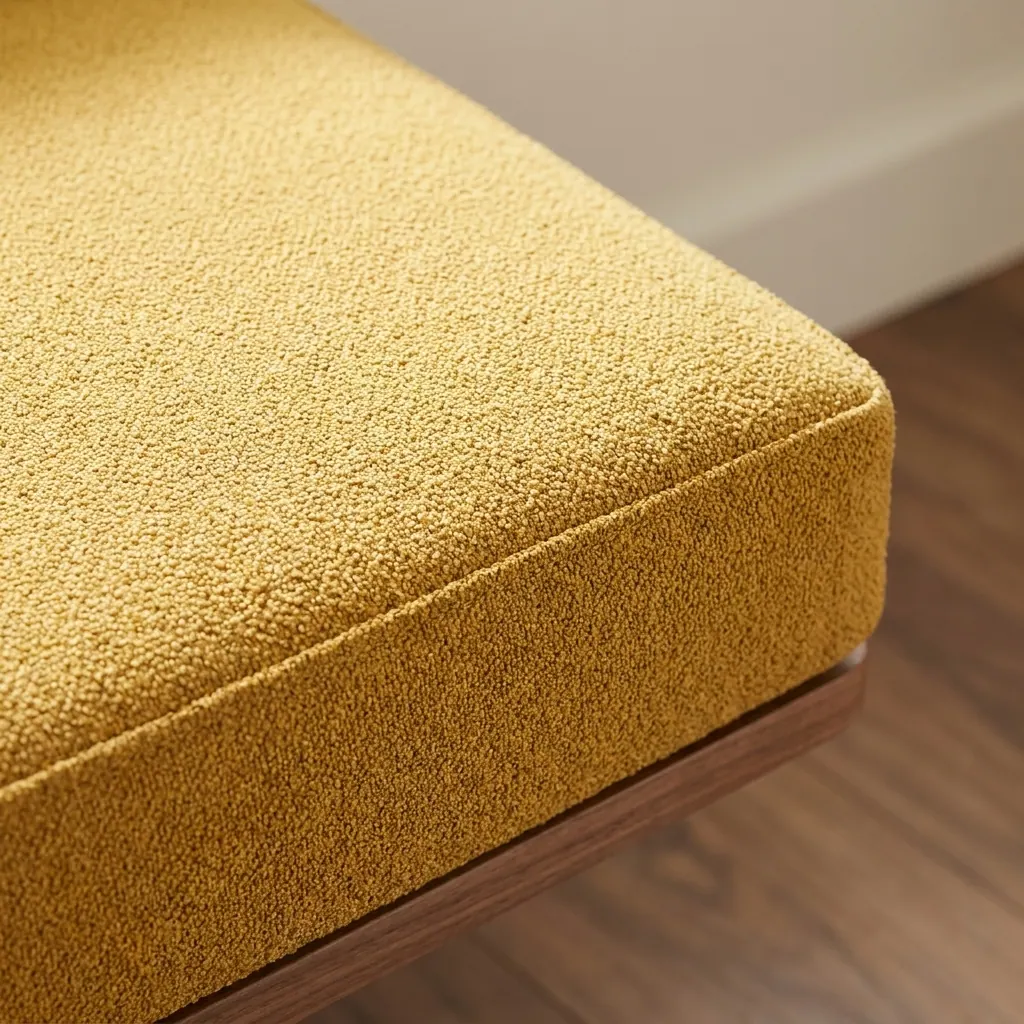
No piping, no pillows, no styling: one mustard corner on walnut. A close-up is where measuring mistakes have nowhere to hide, so I took the tape measure to it.
Mustard bouclé on walnut: a mid-century pairing where the fabric texture carries the edge.

The quick answer
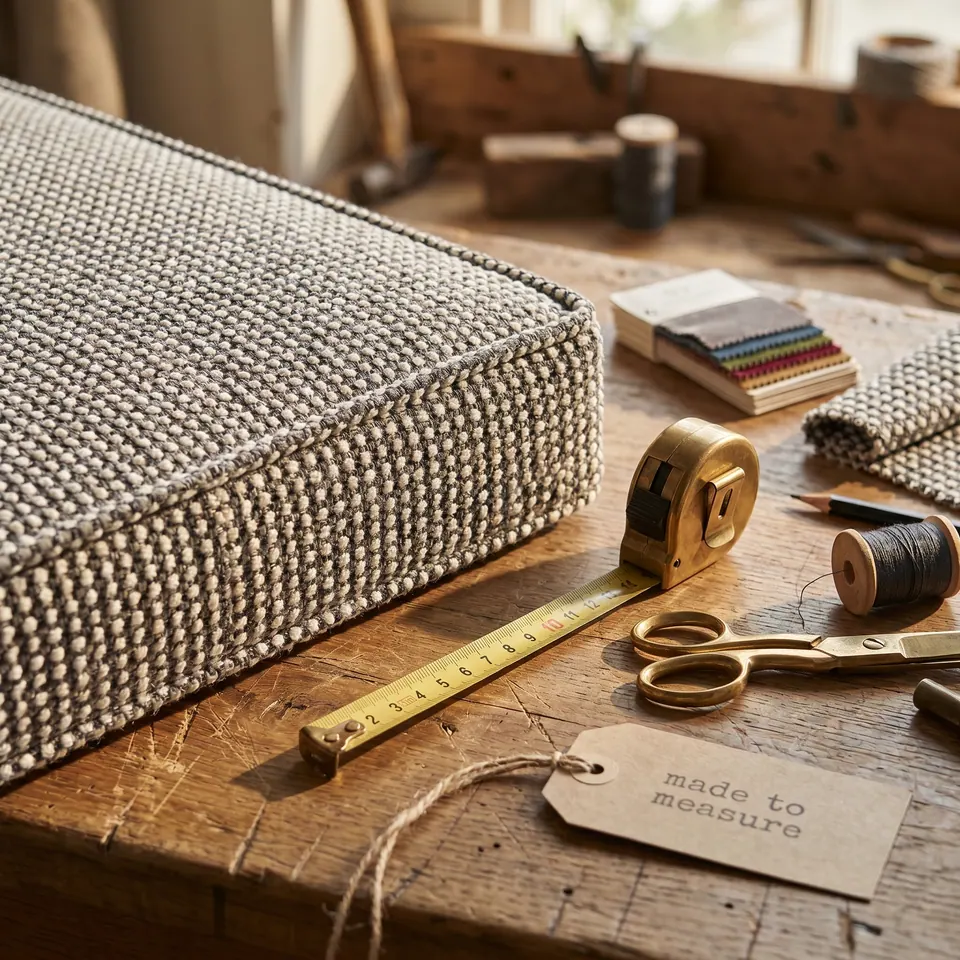
Measure a custom bench cushion from the bench itself: the length and depth of the top, the shape of each corner and the thickness you want, in fractional inches if that is what the tape says. An old cushion has squashed and spread, so copying it copies the wear. This mustard bouclé box cushion needs no piping; its loops outline the edge.
What a bare corner tells a tailor
A close-up is the most honest photograph a cushion ever sits for, and this one has nothing to hide behind.
It is a box cushion in mustard bouclé on a walnut bench, with no piping at all. I have spent thirty-odd years defending the welt, and even I'll admit one would be wasted here. The speckled loops already draw a soft, nubbly line along every edge. Put trim on flat cloth; let a textured cloth outline itself. Matching, contrast or no piping sets out the rule.
Now the corner nearest the camera. The foam rounds it very slightly, a relaxed shoulder rather than a knife point, and that easy shape suits a bold solid. The side boxing runs in one piece with no join along the visible face, which is exactly where a seam would have shown.
Mustard and walnut is an old mid-century pairing. The dark wood pushes the yellow toward gold, where pale oak would make it read lemony. The white baseboard behind keeps the color from swallowing the frame, and the dark floorboards hold everything down. Three supporting players, all wood and paint. That restraint is the design.
What color is the wood under your bench? Before you order a custom bench cushion like this one, read the list below; it is where I watch measurements go astray. The cloth itself lives with the bouclé and teddy family.
A mustard bouclé box cushion needs no piping: the looped surface already draws a soft line along every edge, and a welt would only repeat it.
Maggie
Pinned by Maggie: four details at close range
Four pins, from the softly rounded corner to the walnut edge that turns the yellow gold.
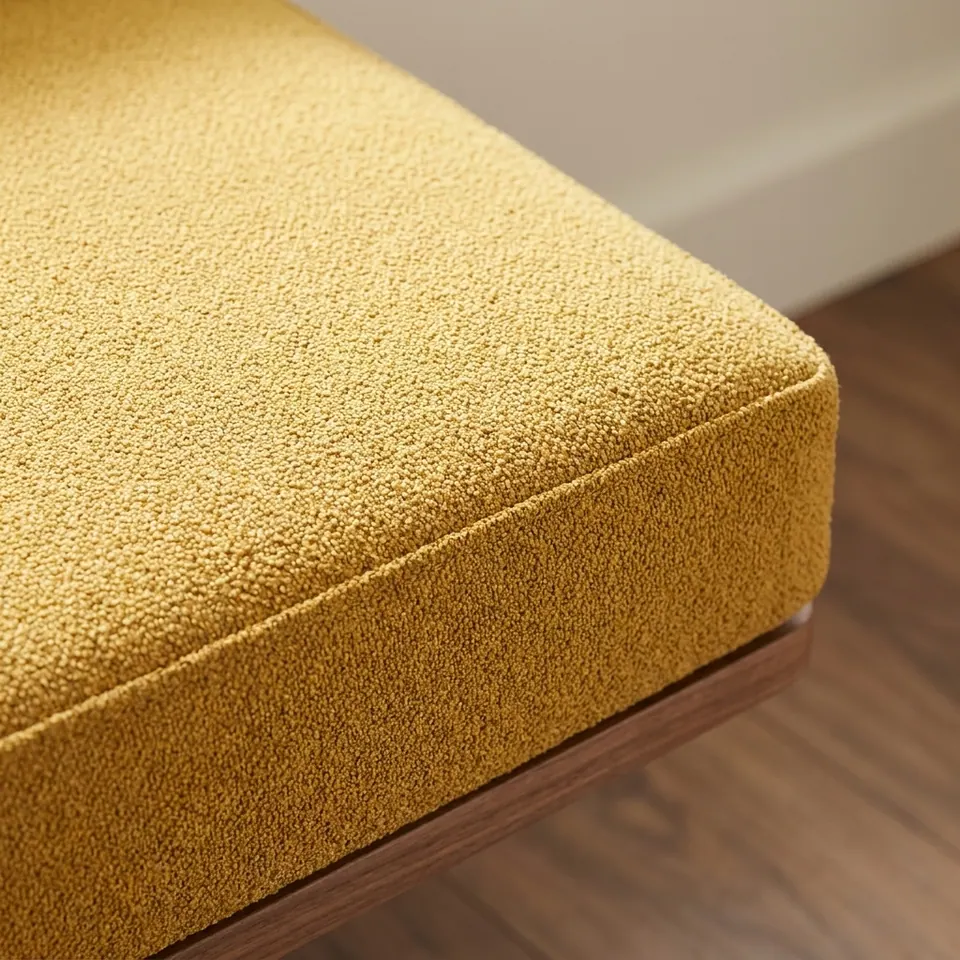
- Rounded box corner
The corner is slightly rounded by the foam, a relaxed look that suits a bold color.
- Speckled mustard loops
Mustard bouclé has a lively speckle, so it keeps interest even with no piping.
- Side boxing
The boxing is cut in one piece with no visible join along this side.
- Walnut base edge
Mustard and walnut is a classic mid-century pairing; the dark wood makes the yellow look richer.
- Rounded box cornerThe corner is slightly rounded by the foam, a relaxed look that suits a bold color.
- Speckled mustard loopsMustard bouclé has a lively speckle, so it keeps interest even with no piping.
- Side boxingThe boxing is cut in one piece with no visible join along this side.
- Walnut base edgeMustard and walnut is a classic mid-century pairing; the dark wood makes the yellow look richer.
Where the tape measure goes wrong on a bench like this
- Measuring the old cushion. It has slumped, spread and rounded. Measure the bench, not the cushion you used to have.
- Rounding to the nearest inch. Fractional sizes are fine, and 65 1/8 in (165.4 cm) is an order, not a nuisance.
- Guessing the corners. Say square, clipped or rounded, and give the radius for rounded ones; measuring rounded corners shows where the tape goes.
- Measuring once. Take the depth at both ends and the length at front and back; a handmade bench is rarely a perfect rectangle.
- Forgetting the height. Bench height plus cushion thickness is your seat height; check it with the seat height calculator before you choose a thickness.
The backrest that arrived smelling of smoke
A buyer got in touch about one backrest cushion for a living-room floor sofa that arrived smelling strongly of cigarette smoke. They aired it for several days and washed the cover a few times, and the fabric came clean. The foam insert did not. It still held the smell, and it was far too big for any washing machine. The workshop sent a replacement filling.
Why tell that story in a measuring Reading, dear? Because the cover is the part you wash, and the insert is the part you measure for, live with and, now and then, replace. Get the insert's numbers right once, keep them in a drawer, and a new cover or a new filling becomes a simple swap. Airing advice for fresh foam is in new foam smell and airing.
On the cutting table: mustard on walnut
| Product | Custom bench cushion, rectangle |
|---|---|
| Fabric | Mustard bouclé with a speckled loop |
| Edge | Box edge; corners softened slightly by the foam |
| Piping | None; the loops outline the edge |
| Boxing | One piece along the visible side |
| Base | Walnut bench over dark floorboards, white baseboard behind |
| Sizes | Fractional inches accepted, e.g. 65 1/8 in (165.4 cm) |
| Measure | Length at front and back, depth at both ends, corner shape, seat height |
| Best for | Mid-century living rooms, entry benches, statement seats |

Have it made
Have this made — ask Maggie’s workshop
I once cut a lovely cushion two inches short, and I have not forgotten it. That is why the workshop goes over your measurements with you on the phone. — Maggie
Leave your details and the workshop will call you to confirm measurements, fabric, foam and piping. No prices, dates or payment on this page: it is a request, not an order.
Buyer questions: matching a sofa, bolsters on angles, and fractional inches
- A common question
My sofa came from another maker. Will a backrest or extra piece from you match its color?
The workshop's answerThe workshop can't promise an exact tone match with another maker's fabric, but choosing the nearest color gets close. Send a photo when your other piece arrives and the workshop will confirm the match. If the sizes are similar, replacing every cover at once takes the guesswork out.
- A common question
Could you make a trapezoid window seat cushion with bolsters along the angled sides?
The workshop's answerYes. The workshop needs every side length plus the seat depth. One seat measured 117 in (297 cm) along the back, 68.5 in (174 cm) along the front and 34 in (86 cm) on each diagonal, 25.5 in (65 cm) deep. The cushion was 4 in (10 cm) thick, the bolsters 10 in (25 cm) across, and it was made without tufting for clean lines.
- A common question
My breakfast nook needs three tufted cushions in odd sizes: 65 1/8 x 17, 56 1/4 x 17 and 91 x 17 in. Is that possible?
The workshop's answerYes, fractional inches are no trouble. Those three, 65⅛, 56¼ and 91 in (165.4, 142.9 and 231.1 cm) long by 17 in (43.2 cm) deep, were made as French-style tufted linen cushions on one custom order link. That order took 7 business days of production and another 3 to 5 business days of delivery.
Questions buyers ask next
Should a bouclé bench cushion have piping?
Usually not. The looped surface gives every edge its own soft outline, so a welt adds little. Piping earns its place on flat weaves such as cotton or linen-look, where the edge needs a drawn line to look tailored.
Why does a box cushion corner look slightly rounded?
Foam inside a snug cover softens a square corner a little, and a thick, textured cloth adds to the effect. If the bench itself has rounded corners, measure the radius and write it down so the cushion follows the wood.
What wood tone suits a mustard cushion?
Dark wood such as walnut deepens mustard toward gold; pale oak makes it brighter and more lemony. Keep the other surfaces to wood and white so the one saturated solid carries the bench on its own.
How precise should bench measurements be for a made to measure cushion?
As precise as your tape. Write fractions exactly as measured, such as 65 1/8 in, and take the depth at both ends and the length at front and back. The cushion is made to the numbers you send.
Stitch straight — Maggie