Across the Map · Europe
Custom cushions for Estonian wooden houses, apartments and summer homes
Tallinn's shortest day has about six hours of light. Its longest has more than eighteen. A cushion here lives through both.
- Sun & UVModerate
- HumidityHumid
- WinterCold
- CoastSalt air nearby
- Typical seatsWindow seat, sauna dressing room bench, summer-home terrace chairs

 Save
The quick answer
Custom cushions in Estonia work hardest in three places: window seats through the short days of December, sauna dressing rooms and terraces at summer homes, and apartments in wooden houses or Soviet-era blocks. Choose zippered, washable covers, keep foam cushions out of the hot steam room, use outdoor fabric on terraces, and pick pale colors that return low winter light.
Field notes
Weather and light in Estonia
- Sun & UVModerate (level 2 of 4)About 21 sunshine hours in all of December, 294 in June
- HumidityVery humid (level 4 of 4)81% on average in Tallinn, driest in May
- Rain & stormsModerate (level 2 of 4)About 28 in (700 mm) a year
- Snow & freezeRegular (level 3 of 4)January nights average 22°F (−5.5°C) in Tallinn
Watch for
- Damp air in closed summer homes
- Wet towels in the sauna dressing room
- Six-hour days at the window in December
Plain-language levels from general climate patterns, not measurements. Your own porch, shade and window exposure matter more.
About six hours in December, more than eighteen in June
On the winter solstice Tallinn has a little over six hours of daylight. At midsummer it has more than 18 hours and 40 minutes, and the nights stay pale.
The sunshine follows. December averages about 21 hours of sun for the whole month. June averages about 294.
The air is damp. Average humidity in Tallinn is 81%, highest around 89% and lowest, 69%, in May. Precipitation comes to about 28 in (700 mm) a year, and January nights average 22.1°F (−5.5°C).
Two things follow. In winter the window seat is where the light is, so the cushion should give it back: pale and matte. In summer the long days put real light on a sill, so turn the cushion now and then and keep strong colors out of full sun.
Wooden houses, stone stairs, block apartments
Kalamaja's wooden houses were built for the workers who came after the railroad reached Tallinn in 1870. The district is one of the best-preserved areas of wooden architecture in Estonia.
The Tallinna maja, the Tallinn house, came later: a two- or three-story wooden apartment house with a stone stairwell, built from the 1920s until the Second World War. More than 500 survive in Tallinn, and 32 are protected as architectural monuments.
Then the large Soviet-era districts: Mustamäe, Väike-Õismäe and Lasnamäe, which is still Tallinn's most populous district.
Each has its seat. In a wooden house it may be a low bench under an attic window. In a block apartment it is the balcony, or a floor mattress in a small bedroom. Measure the seat, not the room. The Pattern on measuring a window seat shows how, and the window seat hub shows the edges.
The sauna rule: cushions in the dressing room, never on the hot bench
The smoke sauna tradition of Võromaa, in southeast Estonia, was added to UNESCO's list of intangible cultural heritage in 2014. About 800 smoke saunas have been counted in the country.
A sauna has rooms, and only one of them is hot. Foam cushions belong in the dressing room, on the terrace, on the bench where you cool down. Not on the benches of the steam room. In a smoke sauna the walls and ceiling also gather soot, one more reason to keep fabric out.
In the dressing room, wet skin and damp towels meet the cushion. Choose a zippered cover that comes off for the machine, and a fabric that dries quickly: performance fabric or outdoor acrylic. Leave the door open after the sauna so the room can air.
The same habit keeps a summer home in Finland dry.
Window, sauna room, terrace, floor
| Seat | Fabric | Thickness | Notes |
|---|---|---|---|
| Winter window seat | Linen or linen-look, pale | 2 to 3 in (5 to 7.5 cm) | Self piping; non-slip base |
| Sauna dressing room bench | Performance fabric or outdoor acrylic | 2 in (5 cm) | Zippered, washable cover; never in the steam room |
| Summer-home terrace armchairs | Outdoor linen-look, UV-resistant and water-repellent | 3 to 4 in (8 to 10 cm) seats | Ties at the back corners |
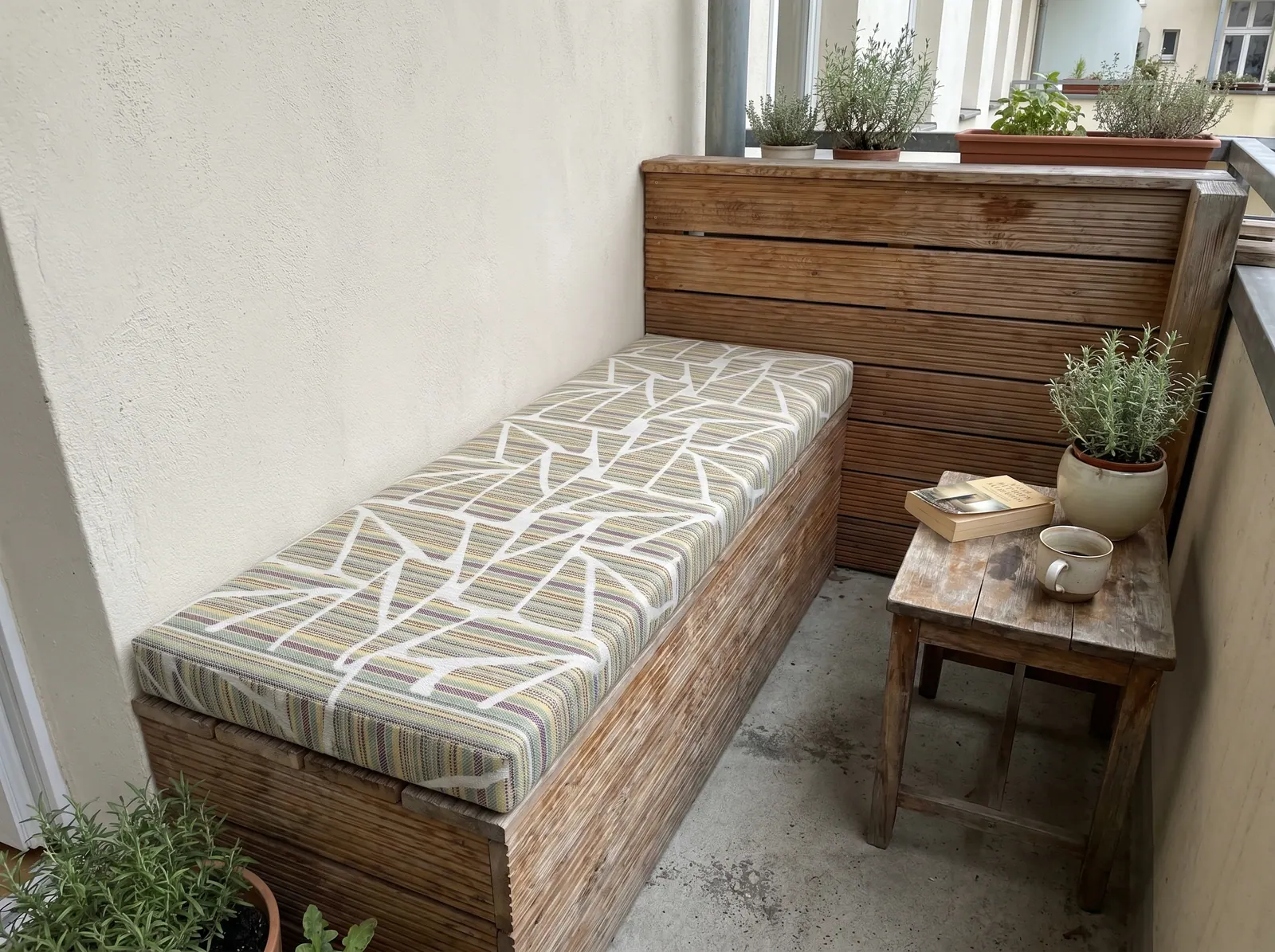
| Block-apartment balcony bench | Outdoor acrylic | 2 to 3 in (5 to 7.5 cm) | Indoors for the cold months |
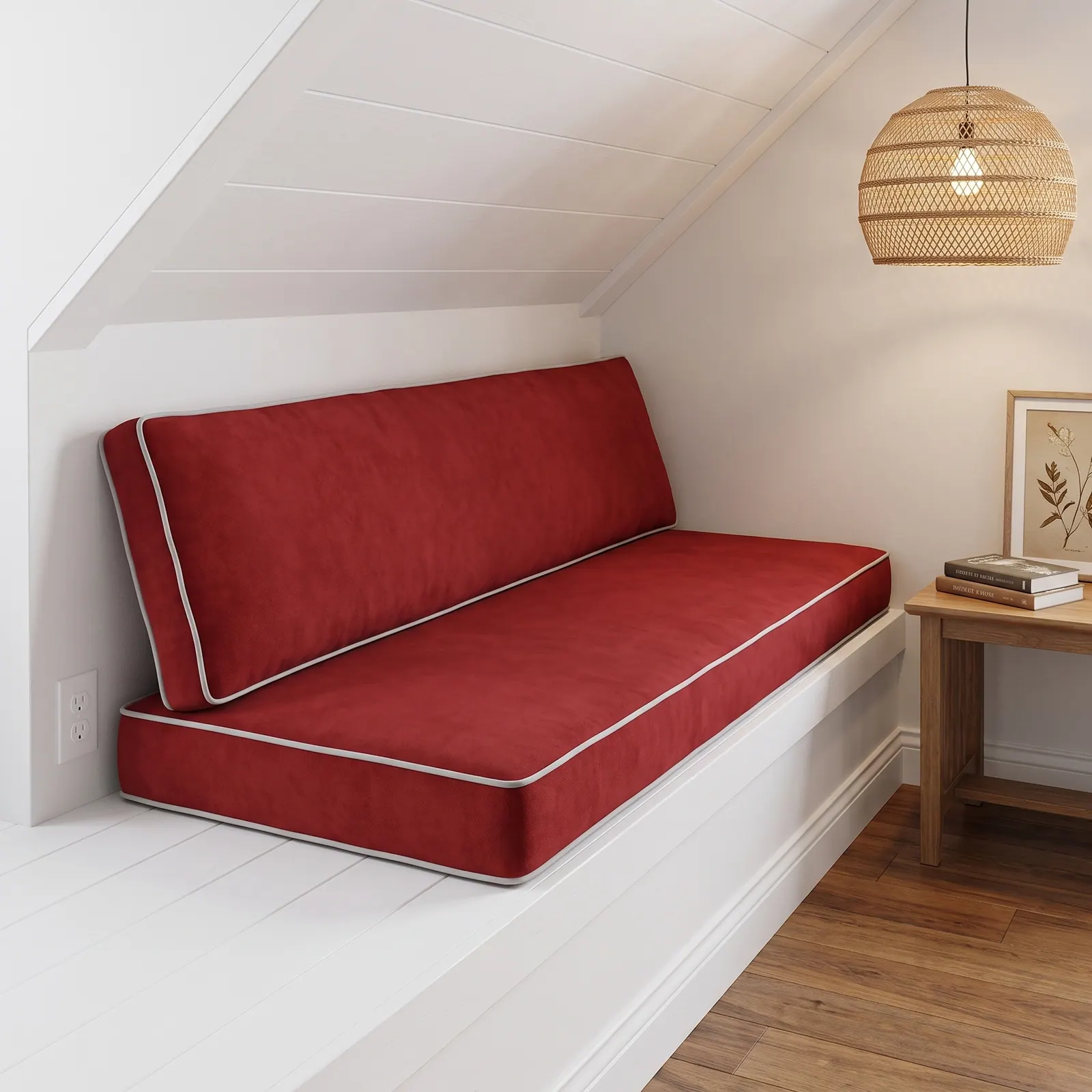
| Attic nook under a sloped ceiling | Linen or corduroy | 2 in (5 cm) | Check head height from the seat board first |
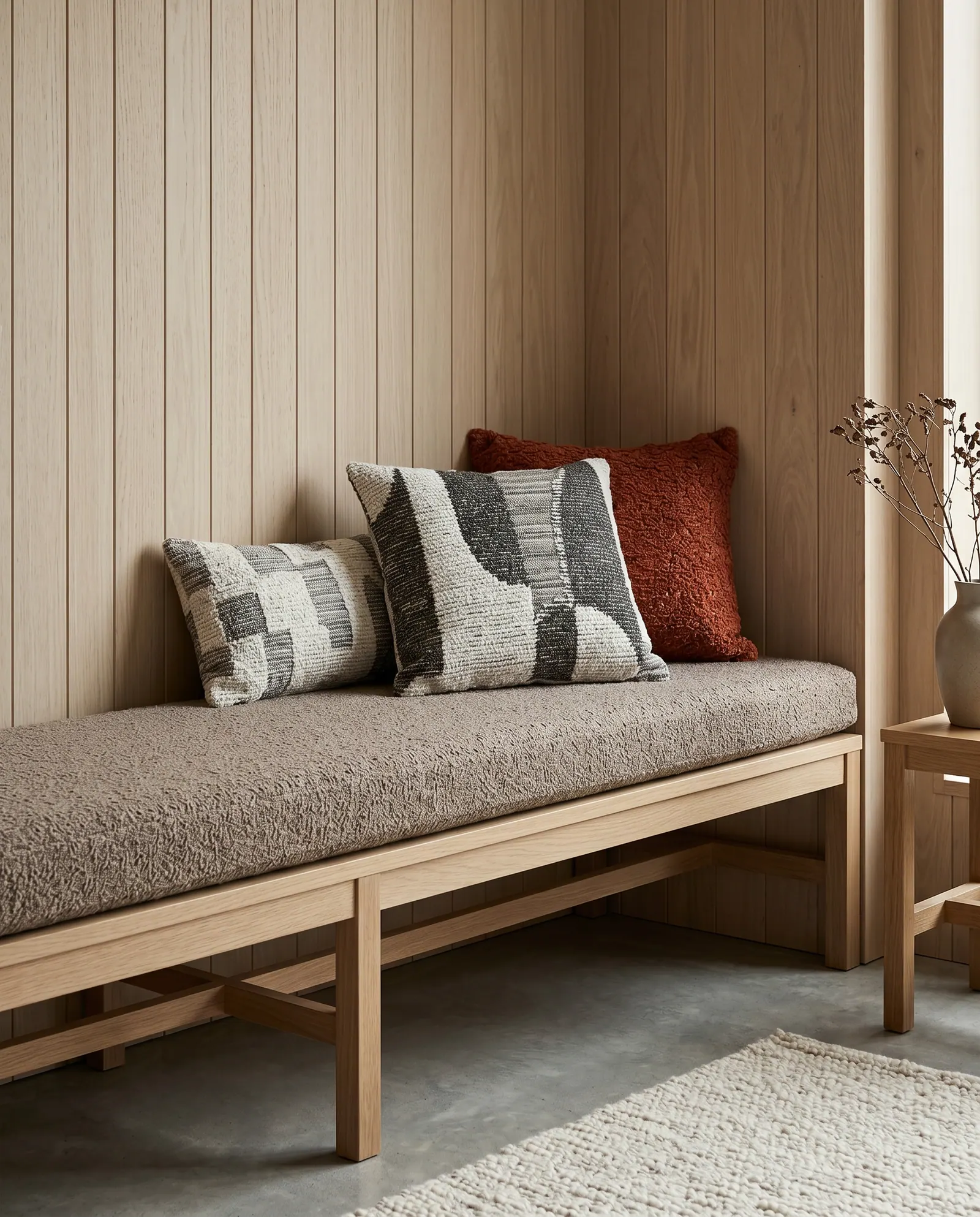
| Bedroom floor mattress | Linen-look or bouclé | Made in two halves, such as two 29.5 x 59 in (75 x 150 cm) pieces | Easier to make, ship and carry |
Seat foam is 32 kg/m³, about 2.0 lb/ft³. Cotton ticking stays indoors; outdoors, only outdoor fabric.
Picked for Estonia
Seats to start from
Fabric families
Try it in the Studio
A bone-white floor mattress, made in two
A buyer in Estonia wanted a floor mattress for a minimalist bedroom. 59 x 59 in (150 x 150 cm), bone white, no ruffles, finished plainly like the workshop's sofas.
The workshop suggested two pieces of 29.5 x 59 in (75 x 150 cm).
Two halves lie together as one surface. They are easier to make and ship, and easier to carry up a narrow stairwell. The room stays quiet: one pale plane on the floor, nothing more.
Leave a hand's width of floor around it. The eye reads the space as calm when the edges can breathe. The floor cushion hub has the thicknesses.
How wide is the space you have in mind?
- Measured
- 59 x 59 in (150 x 150 cm) requested; 2 x 29.5 x 59 in (75 x 150 cm) proposed
- What it taught
- Very large floor mattresses are easier to make, ship and handle in two halves.
An Estonian year, in cushion tasks
- May: the driest month, 69% average humidity. Air stored cushions outside before summer.
- June and July: long light on the sill. Turn window seat cushions now and then.
- After each sauna evening: unzip damp dressing-room covers and leave the door open.
- Wash covers at 86°F (30°C) on a gentle cycle, no bleach; air dry, no tumble dryer.
- Before the summer home closes: dry the foam completely, standing on edge.
- Store off the floor, indoors, in breathable bags. Never sealed damp.
- December: wipe the sill dry if the glass sweats under a window seat.
Photographs for homes like these
Open any photograph large; each one has its own link and a Save button.
 Save
 Save
 Save
 Save
 Save
Pale rooms, one warm line
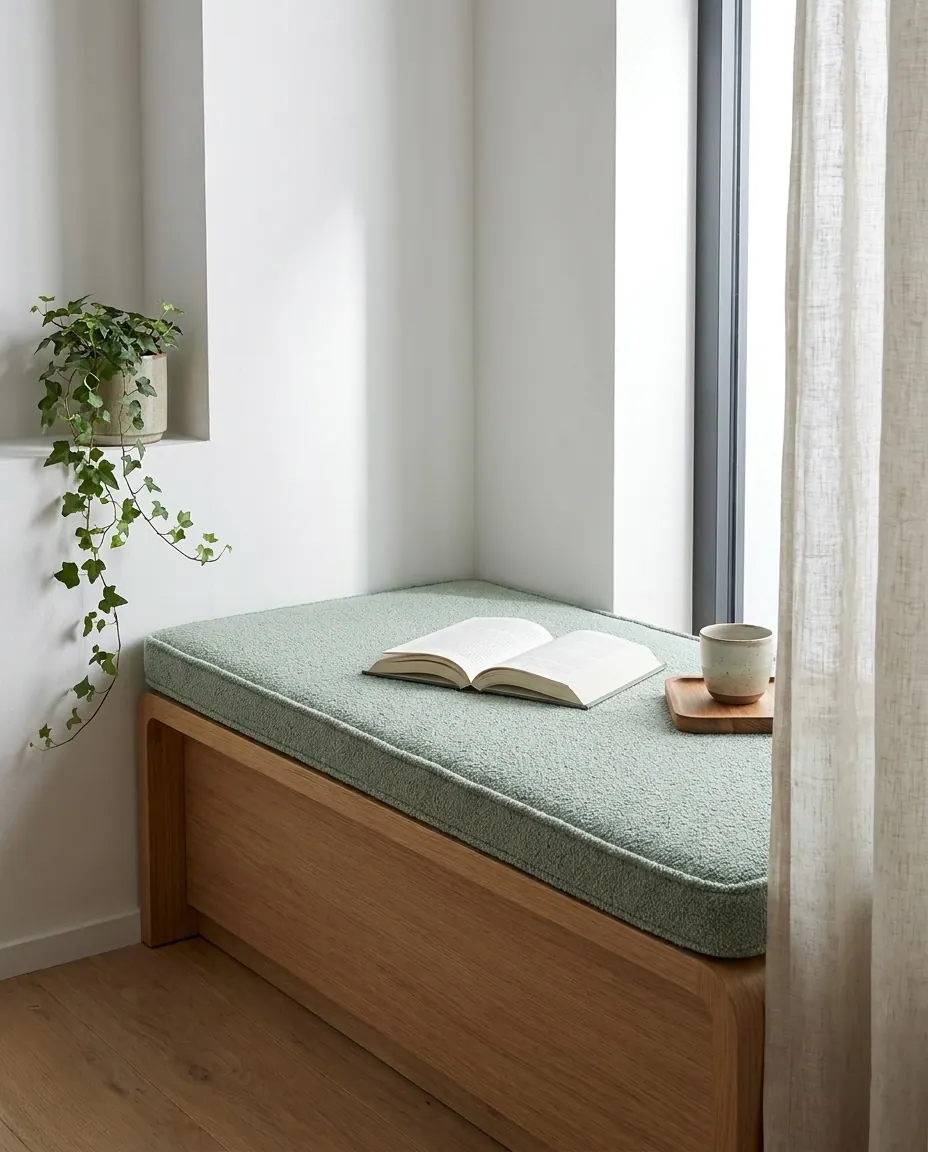
In six-hour days, pale is practical. Light surfaces return light. For the cushion body: oat, birch white, warm gray in a linen. For a single line of piping: rust, or a deep forest green.
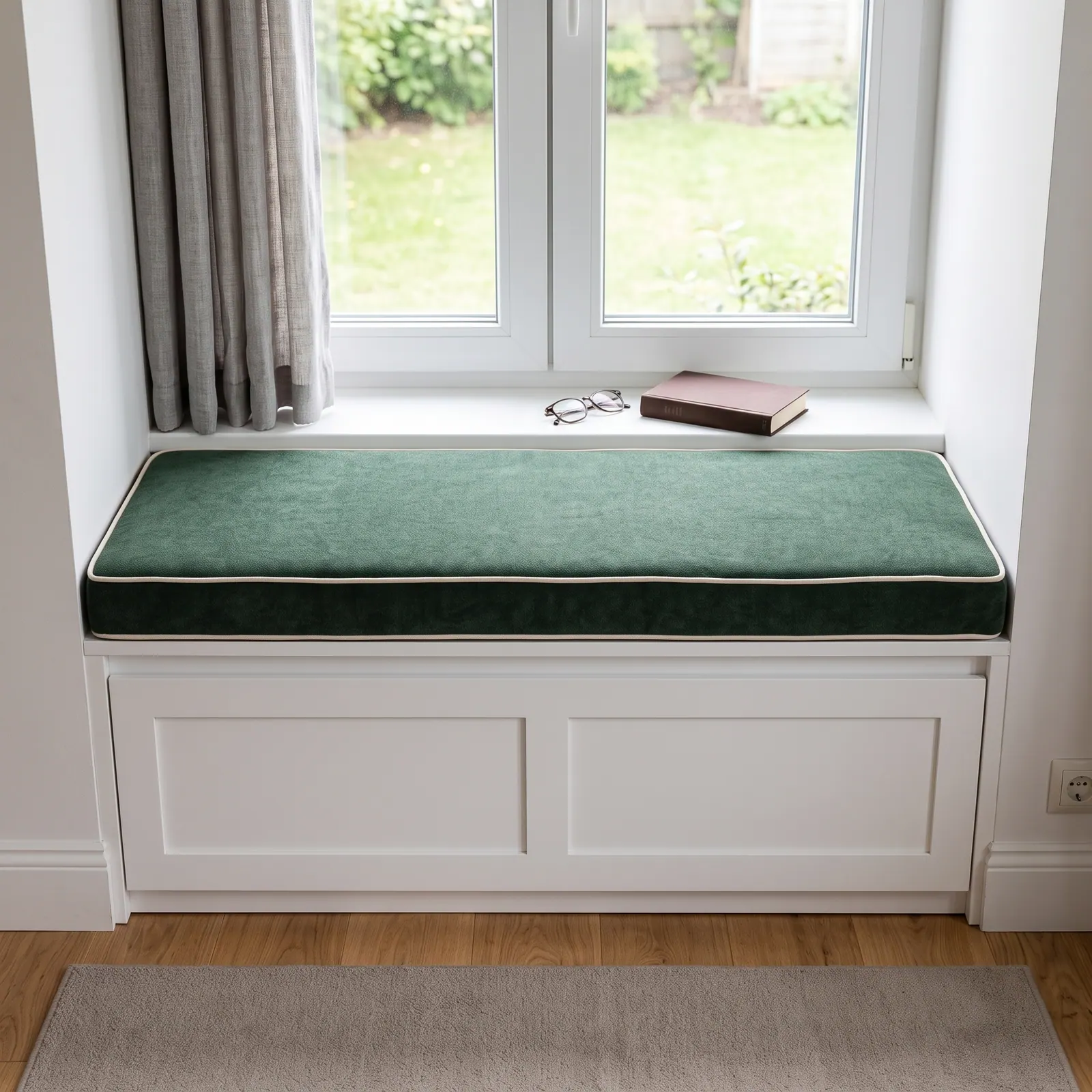
Or turn it around, as in the photograph above: a forest green cushion with ivory piping reads as one calm block in a white window recess.
Short days. A pale wall. The window does the rest.
In Estonia a cushion lives through six-hour days and eighteen-hour days. Build it for both.
Hana
Buyer questions: zippers, armchairs and backrest heights
- A common question
Does every cushion come with a zipper so I can wash the cover?
The workshop's answerYes. Every cushion has a zippered cover that comes off for washing, and cover-only orders are sent with zippers too.
- A common question
I only know the overall size of our garden armchairs. Is that enough for seat and back cushions?
The workshop's answerNot for a good fit. Measure the width between the armrests, the seat depth and the back height you want. The workshop recommends 3 to 4 in (8 to 10 cm) seats in 32-density HR foam wrapped in polyester wadding, with ties at the back corners. Boxed cushions with piping are no problem.
- A common question
Will the color look the same at home as it does on my screen?
The workshop's answerThere can be small differences in daylight. The workshop sends real photos of the fabric on finished cushions and suggests ordering samples.
- A common question
How tall are the back pillows on a daybed set? Could they be 27.5 in (70 cm)?
The workshop's answer16 in (40 cm) is the standard height, so a 79 in (200 cm) daybed takes two back pillows of 16 x 39 in (40 x 100 cm). 27.5 in (70 cm) is too tall to work as a backrest.
- A common question
How do I measure for new covers on shaped chair pads?
The workshop's answerDraw the foam insert with every side labeled, for example a slight trapezoid of about 17.75 x 17 x 19.75 x 17 in (45 x 43 x 50 x 43 cm) with rounded front corners, 1.5 in (4 cm) high. Measure the bare foam, not the old cover. When one set came out about ¾ in (2 cm) short, the remake was cut ½ to ¾ in (1 to 2 cm) larger.

Have it made
Have it made for your home — ask Hana’s workshop
Measure once, slowly. Write the numbers here. The workshop will go over them with you. — Hana
Leave your details and the workshop will call you to confirm measurements, fabric, foam and piping. No prices, dates or payment on this page: it is a request, not an order.
Questions buyers ask next
Can a foam cushion go on a sauna bench?
Not on the hot benches of the steam room; the heat and steam there are not what upholstery foam and cushion fabric are made for. Use cushions in the dressing room, on the terrace or on a cooling-off bench, with a zippered cover you can wash.
What colors suit a Tallinn apartment in winter?
Pale, matte colors such as oat, birch white or warm gray return the little light there is: December in Tallinn averages about 21 hours of sunshine for the whole month. Keep saturated colors for one pillow or a line of piping.
How should summer-home cushions be stored for an Estonian winter?
Clean and dry, indoors, off the floor. Wash covers at 86°F (30°C), dry the foam standing on edge and use breathable bags. Tallinn's average humidity is 81%, so never seal anything that is still damp.
How thick should a cushion be in an attic nook with a sloped ceiling?
Measure from the seat board to the ceiling above where you sit, then sit on the bare board to check. In a low nook, 2 in (5 cm) keeps head room; 3 in (7.5 cm) is softer if the height allows.
— Hana
The atelier
Keep going
Across the Map
Nearby places
Close by on the map