Across the Map · Pacific Northwest · United States
Custom cushions for Alaska cabins, window seats and boats
Juneau sees rain or snow on 224 days a year. Fairbanks gets 3 hours 39 minutes of daylight on the shortest day. An Alaska cushion lives mostly indoors, and it still has to handle wet boots, woodstove heat and a skiff that comes out of the water before freeze-up.
- Sun & UVModerate
- HumidityModerate
- WinterLong and hard
- CoastSalt air nearby
- Typical seatsArctic-entry bench, window seat, cabin bunk mattress

 Save
The quick answer
Custom cushions in Alaska are mostly indoor work: window seats for long winter dark and long summer light, arctic-entry benches that take wet boots, and cabin bunk mattresses. Use outdoor or performance fabric by the door, foam-filled outdoor cushions on skiffs, and keep every cushion at least 3 ft from the woodstove. Vacuum-packed foam travels small but should be opened within weeks.
224 wet days in Juneau, 225 freezing ones in Fairbanks
Alaska is three climates wearing one name. Plan cushions for the one you live in.
Southeast is the rainforest coast. Juneau averages 66.99 in (170 cm) of precipitation, with rain or snow on 224 days a year. The station near Ketchikan logs 103.51 in over 226 days. The Tongass there is the largest national forest in the country and the largest intact temperate rainforest in the world. Treat it like the Pacific Northwest, only wetter and saltier. Rain doesn't negotiate.
Southcentral is gentler. Anchorage gets 16.42 in of precipitation and 77.9 in of snow, with 191 days at or below freezing and 239 cloudy ones.
The Interior is dry and cold. Fairbanks gets 11.67 in of precipitation, 64.6 in of snow and 225 freezing days. May afternoons there average 37% humidity.
Then the light. On December 21, Fairbanks has 3 hours 39 minutes of daylight, Anchorage 5 hours 27 minutes, Juneau 6 hours 24 minutes. In June, Anchorage passes 19 hours of sunlight. Fresh snow almost doubles UV exposure, so a south window over a snowy yard in March fades fabric faster than the latitude suggests.
Arctic entries, dry cabins and the window seat that watches weather
Search data says it plainly. Alaska ranks last in the country for 'outdoor cushions' and next to last for 'bench cushion'. Up here the cushion work happens inside.
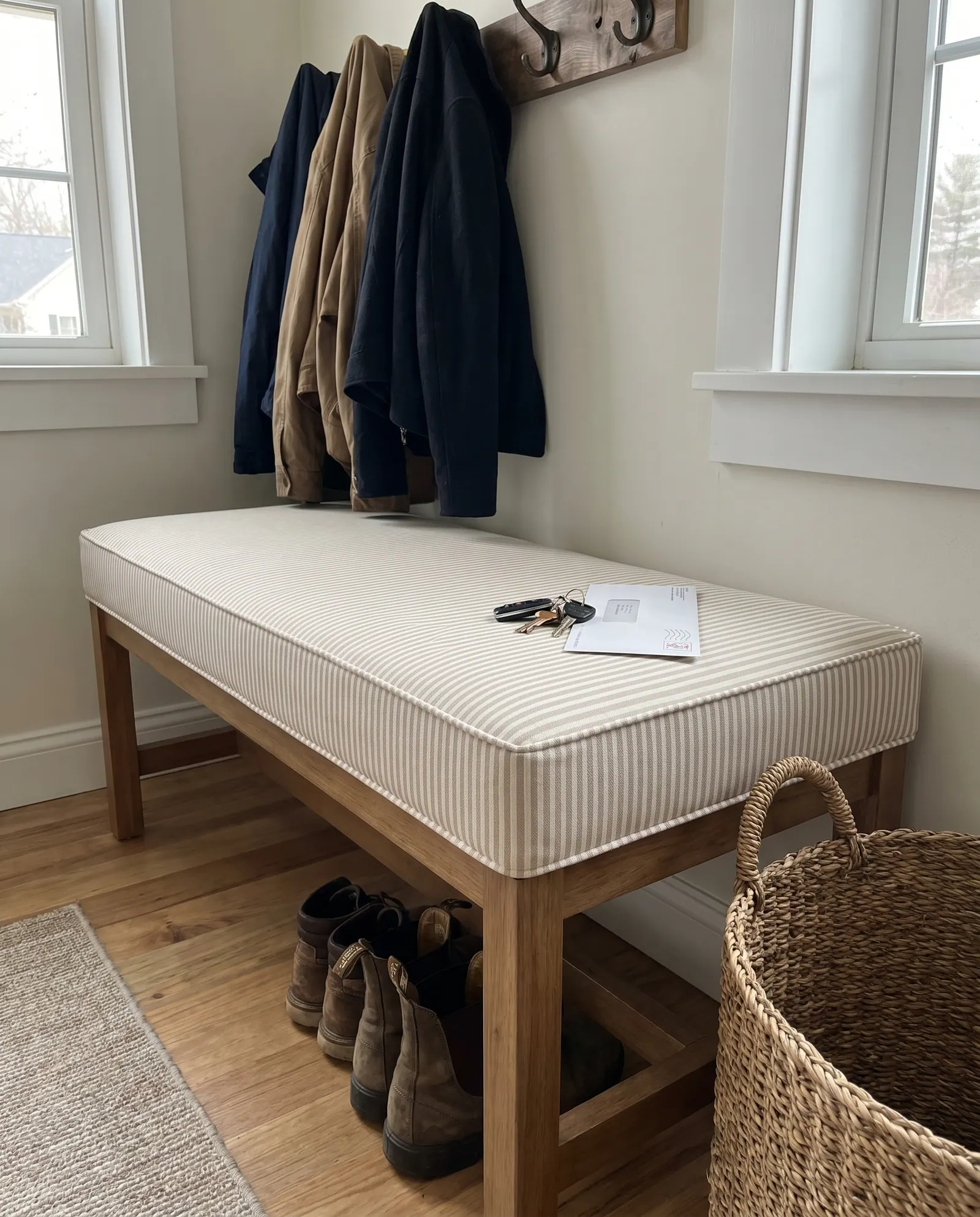
The most Alaskan room in the house is the one you walk through first. An arctic entry is a hall or vestibule sealed from both the outside and the house. The boots, parkas and snow stay there. A bench belongs there too, and that bench takes wet boots, dripping dogs and gravel for half the year. Start at mudroom and entryway bench cushions.
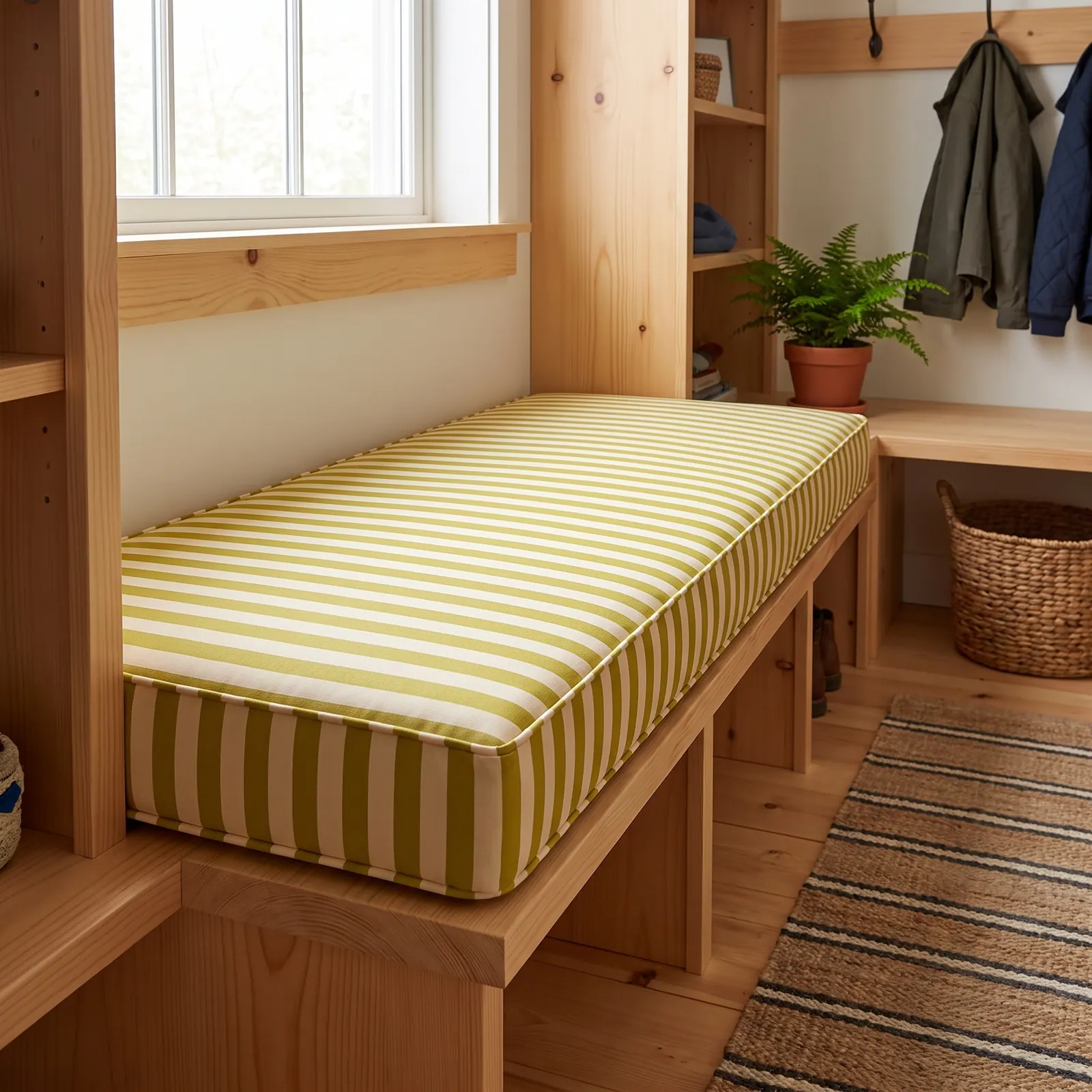
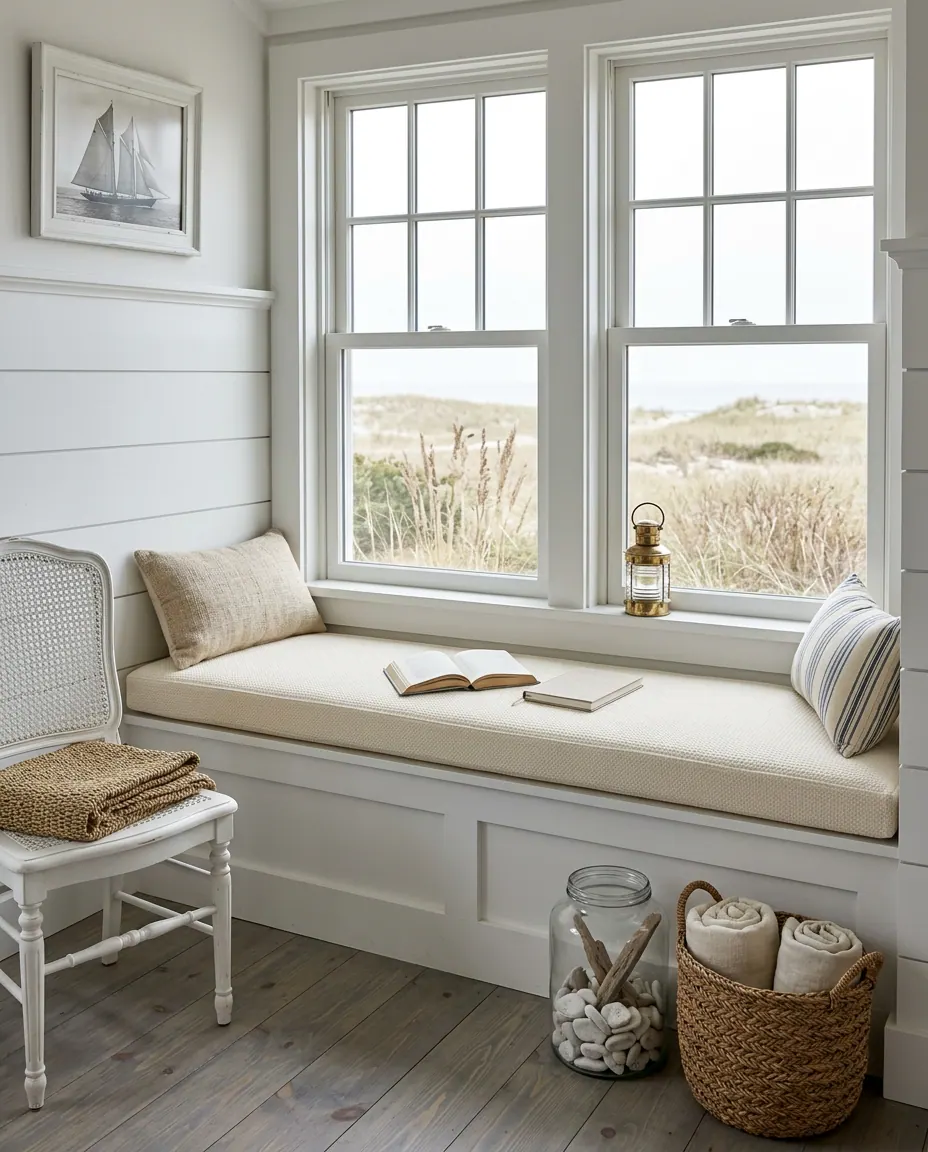
Then the window seat. When the day runs 19 hours in June and 5 1/2 in December, a deep seat at the glass is where people read, watch the weather come in and wait for the aurora. The window seat hub and the measuring pattern cover the fit.
Out of town, it's cabins. Around Fairbanks, dry cabins with no running water are common, partly because permafrost makes wells and septic hard, and many run on a woodstove. NFPA's rule: keep anything that can burn at least 3 ft (91 cm) from heating equipment. That means the bench cushion and the floor pillow too.
About 82% of Alaska communities aren't connected to the road system. Your cushion may ride a floatplane, a barge or a skiff before it reaches the door. Which one is carrying yours, friend?
Entry bench, window seat, skiff, bunk: what to cut for each
Indoors the question is wear and damp. On the water it is salt and drainage. Near the stove it is distance.
| Seat | Fabric | Thickness and foam | Build notes |
|---|---|---|---|
| Arctic-entry bench | Outdoor fabric or a performance weave | 2 to 3 in (5 to 7.5 cm); work back from seat height | Zippered cover, non-slip base; wash after breakup |
| Window seat with a view | Performance weave or corduroy; outdoor fabric on a south window over snow | 3 in (7.5 cm) for a neat line, 4 in (10 cm) to lounge | Lift it off a cold, sweating sill so the underside dries |
| Skiff or open boat seat | Outdoor fabric, water-repellent and UV-resistant | 2 to 3 in; foam-filled, never tufted | Concealed extra-strong zipper; rinse salt off; stow dry |
| Cabin bunk or camper mattress | Performance weave, linen-look or velvet | Check headroom first; a thick pad eats it fast | Ships vacuum-packed; open it within a few weeks |
| Woodstove bench or floor pillow | Corduroy, velvet or a heavy weave | Any thickness; distance matters more | At least 3 ft (91 cm) from the stove |
A 15 in bench, an 18 in seat and one boot-bench cushion
A buyer in the US had a mudroom niche built into the wall: 17 x 35.75 in (43 x 91 cm), with the bench top 15 in (38 cm) off the floor. They wanted the seat at 18 in (46 cm).
Arithmetic did the rest. 18 minus 15 is 3, so the cushion was 3 in (7.5 cm) thick. The workshop told them to pick 17 in width, 36 in length and 3 in thickness on the menu, then write the exact size, 17 x 35.75 x 3 in, in the note. It was made to the note.
Another buyer asked for two 71 x 28 in (180 x 71 cm) cushions for a camper's top bunk and kept the 12 in (30 cm) thickness from the photo. The workshop pointed that thickness out before quoting. Twelve inches is a lot of foam under a low ceiling. Check the headroom before you fall for a thick mattress.
An arctic entry works the same way. Measure the bench. Pick the seat height. Subtract. The seat height calculator does it for you.
Spruce, birch and colors for long evenings
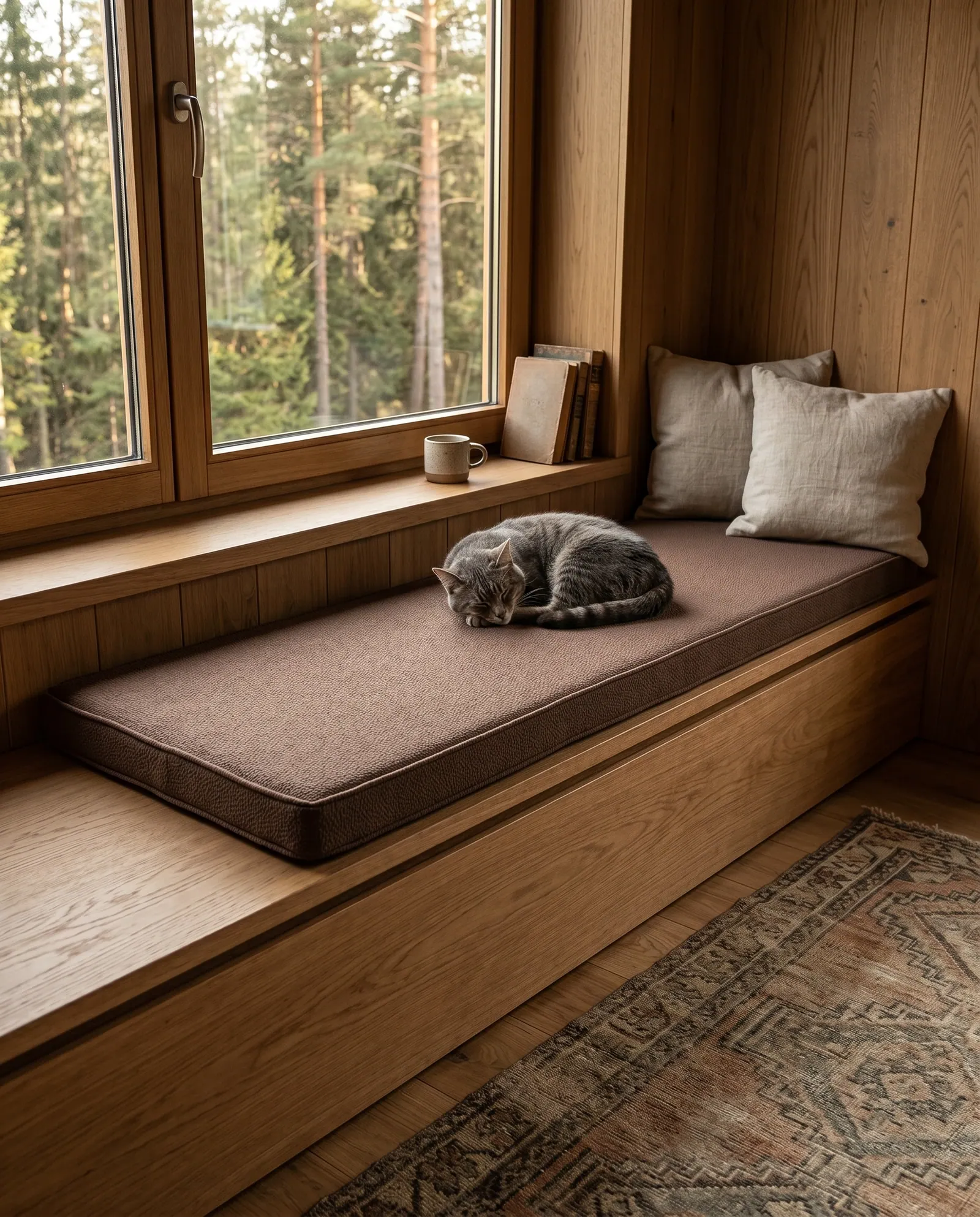
Alaska rooms lean on wood: log walls, knotty pine, birch, spruce outside every window. Against all that honey and brown, cushions do best in colors that hold up in low light. Mocha, forest green, navy corduroy, a rust pillow for warmth. The seat in our photo is a mocha weave in an oak cabin nook, with linen pillows and a forest behind the glass. It looks warm at noon in December.
Summer flips it. Under 19-hour days a south-facing seat fades, and snow glare in March adds to it. If the window faces south over open snow, choose a fade-resistant outdoor weave or a mid-tone that hides slow change. The window seat fading guide has the details.
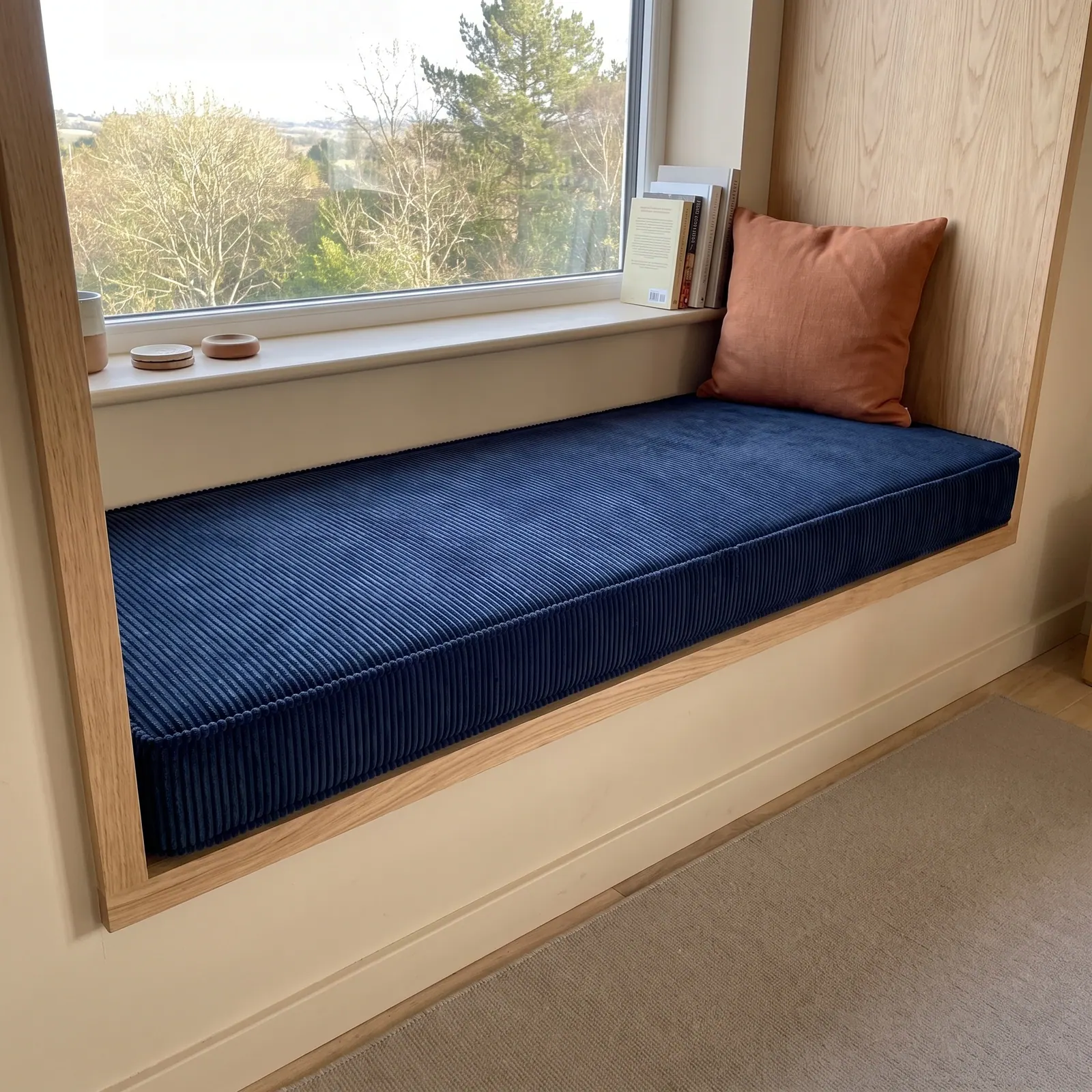
By the door, go darker and tougher. Gray, navy and olive stripes hide gravel dust and breakup mud. See performance and pet-friendly weaves and outdoor fabric.
Photographs for homes like these
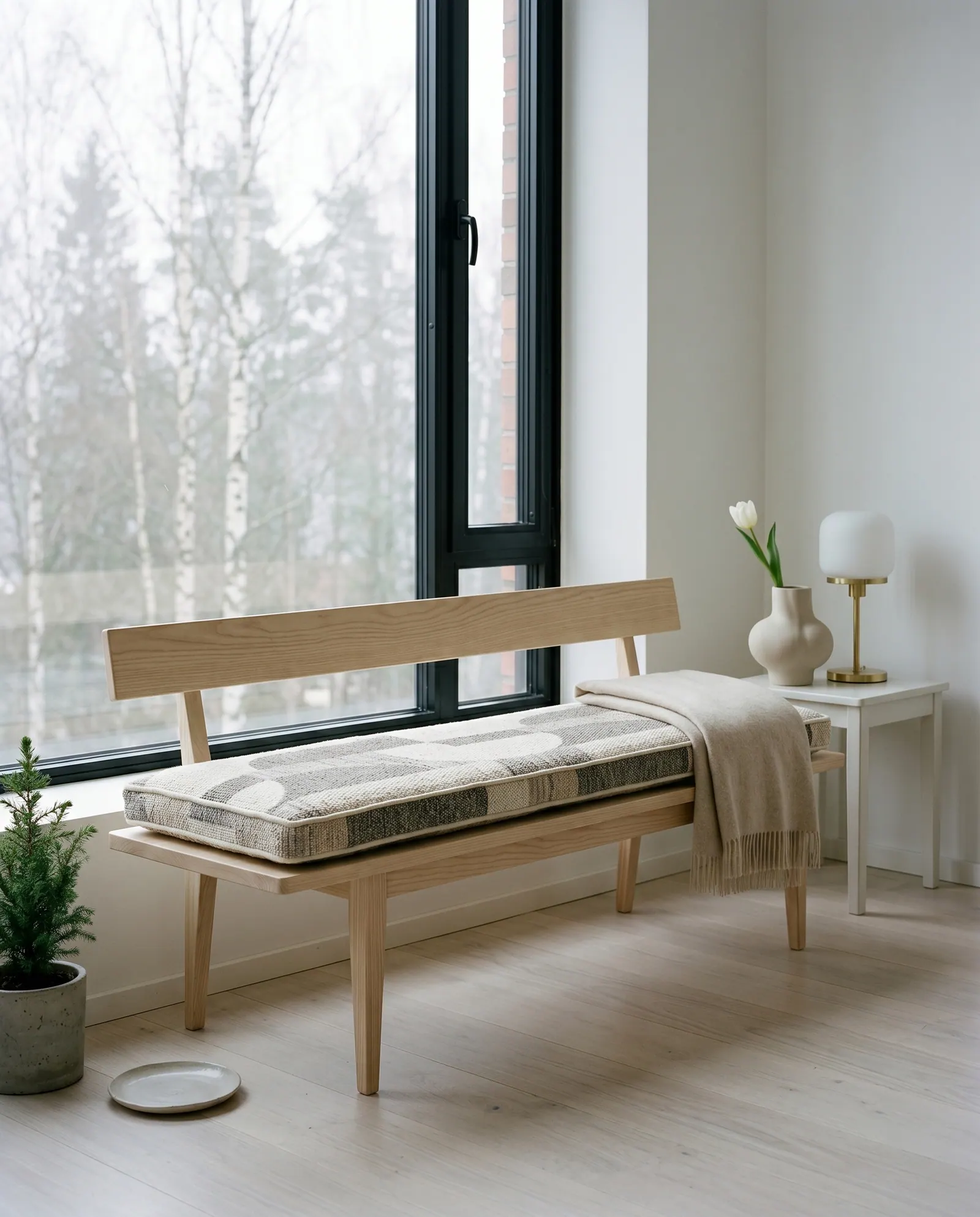
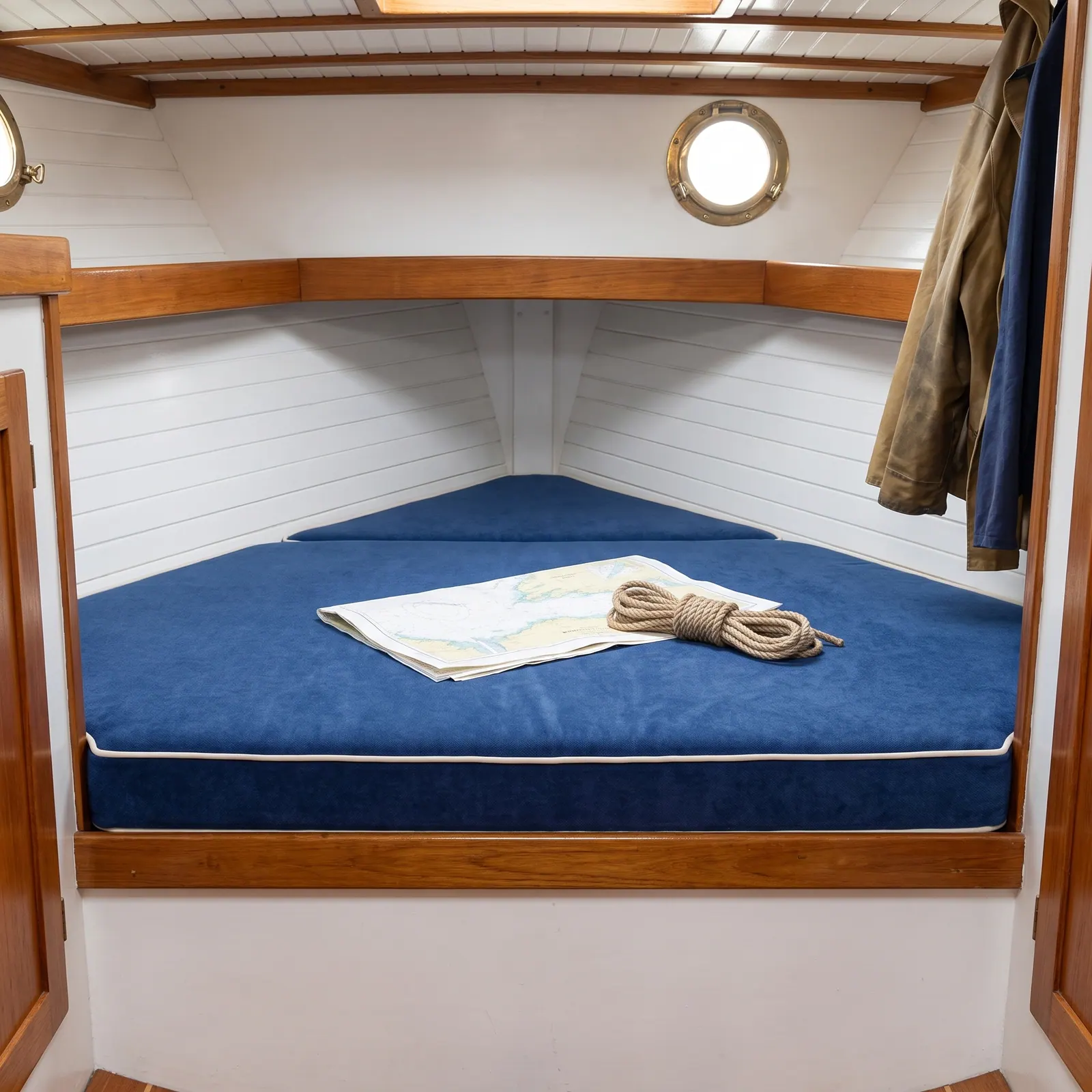
Open any photograph large; each one has its own link and a Save button.
 Save
 Save
 Save
 Save
 Save
An Alaska cushion year, breakup to freeze-up
- Breakup, when the snow turns to slush: gravel and meltwater come in on boots. Wash the entry-bench cover at 86°F (30°C) on gentle and let it air dry fully before it goes back on.
- When the ice goes out: bring the skiff cushions up from storage and check every zipper and seam.
- After every day on salt water: rinse the covers with fresh water and stand the cushions on edge to drain.
- Midsummer: turn window-seat cushions now and then, so one sunny edge doesn't fade alone under 19-hour days.
- Before freeze-up: dry boat, porch and camper cushions completely, then store them breathable and off concrete. Water left in foam freezes and never really dries.
- Winter: lift window-seat cushions off cold, sweating sills and let the underside air. Dry anything damp within 24 to 48 hours.
- All year near the stove: cushions, pillows and throws stay at least 3 ft (91 cm) away.
In Southeast Alaska a skiff cushion should be foam-filled, never tufted, and bone dry before it goes into storage for the winter.
Callum
Buyer questions: boots, bunks and vacuum packs
- A common question
My entry bench sits right by the door where two big dogs come in and out. What fabric should I use?
The workshop's answerFor a busy spot with dogs, the workshop recommended outdoor fabric as the rugged choice and pointed to the outdoor listing for the full range of colors.
- A common question
Can you replace a travel-trailer cushion that measures 6 feet by 31 inches and is at least 3 inches thick?
The workshop's answerYes. The workshop can make it to those measurements, 72 x 31 in (183 x 79 cm) at 3 in (7.5 cm) or more, and sends a purchase link for the exact size.
- A common question
Can I have a tufted cushion outdoors, somewhere it will get wet?
The workshop's answerA tufted cushion lets water inside, even in outdoor fabric. For outdoor use the workshop recommends a non-tufted, foam-filled cushion in outdoor fabric instead.
- A common question
What thicknesses can I choose, and which works best on a window seat?
The workshop's answerStandard options are 2, 3, 4 and 5 in (5 to 13 cm). Most buyers choose 3 or 4 in: 3 in gives a neater, lower profile on a window seat, and 4 in gives more cushioning. The default seat is about 4 in.
- A common question
Is it OK to leave a cushion in its vacuum packaging for a while before I open it?
The workshop's answerNo. Open it as soon as it arrives. Foam expands fine if it's opened within a few weeks, but kept compressed for a very long time the foam cells are damaged and may not recover; one couch sat packed for a year and a half. Long storage also leaves heavy creases, especially in velvet.

Have it made
Have it made for your home — ask Callum’s workshop
Sun, rain, salt. Say which of them your cushion will meet, and the workshop will plan around it. — Callum
Leave your details and the workshop will call you to confirm measurements, fabric, foam and piping. No prices, dates or payment on this page: it is a request, not an order.
Alaska questions before you order
What fabric suits a window seat that faces snow in spring?
Choose a fade-resistant weave or a mid-tone. The WHO notes fresh snow almost doubles UV exposure, and Alaska's spring days lengthen fast. A south-facing seat over a snowy yard takes more light than its latitude suggests, so outdoor-grade fabric is a fair choice even indoors.
Does the three-foot stove rule apply to bench cushions too?
Yes. NFPA says to keep anything that can burn at least 3 ft (91 cm) from heating equipment, and a foam cushion in a fabric cover counts. Plan the bench, the floor pillows and the throws around that circle before you order sizes.
Can boat cushions stay aboard through an Alaska winter?
Better not. The foam is not quick-dry and there is no mesh bottom, so water left inside freezes and thaws all winter. After haul-out, rinse off the salt, dry each cushion completely and store it breathable and off concrete until the ice goes out.
How big is the parcel for a long cushion going to a remote cabin?
Smaller than you'd think, because cushions ship vacuum-packed. One 111.5 x 34 in (283 x 86 cm) cushion traveled in a package about 24 x 20 x 8 in (60 x 50 x 20 cm). Open it within a few weeks and give the foam 24 to 48 hours to regain its full shape.
Fair winds — Callum
Concept Sketches
Sketches for homes like these
Real projects, drawn up as ideas you can borrow.
The atelier
Keep going
Across the Map
Nearby places
Close by on the map