A Reading by MaggieBench Cushions
A knotted-stripe custom bench cushion, and what a box edge does for a stripe
Maggie answers three letters about fringe, seat height and an IKEA bench, then gets down to table level to read the corner of a warm gray stripe with chestnut knots.

 Save
The quick answer
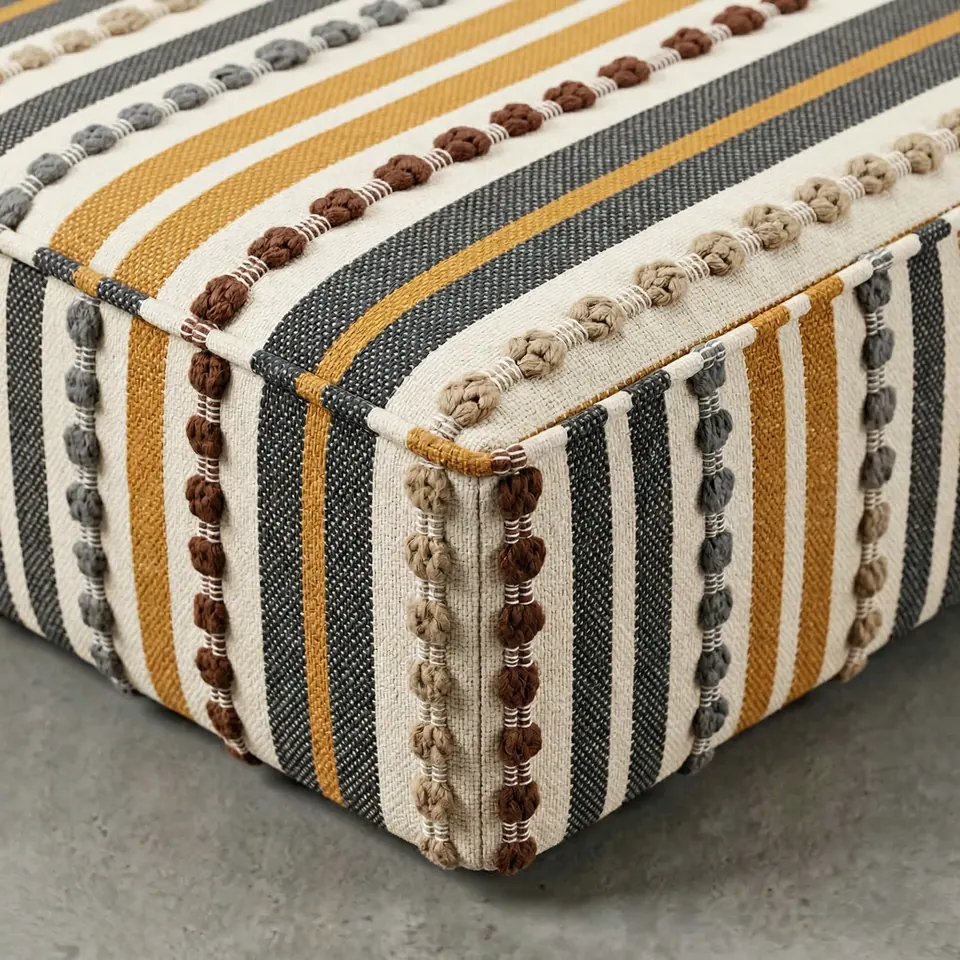
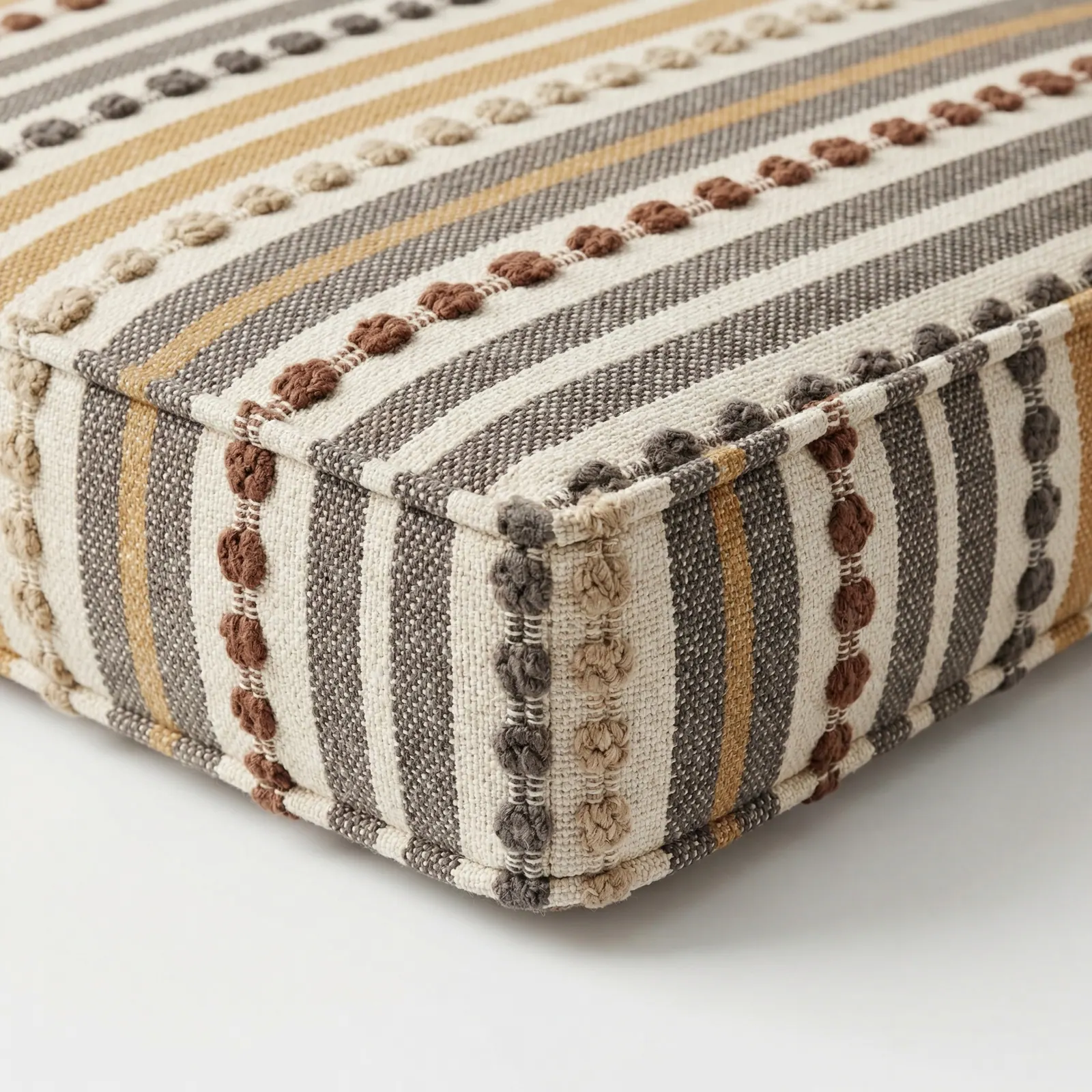
A striped custom bench cushion looks upholstered when it has a box edge, because the stripe carries onto the boxing strip and the knot rows run straight down the side. This cream cushion with warm gray bands and slim mustard lines has chestnut knot rows and self piping at top and base. A knife edge would lose the side stripe entirely.
Buyer questions
- A common question
Could you add fringe or a scalloped edge to my bench cushion?
The workshop's answerYes, if you send an example picture of the edging you want. For special details like this, the shop sends a photo before the cushion ships so you can check it.
- A common question
I need a seat height of 26 in. Can you do that?
The workshop's answerThe shop first checks whether 26 in (66 cm) means the total height from the floor to the top of the seat, then asks for all three dimensions: width, length and height. Any size can be made once those are clear.
- A common question
Can you make a thin cushion for my IKEA bench?
The workshop's answerYes. A cushion 48 x 14 in (122 x 36 cm) and about 3 in (7.5 cm) thick was quoted for exactly that, with shipping added on top.
Now, the reading
Pinned by Maggie: one corner, four decisions
Four pins on one corner, from the chestnut knot row on top to the piped seam at the base.
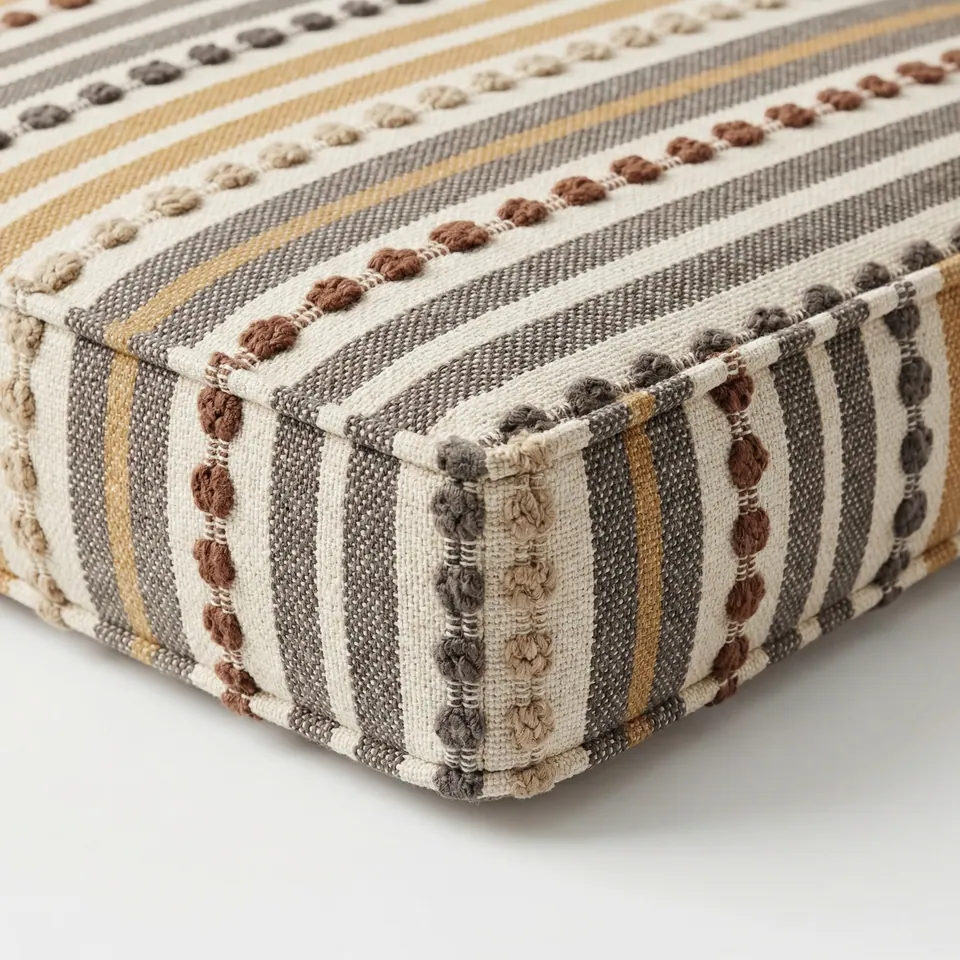
- Chestnut knot row
Here the chestnut knots are the main accent, with narrow mustard lines in support.
- Self-piped corner
Self piping keeps a tailored edge without committing the cushion to one accent color.
- Knot column on boxing
The knots on the side panel run perfectly straight, which makes a thick cushion look upholstered.
- Base seam
The lower piped seam sits just above the surface, so the cushion rests on a flat base.
- Chestnut knot rowHere the chestnut knots are the main accent, with narrow mustard lines in support.
- Self-piped cornerSelf piping keeps a tailored edge without committing the cushion to one accent color.
- Knot column on boxingThe knots on the side panel run perfectly straight, which makes a thick cushion look upholstered.
- Base seamThe lower piped seam sits just above the surface, so the cushion rests on a flat base.
Get down low and look at the side
The camera sits low for this one, nearly at table level, and I'm glad of it, because the side of a cushion is where the edge decision lives.
This is a box edge: a top, a base and a boxing strip between them, piped at both seams. On a stripe, that matters. The knot rows on the boxing run in straight columns, top to bottom, so a thick bench cushion looks upholstered rather than stuffed. With a knife edge, top and base meet in a single seam and the side stripe simply disappears.
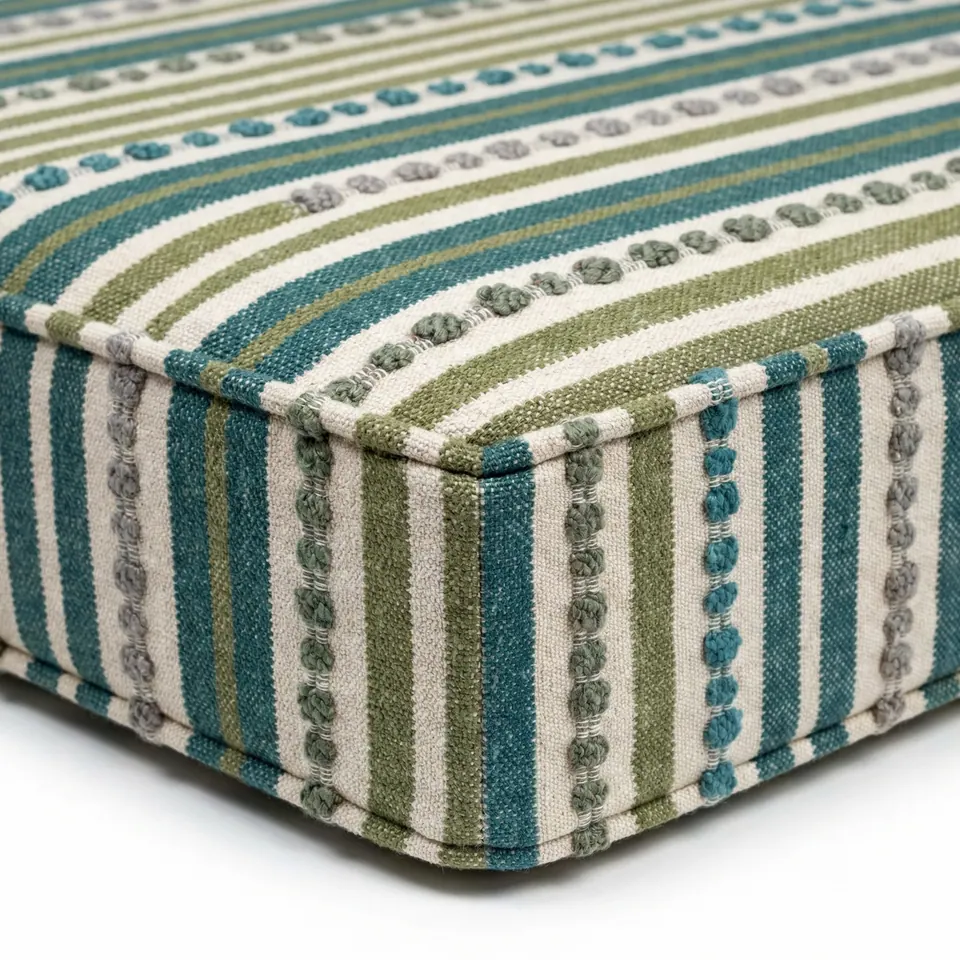
The colorway is the lighter one: a cream ground, warm gray bands and mustard lines kept narrow, so the chestnut knots take the lead with tan and gray knots in support. It lands comfortably between warm oak and cool gray stone, an easy pick for an open-plan kitchen and dining space.
The piping is self, cut from the same cloth, so the edge is tailored without committing to one accent color. The lower piped seam sits just above the white surface, which tells you the cushion rests on a flat base. A straight welt is a kind of honesty, and a crooked one on a stripe is a confession.
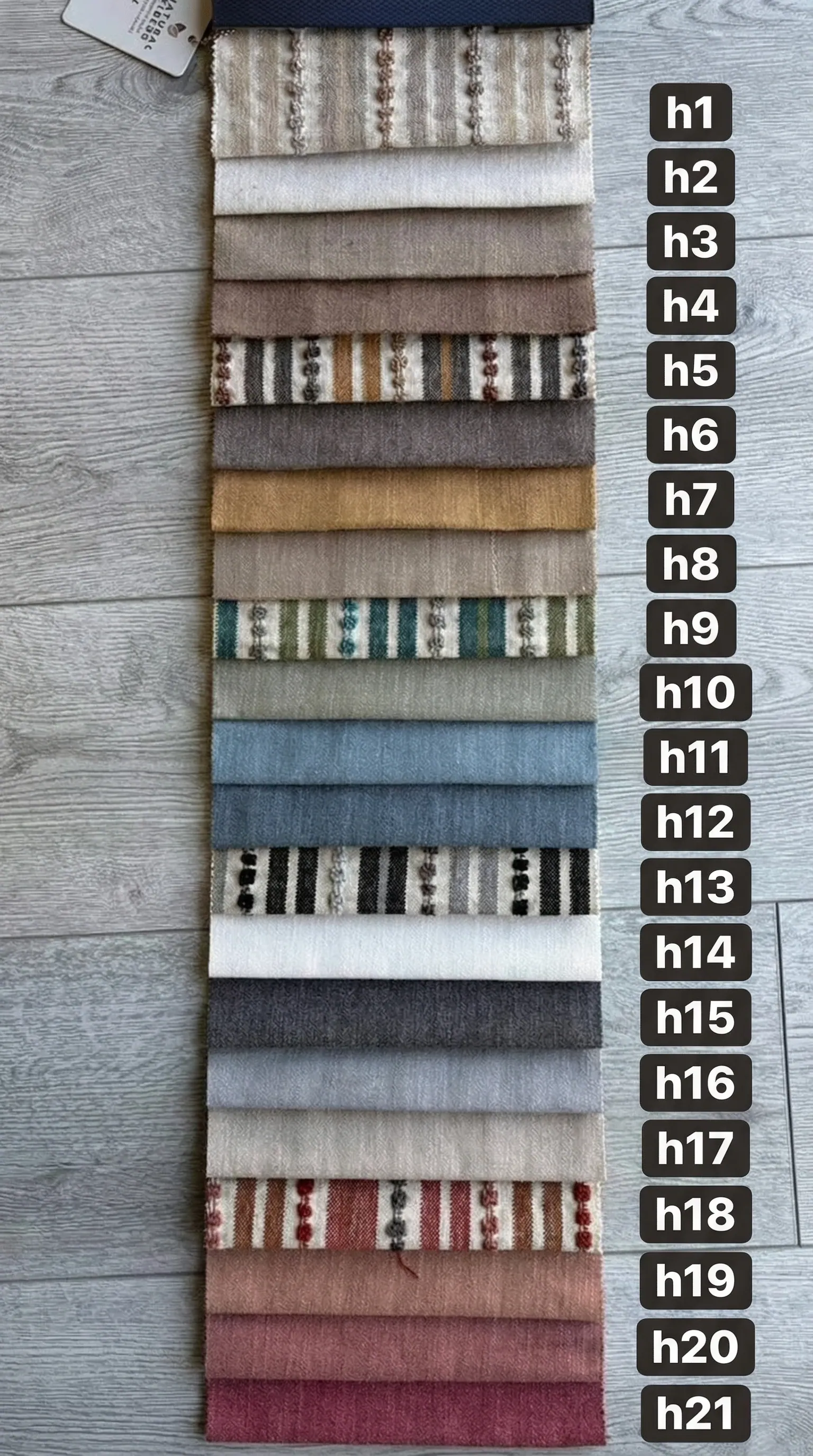
Corners next. Rounded corners would have to bend those stripes; square box corners let them run true. For a kitchen bench I'd keep them square, dear. The cotton card in the gallery shows 21 plain and knotted-stripe shades if you'd like another colorway. See striped cotton and ticking, box edge vs knife edge, kitchen nook cushions and more bench cushions.
Box edge or knife edge, for a knotted stripe
| Box edge | Knife edge | |
|---|---|---|
| Side of the cushion | A boxing strip where the knot rows run in straight columns | No side panel; top and base meet in one seam |
| Look on a bench | Upholstered and squared | Softer, more like a pillow |
| Piping | Two seams, top and base | One seam around the middle |
| Best for | Thick kitchen and dining bench cushions | Thin pads and chair pads |
Left side 33 3/4, right side 33
A buyer in the US sent four measurements for a wide, angled bay window seat: 68 1/4 in (173 cm) at the back against the wall, 113 3/4 in (289 cm) along the front edge, 33 3/4 in (86 cm) on the left side and 33 in (84 cm) on the right.
The two sides differed by three-quarters of an inch. Some people would round that off to make it tidy. Don't. Real walls are rarely identical, and the workshop quoted the custom shape exactly as measured.
I confess I once rounded a window seat to the nearest inch because it looked neater on paper. The cushion looked neater too, right up until it met the window. Measure every side of a trapezoid on its own, and let the trapezoid cushion calculator check the shape.
On the cutting table: the knotted stripe
| Cushion | Box-edge bench cushion |
|---|---|
| Fabric | Cotton knotted stripe: cream ground, warm gray bands, slim mustard lines |
| Accent | Chestnut knot rows, with tan and gray in support |
| Piping | Self piping at the top and base seams |
| Boxing | Deep strip with knot columns running straight |
| Corners | Square |
| Colorways | Cotton card of 21 plain and knotted-stripe shades |
| Best for | Open-plan kitchens, dining and breakfast-nook benches |

Have it made
Have this made — ask Maggie’s workshop
Have the tape measure handy when they call. Old cushions shrink and sag; the seat underneath does not. — Maggie
Leave your details and the workshop will call you to confirm measurements, fabric, foam and piping. No prices, dates or payment on this page: it is a request, not an order.
A striped bench cushion needs a box edge to look upholstered: the boxing strip carries the stripe down the side, where a knife edge has none.
Maggie
Questions buyers ask next
What is a boxing strip on a cushion?
It is the side panel of a box-edge cushion, the band of fabric between top and base. On a striped cushion it carries the pattern down the side, and piping at its top and bottom seams gives the cushion a tailored outline.
Which piping suits a multi-color knotted stripe best?
Self piping is the safe choice on a multi-color stripe, because it keeps the edge tailored without picking one accent color. Contrast piping works when you want to pull out a single stripe color, such as the chestnut here.
Can a trapezoid window seat have unequal sides?
Yes, and it often does. Real walls are rarely identical: one wide bay seat measured 33 3/4 in on the left and 33 in on the right, and it was quoted exactly as measured rather than rounded off.
Stitch straight — Maggie
More photographs to read
 Save