A Reading by MaggieDining Chair Cushions & Pads
A terracotta chair cushion with ties, chosen from the rug up
Dark wood, gray daylight and a faded rug. The color for this chair pad was lying on the floor the whole time. Someone just had to look down.

 Save
The quick answer
A terracotta chair cushion with ties suits a dark stained spindle-back chair because the warm color lifts the wood without hiding it. Take the cushion color from the strongest tone in your rug, keep the piping pale to echo a lamp or trim, and tie it at the back posts so the spindles stay on show.
Three chair questions before we get to the chair
- A common question
I have a Danish-style chair. Can you make a trapezoid seat and a rectangular back cushion for it?
The workshop's answerYes. Order the seat through the trapezoid option, for example 23 in front, 22 in back, 24 in deep and 4 in thick (58.5, 56, 61 and 10 cm), non-tufted with the zipper at the back. Order the back as a rectangle, 22 x 19 in (56 x 48 cm) and 3 in (7.5 cm) thick. Reversible cushions are made without a non-slip bottom.
- A common question
If a cushion has to come back, can you send me a return label or take the postage out of my refund?
The workshop's answerNo return labels are possible, because the shop's carrier contracts cover outgoing parcels only. Return postage on a bulky parcel can cost more than the cushion itself, so when a piece was made correctly the shop may offer a partial refund if you keep it instead.
- A common question
We need new seat and back cushions for a nursery armchair, 5 inches thick. Can you do that?
The workshop's answerYes. The quote covered a 20 x 22 x 5 in (51 x 56 x 12.5 cm) seat and a 21 x 27 x 5 in (53 x 68.5 x 12.5 cm) back, filled with fiber and silicone balls for comfort. Thicker than 5 in (12.5 cm) is possible too.
Now, the reading
Where the terracotta came from
Right, then. A confession first: I once covered a set of dark oak chairs in a lovely cool gray and spent a year apologizing to them. Dark stained wood wants warmth.
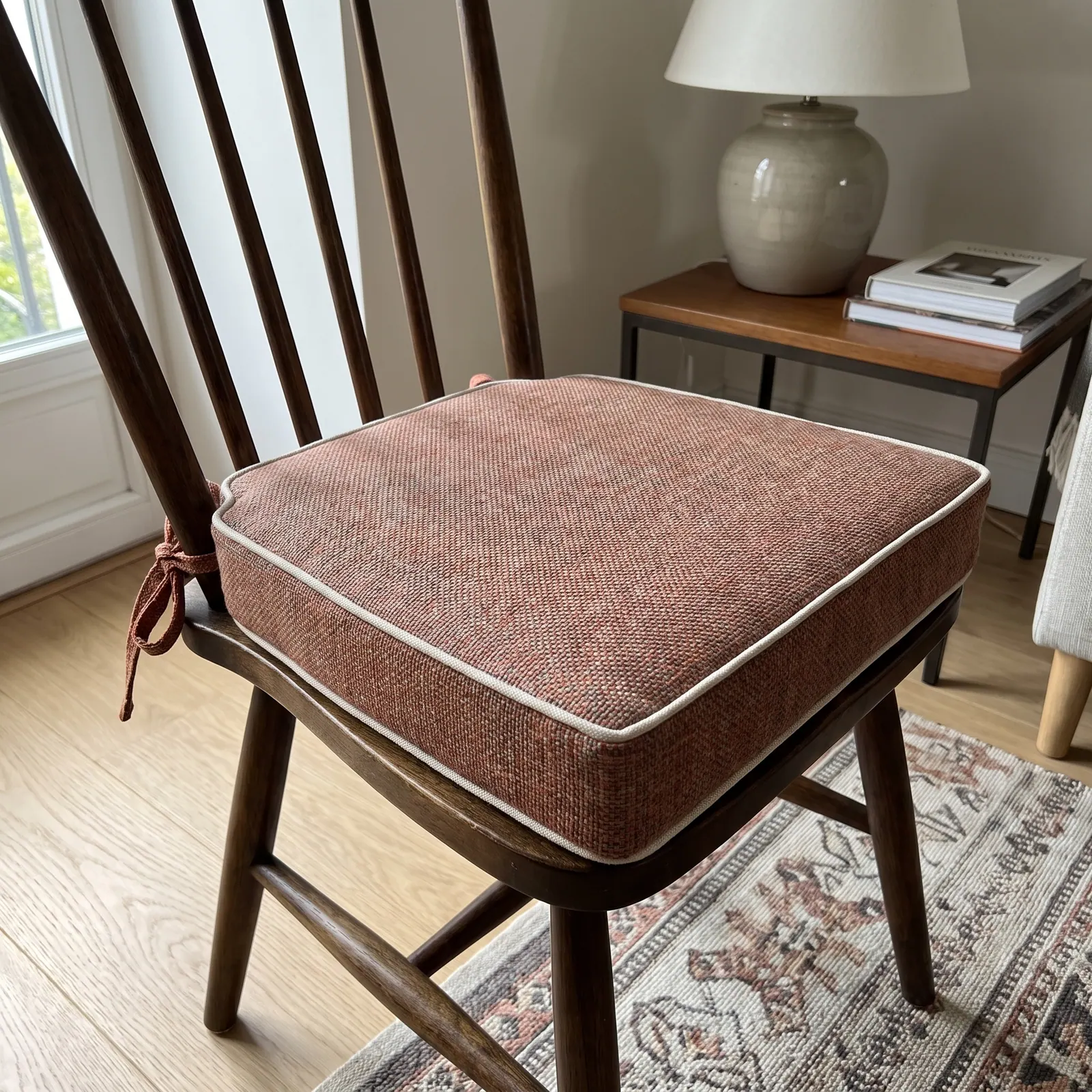
This chair cushion with ties gets it right. The spindle-back chair is stained nearly black, and the room is lit by soft gray daylight, the least flattering light there is for a cool color. Terracotta flecked with cream answers both problems. It warms the wood without hiding a single spindle, and the lighter threads stop it reading as a solid brick block.
The color was not invented. Look at the faded vintage rug: the rust tones in its pattern are where the terracotta came from. Floor first, cushion second. The ivory welt takes its cue from the stoneware lamp, pale shade and pale base, so the piping repeats something already in the room instead of adding a new idea.
The proportions are honest too. The pad is thick and fills the seat right out to its rounded front edge. A tie at the back post holds it, placed so the slender spindles stay on show; tie placement for chairs and swings covers the details.
The rest of the corner is supporting cast. The teak and black-metal side table repeats the chair's dark tone at another height. The coffee-table books say reading chair, not a dining chair doing overtime. The cream armchair at the edge of the frame reminds you the room is soft, and the chair is the one firm thing in it.
The weave belongs to the linen-look fabrics. More pads live under dining chair cushions and living room cushions, and you can draw your own in the chair cushion builder.
What is the strongest color in the rug under your chair, dear?
Swatch strip: five colors, one chair
- Terracotta weave#B5603EThe seat, taken straight from the rust in the rug
- Cream fleck#EFE4D2Lighter threads that stop the terracotta reading as brick
- Ivory welt#F3EEE3Piping matched to the lamp shade, not the chair
- Dark walnut stain#3B2A20The spindles the ties are careful not to hide
- Teak#8A5A36The side table, a middle step between wood and cushion
Pinned by Maggie
Five pins, from the terracotta tie at the back post to the rug where the color began.
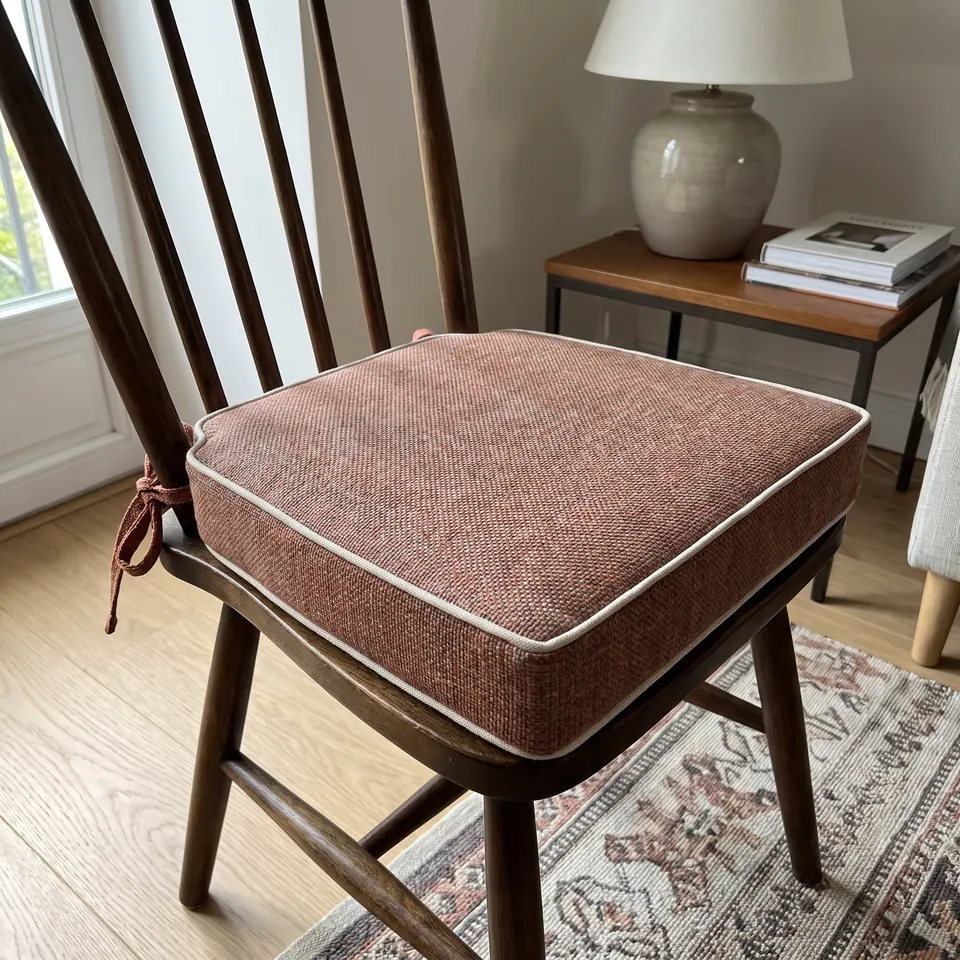
- Terracotta tie
One tie at the back post keeps the slender spindles on show.
- Ivory piped edge
The pale welt echoes the lamp's shade and stoneware base.
- Stoneware lamp
A pale ceramic lamp lifts the dark chair and warm cushion.
- Coffee-table books
A book stack on teak sets the scene as a reading corner in the living room.
- Vintage rug
Rust tones in the rug are where the terracotta was taken from.
- Terracotta tieOne tie at the back post keeps the slender spindles on show.
- Ivory piped edgeThe pale welt echoes the lamp's shade and stoneware base.
- Stoneware lampA pale ceramic lamp lifts the dark chair and warm cushion.
- Coffee-table booksA book stack on teak sets the scene as a reading corner in the living room.
- Vintage rugRust tones in the rug are where the terracotta was taken from.
The rattan armchair that was easy until the back
A buyer in the US sent the workshop a classic rattan armchair with a U-shaped seat, a little wider at the front, with curved back edges. Measured properly, the seat came to 24 in deep and 21 1/4 in wide (61 x 54 cm), under 3 in (7.5 cm) thick.
That part was straightforward, and the shop said so. A seat pad on a curved chair lies flat on a flat surface; the curve only decides the outline.
The back cushion was another matter. Pressed against a curved frame, a back cushion either follows the curve or fights it, and a small error shows as a gap. So the shop flagged it as the risky piece and asked for measurements plus a straight-on photo of the curve before committing to anything.
Seat first, back second, and a photograph for anything curved. The measuring method for pads is in dining chair pad measurements.
On the cutting table: the spindle-back chair pad
| Piece | Chair pad with ties, box edge |
|---|---|
| Fabric | Terracotta linen-look weave flecked with cream |
| Piping | Contrast welt in ivory |
| Fastening | Ties at the back posts, clear of the spindles |
| Depth | Thick pad filling the seat to its rounded front |
| Curved seats | Straightforward; send the outline |
| Curved backs | Measurements plus a straight-on photo first |
| Reversible option | Made without a non-slip bottom |
| Best for | Dark stained chairs in gray daylight |

Have it made
Have this made — ask Maggie’s workshop
Numbers first, fabric second, piping last. Jot down what you have, and the workshop will go down the list with you, item by item. — Maggie
Leave your details and the workshop will call you to confirm measurements, fabric, foam and piping. No prices, dates or payment on this page: it is a request, not an order.
Dark stained wood wants warmth. Take a chair cushion's color from the strongest tone in the rug under it, and pick the piping from the lamp.
Maggie
Questions buyers ask next
How do I choose a cushion color for a dark wood chair?
Dark stained wood usually wants a warm color. Take it from the strongest tone in the rug or floor nearby, the way terracotta was taken from the rust in this vintage rug, then choose piping that repeats something pale in the room.
Where should ties go on a spindle-back chair cushion?
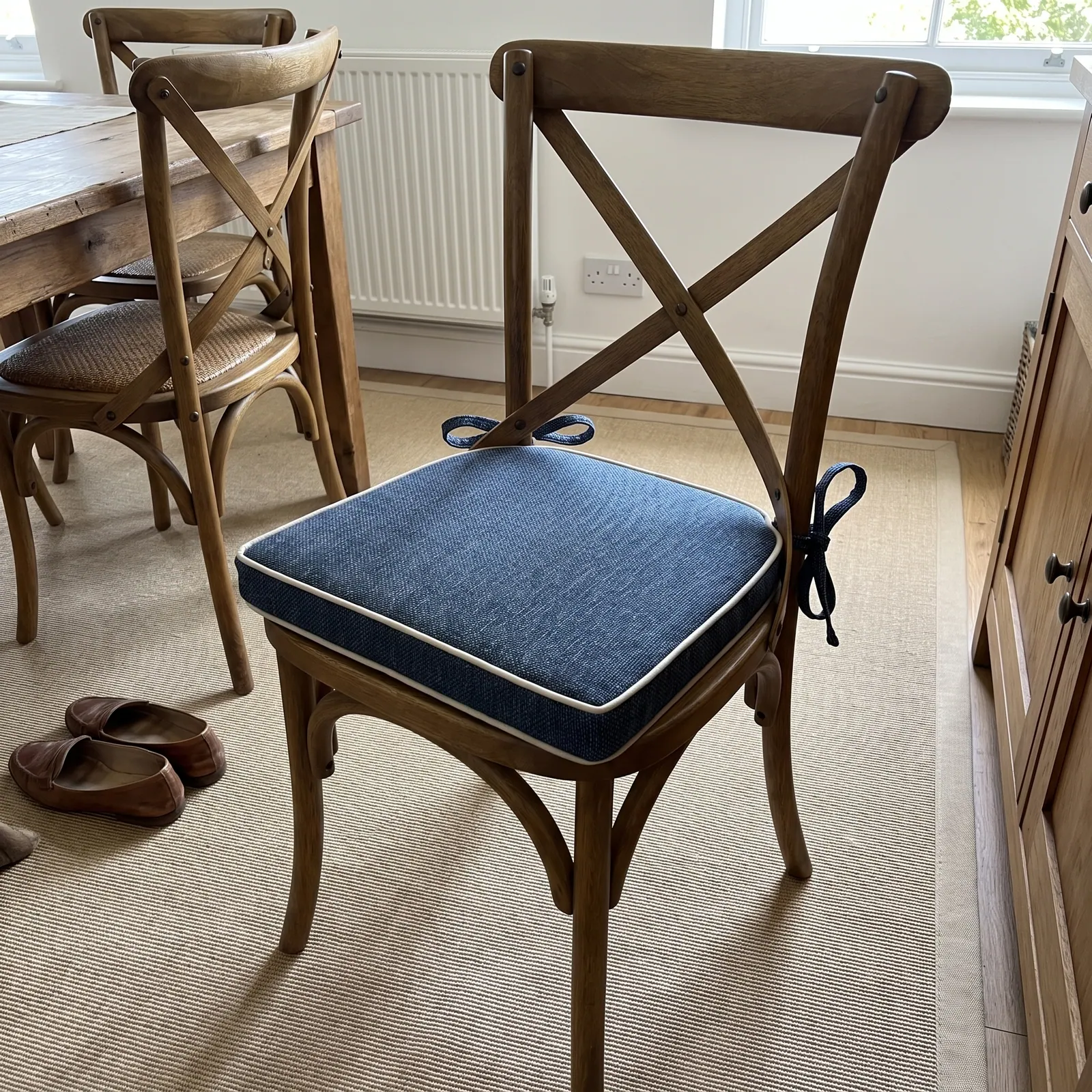
At the back posts, placed so the ties wrap the posts rather than the spindles between them. That holds the pad in place and keeps the spindles visible, which is the whole point of a chair like this.
Can a chair pad be made for a curved or U-shaped seat?
Yes. The seat pad is the easy part, because it lies flat and the curve only sets the outline. Send the depth, the widths and a drawing of the curve; a back cushion against a curved frame needs a straight-on photo as well.
Stitch straight — Maggie
More photographs to read
 Save
 Save
 Save
 Save
 Save
 Save