 Save
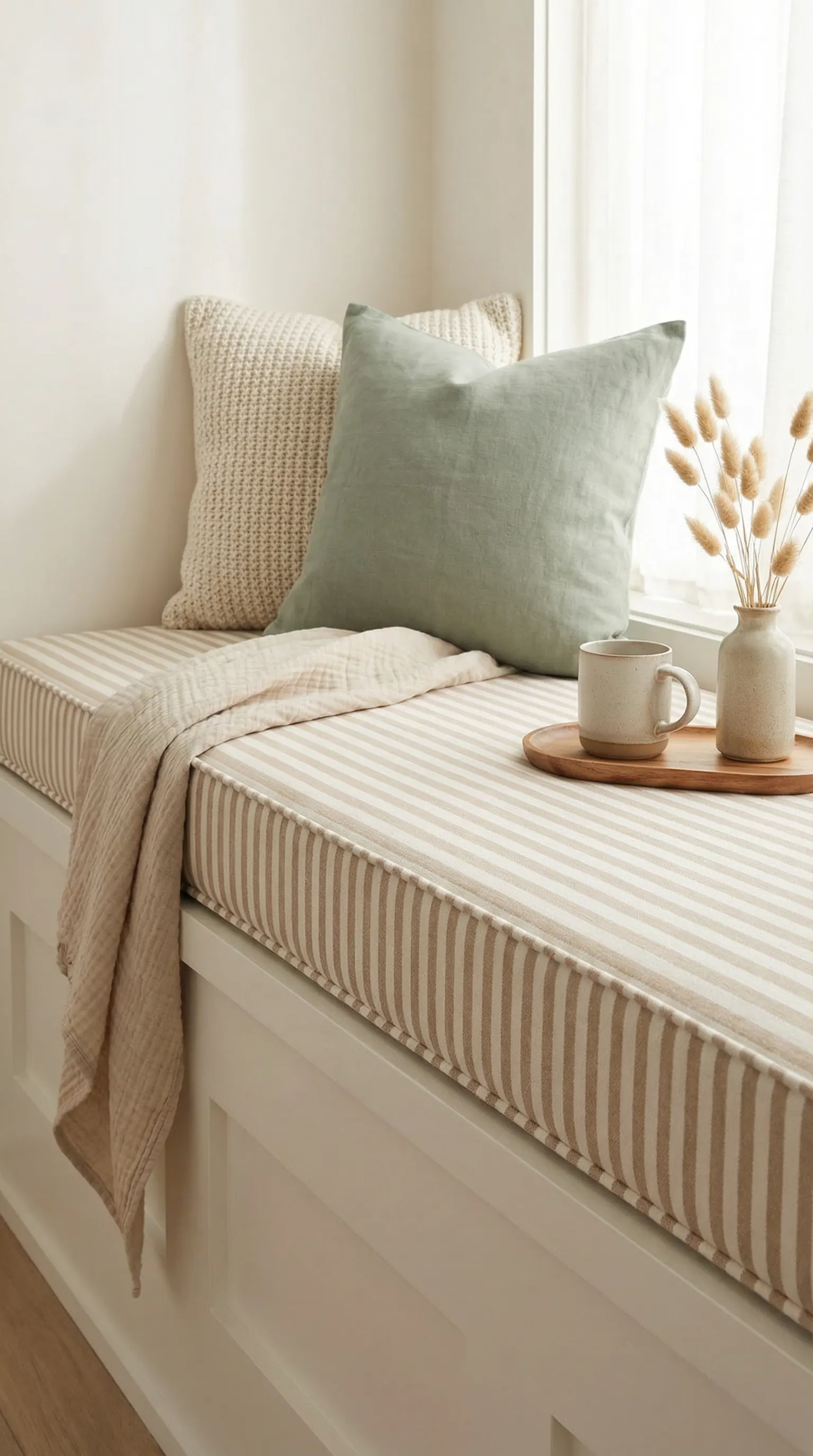
- chunky knit pillow
Knit behind and flat linen in front: two textures in two layers.
- sage linen pillow
Sage is the one color note, cool against the warm taupe stripe.
- tray with a mug
A firm foam seat is flat enough to hold a tray, which makes this a coffee corner.
- bunny-tail grass
The grass is the same color as the stripe's dark band, tying sill to seat.
- draped linen throw
The throw repeats the taupe and softens the box corner at the open end.
Plate Taupe Stripe Window Seat Set with a Tray and Sage Pillow
A wooden tray turns the end of a taupe-striped window seat into a place for morning coffee.
A Reading by ÉlodieWindow Seat Cushions
One Taupe-Striped Window Seat Cushion, and the Corner It Made
Morning light through sheers, a mug on a wooden tray, one sage pillow. Picture this window without its cushion, my friends, and you will see the whole makeover in a single piece of cloth.

The quick answer
A window seat cushion that doubles as a coffee spot needs a firm, flat top: about 4 in (10 cm) of solid high-density foam, so a tray sits level without rocking. A taupe-and-cream cotton stripe reads calm in morning light, and one cool accent, here sage linen, gives the eye a place to land. Keep the soft fills for pillows.
Plate I: five pins from the knit pillow to the grass
Five pins read the corner from the knit pillow at the back to the grass on the sill, and each one marks a choice worth copying.
The numbers match the pins on the plate.
- chunky knit pillowKnit behind and flat linen in front: two textures in two layers.
- sage linen pillowSage is the one color note, cool against the warm taupe stripe.
- tray with a mugA firm foam seat is flat enough to hold a tray, which makes this a coffee corner.
- bunny-tail grassThe grass is the same color as the stripe's dark band, tying sill to seat.
- draped linen throwThe throw repeats the taupe and softens the box corner at the open end.
Before the cushion, a white box; after it, a place to stay
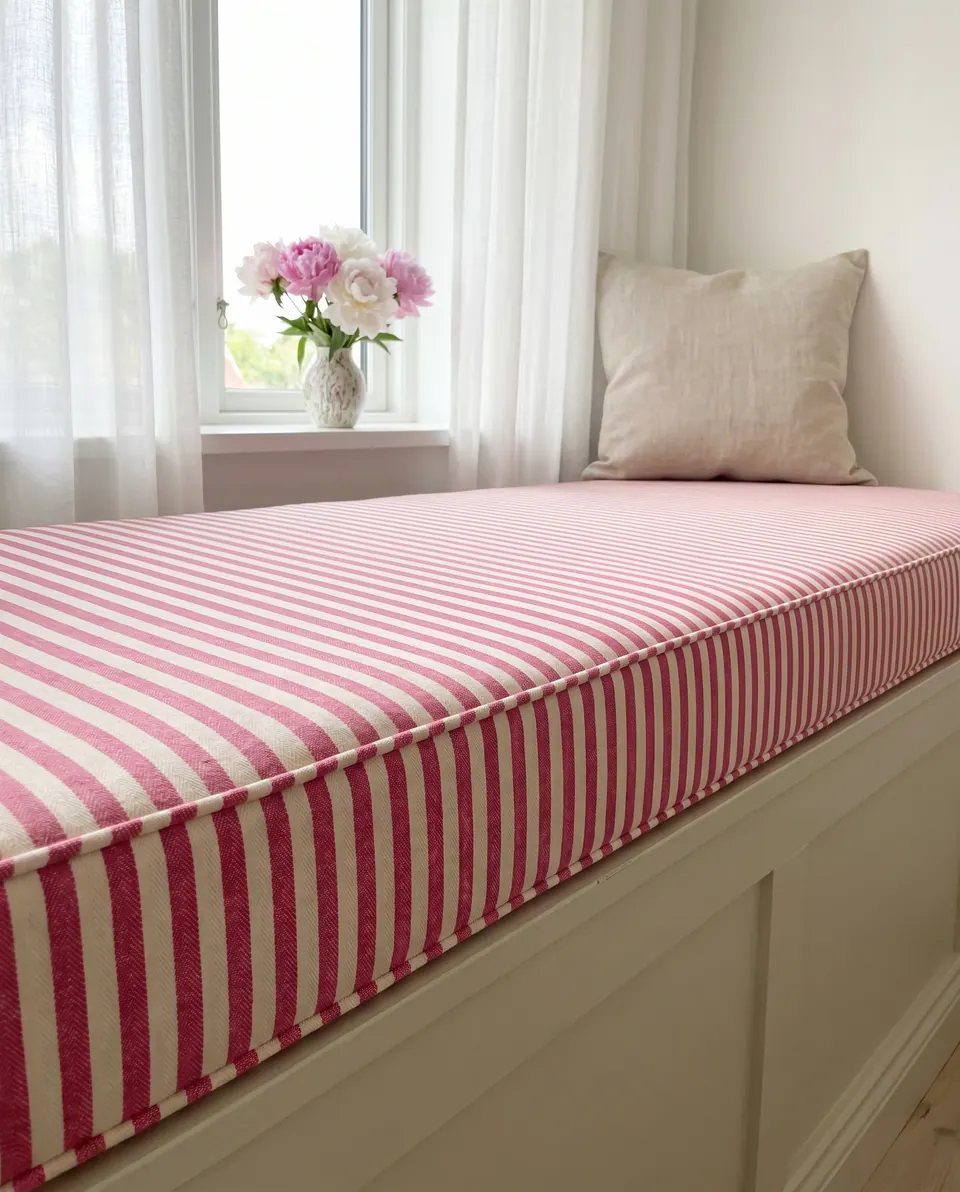
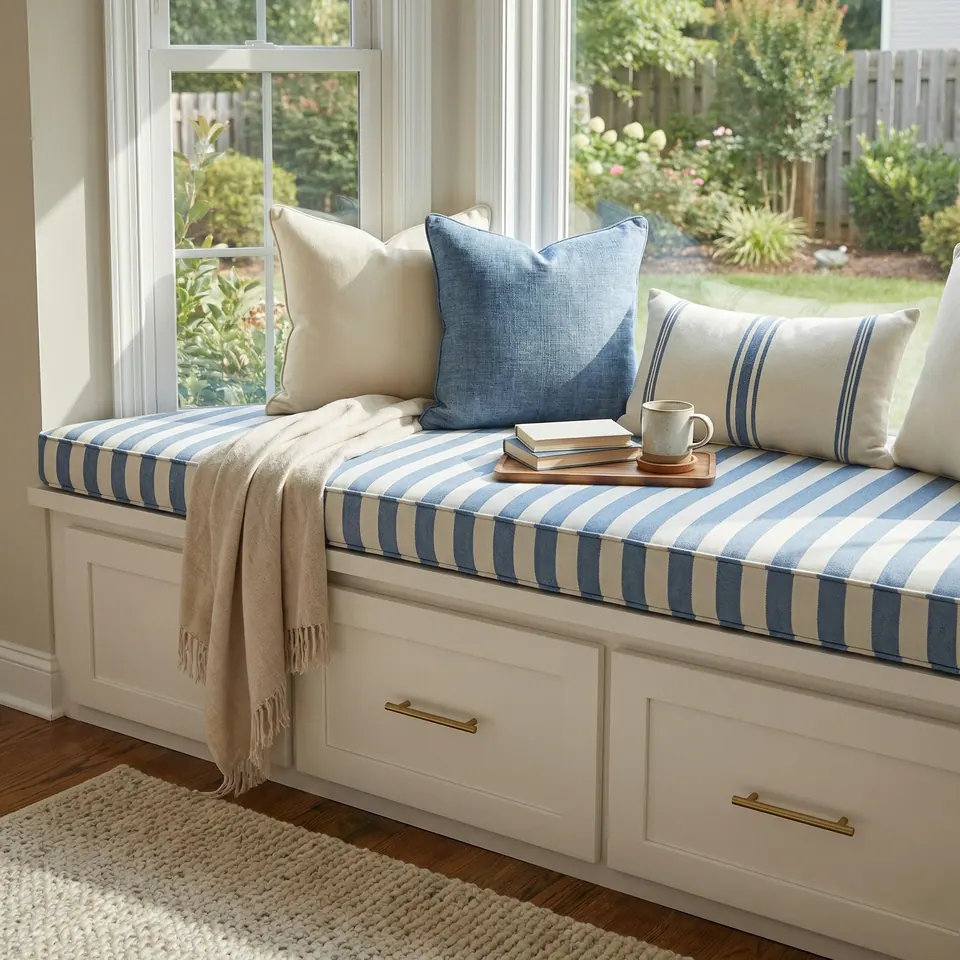
The eye sits down first, and here it sits on a stripe. A window seat cushion in taupe and cream runs the length of a white paneled seat, with soft morning light filtering through sheer curtains behind it. At the open end, a round wooden tray holds a ceramic mug. That tray is the makeover in one object.
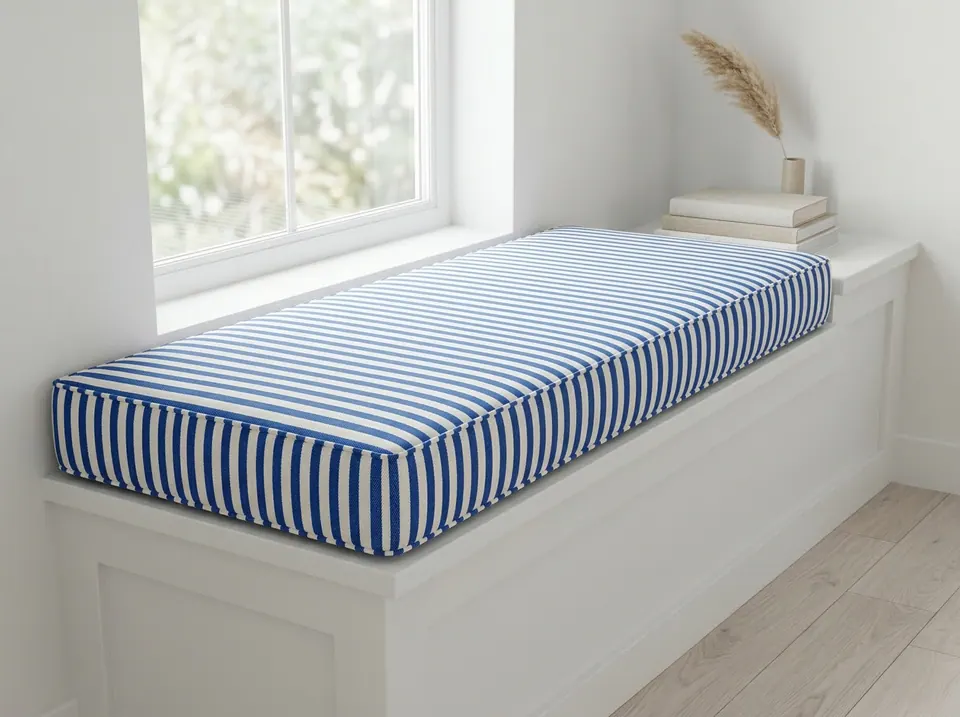
Picture the seat bare: white paint, white panels, white sheers. A lovely box that nobody sits on for longer than it takes to tie a shoe. Add a firm cushion around 4 in (10 cm) thick and the window gains a purpose. Seats like this take solid high-density foam precisely so a tray stays level; soft fills are saved for backs and pillows.
The cloth is a cotton stripe, warm taupe on cream, running the long way so the eye travels along the window instead of across it. Self piping keeps the box edge quiet, because a contrast cord would only argue with the lines. In diffused light the taupe turns almost mushroom and the cream goes to milk.
Now the props, each one chosen. A chunky knit cream pillow stands at the back and washed sage linen sits in front: two textures in two layers. Sage is the only cool note in the picture, set against all that warm taupe, so the eye has somewhere to rest. An oatmeal striped throw falls over the open end and softens the box corner. On the sill, a bud vase of bunny-tail grass in exactly the brown of the stripe's dark band ties sill to seat.
Copy one idea from this corner: a tray with a lip. It turns any firm seat into a table and keeps coffee off natural cotton. Which window in your house is waiting for its tray? Our Patterns on stripe direction and window seat thickness cover the two decisions that matter most here.
Before and after, one cushion apart
| What changes | Bare white seat | With the striped cushion |
|---|---|---|
| What you do there | Perch for a moment | Sit with coffee and stay |
| Where the eye goes | Straight out the window | Along the stripe, then to the sage pillow |
| Surface | Painted wood | Firm, flat foam about 4 in (10 cm) thick |
| Color | White on white | Warm taupe with one cool sage accent |
| The tray | Nowhere to put it | Sits level at the open end |
Two numbers, 173 in and 73 in, that turned out to be an L
A couple wrote to the workshop about a built-in lounge bed for a TV corner against a brick wall. They gave two numbers, about 173 in (4.39 m) along one wall and 73 in (1.86 m) along the other, and asked for one big non-slip seat in a plain linen, untufted, about 3 in (8 cm) thick.
Two numbers can describe a rectangle or an L, and the difference is not small. The workshop asked. It was an L. So the workshop drew the layout back to them: one cushion of about 23 1/2 x 73 in (60 x 186 cm) and two of about 23 1/2 x 75 in (60 x 190 cm), with wedge backrests in four pieces.
That drawing is my makeover lesson too. Before anything is cut, ask the maker to sketch your seat back to you. A picture of the plan takes minutes; a cushion cut to the wrong shape has to be made twice.
Buyer questions: thinner backs, a preview, and ties underneath
- A common question
Do my back cushions have to be as thick as the seat?
The workshop's answerNo. Backrests can be thinner than the seat, for example 4 in (10 cm) backs on an 8 in (20 cm) seat, or 6 in (15 cm) instead of 8 in (20 cm) to bring the cost down. Backrests can also run along both the long and the short sides.
- A common question
Can I see a mockup of my cushion before I pay?
The workshop's answerOnce colors are chosen, the workshop has offered a rendering. More often it helps you picture the result with close-ups of your fabric codes side by side and photos of finished cushions. For a large or color-critical project, order physical samples.
- A common question
Could you sew ties on the underside so the cushion can be tied to the bench?
The workshop's answerYes. Write the request for ties in the personalization section when you order, and production will add them.
On the cutting table: the coffee-corner seat
| Piece | Window seat cushion, one long rectangle |
|---|---|
| Fabric | Taupe and cream cotton stripe |
| Stripe direction | Running the length of the seat |
| Edge | Box edge |
| Piping | Self piping |
| Thickness | About 4 in (10 cm) |
| Filling | Solid high-density foam, flat enough for a tray |
| Pillows | Chunky knit cream behind, sage linen in front |
| Best for | A coffee corner in a living room window |

Have it made
Have this made — ask Élodie’s workshop
A fabric reads one way at noon and another at dusk. Mention your light, and the workshop will weigh it with you. — Élodie
Leave your details and the workshop will call you to confirm measurements, fabric, foam and piping. No prices, dates or payment on this page: it is a request, not an order.
A window seat cushion about 4 in thick in firm high-density foam holds a tray level, and that is what turns a window into a coffee corner.
Élodie
Questions buyers ask next
How firm should a window seat be if I want to set a tray on it?
Firm enough that the top stays flat under weight. Solid high-density foam about 4 in (10 cm) thick holds a tray level. Softer fills belong in the back pillows, where a little give is welcome.
Which way should the stripes run on a long window seat?
Along the length is the calm choice: the stripe carries the eye across the window and makes the seat read longer. Running the stripe front to back gives a livelier, more graphic look on a short seat.
What pillow color goes with a taupe striped cushion?
One cool note against the warm taupe, as the sage linen pillow does here. Add a second pillow in a cream texture such as chunky knit, and stop there. Two pillows and a throw are plenty on a seat meant for a tray.
Is a cotton stripe practical on a window seat used for coffee?
Yes, with a tray that has a lip, so a spill stays on the wood rather than in the weave. Keep the tray at the open end of the seat, where nobody sits on it by accident.
With color and care — Élodie