A Reading by CallumBench Cushions
A sand-stripe seat and back cushion set on a courtyard bench, and what keeps it put
Callum writes from a gravel courtyard about the one thing a photo never shows: what keeps the cushions where you left them.
 Save
The quick answer
Fasten an outdoor bench cushion set by job: ties on the back cushion, which catches wind against a fence; a non-slip base under the seat, which stops it creeping on smooth timber; and the zipper on the back edge, out of sight. Write the fastening in the personalization note with size, thickness, fabric code and piping.
Portland ·
Friend,
A letter from the courtyard
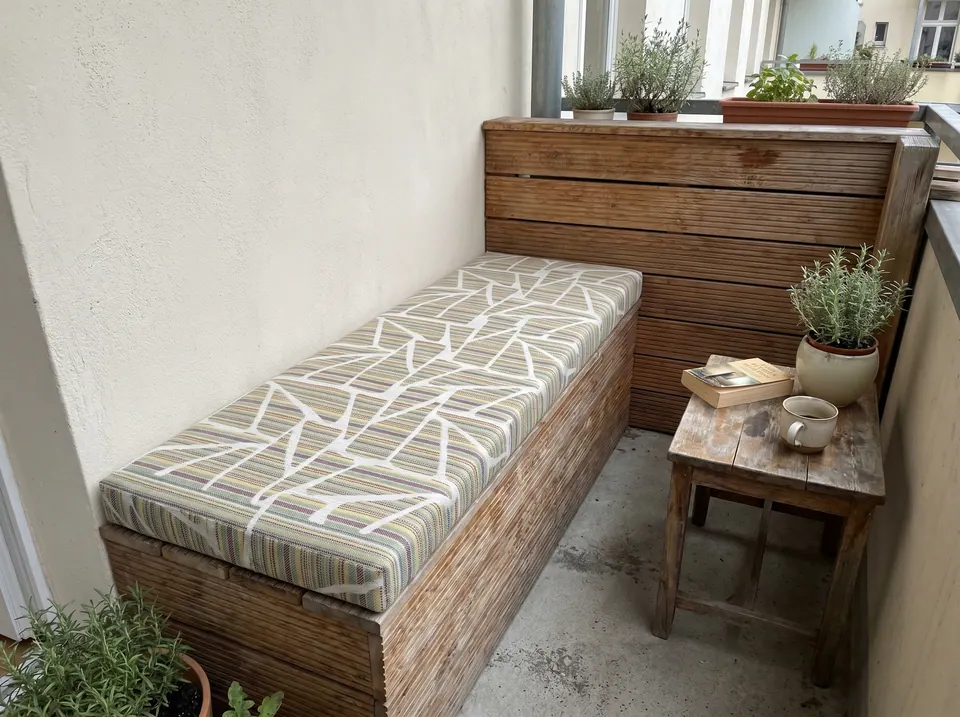
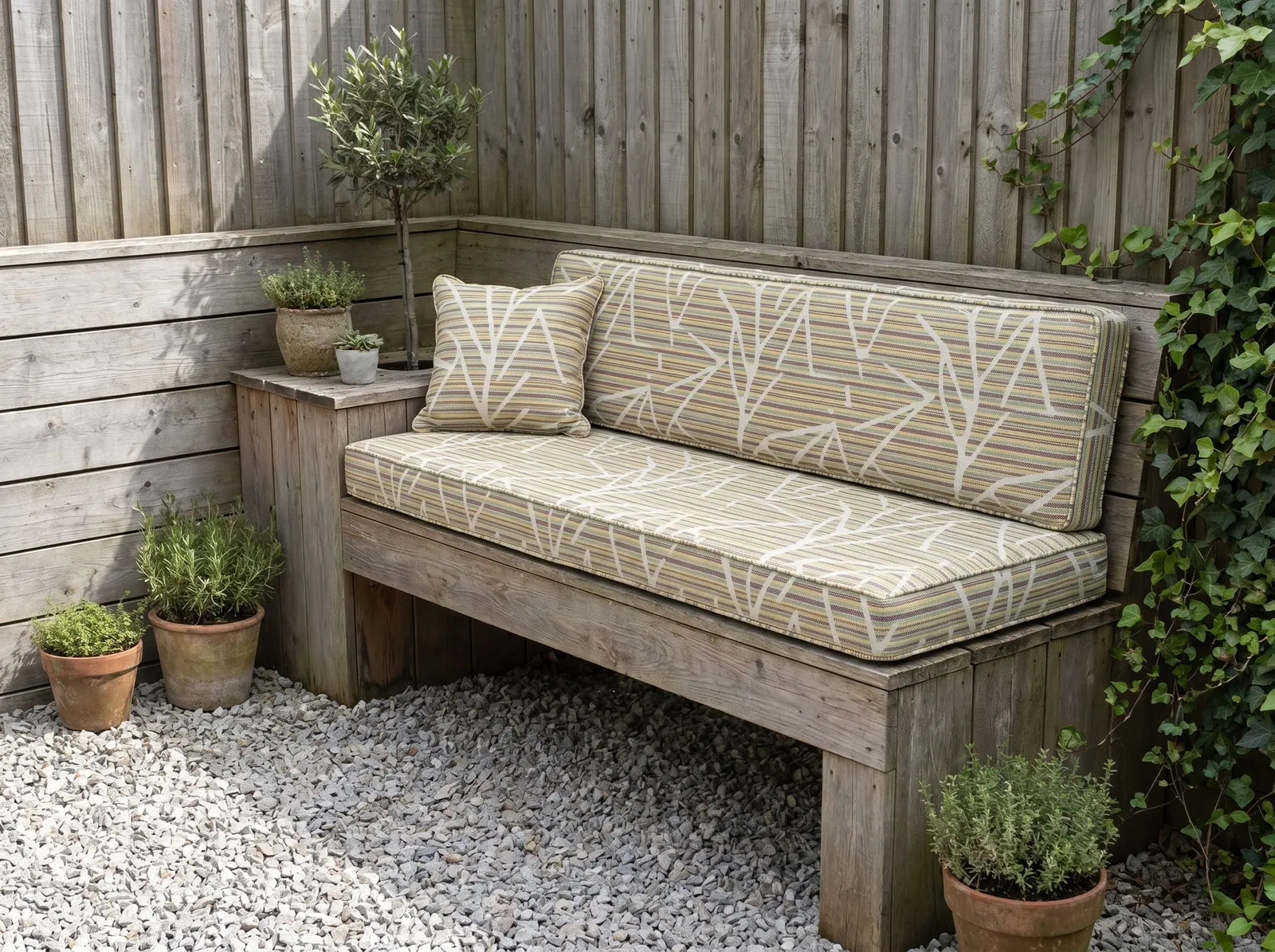
I'm writing from the gravel. That's where this photo puts you: a corner bench of rough sleeper timber, a fence at its back, ivy climbing, pale gravel underfoot. On the bench sits a seat and back cushion set in a sandy stripe with white branch lines, and one square pillow at the open end.
The seat covers the full depth of the timber, box ends square. The back cushion is shallower than the seat, which keeps you upright against the fence, the way you want to sit with a coffee. The scatter pillow sits at the plinth end where there's no arm, so nobody leans into bare wood.
The fabric is an outdoor acrylic in sand, ochre and sage. It sits with gray timber the way a dune sits with a dock piling: close enough in tone that the stripe does the talking. The greens woven into it come back in rosemary and thyme in terracotta pots, and a potted olive trained as a standard gives the corner some height.
Here's what the photo doesn't show, and what I'd ask first: how do these stay put? A back cushion leaning on a fence is a sail. Rain doesn't negotiate, and neither does a gust across an open courtyard.
More of these live among our bench cushions and patio and porch cushions, and the stripe is one of the outdoor acrylics.
Pinned by Callum: the courtyard corner
Five pins, from the seat cushion to the rosemary that repeats its greens.
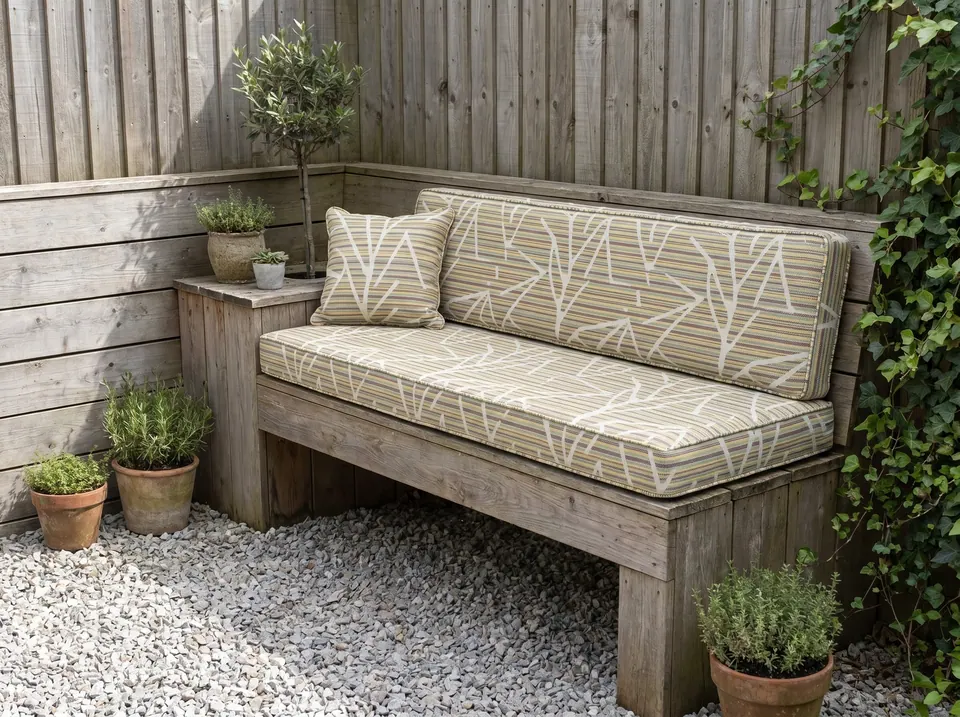
- Seat cushion
The seat covers the full bench depth with square box ends.
- Back cushion
Shallower than the seat, it keeps an upright angle against the fence.
- Scatter pillow
One pillow softens the open end where there is no arm.
- Olive standard
A tall potted tree gives the seating corner height.
- Potted rosemary
Herbs repeat the greens woven into the fabric.
- Seat cushionThe seat covers the full bench depth with square box ends.
- Back cushionShallower than the seat, it keeps an upright angle against the fence.
- Scatter pillowOne pillow softens the open end where there is no arm.
- Olive standardA tall potted tree gives the seating corner height.
- Potted rosemaryHerbs repeat the greens woven into the fabric.
Ties, a grip, or a zipper on the right edge
Three answers to the fastening question, each for a different job.
- Ties hold a back cushion to the bench frame or a rail. On an open bench they're the first thing I'd ask for on the back cushion, because wind finds a standing cushion long before a lying one.
- A non-slip base keeps a seat cushion from creeping forward on smooth timber as people sit and stand. It stops sliding. It does nothing about wind.
- Zipper placement decides what you see. Put the zipper on the back edge, against the fence, where it stays out of sight and out of the way of legs, and the cover still comes off for washing or winter storage.
Write the fastening you want in the personalization box, with the size, thickness, fabric code and piping. That box is what the makers cut from. The ties and non-slip Pattern and the zipper placement Pattern go further. What does your bench back lean against?
Fourteen feet of booth, cut in three
A restaurant owner in the US wrote to the workshop about a U-shaped booth: two end pads at 24 x 19 in (61 x 48 cm) and one long pad at 14 ft x 19 in (427 x 48 cm), needed within a few weeks.
The workshop didn't make one giant U. It recommended three separate pads, one per run, and asked for the final measurements in one unit only. All inches or all centimeters, never a mix. Then it confirmed 1 to 2 weeks for production and delivery.
The same thinking suits a courtyard bench. Pads that come apart come indoors one at a time before a storm. And a sketch with mixed units is how a 19 in depth gets cut at 7½ in (19 cm).
Buyer questions: sizes, prices and L-shaped nooks
- A common question
My bench size isn't on the list. How do I order a custom size?
The workshop's answerChoose the closest size option, and the workshop will tell you which one, then type your exact dimensions, thickness, fabric code and piping in the personalization box at checkout. Two 17 x 19.5 in seat pads, for example, went through the 18 x 18 in option with quantity 2. A missing size like 58 x 12 in can also be added. The makers cut to your numbers.
- A common question
Roughly what does a made-to-measure bench cushion cost?
The workshop's answerSelect your size range and thickness on the listing and the price shows. Anything unusual, like a 34 x 6 x 4 in stair cushion, a trapezoid bay seat with a 107.5 in back edge or a pair of 8 in high backrests, the workshop quotes in messages.
- A common question
Can you make a one-piece L-shaped seat with backrests for a dining nook?
The workshop's answerYes, L-shaped seats and backs are made regularly. Send a sketch with both runs of the L measured corner to corner, note any angled part, and add a photo of the nook and a picture of the backrest style you like; the workshop quotes from that.
On the cutting table: the courtyard set
| Cushions | Seat and back set plus one square scatter pillow |
|---|---|
| Fabric | Outdoor acrylic stripe in sand, ochre and sage with white branch lines |
| Piping | Self piping |
| Edge | Box edge, square ends |
| Back cushion | Shallower than the seat, upright against the fence |
| Fastening to ask for | Ties on the back cushion, a non-slip base under the seat |
| Zipper | Back edge, facing the fence |
| Units | One unit on every measurement |
| Best for | Courtyard, patio and porch benches |
Have it made
Have this made — ask Callum’s workshop
Tell them where it lives. Porch, deck or boat: the weather picks the fabric and the foam before anyone else does. — Callum
Leave your details and the workshop will call you to confirm measurements, fabric, foam and piping. No prices, dates or payment on this page: it is a request, not an order.
A back cushion leaning on a fence is a sail: ties hold the back, a non-slip base holds the seat, and neither one does the other's job.
Callum
Questions buyers ask next
Should the back cushion on an outdoor bench have ties?
On an open bench, ties on the back cushion are the first fastening to ask for. A back cushion leaning on a fence catches wind like a sail, and ties hold it to the frame or a rail.
What does a non-slip base do under a bench seat cushion?
It keeps the seat from creeping forward on smooth wood or timber as people sit and stand. It helps with sliding, not with wind; for wind, use ties on the back cushion.
Which edge should the zipper go on for an outdoor bench cushion?
The back edge, facing the fence or wall. It stays out of sight and out of the way of legs, and the cover still comes off for washing or winter storage.
Why keep every cushion measurement in one unit?
Mixed inches and centimeters on one sketch is how a 19 in depth gets cut at 7½ in (19 cm). The workshop asked one booth buyer for final measurements in a single unit before cutting.
Fair winds — Callum