 Save
A Reading by ÉlodieBench Cushions
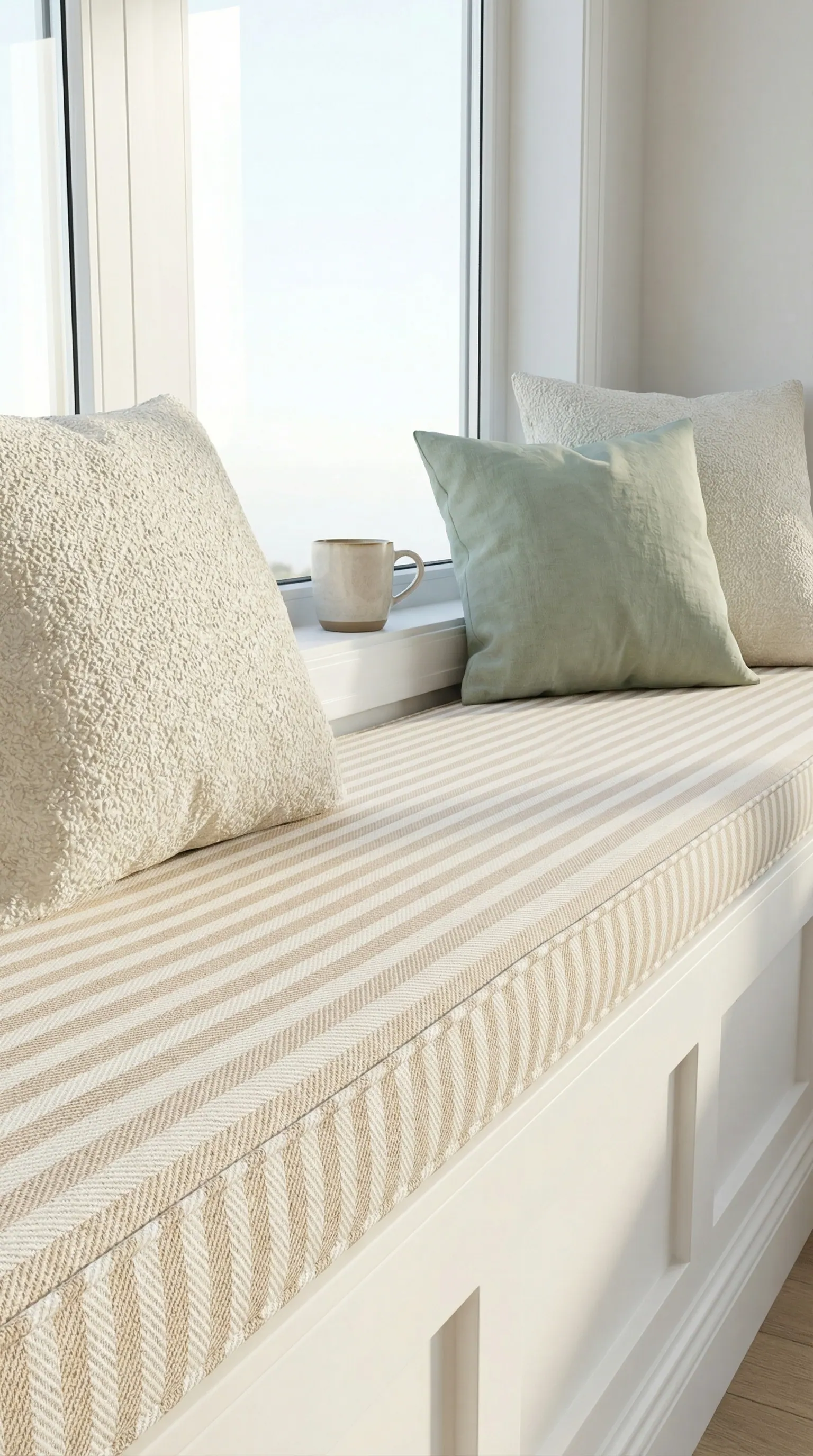
A sand-striped bench cushion that makes a narrow wall feel wide
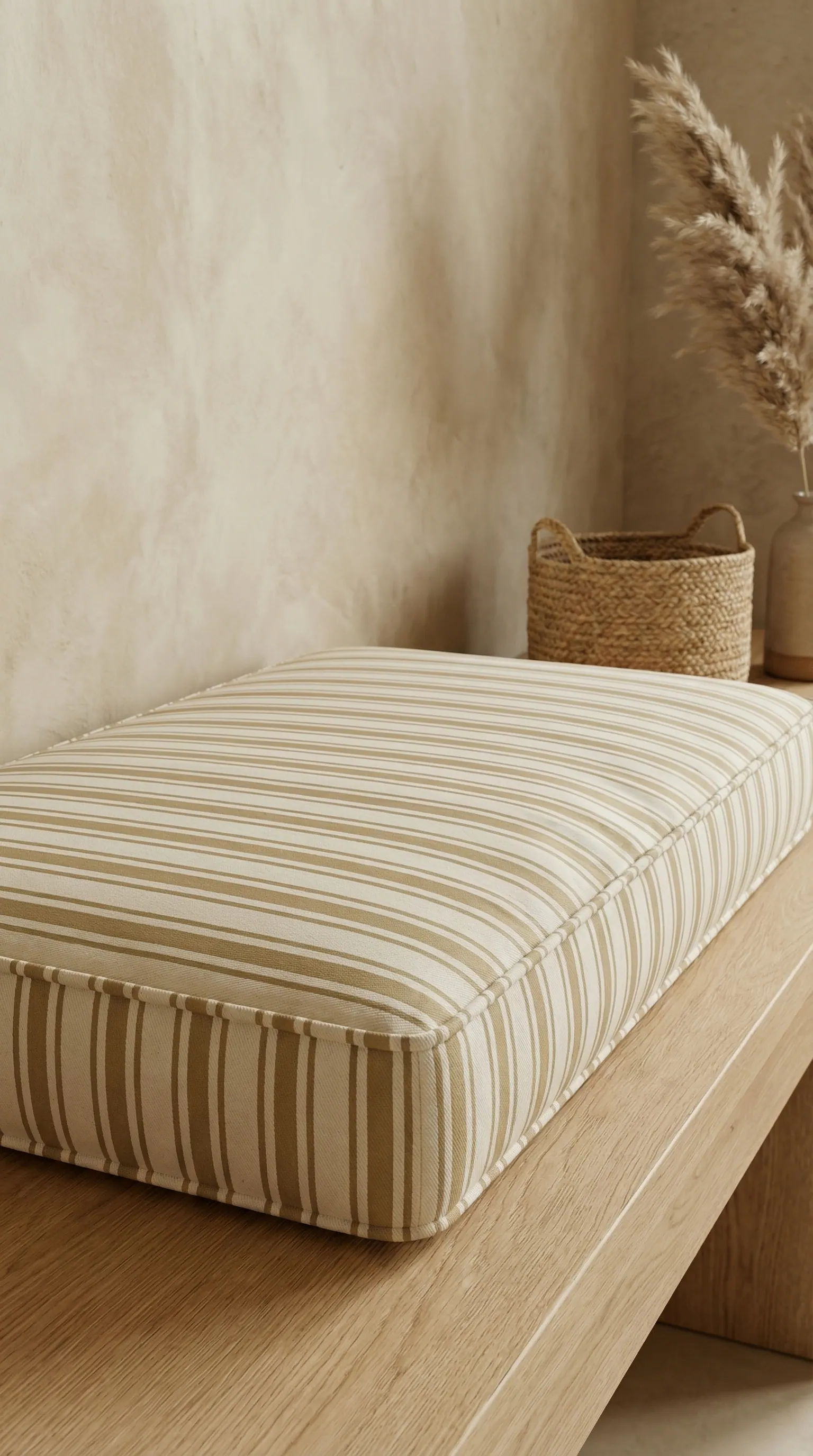
Let one color speak and the others listen. Here the speaker is a sand stripe, and everything else in a very small corner has agreed to whisper.

Swatch strip measured from the photograph
- umber#6a4c2d25%
- sand#c1b19721%
- oatmeal#cabfab21%
- camel#a1896821%
- oatmeal#d1c9b712%
The quick answer
To make a narrow bench feel generous, keep everything around a striped bench cushion in one warm family, such as oak, limewash, seagrass and pampas, so the stripe is the only pattern. Order the cushion a little shorter than the bench and use the bare wood at one end as a shelf, so you need no side table.
One warm key, seven notes on a striped bench
Named by eye in soft side light; the strip above is measured from the photograph.
- Cream ground#e6dcc8The cushion's base, close to the limewash, so the wall seems to continue.
- Sand stripe#c8b08aThe wide bands that carry across the top.
- Khaki stripe#9a8763The narrow bands that sharpen the tall side band.
- Pale oak#c9ab80The bench, a shade warmer than the sand.
- Limewash plaster#d8cfbfSoft and mottled, light enough to step back.
- Seagrass#a38c5fThe basket, one step darker, parked on bare oak.
- Pampas#d9c7a4The same sand again, made feathery.
How a small corner borrows room
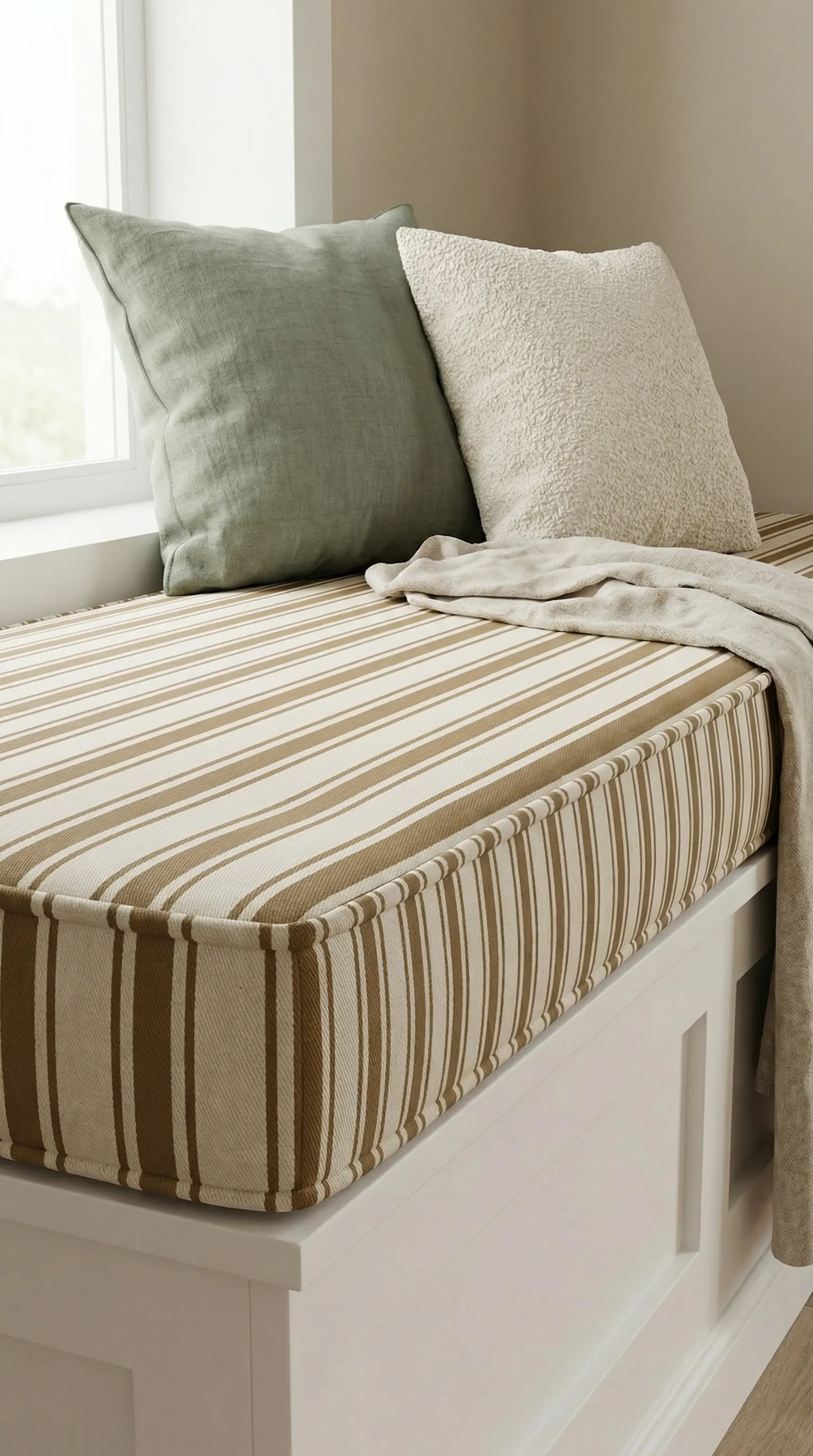
Small spaces feel crowded when every object argues. In this corner nothing argues. Oak, plaster, seagrass and pampas all belong to one sandy family, and the striped bench cushion is the only pattern and the only contrast in the picture. When a palette agrees like that, the edges of the room go soft and the wall seems to step back.
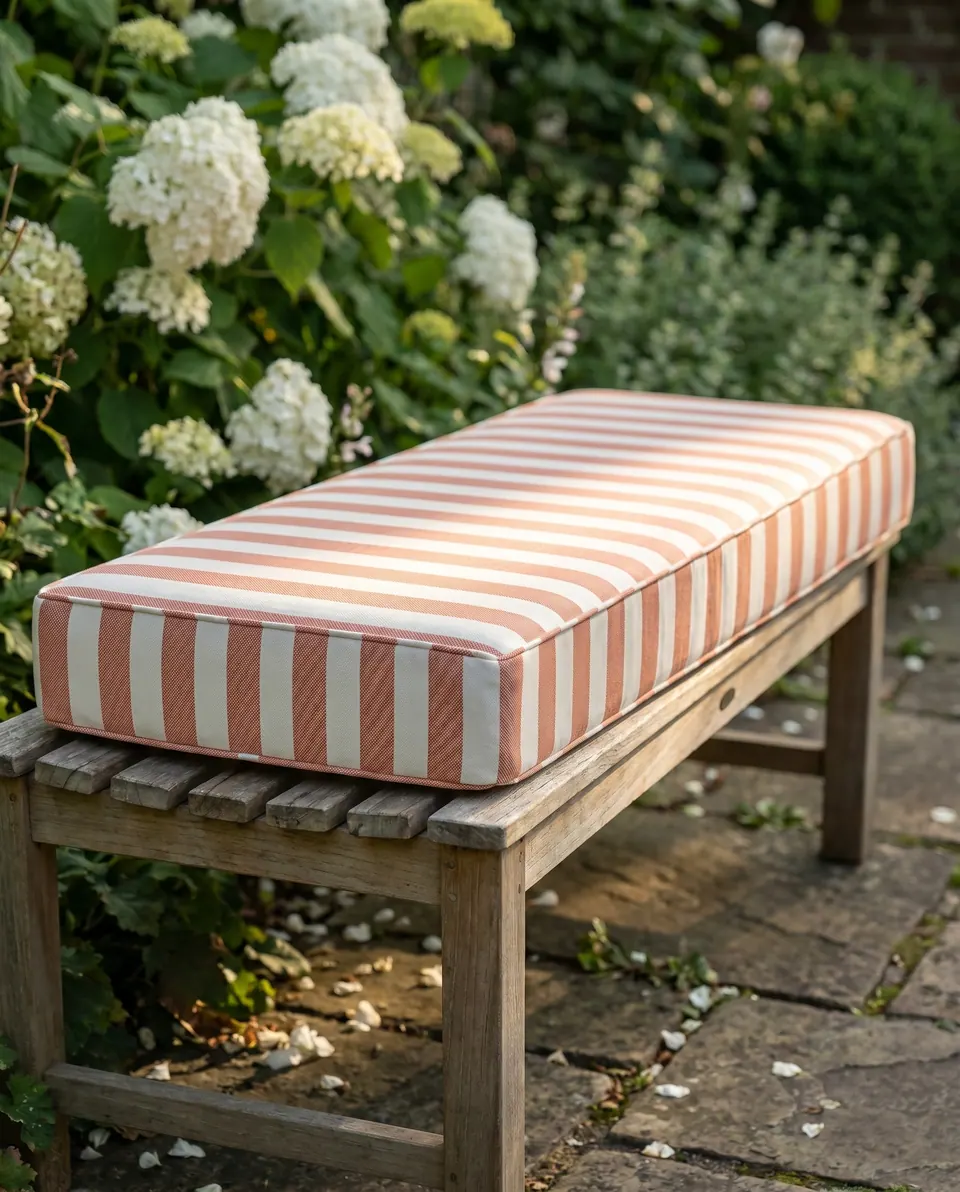
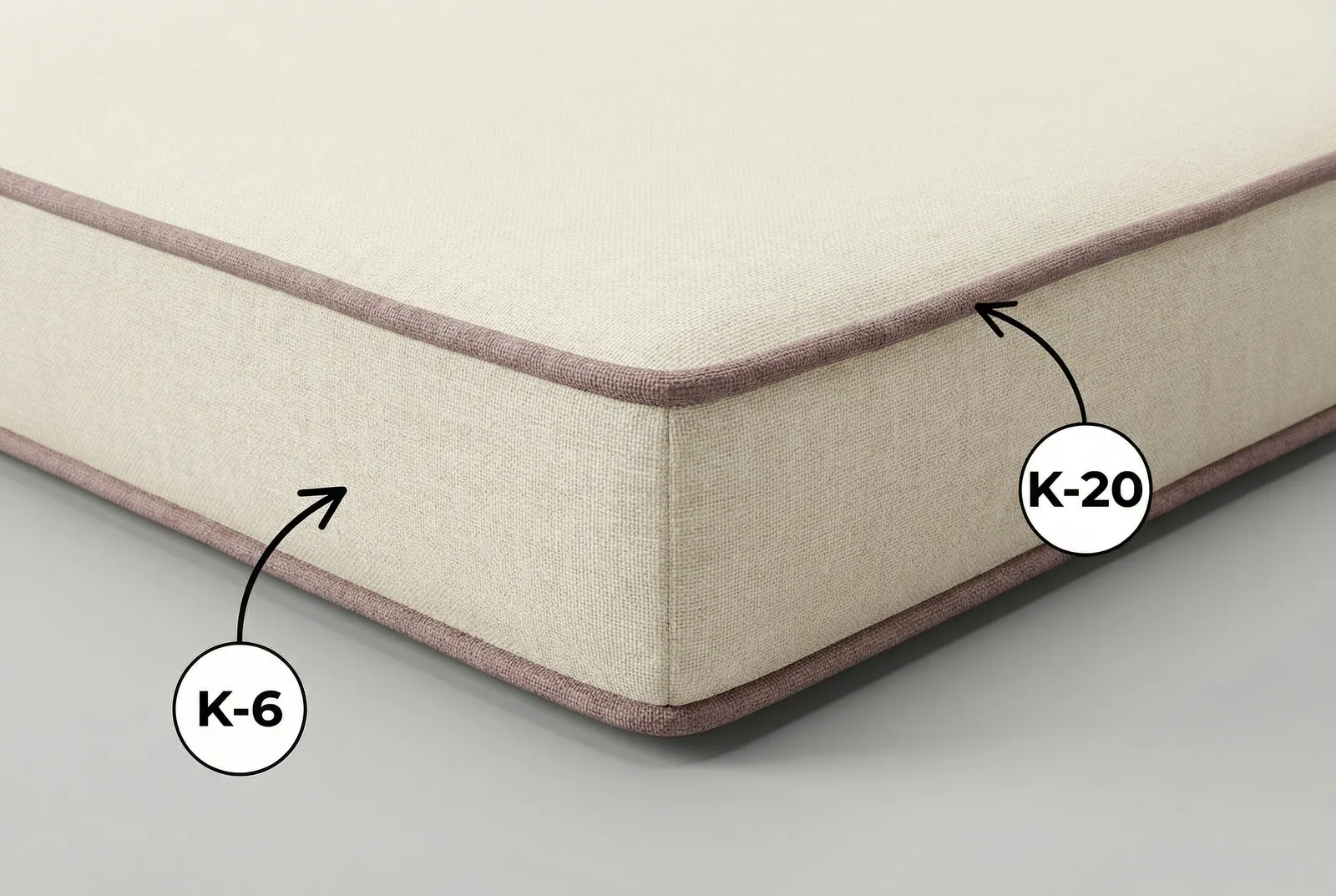
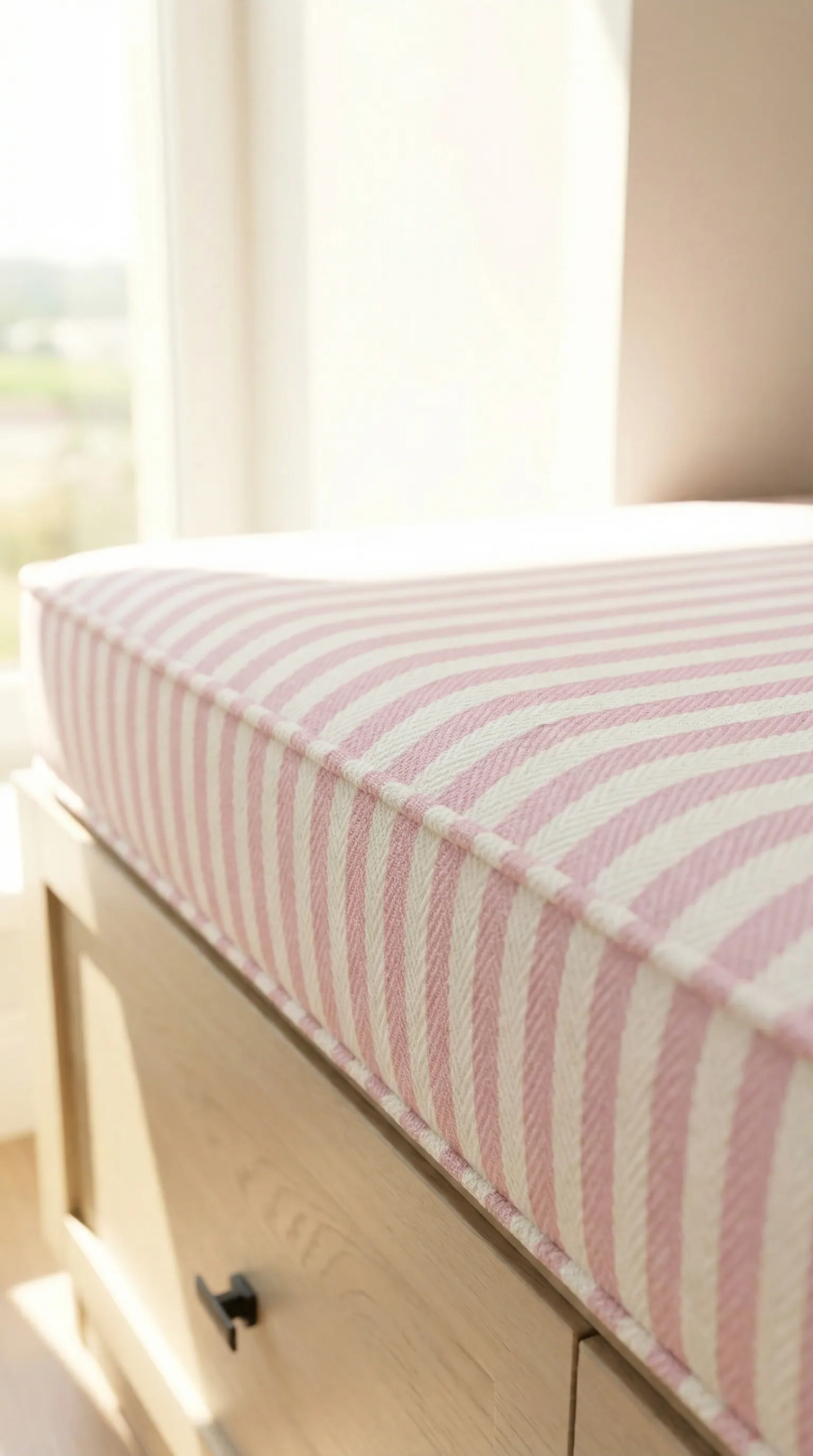
Look at the stripe. It has bands of different widths: wide ones across the top, narrow ones along the tall side band. On a thick box cushion, about 5 in (12.5 cm) here, that rhythm keeps the block from looking heavy, and self piping keeps the side band square without adding a line of a new color.
Then the clever part. The cushion stops short of the end of the bench and leaves a stretch of bare oak, and the seagrass basket lives there. No side table, no extra footprint, just a shelf you already own. The bench floats off the wall, too, so you see floor beneath it, and visible floor always reads as space.
The pampas in its stoneware vase is the last word: the sand tone again, but feathery, lifting the eye up the plaster. Height is room you do not have to pay for.
One caution, my friends. The cotton stripes are 100% cotton and indoor-only, and they stain more easily than performance fabric. By a door with muddy boots or small hands, choose a performance fabric in a similar sand. What would you park on the bare end of your bench?
Pinned by Élodie
Five places where the palette stays in one key.
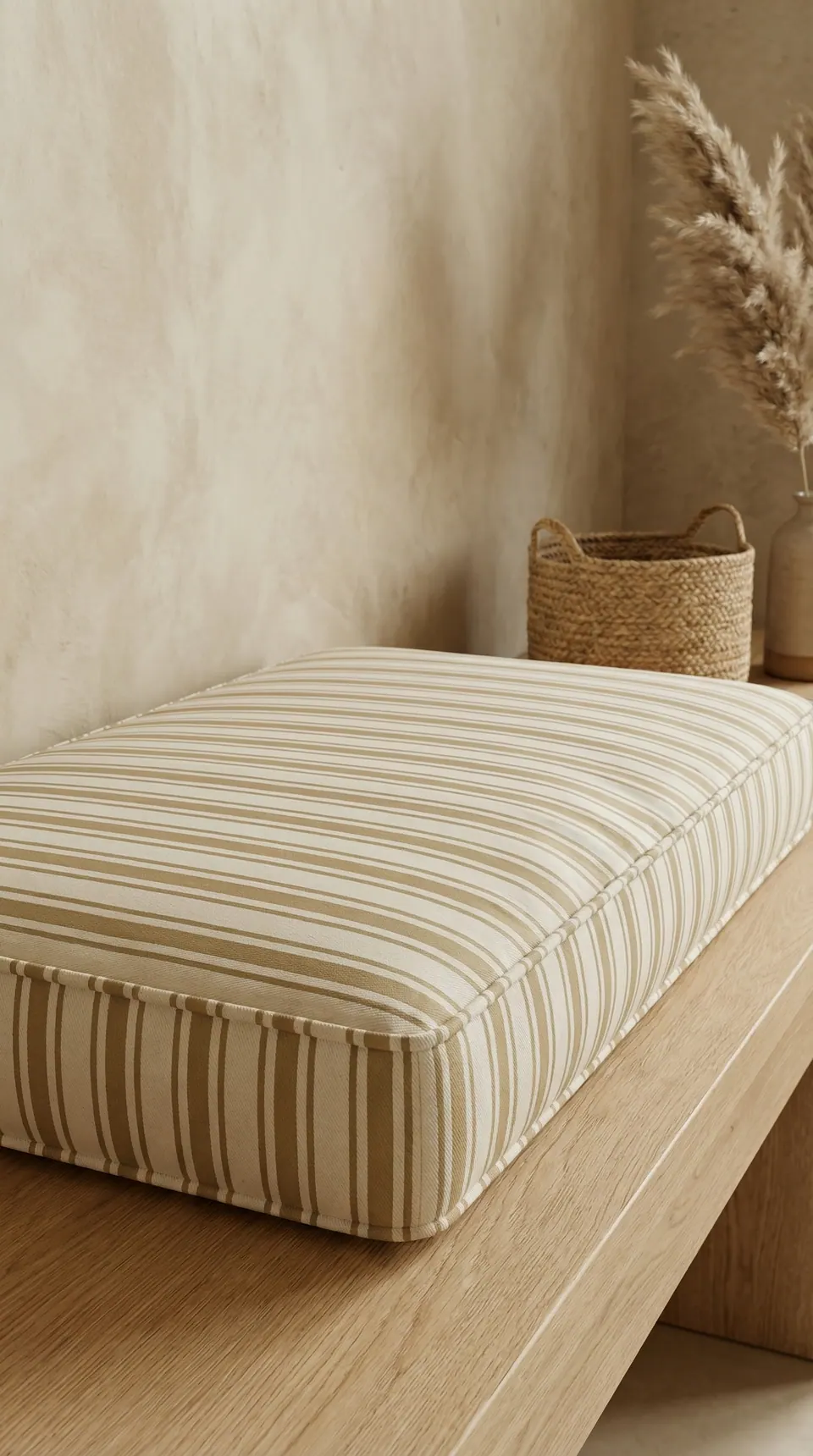
- pampas grass
Pampas repeats the stripe's sand tone in a soft, feathery texture.
- seagrass basket
The cushion stops short, leaving bare oak as a shelf for the basket.
- mixed-width stripes
Wide and narrow bands give a thick cushion rhythm without extra color.
- piped box corner
On a 5 in box, self piping keeps the tall side band square and neat.
- floating oak bench
Oak, plaster and seagrass all sit in one warm family around the stripe.
- pampas grassPampas repeats the stripe's sand tone in a soft, feathery texture.
- seagrass basketThe cushion stops short, leaving bare oak as a shelf for the basket.
- mixed-width stripesWide and narrow bands give a thick cushion rhythm without extra color.
- piped box cornerOn a 5 in box, self piping keeps the tall side band square and neat.
- floating oak benchOak, plaster and seagrass all sit in one warm family around the stripe.
Bench cushion questions from narrow places
Three questions that come up often, with the workshop's answers.
- A common question
My bay window seat has two extra edges, more of a hexagon than a trapezoid. Can you make that?
The workshop's answerYes. Send the exact length of every side, or a simple sketch, and the workshop turns it into a template for you to check. Then choose the length and width ranges that fit, for example 78 in and 22 in, and write the full shape in the personalization box: front, back, angled sides, end sides and depth.
- A common question
Are the covers removable and washable, and where does the zipper go?
The workshop's answerYes. Every cover comes off with a zipper placed on the underside, so it stays hidden, and every fabric machine washes at 86°F (30°C) on a delicate cycle.
- A common question
Kids are messy. Which fabric is easiest to clean for a family eating nook, and should I go with velvet?
The workshop's answerThe workshop recommends its soft fabric, which is durable and easy to clean, and suggested it over velvet for a children's playroom. If you want a light beige look, the color called smoke is a beige-gray.
Cream to sit beside the striped chairs
A buyer in the US had a newly built breakfast nook bench and striped dining chairs on the way. She wanted a cream linen to go with them and sent a link to the chairs. The workshop suggested a cream and said plainly that an exact match to another maker's fabric is nearly impossible.
Then the chairs arrived, and the piping debate began. A dark contrast cord seemed clever until the samples spoke: one code turned out to be a very dark gray, the next a true black. In the end she chose self piping in the same cream, which the workshop called the safest choice. I would have said the same. Beside a busy stripe, a quiet edge is the generous one.
- Fabric
- Cream linen, self-piped
The lesson: When in doubt, self piping on a forgiving cream always looks clean.
A 5 in striped bench cushion suits a narrow room when it is the only pattern: keep the oak, the plaster and the basket in one warm sand family.
Élodie
On the cutting table: the striped oak bench cushion
| Cushion | Bench cushion, box edge, about 5 in (12.5 cm) thick |
|---|---|
| Fabric | Striped cotton: cream ground, sand and khaki bands |
| Stripe | Mixed widths, woven in, in a fixed colorway |
| Piping | Self piping |
| Length | Shorter than the bench, leaving bare oak at one end |
| Fiber | 100% cotton, indoor-only |
| Care | Zipped cover, 86°F (30°C) delicate cycle, air dry |
| Best for | Narrow living-room walls, entries and small nooks |

Have it made
Have this made — ask Élodie’s workshop
A fabric reads one way at noon and another at dusk. Mention your light, and the workshop will weigh it with you. — Élodie
Leave your details and the workshop will call you to confirm measurements, fabric, foam and piping. No prices, dates or payment on this page: it is a request, not an order.
Questions buyers ask next
How wide are the stripes on a cotton stripe cushion?
It depends on the code. Widths run from about 1/4 in (0.7 cm) up to about 2 in (5 to 6 cm), and the stripes are woven in, so each fabric comes in its own fixed colorway.
Which way do stripes run on a long bench cushion?
By default, front to back. The fabric roll is about 55 in (140 cm) wide, so a long striped piece may need a seam, and stripes are matched on one face only. Say so in your order note if you want another direction.
What piping suits a striped bench cushion?
Often piping cut from the same striped fabric. Matching a solid cord exactly to one color in a stripe is hard, so the workshop has suggested same-stripe piping instead; a plain cream, as in the nook story, is the other quiet choice.
With color and care — Élodie
More stripes in small places
 Save
 Save
 Save
 Save
 Save
 Save