CushionGuide

A Reading by ÉlodieBench Cushions

Salt-and-pepper chenille, up close: a bench cushion made for lingering

At arm's length it is white dots on black. From the doorway it is a soft gray. Élodie reads one corner of a chenille bench cushion and what it asks of a long sit.

The quick answer

A salt-and-pepper chenille bench cushion suits long sitting because its tufted pile is soft to the touch and its white-on-black weave reads as a lively mid gray that never looks flat. For reading or working, choose 3 in (8 cm) of medium-firm foam over a 2 in pad, skip piping so the dots turn the corner, and add a backrest.

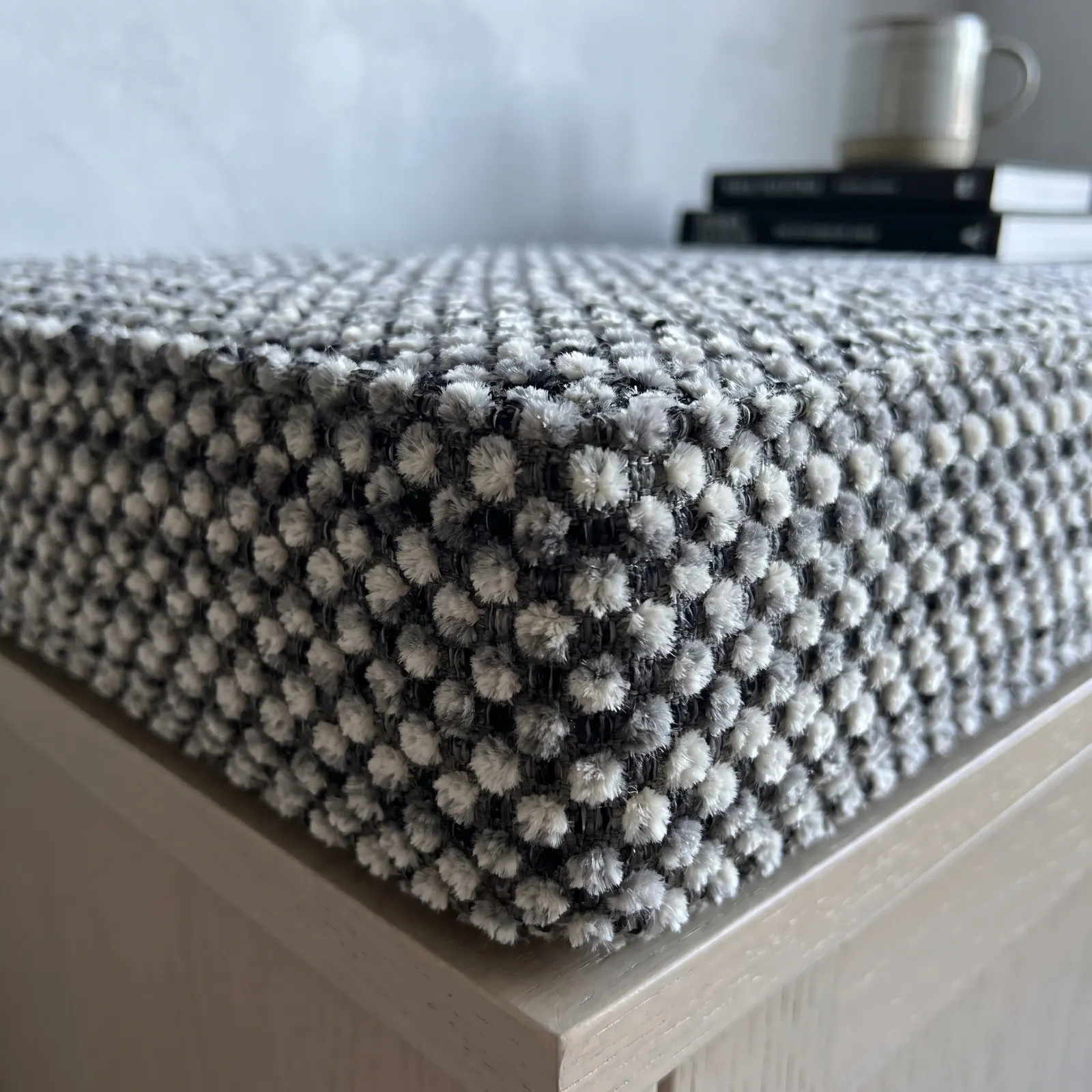
Macro of a white, gray and black dotted chenille cushion corner without piping on a whitewashed oak cabinetSave
White dots over a charcoal ground make a gray that reads soft up close and graphic from across the room.

Pinned by Élodie: one corner, up close

Start at the unbroken corner of the cushion, then let the pins lead you back to the stoneware mug and the black books on the cabinet.
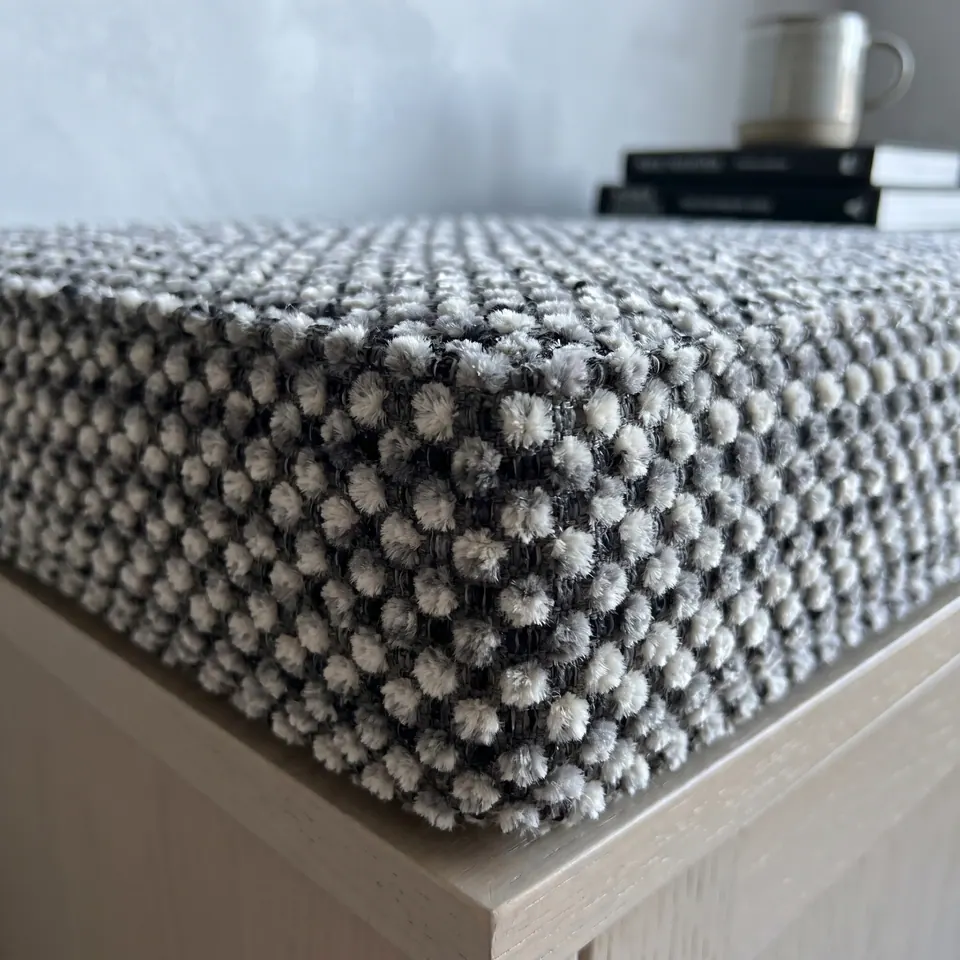
Pinned: Macro of a white, gray and black dotted chenille cushion corner without piping on a whitewashed oak cabinet
  1. Salt-and-pepper corner

    White tufts over a black ground turn the corner uninterrupted.

  2. Top surface

    From a distance the dots blend into a soft mid gray.

  3. Whitewashed oak

    Pale wood keeps the monochrome weave from feeling cold.

  4. Stoneware mug

    A cream mug echoes the white tufts.

  5. Black books

    Black spines pick up the darkest thread in the weave.

  1. Salt-and-pepper cornerWhite tufts over a black ground turn the corner uninterrupted.
  2. Top surfaceFrom a distance the dots blend into a soft mid gray.
  3. Whitewashed oakPale wood keeps the monochrome weave from feeling cold.
  4. Stoneware mugA cream mug echoes the white tufts.
  5. Black booksBlack spines pick up the darkest thread in the weave.

A gray made of black and white

Lean in close, my friends, and this cushion is not gray at all. It is chalk-white tufts standing proud of a charcoal-black ground, the way coarse salt sits on a dark iron skillet. Step back to the doorway and the dots melt into a soft, even mid gray.

That shifting gray is the reason to choose it. A flat gray in cool daylight can look tired by afternoon. A woven salt-and-pepper keeps moving, so the seat never goes dull, even in the flat north light of this photograph, which was taken at seat height, close to how the cloth will look in a real hallway.

There is no piping. The dots simply roll over the box edge and down the side, uninterrupted, like frost over a step. A contrast welt here would have drawn a hard line through the texture.

The props finish the thought. The whitewashed oak cabinet keeps a black-and-white weave from feeling cold. The cream stoneware mug echoes the white tufts; the stack of black books picks up the darkest thread. At home, pair it the same way: black accents and pale wood. The jacquard and chenille shelf holds its cousins, and the glossary explains chenille.

Made for the third hour on the bench

The mug and the books tell you what this bench is for: the second cup, the next chapter. Long sitting asks three things of a bench cushion.

A soft face. Chenille's tufted pile is warm under the hand, so the surface still feels kind long after the coffee has gone cold.

Real depth of foam. A 2 in (5 cm) pad is fine for pulling on boots. For reading or working, 3 in (8 cm) of medium-firm high-resilience foam is the better base, and it happens to be the workshop's best-selling thickness.

Something to lean on. A bench against a wall becomes a lingering spot the day it gets a backrest. Backrest cushions are sold separately and can be matched to the color of an earlier order.

Try the bench cushion builder to see thickness and backrest together, or browse the bench cushion atlas. How long do you really sit on your bench each day?

A real project

The stripe that turned blue in daylight

A buyer in the US wanted a 2 in (5 cm) bench cushion in a striped cotton, with bolsters. A set with 8 in and 6 in (20 and 15 cm) bolsters was quoted; in the end they ordered only the cushion, 73 x 26 in (185 x 66 cm).

When it arrived, the dark stripe read as blue. From the photos they had expected charcoal. The workshop checked, confirmed the correct fabric code had been used, and offered a partial refund, or a return at the buyer's cost.

Daylight never lies; your screen sometimes does. Dark stripes often photograph as charcoal and live as navy. When the exact shade matters, and on a salt-and-pepper weave it does, order a swatch first. The swatch pattern explains how.

On the cutting table: the chenille corner

PieceBench cushion with a box edge
FabricSalt-and-pepper chenille: white tufts over a black ground
Reads asGraphic up close, soft mid gray from across the room
PipingNone, so the dots turn the corner unbroken
Thickness for long sits3 in (8 cm), the best seller; 2 in (5 cm) for quick perching
BackrestSold separately, matched to the seat color
Pairs withBlack accents and pale or whitewashed wood
Before orderingAsk for a swatch and view it in daylight

Order this cushion

Have it made

Have this made — ask Élodie’s workshop

A fabric reads one way at noon and another at dusk. Mention your light, and the workshop will weigh it with you. — Élodie

Leave your details and the workshop will call you to confirm measurements, fabric, foam and piping. No prices, dates or payment on this page: it is a request, not an order.

Fabric · Foam · Pipingwhat the workshop will confirm with you

Fabric
Salt-and-pepper chenille: white tufts over a black ground
Foam
The core: its density and thickness set the feel.
Piping
None, so the dots turn the corner unbroken
Only for this request: no marketing calls or texts. Outside the US, add the country code.
In inches: length × depth × thickness, plus any angles or cut corners.

* Required. A member of the workshop team will call you to talk it through; nothing is charged and nothing is made until you have agreed on every detail with them.

We use these details only to answer this request and make your cushion: your name and contact details, the cushion details and photos you send, the page you came from and the ad or link that brought you, if any. The workshop that makes the cushions receives them. We don't sell them or share them for advertising, and we delete requests after 24 months. Privacy notice for requests.

Nothing is made or charged until you approve the details.

Want to pick the shape and add photos? Use the full quote form

Buyer questions: sizes, sets and backrests

  1. A common question

    My bench is longer than the biggest size in the dropdown. How do I order it?

    The workshop's answer

    Choose the closest listed size, such as 20 x 92 in for a 20 x 94 in cushion, and write your exact dimensions in the personalization box; that is the size that gets made. The dropdown mainly sets the price bracket. For very long or unusual sizes, the shop adds a custom option made just for you to the listing.

  2. A common question

    Are your prices fixed, or can I get a quote for a whole set?

    The workshop's answer

    Single cushions are priced by size range right on the listing. For multi-piece sets the shop sends a custom quote, often with a set price below the total of the pieces, and a private purchase link. Shaped cushions have their own trapezoid listing, priced by size range the same way.

  3. A common question

    Can I buy extra straight or L-shaped backrest cushions on their own?

    The workshop's answer

    Yes, every piece is sold separately, and backrests can be matched to an earlier order's color. After a contractor damaged one buyer's originals, the shop set up a dedicated link for two L-shaped backrests in navy.

A salt-and-pepper bench cushion reads graphic up close and soft gray from the doorway, because white tufts sit over a black ground.

Élodie

Questions buyers ask next

What thickness suits a bench where I read for hours?

For reading or working, 3 in (8 cm) of medium-firm high-resilience foam is a sound base and the workshop's best-selling thickness. A 2 in (5 cm) pad suits quick perching, such as pulling on boots in an entryway.

Why does salt-and-pepper chenille look different from across the room?

White tufts sit over a black ground. Up close you see the dots; from a few steps away they blend into a soft mid gray. That movement keeps the seat from looking flat in cool daylight.

Should a textured chenille cushion have piping?

Usually not. Without piping, the pattern rolls over the edge unbroken, which suits a dotted or tufted weave. A contrast welt would draw a hard line through the texture; save piping for smooth fabrics where the edge needs defining.

With color and care — Élodie