A Reading by MaggieBench Cushions
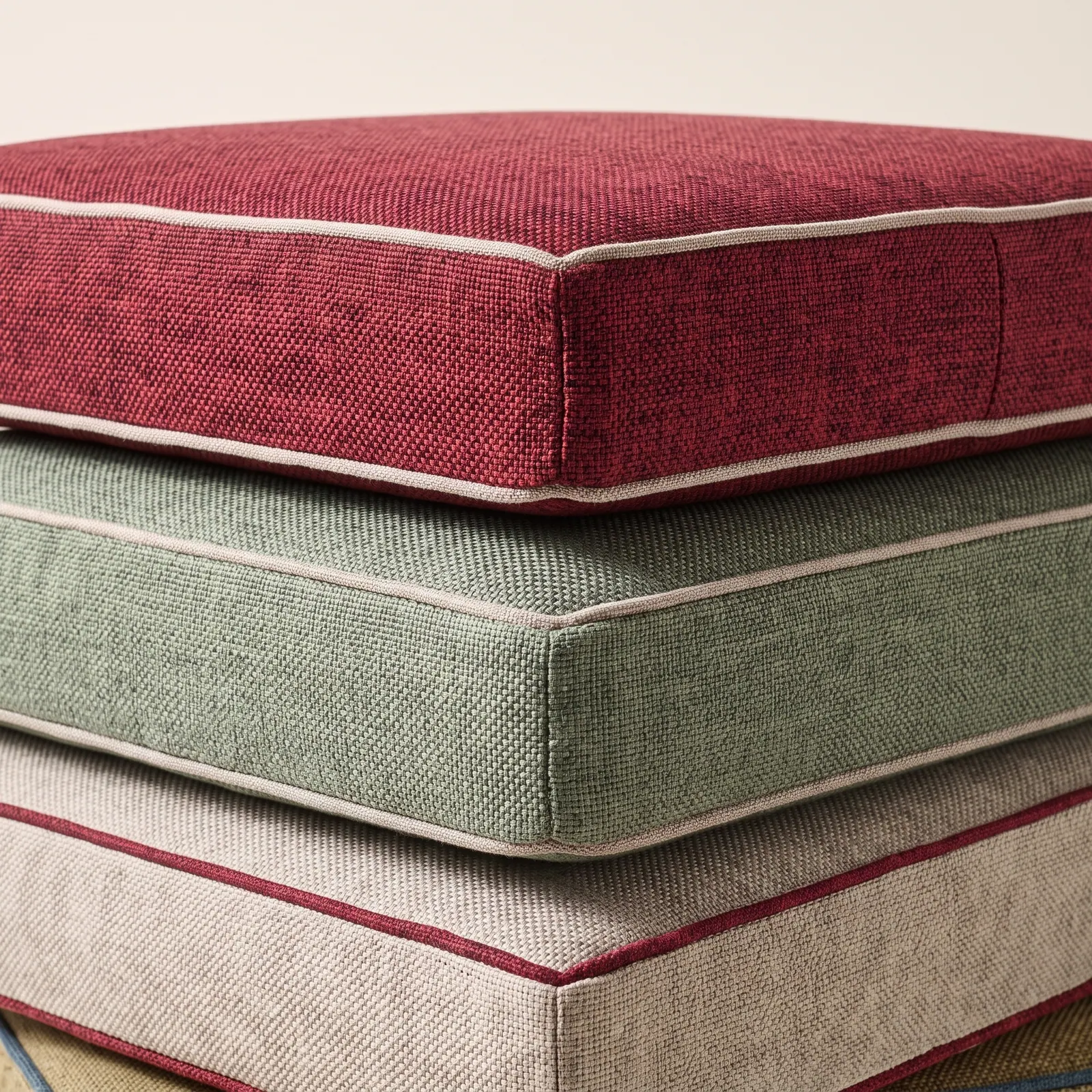
Custom bench cushions in red, sage and oatmeal, read corner by corner
Three cushions, two colors of welt, and the reason a mixed set can seat a crowd and still look like it came from one hand.

 Save
The quick answer
To make several custom bench cushions look like one set when you host, keep every fabric in one tone family and reverse a piping pair: cherry red with oatmeal welt, oatmeal with red welt, sage in between. Up close, check for piping on the top and bottom seams, square corners and a side panel that lies flat.
The cushion, cut open
Cover fabric. A removable, zippered cover. Machine wash at 86°F (30°C) on a gentle cycle and air dry.
Piping. A fabric-covered cord sewn into the seams. It sits on the seam line, so it does not change the size.
Fiber wrap. Polyester fiber (Dacron) batting around the foam: it fills the cover out and softens the edges.
Foam core. About 2.0 lb/ft³ (32 kg/m³) high-resilience foam, firm to medium-firm, cut to the ordered size.
Zipper. Along the back band, as hidden as possible. The zipper side faces down or toward the wall.
Base panel. The underside of the cover. A non-slip fabric backing can cover the whole of it instead.
Pinned by Maggie: four places a corner tells the truth
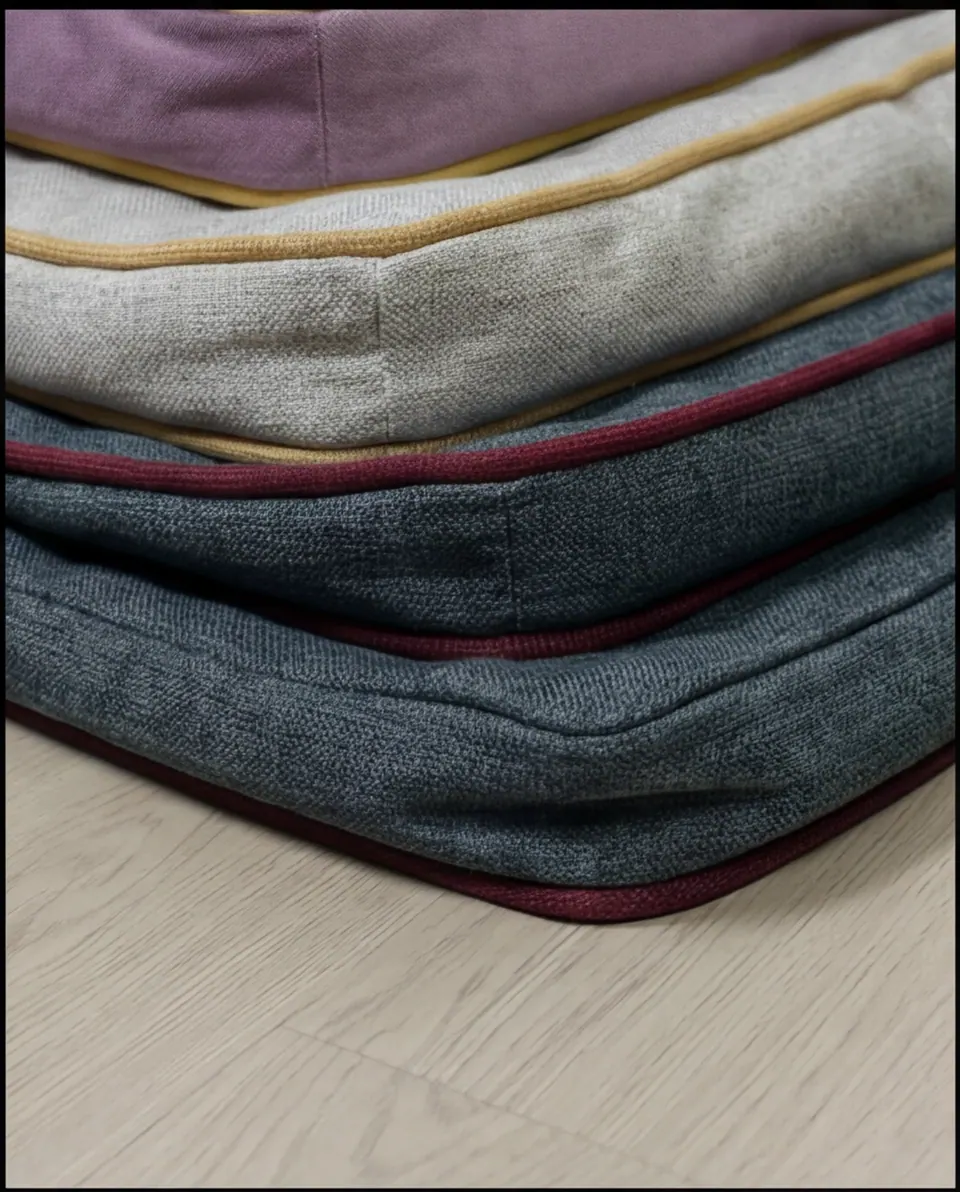
Start at the red cushion on top and work down; every pin is a seam or a corner you can check yourself.
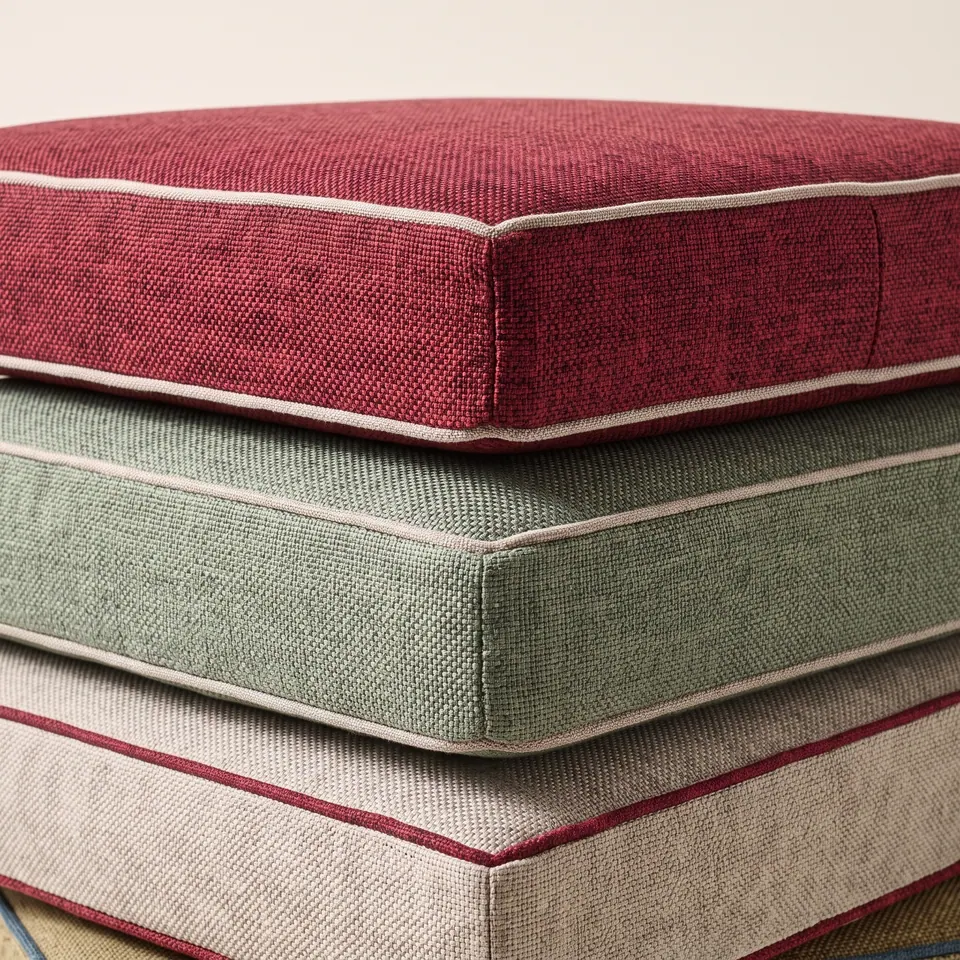
- Red with oatmeal piping
Pale welt on red makes the box corner crisp and easy to see.
- Sage box corner
The corner is sewn square with no puckering at the piping join.
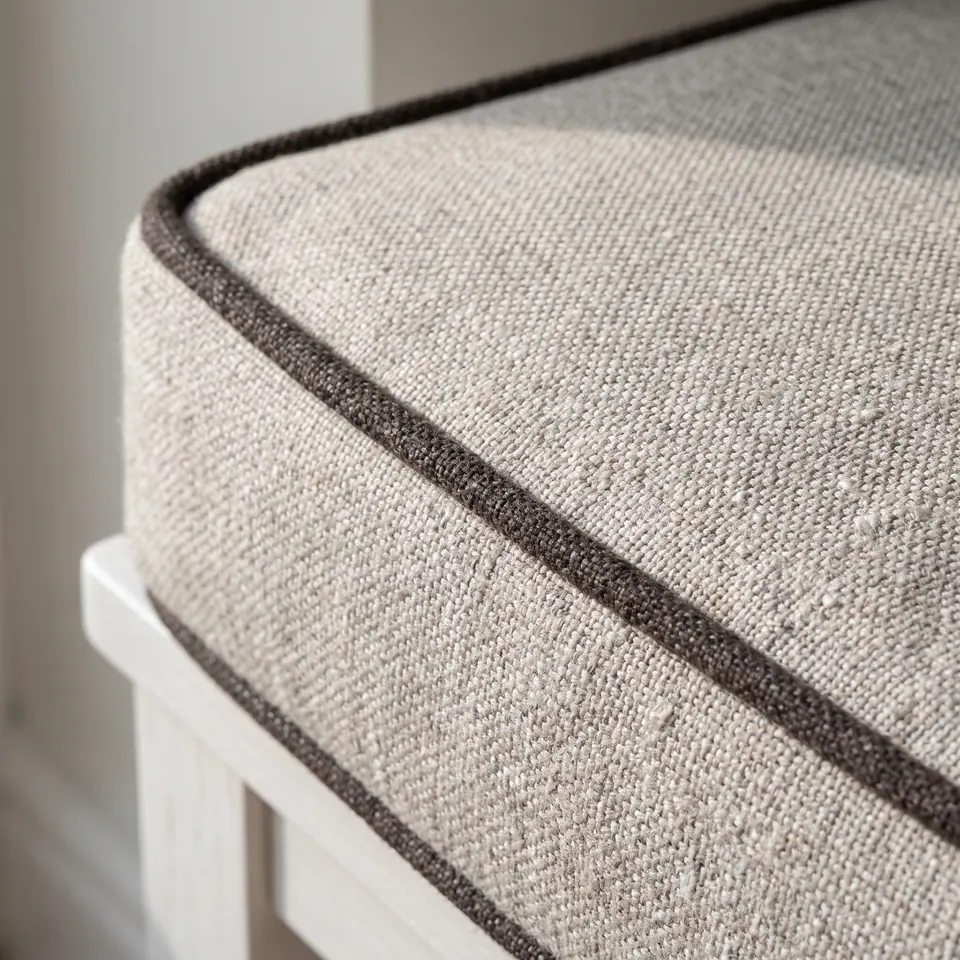
- Basket-weave texture
The open weave shows why this fabric looks like linen but holds its shape.
- Red piping on oatmeal
The same red and oatmeal pair, reversed, on the cushion below.
- Red with oatmeal pipingPale welt on red makes the box corner crisp and easy to see.
- Sage box cornerThe corner is sewn square with no puckering at the piping join.
- Basket-weave textureThe open weave shows why this fabric looks like linen but holds its shape.
- Red piping on oatmealThe same red and oatmeal pair, reversed, on the cushion below.
Reading the stack from the top welt down
Close up, a cushion can't hide much. That's why I like this photograph.
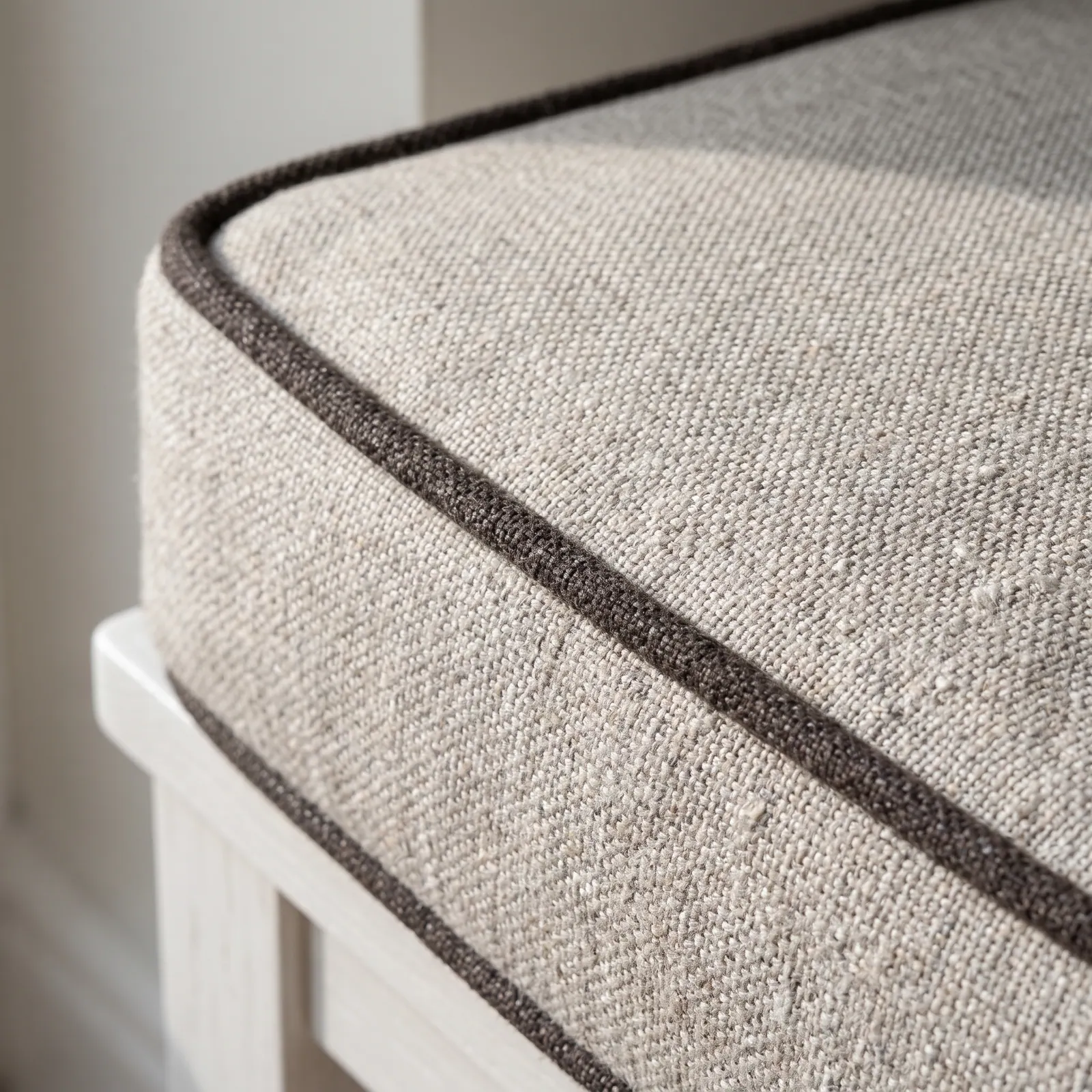
Top of the stack: cherry red linen-look with an oatmeal welt on the top and bottom seams. Pale cord against red makes the box corner crisp, so you can tell it's square from across a dining room.
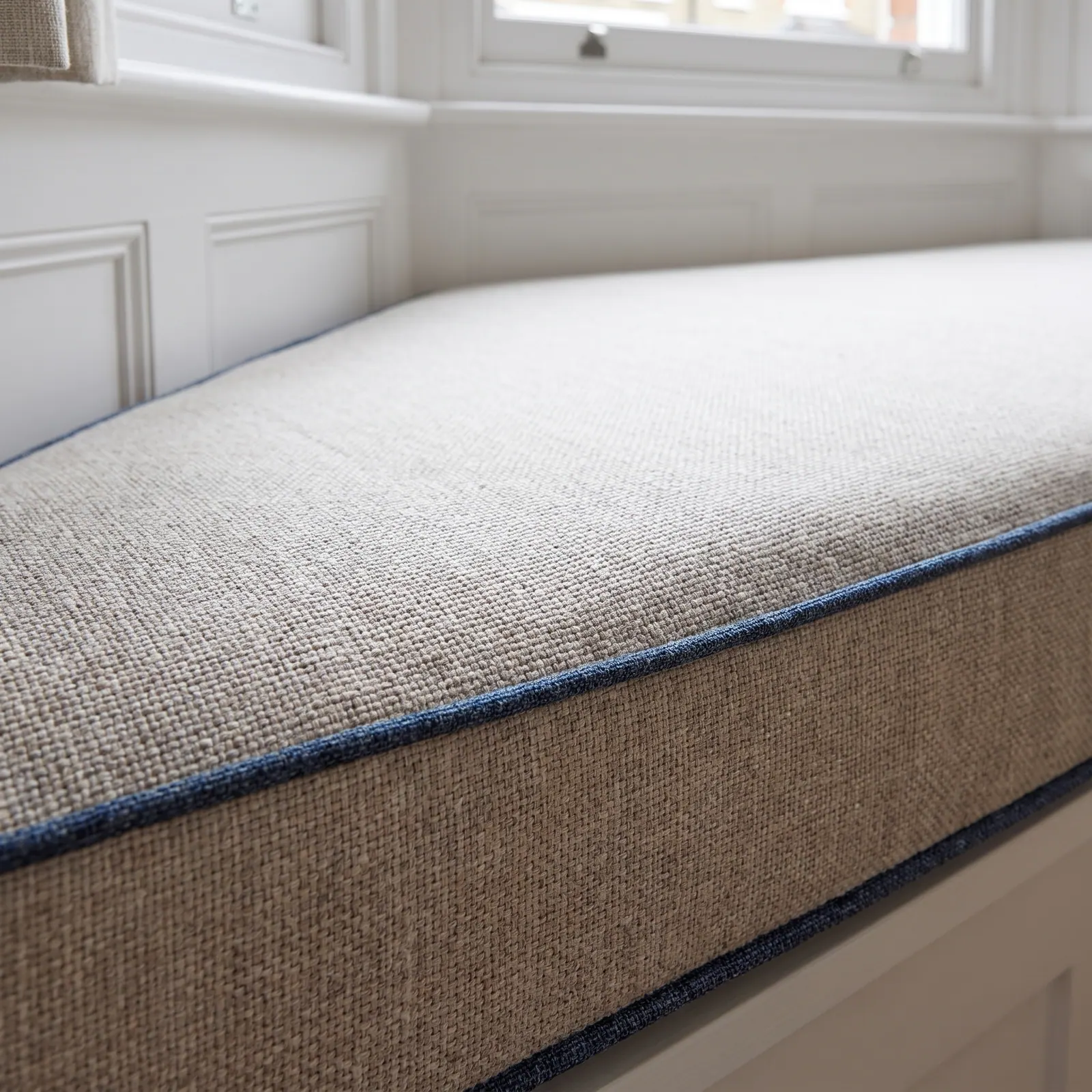
Middle: sage with oatmeal piping. Look where the welt turns the corner. No puckering, no wandering. A straight welt is a kind of honesty, and this one has nothing to confess.
Bottom: oatmeal with red piping. The same pair as the top cushion, reversed. That's the whole trick for hosting. Your guests sit on different colors, but the eye reads one family. For a long table with several bench cushions, it beats hunting for three identical fabrics.
Between the welts, the side panel stays flat. That flat boxed edge keeps the seat from rounding off when three people slide along a bench during a long dinner.
And the weave. At this distance you see the basket weave of the linen-look fabric: open like linen, yet it holds its shape. That is what your hand meets when you sit down.
The backdrop is plain cream. No props, dear, nothing to flatter. Which is exactly why the corners have to be right.
How many people does your longest bench need to seat?
Anatomy of a piped box cushion, layer by layer
Top panel
The seat face, where the open basket weave shows and where you actually sit.
Top welt
Piping sewn into the top seam. On red, an oatmeal cord makes the edge easy to read.
Side panel
The boxing strip between the two seams. It should lie flat, not bow.
Corner turn
Where the welt turns 90 degrees. Square, with no puckering at the join.
Bottom welt
A second cord on the bottom seam, so the box edge looks finished top and bottom.
Three benches, three lengths, one family
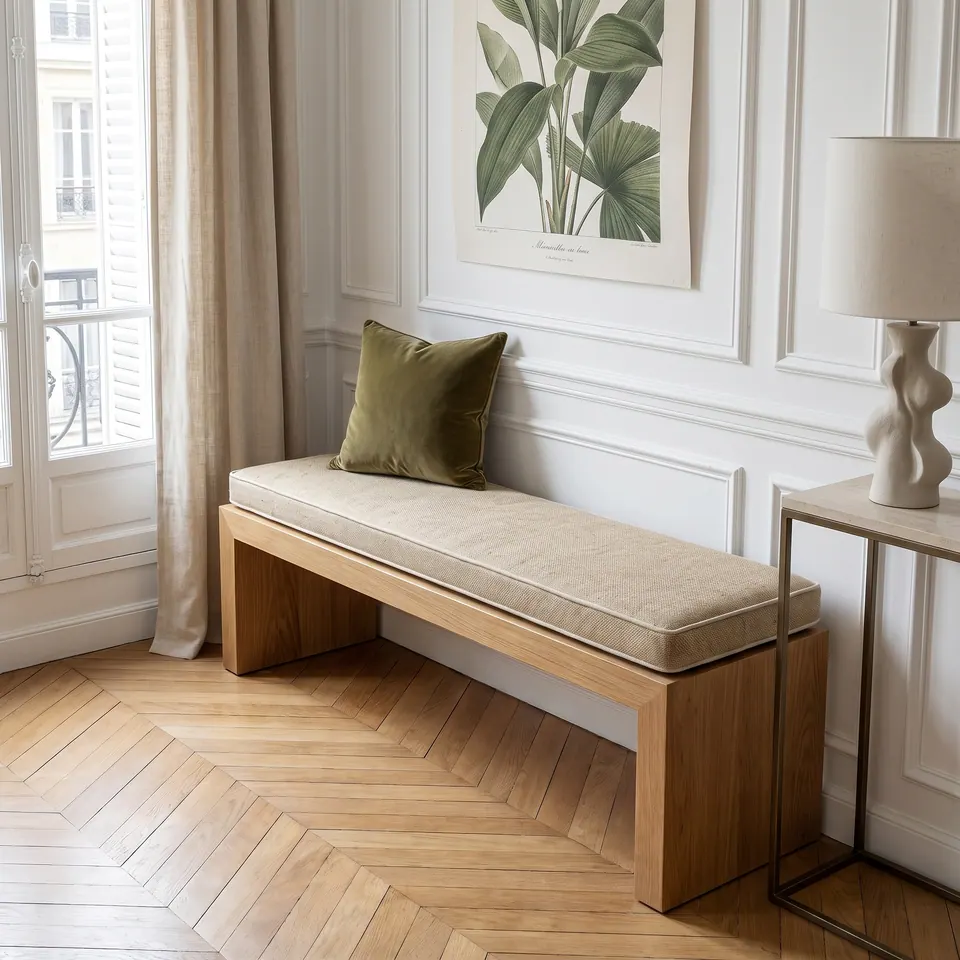
A buyer wrote to the workshop with three built-in indoor benches, measured at 50 x 17 in (127 x 43 cm), 48.5 x 17 in (123 x 43 cm) and 49.25 x 17 in (125 x 43 cm), plus four 20 x 20 in (51 x 51 cm) pillows and a lumbar pillow to match.
Three benches, three lengths. The advice was the same I'd give anyone seating a crowd: piping on both cushions and pillows ties a set together when it stays in one tone family.
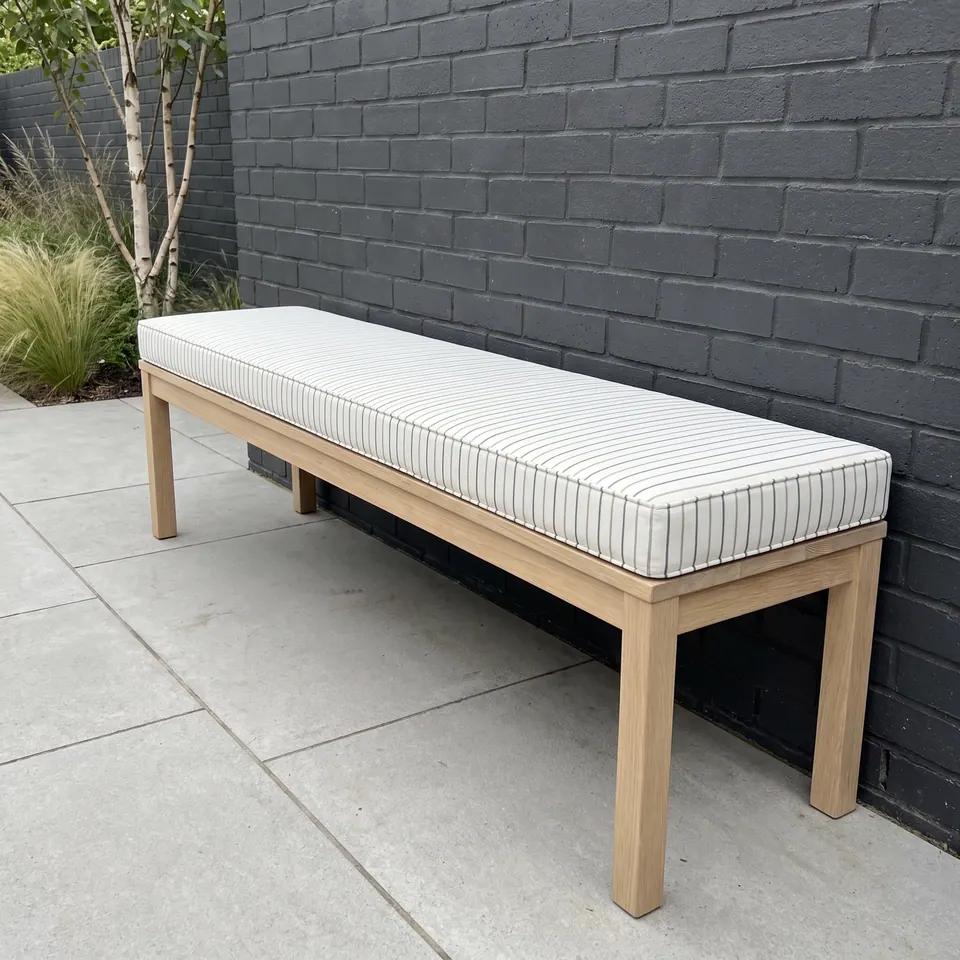
Then came a front-porch bench with arms, 43 in (109 cm) in front of the arms and 47 in (119 cm) behind them. The workshop explained that it makes exactly the measurements it is given, and held the order until the buyer confirmed. It also added the outdoor fabric code that was missing, HM-29 with matching piping.
With arms in the way, you decide which span to measure. The Pattern on how to measure a bench shows both.
Buyer questions: a joining bolster, a corner, a wall board
- A common question
Could you make a straight, cylinder-shaped backrest to join two sofas into one sectional?
The workshop's answerYes. A straight backrest about 39 1/2 in (100 cm) long was made in a matching off-white for exactly that job.
- A common question
I have a corner spot where a bench meets a wall section. Can you make a cushion for it?
The workshop's answerThe shop asked for a photo of the space before quoting. In the end the buyer chose one 16 x 65 in (41 x 165 cm) single-button cushion, which could be ordered straight from the listing by picking that size.
- A common question
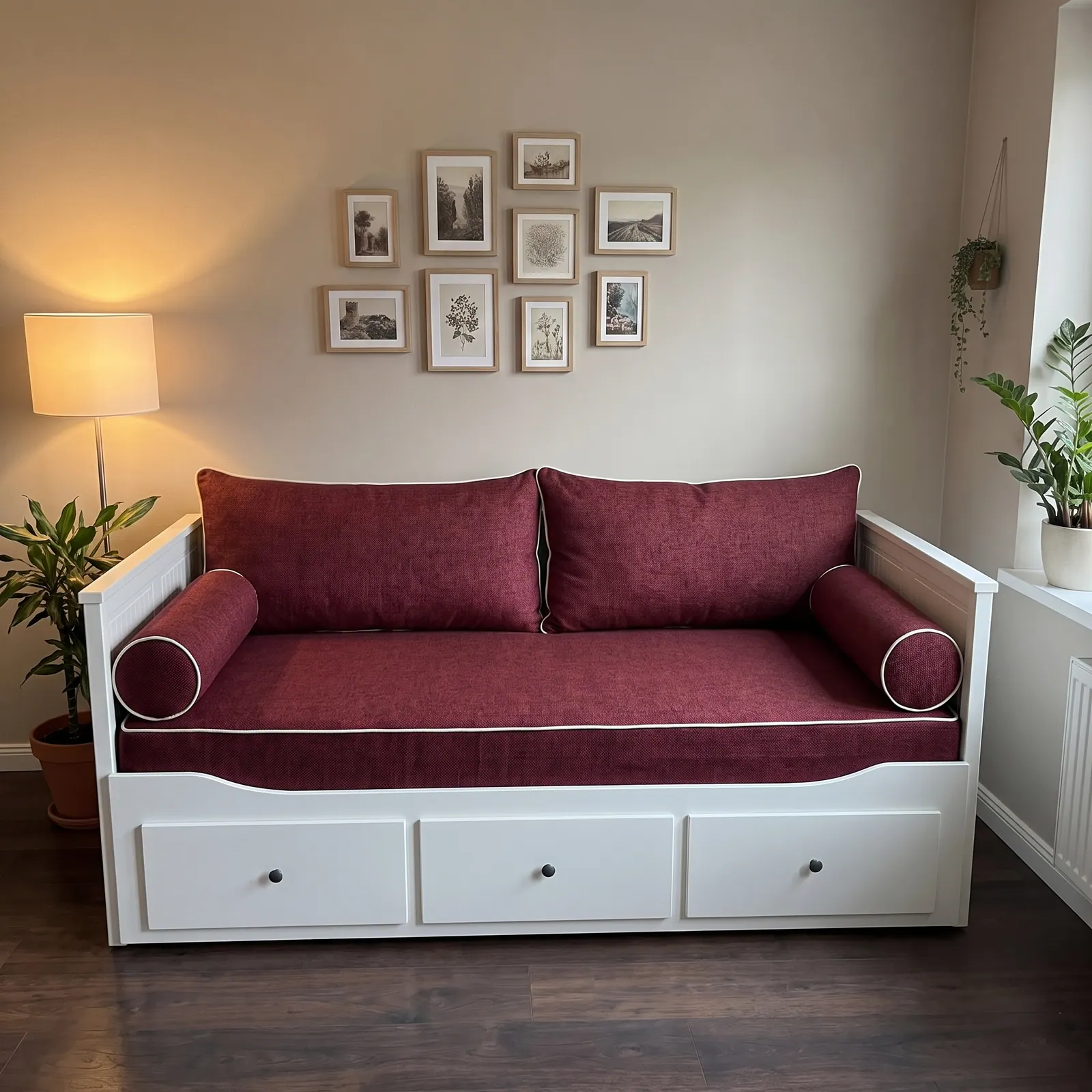
Can you make an upholstered wall board in the same fabric as my daybed cushion?
The workshop's answerThe style in that photo has a wooden board inside, which isn't the standard here. Instead the shop can make a foam-filled backrest with no wood; it looks softer than an upholstered board. The buyer planned to fix it to the wall with hook-and-loop tape.
On the cutting table: the three-color stack
| Cushions | Three stacked box cushions for bench seating |
|---|---|
| Fabric | Linen-look basket weave (L52, L24, L06) |
| Colors | Cherry red, sage green, oatmeal |
| Piping | Oatmeal on red and on sage; red on oatmeal |
| Seams | Welt on the top and bottom seams |
| Edge | Box edge, square corners, flat side panel |
| Check before ordering | A sewn corner sample, not a flat swatch |
| Best for | Several benches that must seat a crowd as one set |

Have it made
Have this made — ask Maggie’s workshop
I once cut a lovely cushion two inches short, and I have not forgotten it. That is why the workshop goes over your measurements with you on the phone. — Maggie
Leave your details and the workshop will call you to confirm measurements, fabric, foam and piping. No prices, dates or payment on this page: it is a request, not an order.
Reverse one piping pair across a set of bench cushions, red welt on oatmeal and oatmeal welt on red, and different colors read as one family.
Maggie
Questions buyers ask next
How do I make bench cushions in different colors look like a set?
Keep every fabric in one tone family and repeat a piping color across them. Here the red and oatmeal pair appears twice, reversed, with sage in between, so three cushions read as related without matching.
Why pipe both the top and bottom seams of a box cushion?
Two welts give the box edge two clean lines and a defined, square corner. The side panel between them reads as a neat band, and the cushion looks finished from whichever side your guests see.
What should I look for in a close-up photo of a piped cushion?
The corner where the welt turns: it should be square, with no puckering at the join. Then check that the side panel between the seams lies flat instead of bowing out.
Stitch straight — Maggie
More photographs to read
 Save
 Save
 Save
 Save
 Save
 Save